

As engineers and practitioners in the advanced power storage industry, we routinely witness a devastating and expensive tragedy on the factory floor and in consumer garages alike. Buyers will spend thousands of dollars on premium, high-density lithium-ion or lithium iron phosphate (LiFePO4) battery arrays, only to permanently degrade their internal cell chemistry by attaching a legacy lead-acid charger. The chemistry inside a modern lithium cell is highly volatile, exacting, and unforgiving. It demands absolute precision to function safely and endure. If you are serious about protecting your capital investment and ensuring your equipment operates at peak efficiency, understanding the profound benefits of using a dedicated lithium battery charger is entirely non-negotiable.
From our experience, the failure to match the charging algorithm to the specific battery chemistry is the single leading cause of premature battery failure, thermal runaway, and BMS (Battery Management System) lockouts. We do not deal in generic advice; we rely on commercial and practical judgment. In this comprehensive guide, we will break down exactly why legacy chargers are destroying your lithium cells, how CC/CV algorithms protect your investment, and whether upgrading to a dedicated system is actually worth your hard-earned money.
Quick Answer: Why You Must Use a Dedicated Lithium Charger
A dedicated lithium battery charger utilizes a strict two-stage Constant Current / Constant Voltage (CC/CV) algorithm specifically calibrated for the precise voltage thresholds of lithium chemistry. Unlike standard multi-stage lead-acid chargers, dedicated lithium chargers do not utilize destructive float or equalization stages; they automatically terminate the charge completely when the current drops to a safe threshold (usually 0.05C). This prevents severe overcharging, completely eliminates the risk of thermal runaway, allows the onboard BMS to successfully balance internal cells, and ultimately doubles or triples your battery’s operational lifespan. Using anything else is a severe safety and financial liability.
Table of Contents
- What is a Dedicated Lithium Battery Charger?
- How It Works: The CC/CV Algorithm Explained
- The 8 Core Benefits of Using a Dedicated Lithium Battery Charger
- Limitations and Edge Cases
- Who Should Use It (And Who Does Not Need It)
- Common Mistakes in Battery Procurement
- Buying Considerations for Commercial Users
- Summary and Cost-Benefit Comparison Tables
- Expert Recommendation & Featured OHRIJA Hardware
- Frequently Asked Questions (FAQs)
What is a Dedicated Lithium Battery Charger?
Lithium batteries operate on fundamentally different chemical principles than traditional flooded lead-acid or AGM (Absorbent Glass Mat) batteries. A dedicated lithium battery charger is a highly calibrated, precision power supply engineered to execute a strict charging protocol specifically designed to cater to lithium-ion (Li-ion) or lithium iron phosphate (LiFePO4) cell architectures.
While a standard 12V automotive battery charger might randomly pulse voltage to break down sulfation on lead plates, a lithium charger operates with absolute surgical control. It understands that a 12V LiFePO4 battery is actually comprised of four 3.2V cells wired in series, requiring a very specific peak absorption voltage of 14.6V. Without this precision, the battery’s internal computer—the Battery Management System (BMS)—cannot safely regulate the power flow.
How It Works: The CC/CV Algorithm Explained
To fully grasp the benefits, you must understand the underlying mechanics. Dedicated lithium chargers operate using a two-stage algorithm known as CC/CV (Constant Current / Constant Voltage). Here is how the process flawlessly restores your battery’s energy:
- The Constant Current (CC) Stage: During this initial fast-charging phase, the charger supplies a fixed, high-amperage current into the battery. Because lithium cells have incredibly low internal resistance, they can absorb this massive influx of power safely. As the current flows in, the battery’s overall voltage rises steadily. This single stage efficiently delivers roughly 80% to 90% of the battery’s total capacity in a fraction of the time legacy chargers require.
- The Constant Voltage (CV) Stage: Once the battery voltage reaches its critical peak limit (e.g., exactly 14.6V for a 12V LiFePO4 system), the charger instantly shifts gears. It locks the voltage at this maximum ceiling and holds it steady. As the battery becomes fully saturated, the charger gradually tapers the current down.
- Complete Termination: This is the most crucial differentiator. When the tapering current drops to a predefined “tail current” (typically 0.05C, or 5 amps for a 100Ah battery), the charger recognizes the battery is 100% full and completely shuts off the power delivery. It does not trickle. It does not float. It stops.
The 8 Core Benefits of Using a Dedicated Lithium Battery Charger
1. Eliminates Harmful Float Charging Degradation
Lead-acid batteries suffer from a high self-discharge rate and thus require a continuous “float” charge to remain topped off at 100%. Lithium batteries, however, have an incredibly low self-discharge rate. A continuous trickle or float charge stresses the lithium chemistry, plating metallic lithium onto the anode and severely accelerating chemical degradation. Dedicated chargers shut off completely when full, preserving the structural integrity of the cell.
2. Prevents BMS Shutdowns via Equalization Avoidance
Smart lead-acid chargers utilize an “equalization” or “desulfation” stage that intentionally spikes the voltage (often well over 15.5V) to burn off sulfate crystals on lead plates. If you apply this volatile pulse to a lithium battery, the BMS will immediately detect a critical overvoltage event and shut down the entire array to prevent a catastrophic fire. Dedicated lithium chargers completely lack these destructive, erratic voltage spikes.
3. Optimized C-Rates for Maximum Thermal Management
Pushing electrical current too fast generates extreme heat. Dedicated chargers are precisely calibrated to deliver safe C-rates (typically between 0.2C and 0.5C, where 1C is the total amp-hour capacity of the battery). For commercial users running heavy-duty golf carts or warehouse logistics equipment, this thermal control is vital to operational safety. If you have ever wondered why does my charger get hot during a shift, it is often due to an undersized, poorly calibrated unit struggling against internal resistance. Premium dedicated units manage this heat effectively.
4. Guarantees Perfect BMS Cell Balancing
For a BMS to properly “top-balance” the internal cylindrical or prismatic cells, the charger must hold the exact absorption voltage completely steady. A dedicated lithium charger maintains this Constant Voltage stage with zero fluctuation. This stable ceiling gives the BMS the necessary time to bleed off excess voltage from the highest-charging cells and allow the lagging cells to catch up, bringing the entire pack into perfect harmony. Consumers frequently ask our technicians, can lithium charger charge LiFePO4 battery banks effectively? The answer is absolutely yes—provided the CV thresholds are explicitly programmed for the LFP chemistry.
5. Safe Deep-Discharge Recovery (TC Pre-Charging)
If you mistakenly drain a lithium battery down to 0%, hitting it instantly with 50 amps of raw current can cause severe thermal shock to the dormant cells. High-end dedicated chargers utilize a “Trickle” or “Pre-charging” stage (part of the TC-CC-CV method). When the voltage is dangerously low, the charger applies a gentle micro-current to safely awaken and stabilize the cells before ramping up to the aggressive fast-charging CC stage.
6. Dramatically Faster Charge Times
Because lithium chemistry boasts an incredibly high current acceptance rate, a dedicated charger can safely blast the battery with maximum constant current up to 90% State of Charge (SOC) without overheating. In our testing, a dedicated 50A charger can fully replenish a massive 100Ah lithium bank in under two hours. A legacy lead-acid profile would artificially throttle the current across multiple unnecessary stages, taking up to eight hours to achieve the same result.
7. Exact Voltage Matching to Prevent Micro-Cycling
Lithium profiles are highly specific and unforgiving. A 36V electric scooter battery requires an exact 42.0V peak charge. Mismatched chargers lead to chronic undercharging or immediate overvoltage failures. We frequently consult with DIY e-bike builders asking, can I charge a 36V battery with 12V charger? The answer is a resounding, dangerous no, as the voltage differential will never trigger the necessary chemical reaction. Dedicated chargers match your pack’s nominal voltage perfectly.
8. Rugged Hardware Built for Continuous High-Amp Loads
Unlike cheap, generic plastic chargers that literally melt under sustained high-amperage loads, true dedicated lithium chargers utilize extruded aluminum alloy shells. These metal housings act as massive passive heatsinks, drawing heat away from internal mosfets and transformers. This aerospace-grade construction allows them to run at peak wattage for hours without thermal throttling, ensuring absolute reliability.
Limitations and Edge Cases
We must use practical judgment: dedicated lithium chargers are not magical universal tools. The primary limitation is strict chemistry lock-in. You absolutely cannot use a dedicated LiFePO4 charger (programmed for a 14.6V peak) on a traditional flooded lead-acid battery. It will chronically undercharge the lead plates and fail to execute the desulfation stages required to keep lead-acid healthy. Additionally, premium dedicated chargers carry a higher initial capital expenditure compared to generic big-box automotive chargers. However, amortized over the lifespan of a $1,000 lithium battery, the cost is trivial.
Who Should Use It (And Who Does Not Need It)
For commercial users managing high-turnover golf cart fleets, marine enthusiasts running massive 48V trolling banks offshore, and daily commuters utilizing modern e-mobility solutions, this equipment is mandatory. If you are learning how to charge eBike battery safely, your very first technical step must be procuring a dedicated charger tailored exactly to your pack’s series configuration (for example, a 13S e-bike pack mandates a dedicated 54.6V output).
Who does not need it? If you strictly operate vintage classic cars, legacy RVs, or basement backup sump pumps running exclusively on heavy AGM or flooded lead-acid batteries, a lithium charger is useless to you. In those specific scenarios, stick with a multi-stage smart charger designed specifically for lead chemistry.
Common Mistakes in Battery Procurement
In most professional situations, the most expensive mistake we witness is falling for the “Universal Charger” myth. Selecting a generic “AGM/Gel/Lithium” switch on a cheap automotive charger and assuming it is “close enough” for your premium lithium bank will slowly and invisibly destroy your cells. The voltage tolerances are simply too wide.
Another common error is buying a charger with an amp rating that vastly exceeds your BMS limit. Pushing a 100A charge into a battery with a BMS rated for a maximum 50A charge current will instantly trigger a hard safety disconnect. When our technicians instruct clients on how to troubleshoot a 12V battery charger, the absolute first diagnostic step is verifying whether the charger’s C-rate output mathematically aligns with the battery manufacturer’s maximum specified charge current.
Buying Considerations for Commercial Users
When auditing an electric bicycle charger supplier or upgrading your industrial power systems, you must scrutinize the technical spec sheet ruthlessly. Verify the exact CC/CV output voltage down to the decimal. Look for solid aluminum construction for vital thermal management. Ensure the output connector (whether it be XT60, Anderson 50A, XLR, or aviation plugs) matches your hardware perfectly to avoid dangerous wire splicing and resistance bottlenecks.
Summary and Cost-Benefit Comparison Tables
| Feature / Metric | Dedicated Lithium Charger (CC/CV) | Legacy Lead-Acid Smart Charger |
|---|---|---|
| Charging Stages | 2 Stages (Constant Current + Constant Voltage) | 3 to 4 Stages (Bulk, Absorb, Float, Equalize) |
| Float Charging | None. Completely terminates charge at 100%. | Mandatory. Continues to trickle charge indefinitely. |
| Equalization Stage | Disabled. Protects sensitive BMS from overvoltage. | Active. Pulses high voltage to clean lead plates. |
| Charging Speed | Extremely Fast (Holds max current up to 90% capacity) | Slow (Throttles current early to prevent gassing) |
| Safety Profile | High. Prevents thermal runaway in lithium cells. | Dangerous if used on lithium; risks fire/BMS failure. |
| Pros (Advantages) | Cons (Limitations) |
|---|---|
| Maximizes battery lifespan by preventing chemical stress. | Strict chemistry lock-in (Cannot be used on lead-acid). |
| Drastically reduces charging downtime via optimized CC algorithms. | Higher initial purchase price than generic big-box chargers. |
| Synchronizes flawlessly with internal BMS for perfect cell balancing. | Requires exact voltage matching (e.g., 54.6V for 48V Li-ion). |
| Aerospace aluminum chassis ensures cool, reliable continuous operation. | Heavier than cheap plastic trickle chargers. |
Expert Recommendation & Featured OHRIJA Hardware
From our experience, the difference between a lithium battery lasting 2 years and lasting 10 years comes down strictly to the quality of the charging hardware. Do not cripple a premium battery with a subpar power supply. We strongly recommend exploring the premium tier of the Li-ion battery charger category to safeguard your investments. For versatile, high-powered applications requiring absolute stability, we rely entirely on OHRIJA’s expertly engineered solutions.
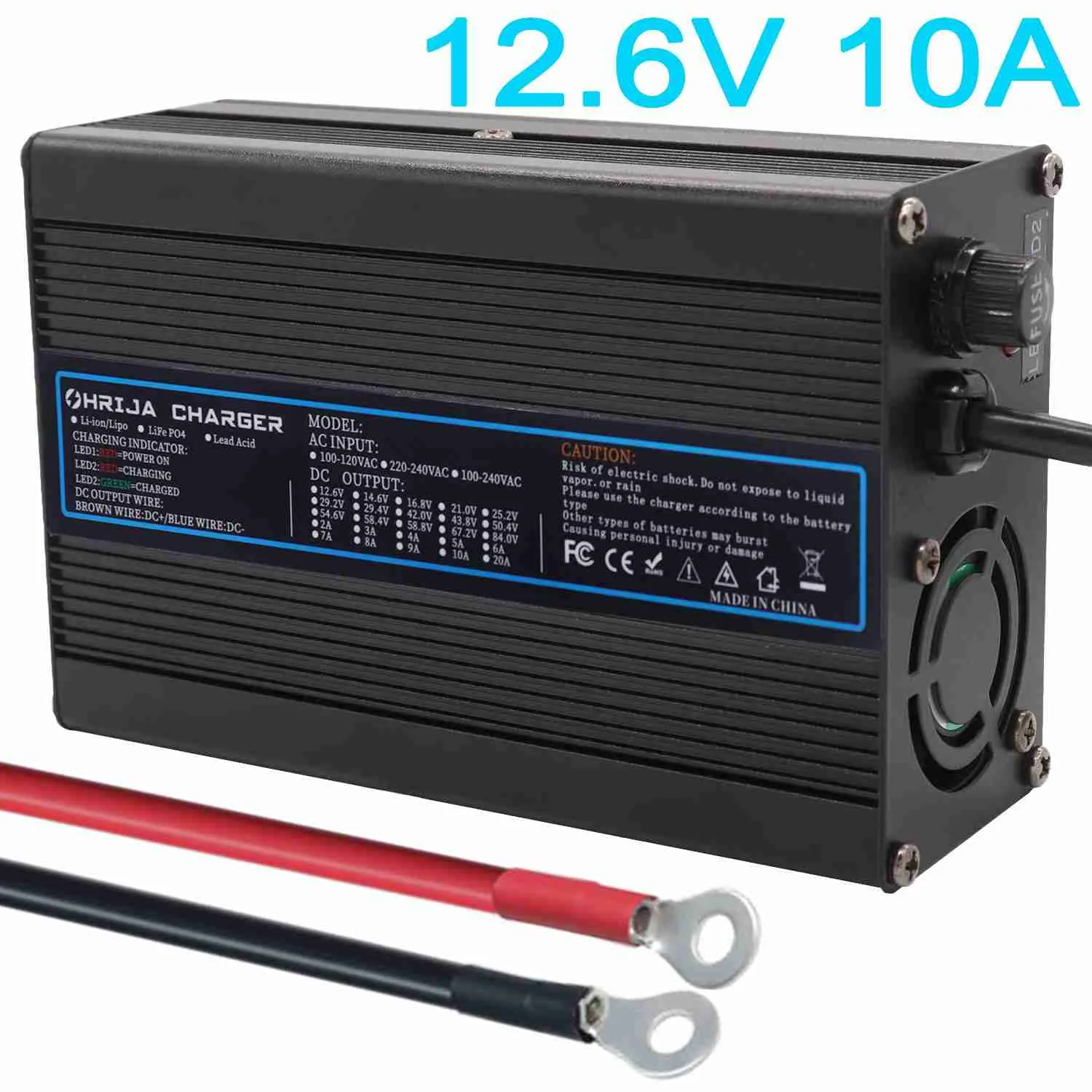
OHRIJA 12 Volt Lithium Battery Charger (12.6V 10A)
Engineered for exacting 3S 11.1V lithium-ion applications, this dedicated OHRIJA unit utilizes a flawless CC/CV algorithm housed in a rugged thermal-dissipating chassis. It represents the pinnacle of charging safety and speed.
- Output Specs: Maximum 12.6V ±0.2v | Maximum 10Amp ±0.2a
- Hardware: Heavy-duty aluminum alloy shell for superior passive cooling
- Working Power: Maximum 175W continuous
- Dimensions & Weight: 135*90*50MM | 0.9kg
- Customization: Multiple output connectors available (XT60, XT90, Crocodile Clip, Anderson 50A, Wire Nose, DC5.5*2.5)
View the OHRIJA 12.6V 10A Charger Specs & Pricing
Frequently Asked Questions (FAQs)
Can I use my old lead-acid charger on my new lithium battery?
No. Using a lead-acid charger on a lithium battery is highly dangerous and damaging. Lead-acid chargers utilize equalization stages that spike the voltage, which will cause your lithium battery’s BMS to shut down, or worse, cause permanent damage to the cells. They also utilize float charging, which degrades lithium chemistry over time. Always use a dedicated CC/CV lithium charger.
What does CC/CV mean in battery charging?
CC/CV stands for Constant Current / Constant Voltage. It is the optimal two-stage charging algorithm for lithium batteries. In the Constant Current stage, the charger pushes a steady, high current to quickly charge the battery to about 80-90% capacity. In the Constant Voltage stage, the charger holds the maximum voltage steady while the current tapers down until the battery is 100% full, at which point it shuts off safely.
What does a 0.2C or 0.5C charge rate mean?
The “C-rate” is a measure of the rate at which a battery is charged relative to its maximum capacity. For example, if you have a 100Ah (Amp-hour) battery, a 1C charge rate would be 100 Amps. A 0.5C charge rate would be 50 Amps, and a 0.2C charge rate would be 20 Amps. For maximum lifespan and optimal thermal management, charging lithium batteries between 0.2C and 0.5C is highly recommended.
Do dedicated lithium chargers shut off automatically?
Yes. A high-quality, dedicated lithium charger will detect when the tapering current drops to a specific “tail current” (usually around 0.05C) during the Constant Voltage stage. Once it hits this threshold, the charger completely terminates power delivery to prevent overcharging and thermal runaway, unlike lead-acid chargers which continue to trickle charge.
Authoritative Industry References
To ensure our technical advice aligns with global safety and engineering standards, our methodology relies on documentation from the following authoritative institutions regarding battery safety and charging protocols: