
No products in the cart.

In the rapidly evolving world of energy storage, the distinction between different types of lithium batteries is often misunderstood. A common question that arises among enthusiasts and professionals alike is: can a lithium battery charger charge a LiFePO4 battery? While both technologies fall under the “lithium” umbrella, treating them as identical can lead to reduced battery life, safety hazards, and suboptimal performance.
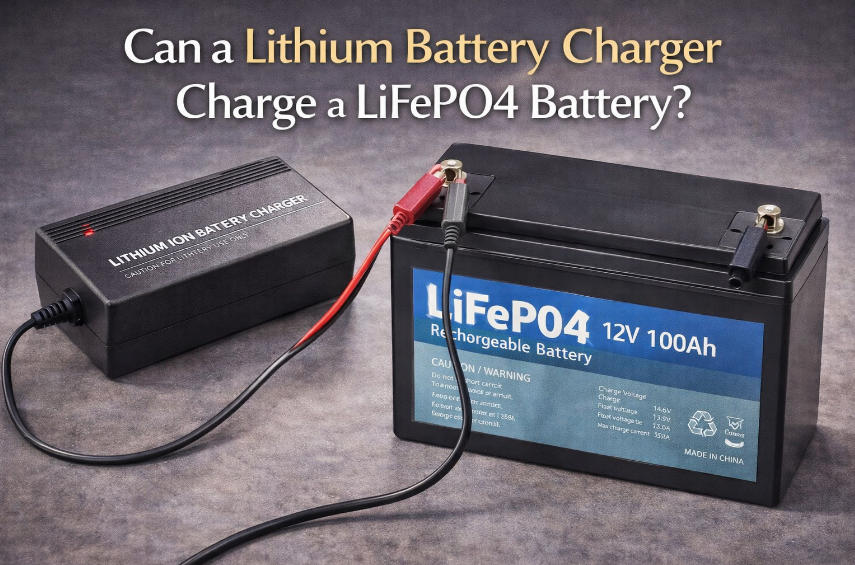
This article delves deep into the electrochemistry, voltage thresholds, and charging algorithms that differentiate standard Lithium-ion (Li-ion) batteries from Lithium Iron Phosphate (LiFePO4) batteries. We will explore why voltage matching is critical and how using the wrong charger can damage your investment.
Table of Contents
- 1. Understanding the Chemistry: Li-ion vs. LiFePO4
- 2. The Critical Voltage Mismatch
- 3. The Charging Process: CC/CV Explained
- 4. The Risks of Using a Standard Li-ion Charger
- 5. OHRIJA: Precision Charging Solutions
- 6. How to Select the Correct Charger
- 7. Summary Comparison Table
- 8. Frequently Asked Questions (FAQs)
- 9. References
1. Understanding the Chemistry: Li-ion vs. LiFePO4
To understand whether you can use a lithium battery charger charge a LiFePO4 battery, one must first recognize that “Lithium-ion” is a broad category. It typically refers to batteries with cobalt-based cathodes, such as Lithium Cobalt Oxide (LiCoO2) or Nickel Manganese Cobalt (NMC). These are commonly found in laptops, phones, and e-bikes.
LiFePO4 (Lithium Iron Phosphate) is a distinct subset. It uses iron phosphate as the cathode material. This chemistry offers superior thermal stability, a longer cycle life (often 2000+ cycles), and enhanced safety. However, it operates at a lower voltage than its cobalt-based cousins. This fundamental difference in operating voltage is the primary reason why chargers are not universally interchangeable.
2. The Critical Voltage Mismatch
The most significant barrier preventing a standard lithium charger from safely charging a LiFePO4 battery is the voltage setting. Chargers are “dumb” devices in the sense that they push current until a specific voltage ceiling is reached. If that ceiling is too high for the battery chemistry, damage occurs.
Nominal Voltage
- Standard Li-ion: 3.6V or 3.7V per cell.
- LiFePO4: 3.2V per cell.
Full Charge Voltage
- Standard Li-ion: 4.2V per cell.
- LiFePO4: 3.65V per cell.
If you use a standard Li-ion charger designed to stop at 4.2V on a LiFePO4 cell designed to stop at 3.65V, you are subjecting the cell to an overvoltage condition of 0.55V per cell. In a 12V battery pack (4 cells in series), this error multiplies, potentially pushing the total voltage 2.2V higher than the safe limit.
3. The Charging Process: CC/CV Explained
Both battery types utilize a similar charging algorithm known as Constant Current / Constant Voltage (CC/CV). This process occurs in two main stages:
- Constant Current (CC): The charger delivers a steady current (Amps) to the battery to raise its voltage. This bulk charging phase restores the majority of the capacity.
- Constant Voltage (CV): Once the battery reaches its peak voltage setpoint (4.2V for Li-ion, 3.65V for LiFePO4), the charger holds the voltage steady while the current slowly drops to zero. This “saturation” phase ensures a 100% charge.
While the method is the same, the targets are different. A standard Li-ion charger will not switch to the CV phase until it hits 4.2V. By the time a LiFePO4 battery reaches 4.2V, it is already grossly overcharged, and the electrolyte inside the cell may begin to decompose.
4. The Risks of Using a Standard Li-ion Charger
Attempting to let a standard lithium battery charger charge a LiFePO4 battery introduces several risks, ranging from reduced performance to safety hazards.
Electrolyte Decomposition
When a LiFePO4 cell is forced beyond 3.65V, the organic electrolyte within the cell begins to oxidize. This process generates gas, which can cause the battery casing to swell or “bloat.” Once a prismatic or cylindrical cell swells, its internal structure is compromised, leading to permanent capacity loss.
Lithium Plating
Overcharging can cause lithium ions to deposit as metallic lithium on the surface of the anode rather than intercalating into it. This phenomenon, known as lithium plating, reduces the amount of active lithium available for future cycles, permanently reducing the battery’s capacity.
BMS Shutdown
Most modern LiFePO4 batteries are equipped with a Battery Management System (BMS). The BMS is designed to protect the cells. If you connect a 4.2V charger, the BMS detects the overvoltage condition (usually around 3.7V – 3.8V) and disconnects the battery from the charger circuit. While this protects the battery, it results in an incomplete charge cycle and can lead to nuisance tripping where the battery refuses to charge.
Summary of Risks
- Overcharging: Exceeding the 3.65V limit.
- Swelling: Gas generation due to electrolyte breakdown.
- Reduced Lifespan: Acceleration of chemical degradation.
- BMS Trips: Constant disconnection due to high voltage.
5. OHRIJA: Precision Charging Solutions
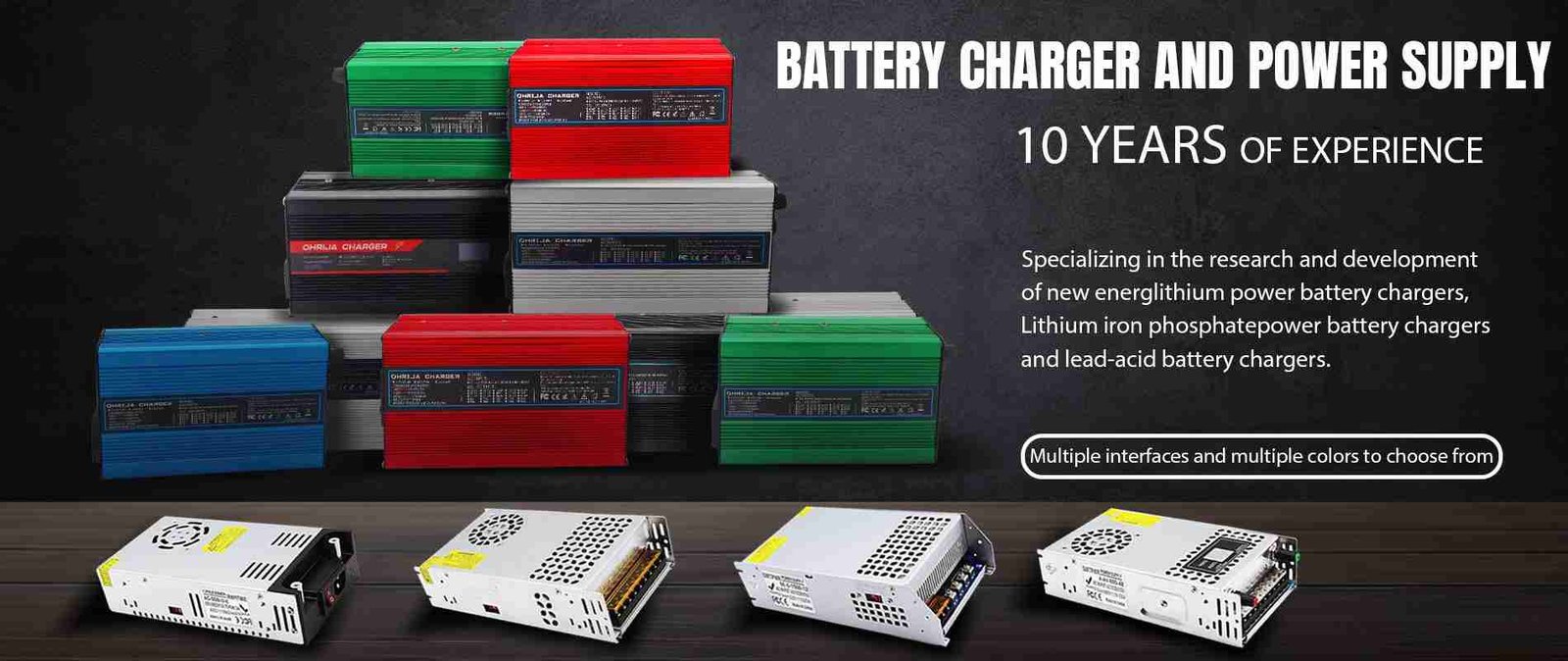
BATTERIELADEGERÄT
Because the voltage requirements for different lithium chemistries are so strict, it is vital to source chargers from manufacturers who understand these nuances. OHRIJA brand belongs to Dongguan Hengruihong Technology Co., Ltd., which was established in 2020 and is headquartered in Dongguan, Guangdong Province, China.
Our company is a high-tech enterprise integrating R&D, production, and sales. We understand that a one-size-fits-all approach does not work for advanced battery chemistries. The company’s main products include:
- Lithium battery charger (Li-ion / NMC)
- Lithium iron phosphate battery charger (LiFePO4)
- Lead-acid battery charger
- Golf cart charger
- Power adapter and Switching power supply
Our Products Highlight:
Whether you need a specific 16S 67.2V Lithium ion charger for a high-voltage e-bike or a dedicated LiFePO4 charger for an RV, OHRIJA provides the exact voltage profiles required to ensure safety and longevity.
6. How to Select the Correct Charger
To ensure you do not damage your battery, always verify the specifications on the charger label against your battery’s requirements. Do not rely solely on the marketing term “Lithium Charger.” Look for the specific voltage.
For a 12V Battery (4 Series Cells)
- LiFePO4 Charger Output: 14.4V – 14.6V.
- Li-ion Charger Output: usually 16.8V (for 4S Li-ion).
Using a 16.8V charger on a 12V LiFePO4 battery is dangerous. Always match the “Max Charging Voltage.”
Smart Chargers
Some “Smart” chargers have selectable modes. If you possess a charger with a switch or software setting for “LiFePO4” or “LFP,” it is safe to use. If the charger only has a generic “Lithium” setting, assume it is for 3.7V/4.2V Li-ion chemistry and do not use it on LiFePO4 unless the manual explicitly states compatibility.
7. Summary Comparison Table
| Feature | Standard Li-ion (NMC/LiPo) | LiFePO4 (LFP) |
|---|---|---|
| Nominal Voltage (Per Cell) | 3.6V / 3.7V | 3.2V |
| Max Charge Voltage (Per Cell) | 4.2V | 3.65V |
| Charge Termination | Strict CV phase at 4.2V | Strict CV phase at 3.65V |
| 12V Equivalent Pack | 3S (11.1V) or 4S (14.8V) | 4S (12.8V) |
| Can charge the other? | No (Voltage too high for LiFePO4) | No (Voltage too low for Li-ion) |
8. Frequently Asked Questions (FAQs)
1. Can I use a lead-acid charger on a LiFePO4 battery?
Sometimes, but it is not ideal. Lead-acid chargers often have “desulfation” or “equalization” modes that pulse high voltages (up to 15V+). This can trigger the LiFePO4 BMS over-voltage protection or damage the cells. If the lead-acid charger allows you to disable these modes and set a custom voltage (e.g., 14.4V), it may be used as a temporary solution.
2. What happens if I undercharge a LiFePO4 battery?
Undercharging (providing a lower voltage than 3.65V per cell) is generally safe but results in a battery that is not 100% full. For example, charging a LiFePO4 battery to 3.5V per cell might yield 90-95% capacity. This is often preferred for extending cycle life, but you may occasionally need a full charge to balance the cells.
3. Will my LiFePO4 battery catch fire if I use a Li-ion charger?
LiFePO4 is chemically very stable and resistant to thermal runaway, making it much safer than standard Li-ion. While it is unlikely to catch fire solely from the charger (especially if the BMS works correctly), it will likely ruin the battery by causing swelling and electrolyte loss.
4. Does OHRIJA offer chargers for custom battery packs?
Yes, OHRIJA provides a wide range of chargers including 10S (42V), 13S (54.6V), and 16S (67.2V) configurations suitable for custom e-bike and scooter builds. Always check the voltage rating of your specific pack before ordering.