
No products in the cart.

Choosing the wrong power adapter can damage electronic equipment, cause unstable operation, reduce battery life, or create unnecessary overheating risks. The problem is that many buyers focus only on the connector size or advertised wattage without checking whether the electrical specifications actually match their device.
Whether you are replacing a laptop power supply, purchasing an adapter for an LED device, sourcing an electric bicycle charger, or selecting a power supply for industrial equipment, voltage and current must be evaluated together. A connector that fits physically does not necessarily mean the adapter is electrically compatible.
From our experience in power supply and battery charger manufacturing, the most important rule is straightforward: match the output voltage, verify the required current capacity, confirm polarity and connector compatibility, and check the device’s actual power requirements before purchasing.
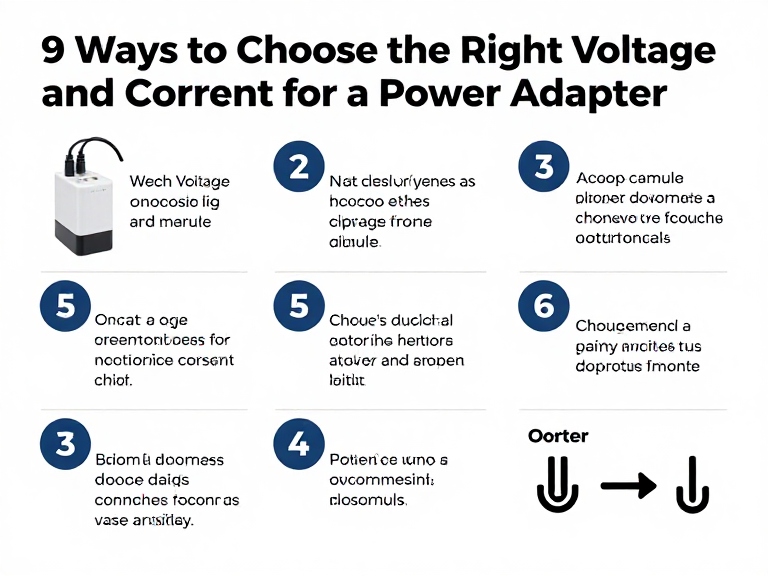
Quick Answer: How Do You Choose the Right Voltage and Current for a Power Adapter?
To choose the right voltage and current for a power adapter, first identify the device’s required output voltage and select an adapter with the same specified voltage. Next, choose an adapter whose rated output current is equal to or greater than the device’s maximum current requirement. Finally, verify connector size, polarity, AC/DC output type, power rating, and safety certifications.
- Voltage: Must match the device’s specified input voltage.
- Current: The adapter must provide at least the current required by the device.
- Power: Calculate watts using voltage multiplied by current.
- Polarity: DC positive and negative terminals must match.
- Connector: Physical fit and electrical ratings must both be correct.
- Battery charging: Use a charger with the correct battery chemistry, charging voltage, current limits, and charging profile. An ordinary power adapter is not automatically a battery charger.
Our recommendation: Never select a power adapter based on current capacity or connector appearance alone. Electrical compatibility comes first, followed by quality, efficiency, thermal performance, and price.Table of Contents
- Understanding Voltage, Current, and Power
- Quick Summary: Adapter Selection
- 9 Ways to Choose the Right Voltage and Current
- Why Voltage Matching Is Essential
- How Much Current Does Your Device Need?
- How to Calculate Adapter Wattage
- Power Adapter Comparison Table
- Pros and Cons of Different Adapter Types
- Power Adapter vs Battery Charger
- Common Power Adapter Selection Mistakes
- Choosing Adapters for Different Applications
- Buying Considerations and Manufacturer Selection
- OHRIJA Power Adapter and Charger Solutions
- Frequently Asked Questions
- Technical References
1. Understanding Voltage, Current, and Power Before Buying an Adapter
Before choosing a power adapter, it is important to understand three basic electrical specifications: voltage, current, and power. These values determine whether a power supply can operate a device correctly and safely.
What Is Voltage?
Voltage, measured in volts (V), is the electrical potential difference that drives current through a circuit. A power adapter converts electrical power from its input source into an output voltage suitable for the connected equipment.
For example, a device labeled 12V DC requires a compatible 12V DC power supply unless its manufacturer explicitly specifies an acceptable voltage range.
Supplying an incorrect voltage can cause unstable operation, excessive heating, component damage, or failure to start.
What Is Current?
Current, measured in amperes (A), describes the amount of electrical charge flowing through a circuit. The current rating printed on a power adapter generally represents the maximum current it is designed to deliver under its specified operating conditions.
A device draws the current it needs according to its electrical design and operating conditions. A 12V 5A adapter does not automatically force 5A into a compatible 12V device that requires only 2A.
This distinction is important because buyers frequently assume that a higher current rating will damage electronic equipment. When voltage, polarity, connector, and power-supply behavior are compatible, a higher available current capacity is generally acceptable.
What Is Power?
Power is measured in watts (W) and describes the rate at which electrical energy is delivered or consumed.
Power (W) = Voltage (V) × Current (A)
For example, a 12V 3A power adapter has a nominal output rating of:
12V × 3A = 36W
Understanding this calculation makes it easier to compare different power adapters and determine whether a particular model can support the connected equipment.
2. Quick Summary: How to Choose the Right Power Adapter
| Selection Factor | What to Check | Our Recommendation |
|---|---|---|
| Output voltage | Device-rated voltage and acceptable range | Match the specified voltage |
| Output current | Maximum device current consumption | Choose equal or higher rated current capacity |
| Output power | Required wattage under peak operating conditions | Allow appropriate power headroom |
| Output type | AC or DC | Match the device input specification |
| Polarity | Positive and negative terminal arrangement | Match exactly for DC barrel connectors |
| Connector | Diameter, length, pin arrangement | Confirm mechanical and electrical compatibility |
| Input voltage | Available AC supply and frequency | Check regional compatibility |
| Protection | Overvoltage, overcurrent, short-circuit, thermal protection | Prefer professionally designed protected adapters |
| Certifications | Applicable market and product safety requirements | Verify genuine compliance documentation |
For most standard electronic equipment, voltage matching is the first requirement. Current capacity and wattage are then checked to ensure the adapter can supply the required load without operating beyond its rated limits.
Recommended products

12V Power Supply 12V 50A 600W AC to DC Converter 110V/120V to 12V Transformer LED Driver Smart Cooling Fan Designed for LED Strip CCTV and Car Devices (DC12V, 12V-50A-600W)
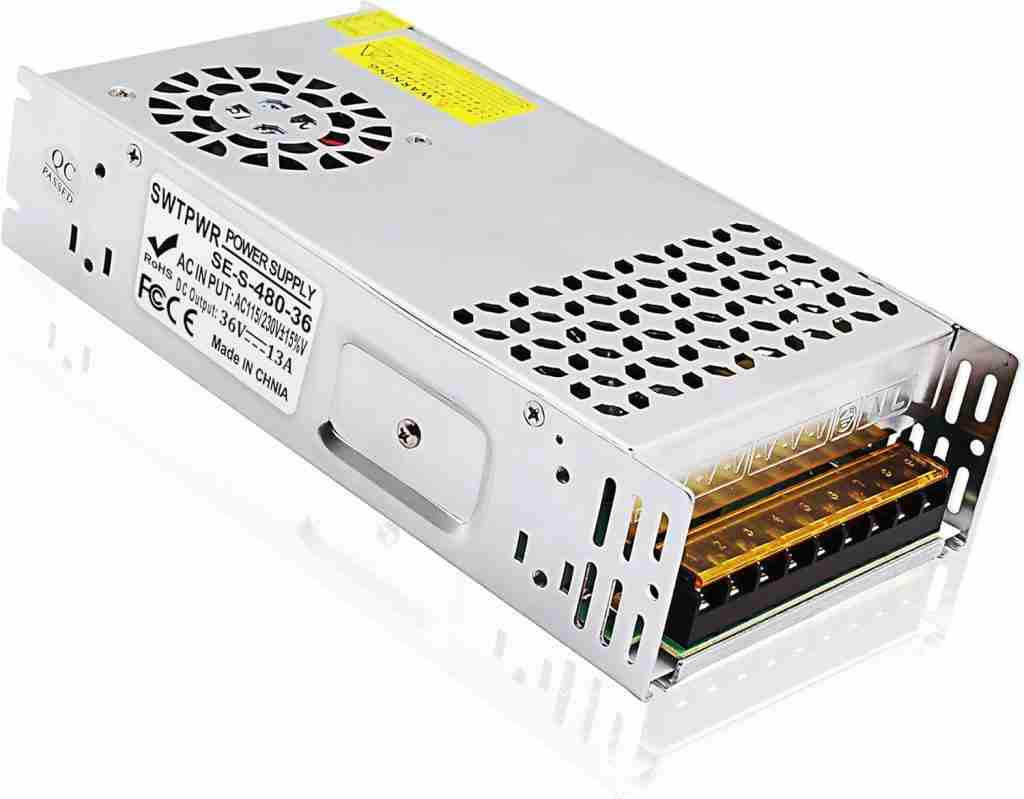
Price range: 23.90$ through 29.90$DC 36V 13A 480W Power Supply AC to DC Converter 110V to 36V Power Adapter 36V Transformer Designed for LED Light Car Stereo Automotive Electronics Industrial Equipment (36V-13A-480W, 36V)
Price range: 13.90$ through 14.90$New Upgraded DIY SMPS 110V 230V AC to DC 24V 15A 360W Power Supply Adapter,Converter Power Supply,DC 24V Voltage Transformer for Motor Pump CCTV 3D Printer Air Compressor Led
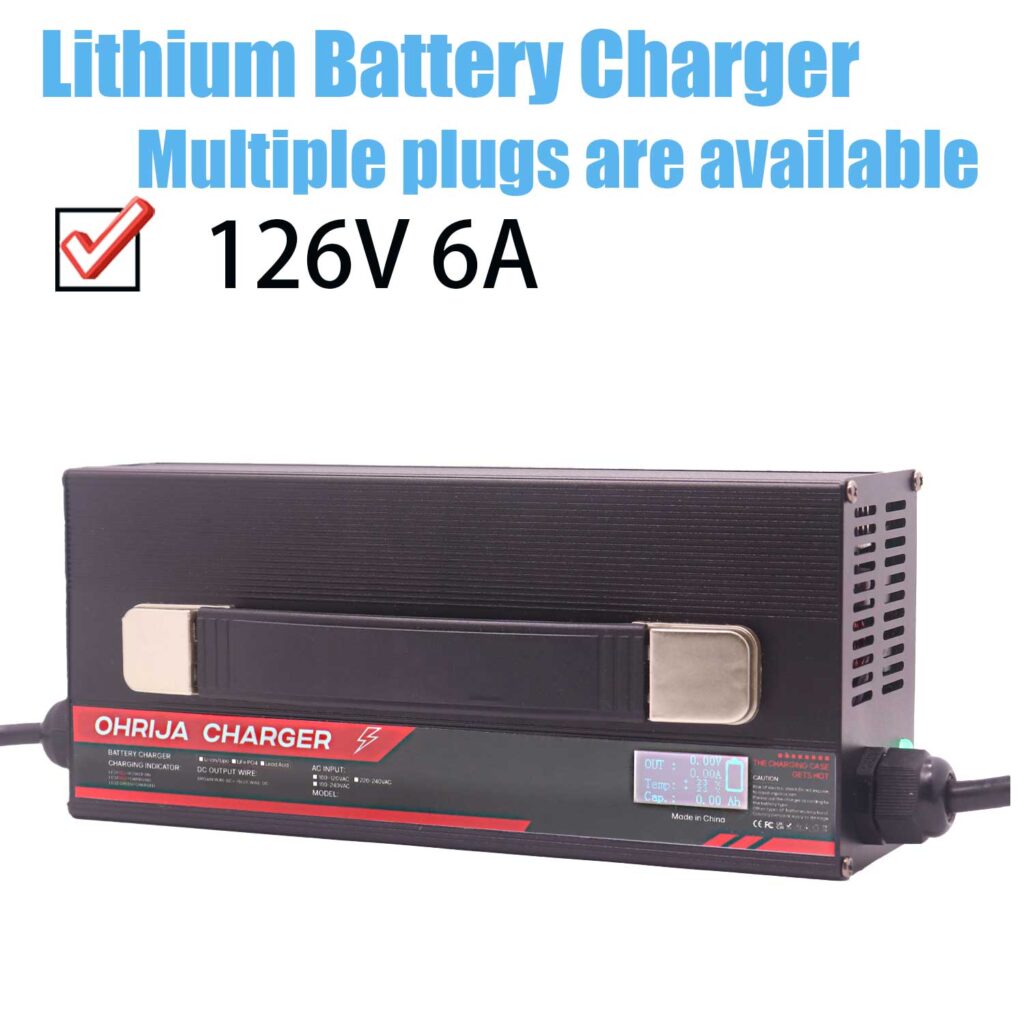
Price range: 23.90$ through 69.90$OHRIJA 126v lithium ion battery charger 126V 6A charger makes it suitable for 30S 111V Li-ion Battery Chargers
49.90$


3. 9 Ways to Choose the Right Voltage and Current for a Power Adapter
Way 1: Check the Original Adapter Label or Device Specification
The safest starting point is the original adapter label or the electrical input specification printed on the device.
Look for information such as:
- Input voltage: 12V DC, 19V DC, 24V DC, or another specified value.
- Input current: 1A, 2A, 3A, or higher.
- Power rating: 24W, 36W, 65W, 90W, and similar values.
- Output polarity symbol.
- Connector type and model number.
For example, if an electronic device specifies 19V DC and 3.42A, its nominal input power is approximately 65W. A replacement should provide the specified voltage, at least the required current capacity, and a compatible connector and polarity.
Do not rely exclusively on the original adapter if it may have been replaced incorrectly in the past. Confirm the device manufacturer’s actual requirements whenever possible.
Way 2: Match the Output Voltage Exactly
Voltage is generally the specification that requires the strictest matching when choosing a conventional DC power adapter.
If a device requires 12V DC, a 24V DC adapter should not be substituted simply because the connector fits. Excess voltage can overstress electronic components and cause permanent damage.
Likewise, an adapter with insufficient voltage may cause the device to restart, malfunction, fail to reach full performance, or refuse to operate.
Some devices accept a defined input voltage range. In those cases, follow the manufacturer’s published limits rather than assuming that any nearby voltage will work.
Professional recommendation: Do not experiment with higher or lower voltage adapters unless the equipment manufacturer explicitly approves the input range. A small voltage difference can matter significantly in sensitive electronics.
Way 3: Choose an Adapter with Sufficient Current Capacity
After confirming voltage, check the device’s maximum current requirement.
Suppose a device requires 12V DC at 2A. The minimum nominal output power is 24W. A compatible 12V 2A adapter may be suitable if it can sustain its rated output under the actual operating conditions.
A 12V 3A or 12V 5A adapter may also work if the device permits a conventional regulated DC supply and all other electrical specifications match.
We recommend avoiding adapters that operate continuously at their absolute maximum capacity when the equipment has high startup current, frequent load changes, or elevated ambient temperatures.
For commercial applications, selecting an appropriate current margin can improve operating stability and reduce unnecessary thermal stress on the power supply.
Way 4: Calculate the Required Wattage
Wattage is a useful way to determine whether a power adapter has enough output capacity.
Use the formula:
W = V × A
Consider three examples:
| Output Voltage | Current | Calculated Power | Typical Application Example |
|---|---|---|---|
| 5V | 2A | 10W | Small electronic devices |
| 12V | 3A | 36W | Routers and LED equipment |
| 24V | 5A | 120W | Industrial equipment and higher-power electronics |
| 48V | 5A | 240W | Specialized equipment and power systems |
Remember that matching total wattage alone does not guarantee compatibility. A 24V 2A device requires a different electrical output from a 12V 4A adapter, even though both have a nominal rating of 48W.
Way 5: Confirm AC or DC Output
Power adapters may provide alternating current (AC) or direct current (DC), depending on their intended application.
Most modern electronic adapters convert household AC electricity into regulated DC output. However, some specialized equipment requires AC output, and those requirements must not be confused.
Check whether the device input is marked with the DC symbol or AC symbol. The output type must match the device’s requirements.
For most electronic products, a regulated DC switching power supply is the appropriate choice. It provides a controlled output voltage across its specified operating range.
Way 6: Check Connector Size and Polarity
A power adapter can have the correct voltage and current but still be incompatible because its output connector is different.
For DC barrel connectors, verify:
- Outer diameter.
- Inner diameter.
- Connector length.
- Center-positive or center-negative polarity.
- Whether the device uses a standard barrel connector or a proprietary connector.
For example, two barrel connectors may look almost identical but have different internal diameters. One may fit loosely, while another may not make reliable electrical contact.
Incorrect polarity can also damage equipment that does not include reverse-polarity protection.
If you are sourcing a replacement connector, compare the options in our power adapter output connector category. For golf cart charging equipment, see our golf cart charger output connectors.
Way 7: Consider Startup Current and Continuous Operating Conditions
Some electronic devices consume more current during startup than during normal operation. Motors, pumps, communication equipment, and systems containing large capacitive loads are common examples.
An adapter that appears adequate based on average current consumption may shut down or experience voltage drops when the connected device starts.
For heavy-duty applications, check:
- Peak startup current.
- Continuous current demand.
- Operating temperature.
- Duty cycle.
- Load variation.
- Adapter derating requirements.
We recommend selecting a power supply based on measured or documented peak demand, not simply the lowest typical operating current.
Way 8: Check Efficiency, Protection, and Thermal Performance
Two power adapters with identical voltage and current ratings can have very different performance and reliability.
A well-designed adapter should provide stable output, appropriate thermal management, and protection against foreseeable electrical faults.
Important features include:
- Overvoltage protection (OVP).
- Overcurrent protection (OCP).
- Short-circuit protection (SCP).
- Overtemperature protection (OTP), where applicable.
- Appropriate insulation and electrical isolation.
- Thermal derating according to operating conditions.
Efficiency also matters. Lower conversion losses generally mean less wasted energy and less heat generated inside the power supply.
For equipment operating for many hours each day, upgrading from a poorly matched or low-quality adapter to a properly engineered model can provide meaningful long-term benefits.
Way 9: Verify Certifications and Manufacturer Reliability
The final step is to evaluate the adapter manufacturer and product documentation.
Look for applicable safety and regulatory compliance for the destination market. Depending on the product and market, relevant requirements may include IEC 62368-1, UL standards, CE-related conformity obligations, and applicable electromagnetic compatibility requirements.
Do not assume that a logo printed on an adapter proves certification. Ask for supporting documentation and verify whether it applies to the actual model being purchased.
For commercial buyers, also evaluate supplier consistency, quality-control procedures, production capacity, customization support, and after-sales service.
4. Why Choosing the Correct Voltage for a Power Adapter Is Essential
Voltage compatibility determines whether the power adapter supplies electrical energy within the range the connected device is designed to accept.
What Happens When the Voltage Is Too High?
Excessive voltage can cause electronic components to operate outside their specified limits. Depending on the equipment, possible consequences include:
- Overheating of internal components.
- Damage to voltage regulators and capacitors.
- Unexpected shutdowns.
- Permanent circuit failure.
- Increased safety risks in poorly protected equipment.
For example, connecting a 24V adapter to a device designed exclusively for 12V DC can cause immediate failure.
What Happens When the Voltage Is Too Low?
Insufficient voltage can prevent a device from operating correctly. Some products may repeatedly restart, produce unstable output, or fail under heavy loads.
Motors and other inductive loads can be particularly sensitive to voltage drops because their operating performance depends on the available electrical supply.
In many cases, replacing an underpowered adapter with a properly rated supply solves the problem. However, the actual cause should be verified before purchasing replacement equipment.
Can You Use a Higher-Voltage Adapter?
Only when the equipment manufacturer explicitly specifies an acceptable voltage range that includes the proposed adapter output, or when the device uses a suitable negotiated power protocol.
Do not treat a higher voltage as an upgrade. A device rated for a fixed 12V input should not automatically be connected to 15V or 19V.
5. How Much Current Does Your Device Need?
Current selection is often misunderstood because the current rating on a power adapter is a maximum delivery capability rather than a fixed amount forced into the device.
Can You Use a Higher-Amp Power Adapter?
In conventional regulated DC applications, yes, provided the voltage, polarity, connector, output behavior, and other electrical requirements match.
For example:
| Device Requirement | Adapter Rating | General Compatibility |
|---|---|---|
| 12V 1A | 12V 1A | Suitable if other specifications match |
| 12V 1A | 12V 2A | Generally suitable |
| 12V 2A | 12V 5A | Generally suitable |
| 12V 3A | 12V 2A | Underrated; not recommended |
| 12V 2A | 19V 3A | Not compatible for a fixed 12V input |
Can You Use a Lower-Amp Adapter?
Generally, this is not recommended when the device requires more current than the adapter can supply.
A 12V 2A adapter connected to equipment requiring 12V 3A may experience voltage drop, overheating, protective shutdown, or reduced service life.
Some devices may operate temporarily at reduced loads, but that does not establish that the combination is safe or suitable for continuous use.
How Much Current Margin Should You Allow?
There is no universal current margin suitable for every adapter. For a stable resistive or electronic load, a correctly rated supply may be sufficient. For equipment with startup surges, variable loads, high ambient temperatures, or continuous operation, additional capacity may be necessary.
For commercial users, we recommend checking the manufacturer’s derating curve and actual operating conditions before specifying a larger adapter.
6. How to Calculate the Correct Power Adapter Wattage
Power calculations help buyers compare adapters and identify insufficient capacity before installation.
The standard calculation for DC output is:
Wattage = Voltage × Current
Example 1: A 12V Router
Suppose a router requires 12V DC at 1.5A.
12V × 1.5A = 18W
The selected adapter should provide 12V DC and at least 1.5A, subject to connector, polarity, and manufacturer requirements.
Example 2: A 24V Industrial Device
A device requires 24V DC at 4A.
24V × 4A = 96W
A 24V 4A adapter provides 96W nominal output. If the device has substantial startup demand or operates in a hot environment, evaluate whether a higher-capacity model is necessary.
Example 3: A Laptop Power Adapter
A laptop adapter rated at 20V and 4.5A provides:
20V × 4.5A = 90W
A replacement must support the laptop’s required voltage, sufficient wattage, compatible connector or charging protocol, and any identification requirements imposed by the manufacturer.
Why Higher Wattage Does Not Always Mean Better
Buying a 200W adapter for a device that needs 30W is not automatically an improvement. If both adapters have the same compatible output voltage and the higher-capacity model meets the device’s input requirements, it may operate correctly. However, the additional capacity may provide no meaningful benefit.
It can also increase purchase price, size, weight, and idle power consumption depending on the design.
Our recommendation is to buy according to actual electrical demand and reasonable operating margin rather than choosing the largest wattage available.
7. Power Adapter Comparison: Which Type Should You Choose?
Different power supply technologies serve different applications. The best selection depends on output stability, portability, operating conditions, and the device’s electrical requirements.
| Adapter Type | Advantages | Limitations | Best Applications |
|---|---|---|---|
| Linear power adapter | Simple design and potentially low electrical noise | Lower efficiency, more heat, heavier construction | Selected low-noise or specialized applications |
| Switching power adapter | High efficiency, compact size, broad power range | Requires appropriate EMI and thermal design | Consumer electronics and commercial equipment |
| USB power adapter | Convenient, standardized connector ecosystem | Voltage and current depend on supported protocol and negotiation | Phones, tablets, compatible electronics |
| Industrial power supply | Designed for specified industrial operating conditions | May be larger and require installation considerations | Control systems, automation, machinery |
| Battery charger | Provides charging control appropriate to a specified battery system | Must match chemistry and battery charging requirements | Lithium, LiFePO4, lead-acid batteries |
Switching Power Adapter vs Linear Power Adapter
For most modern commercial and consumer applications, switching power adapters are the more practical choice. They offer compact construction, good efficiency, and a broad range of output ratings.
Linear supplies may still be useful in specialized applications where their electrical characteristics justify the larger size and lower efficiency.
We recommend choosing a switching power supply from a qualified manufacturer for ordinary electronic equipment unless the application has a specific reason to require another topology.
USB-C Power Adapter vs Conventional DC Adapter
USB-C Power Delivery (USB PD) is different from a conventional fixed-voltage DC adapter. Compatible USB-C devices and power sources can negotiate an available power profile before the supply provides the requested operating voltage.
Depending on the supported specification and equipment, USB PD can provide different voltage and current combinations. The connector alone does not guarantee that a particular power level is supported.
For example, a 100W USB-C adapter does not mean every connected USB-C device receives 100W. The device, charger, and cable must support the relevant power requirements.
8. Pros and Cons of Different Power Adapter Choices
| Power Adapter Choice | Pros | Cons | Our Recommendation |
|---|---|---|---|
| Exact voltage and current match | Directly matches the stated electrical requirements | May provide limited margin for peak loads if the rating is marginal | Best starting point for standard equipment |
| Same voltage, higher current capacity | Can provide additional load capacity and operating margin | May increase size and cost without practical benefit | Good when peak demand or derating requires it |
| Same voltage, lower current capacity | Potentially cheaper and smaller | May cause overheating, voltage drop, or shutdown | Avoid when below device requirements |
| Universal adjustable adapter | Can support multiple compatible voltage settings | Incorrect settings or connector selection can damage equipment | Use only with reliable voltage selection and protection |
| Generic unverified adapter | Often inexpensive | Uncertain performance, safety, and documentation | Not recommended for important equipment |
| Certified application-specific adapter | Better documented compatibility and safety evaluation | May cost more than generic alternatives | Preferred for commercial and long-term applications |
9. Power Adapter vs Battery Charger: Why They Are Not Interchangeable
This distinction is particularly important for buyers of electric bicycles, mobility scooters, golf carts, and lithium battery systems.
A conventional power adapter provides electrical power at a specified output voltage and current capacity. A battery charger must additionally manage the battery charging process according to the battery chemistry and charging requirements.
Why Battery Charging Requires More Than Matching Voltage
Lithium-ion, lithium iron phosphate (LiFePO4), and lead-acid batteries have different charging requirements. A charger must use an appropriate charging profile and work within the battery manufacturer’s voltage and current limits.
For example, a lithium battery charger may use a constant-current/constant-voltage (CC/CV) charging strategy. A lead-acid charger may use different charging stages depending on battery type and manufacturer specifications.
A generic DC adapter should not be substituted for a dedicated battery charger merely because its output voltage appears close to the battery’s nominal voltage.
How to Select the Correct Battery Charger
- Identify the battery chemistry.
- Confirm the battery’s nominal voltage and maximum charging voltage.
- Check the recommended charging current.
- Verify compatibility with the battery management system (BMS), where applicable.
- Confirm connector polarity and charging interface.
- Check temperature monitoring and other required charging protections.
If you are selecting a charger for an electric bicycle, review our electric bicycle charger range.
For mobility equipment, explore our electric wheelchair chargers and our guide on how to charge an electric wheelchair.
Golf cart owners should also understand that charger voltage and charging compatibility must match the complete battery system. Our guide to charging an EZGO golf cart battery explains the practical considerations.
Important safety note: Never connect an ordinary power adapter directly to a rechargeable battery unless the battery manufacturer explicitly specifies that the supply is suitable and the required charging control is provided by the connected equipment. Incorrect charging can cause battery damage, overheating, fire, or other serious hazards.
10. Common Mistakes When Choosing Voltage and Current for a Power Adapter
Mistake 1: Choosing an Adapter Only Because the Plug Fits
A physically compatible connector does not guarantee correct voltage, current, or polarity. Always verify the complete electrical specification.
Mistake 2: Assuming Higher Voltage Means Faster Charging
Higher voltage is not a universal way to charge devices faster. Charging speed depends on the device’s charging circuit, supported power protocol, and battery charging requirements.
Mistake 3: Buying an Adapter with Insufficient Current
An adapter with a lower current rating may not sustain the connected load. It can result in voltage instability, overheating, or protective shutdown.
Mistake 4: Confusing Watts with Volts
Two adapters can have identical wattage but completely different output voltages. Always check voltage and current separately.
Mistake 5: Ignoring Polarity
For conventional DC barrel connectors, reverse polarity can damage equipment. Confirm the positive and negative terminal arrangement.
Mistake 6: Using a General-Purpose Adapter for Battery Charging
Battery charging requires a compatible charging profile. Matching nominal voltage alone is not enough.
Mistake 7: Ignoring Heat and Continuous Operation
An adapter may operate correctly for a short test but fail under continuous high-load conditions. Check temperature ratings and derating requirements.
Mistake 8: Buying Only on Price
Low-cost adapters with uncertain component quality or insufficient protection can create greater replacement and equipment costs. For business-critical equipment, documented product quality should take priority over the lowest quotation.
11. How to Choose the Right Power Adapter for Different Applications
Power Adapter for Routers and Networking Equipment
Routers and networking devices commonly use fixed-voltage DC adapters. Check the original output voltage, current rating, connector dimensions, and polarity.
Because networking equipment may operate continuously, we recommend selecting a reliable regulated adapter with appropriate thermal performance rather than the cheapest available replacement.
Power Adapter for LED Lighting
LED systems may require either a constant-voltage power supply or a constant-current LED driver. These are not interchangeable.
For example, a 12V constant-voltage LED strip requires a compatible 12V supply with adequate wattage. A high-power LED module designed for constant-current operation requires a suitable current-regulated driver.
Check the LED manufacturer’s electrical requirements before purchasing.
Power Adapter for Laptops
Laptop power adapters may use conventional DC connectors or USB-C Power Delivery. Check the required voltage, wattage, connector, and manufacturer-specific charging requirements.
A higher-wattage compatible adapter may support the laptop’s maximum power demand, but the charging interface must also be supported.
Power Adapter for Industrial Equipment
Industrial applications require additional attention to operating temperature, load variation, input voltage range, electrical noise, and protection features.
For heavy-duty applications, we recommend evaluating the full operating environment, not just the nominal output rating.
Equipment installed in control cabinets may also require appropriate mounting, ventilation, and wiring arrangements.
Power Adapter for Electric Bicycles and Mobility Equipment
Electric bicycles, wheelchairs, and mobility scooters generally use dedicated battery chargers rather than ordinary power adapters.
Battery voltage, chemistry, charging current, connector design, and BMS compatibility must all be verified. The wrong charger can compromise battery performance and safety.
For buyers comparing charger specifications, our guide to 42V 2A battery chargers provides additional selection guidance.
12. Buying Considerations: How to Choose a Reliable Power Adapter Manufacturer
For individual consumers, selecting a compatible adapter is the immediate priority. For wholesalers, distributors, OEMs, and equipment manufacturers, supplier selection is equally important.
A power adapter is not simply a transformer inside a plastic enclosure. Its design includes switching circuitry, regulation, insulation, thermal management, protection components, and output connectors. These factors influence reliability and safety.
Check the Manufacturer’s Product Range
A capable supplier should offer a range of voltage and current configurations to support different applications.
Depending on your business, relevant product categories may include:
- Standard DC power adapters.
- Switching power supplies.
- Lithium battery chargers.
- LiFePO4 battery chargers.
- Lead-acid battery chargers.
- Golf cart battery chargers.
- Electric bicycle chargers.
- Mobility scooter and wheelchair chargers.
A supplier with multiple related product categories can be useful for businesses sourcing different power products through one manufacturing partner.
Evaluate Electrical Performance
Ask for the actual rated output voltage, current, wattage, regulation specifications, efficiency, and operating temperature range.
For commercial projects, request information about overvoltage, overcurrent, short-circuit, and thermal protection. Verify the documentation against the exact product model.
Check Safety and Regulatory Compliance
Power adapters must meet the applicable electrical safety and regulatory requirements of their target markets. The relevant standards depend on the product category, output characteristics, and intended use.
IEC 62368-1 is an important safety standard for audio/video, information, and communication technology equipment. However, it is not a universal standard for every battery charger or power product.
Ask suppliers to provide appropriate test reports, certificates, declarations, and model-specific compliance information.
Compare OEM and Standard Products
Standard adapters are generally preferable when the required electrical specifications and connectors already match an existing product. They can simplify procurement and reduce development costs.
OEM or customized adapters are worth considering when your equipment requires a special connector, output configuration, enclosure, cable length, or charging specification.
Customization can create value for businesses with recurring demand, but it may involve engineering, tooling, validation, and minimum production quantities.
Evaluate Long-Term Cost, Not Just Unit Price
When comparing manufacturers, consider:
- Product reliability and expected service life.
- Electrical performance and efficiency.
- Component quality and manufacturing consistency.
- Compliance documentation.
- Warranty and after-sales support.
- Production capacity and delivery lead time.
- OEM customization capabilities.
A slightly more expensive adapter may offer better commercial value if it reduces warranty claims, replacement costs, and customer complaints.
13. OHRIJA: Power Adapter and Battery Charger Solutions
For businesses sourcing power adapters and battery charging equipment, working with a manufacturer that understands different electrical requirements is important.
OHRIJA is a brand belonging to Dongguan Hengruihong Technology Co., Ltd., established in 2020 and headquartered in Dongguan, Guangdong Province, China. The company is a high-tech enterprise integrating research and development, production, and sales.
Its product range includes lithium battery chargers, lithium iron phosphate battery chargers, lead-acid battery chargers, golf cart chargers, power adapters, and switching power supplies.
Explore OHRIJA Power Adapter and Battery Charger Products
OHRIJA focuses on power conversion and battery charging products for different equipment and application requirements.
When selecting an OHRIJA power adapter or charger, buyers should first identify their equipment’s required voltage, current, wattage, connector, and operating conditions.
For battery charging applications, also confirm the battery chemistry, charging voltage, charging current, and BMS compatibility.
Explore OHRIJA Battery Charger Solutions
When Should You Consider a Customized Power Adapter?
Customization is worth considering when a standard adapter cannot meet your product requirements. Examples include specialized DC output connectors, non-standard voltage ratings, unique cable lengths, specific enclosure dimensions, or particular application-related protection requirements.
For distributors and OEM customers, a customized power supply can simplify product integration and create a more consistent equipment specification.
However, customization should begin with a clearly documented electrical requirement. We recommend preparing a specification sheet covering input voltage, output voltage, rated current, peak load, connector, polarity, operating temperature, and applicable safety requirements.
Our Expert Recommendation
For ordinary electronic equipment, choose a regulated adapter with the correct voltage and sufficient current capacity. For products with variable loads or continuous operation, evaluate peak demand and thermal derating. For rechargeable batteries, choose a dedicated charger designed for the specific battery chemistry and charging profile.
Do not pay extra for unnecessary wattage, but do not compromise on electrical compatibility, protection, or product documentation to save a small amount on the purchase price.
The right power adapter is the one that meets the actual electrical requirements, operates reliably under real conditions, and provides good long-term value.
14. Frequently Asked Questions About Choosing the Right Voltage and Current for a Power Adapter
1. How do I know what voltage power adapter I need?
Check the original power adapter label, the device’s input rating, or the manufacturer’s technical documentation. Select an adapter with the specified output voltage and matching AC/DC requirements. If the device specifies an acceptable voltage range, follow that range rather than guessing.
2. Can I use a power adapter with higher amperage?
Generally, yes. For a conventional regulated DC device, an adapter with the same voltage and a higher current capacity can be suitable because the device normally draws the current it needs. However, connector, polarity, output behavior, and manufacturer requirements must also match.
3. What happens if my power adapter has lower amperage?
An adapter with insufficient current capacity may experience voltage drops, overheating, protective shutdown, or unstable operation. It is not recommended to use an adapter rated below the device’s required maximum current.
4. Does higher wattage mean a better power adapter?
No. Higher wattage means greater potential output power, not automatically better compatibility or quality. The output voltage must still match, and the adapter must satisfy the device’s current and connector requirements. Buying excessive wattage may increase cost without providing a useful benefit.
5. Can I use a 12V adapter for a 9V device?
Not unless the device manufacturer explicitly specifies an input range that includes 12V. A fixed 9V device should not automatically be connected to a 12V adapter because excessive voltage may damage its internal components.
6. How do I calculate the wattage of a power adapter?
Multiply the output voltage by the rated output current. For example, a 12V 3A adapter provides 36W of nominal output power. This calculation helps determine capacity, but voltage and other compatibility requirements must also be checked.
7. Is a 5V 2A adapter the same as a 5V 3A adapter?
Both provide 5V output, but their maximum current capacities differ. A 5V 3A adapter can provide up to 3A under its specified conditions, while a 5V 2A adapter is rated for up to 2A. The higher-capacity version may be suitable for a device requiring 2A, provided all other specifications match.
8. What is the difference between a power adapter and a battery charger?
A power adapter provides electrical power at a specified output rating. A battery charger manages the charging process using parameters appropriate to the battery chemistry and design. A standard power adapter should not be substituted for a dedicated battery charger without explicit manufacturer approval.
9. How do I know whether my adapter is overheating?
Some warmth during normal operation is expected, but excessive heat, burning smells, unusual noises, discoloration, or repeated shutdowns indicate a potential problem. Disconnect the adapter if you suspect a fault and check its load, ventilation, rated operating temperature, and condition. Do not continue using a visibly damaged adapter.
10. What should I look for when buying a power adapter in bulk?
Bulk buyers should evaluate output specifications, product safety documentation, electrical performance, protection features, connector compatibility, manufacturing consistency, production capacity, and after-sales support. OEM buyers should also confirm customization capabilities and sample validation procedures.
15. Technical References and Industry Resources
The following authoritative resources provide additional information about power adapter safety, connector requirements, and USB power delivery technologies.
- International Electrotechnical Commission (IEC) – IEC 62368-1:2023. International safety standard covering audio/video, information, and communication technology equipment, including energy-source classification and safeguards.
- USB Implementers Forum (USB-IF) – USB Power Delivery. Official information about USB Power Delivery, negotiated voltage and current, and USB-C charging capabilities.
- American Society of Mechanical Engineers (ASME) – Differences Between Input and Output Plugs for Your Power Adapter. Technical discussion of adapter connectors, DC output compatibility, and the importance of matching electrical specifications.
Technical note: Electrical ratings and safety requirements vary by product category and market. Always consult the equipment manufacturer’s documentation and the applicable standards before selecting or installing a replacement power adapter.