
No products in the cart.

BATTERY CHARGING GUIDE | OHRIJA
Choosing a 12V LiFePO4 charger is not simply a matter of finding a power supply that produces 12 volts. A 12.8V lithium iron phosphate battery requires a compatible charging profile, suitable current output, and appropriate protection. The wrong charger can cause charging interruptions, poor battery performance, or unnecessary stress on the battery management system (BMS).
From our experience in battery charging equipment, the most important purchasing decision is matching charger output to battery capacity and operating conditions. A compact 5A charger may be perfectly adequate for a small backup battery, while a 20A or 40A charger makes considerably more sense for larger battery banks and demanding applications.
In this guide, OHRIJA examines seven popular 12V LiFePO4 charger configurations, explains their practical differences, and identifies which type is worth considering for different applications.
Quick Answer: What Is the Best 12V LiFePO4 Charger?
For a standard 12.8V (4S) LiFePO4 battery, choose a dedicated charger with a charging profile approved by the battery manufacturer. Many 4S batteries use a charging voltage around 14.2V–14.6V, but the exact setting must follow the battery manufacturer’s specifications.
- Small batteries: A 5A charger is suitable for low-capacity batteries and occasional charging.
- General-purpose applications: A 10A charger provides a practical balance between charging speed and cost.
- RV, marine and larger battery systems: A 20A charger is a versatile choice when the battery permits that current.
- Outdoor applications: An IP67 waterproof 20A charger is worth considering where exposure to moisture is a concern.
- Commercial and heavy-duty applications: A 30A or 40A charger can significantly reduce charging time when supported by the battery specifications.
For most users looking for a balance between charging speed and flexibility, we recommend starting with a 10A–20A charger. For larger systems, OHRIJA’s 14.6V 40A LiFePO4 charger is an option worth evaluating, provided the battery supports a 40A charging current.
Quick Summary: 7 Popular 12V LiFePO4 Chargers
| Charger Type | Output Voltage | Charging Current | Best Application | Our Assessment |
|---|---|---|---|---|
| 5A Compact Charger | Battery-specific, commonly 14.2–14.6V | 5A | Small batteries, portable equipment | Best for occasional charging |
| 10A Smart Charger | Battery-specific | 10A | Small RVs, backup systems | Good everyday balance |
| 20A Standard Charger | Battery-specific | 20A | RV, marine and solar storage | Versatile general-purpose option |
| 20A IP67 Waterproof Charger | 14.6V for compatible 4S batteries | 20A | Outdoor and marine environments | Best for demanding environments |
| 30A High-Current Charger | Battery-specific | 30A | Larger battery banks | Good for faster charging |
| 40A High-Power Charger | 14.6V for compatible 4S batteries | 40A | Commercial equipment and large batteries | Best for high-current applications |
| Smart Multi-Bank Charger | Independent battery-specific profiles | Channel-dependent | Multiple battery systems | Best for multi-battery installations |
These are seven common charger configurations and purchasing categories, not a claim that all seven are independently tested models or that their electrical specifications are interchangeable. Actual voltage, current and charging stages must match the battery manufacturer’s requirements.
Table of Contents
- What Is a 12V LiFePO4 Charger?
- How Does a 12V LiFePO4 Charger Work?
- 7 Popular 12V LiFePO4 Charger Types
- 12V LiFePO4 Charger Comparison
- Pros and Cons of 12V LiFePO4 Chargers
- Benefits and Limitations
- How to Choose the Right Charger
- Common Charging Mistakes
- OHRIJA 12V LiFePO4 Charger Recommendations
- Expert Recommendations
- Frequently Asked Questions
- References
1. What Is a 12V LiFePO4 Charger?
A 12V LiFePO4 charger is a dedicated battery charging device designed for 12.8V nominal lithium iron phosphate battery packs. These batteries typically use four cells connected in series, commonly described as a 4S configuration.
Unlike conventional lead-acid batteries, LiFePO4 batteries have different charging voltage requirements and do not need the same equalization and temperature-compensation procedures used by traditional lead-acid charging systems.
A suitable charger supplies controlled DC voltage and current according to a charging profile compatible with the battery. The battery’s BMS monitors important operating conditions, including cell voltage, temperature and current, and may interrupt charging when a protection limit is reached.
What Makes a LiFePO4 Charger Different?
The main difference is charging chemistry. A charger designed for lead-acid batteries may use desulfation, equalization or temperature-compensation functions that are inappropriate for many LiFePO4 batteries.
Some programmable chargers can support multiple battery chemistries, but selecting a lithium-compatible profile is essential. We do not recommend assuming that a charger is suitable simply because its output voltage is close to the battery’s nominal voltage.
Who Should Use a 12V LiFePO4 Charger?
- RV and camper owners using 12.8V lithium house batteries.
- Marine equipment operators using compatible LiFePO4 battery banks.
- Solar energy storage users who need an AC-powered backup charging solution.
- Electric equipment manufacturers integrating rechargeable lithium battery packs.
- Industrial users operating portable power systems and low-voltage equipment.
- Commercial maintenance teams responsible for battery charging and replacement schedules.
Who does not need one? Someone using a different battery chemistry or a battery system with an integrated charging solution that already meets the manufacturer’s requirements does not necessarily need a separate 12V LiFePO4 charger.
2. How Does a 12V LiFePO4 Charger Work?
A typical 12V LiFePO4 charger converts AC electricity from a wall outlet into regulated DC power. It then controls charging voltage and current to replenish the battery safely.
Most suitable charging systems use a constant-current and constant-voltage approach, often called CC/CV charging.
Stage 1: Constant-Current Charging
During the main charging stage, the charger supplies a controlled current while battery voltage gradually rises. The current must remain within the battery manufacturer’s maximum charging-current specification.
For example, a 100Ah battery charged at 20A has a nominal charging rate of 0.2C. The same battery charged at 40A has a rate of 0.4C.
Stage 2: Constant-Voltage Charging
When the battery approaches its specified charging voltage, the charger maintains that voltage while the charging current gradually decreases. This allows the battery to approach its full state of charge without continuously increasing voltage.
Stage 3: Charge Completion or Maintenance
Depending on the charger and battery manufacturer’s instructions, charging may stop, enter a low-voltage maintenance mode, or use a specified float setting.
Do not assume that every LiFePO4 battery requires continuous float charging. Some manufacturers recommend a float voltage, while others advise disconnecting the charger after charging or using a particular storage procedure.
Professional observation: The charging algorithm matters just as much as the advertised amp rating. A 40A charger with an inappropriate voltage profile is not a better choice than a properly configured 10A charger. Always verify the complete charging profile before purchasing.
3. 7 Popular 12V LiFePO4 Chargers: Which Type Is Worth Buying?
1. 5A Compact 12V LiFePO4 Charger
A 5A charger is generally intended for small battery packs, portable equipment and users who do not need rapid charging.
For example, a 20Ah battery charged at 5A has a theoretical charging time of approximately four hours when calculated using capacity divided by current. Actual charging takes longer because current decreases during the constant-voltage stage and charging conditions vary.
Best applications: Portable power equipment, small backup batteries and occasional charging.
Advantages: Lower output current, practical for small batteries and generally easier to match with lower-capacity packs.
Limitations: Slow charging for larger batteries. It is not a sensible choice when equipment needs to return to service quickly.
Our recommendation: Choose 5A when battery capacity is relatively small or charging time is not important. For a frequently used 100Ah battery, we would normally consider a higher-current option if the battery permits it.
2. 10A Smart 12V LiFePO4 Charger
A 10A charger is a practical middle-ground option for smaller residential energy storage systems and moderate-use equipment.
For a 50Ah battery, 10A represents a 0.2C charging rate. This is a reasonable starting point for many battery configurations, although the manufacturer’s maximum and recommended current still take priority.
Best applications: Small RV batteries, backup power systems, portable solar storage and home equipment.
Advantages: Reasonable charging speed without requiring a high-current charging setup.
Limitations: May be too slow for large batteries or equipment that operates continuously throughout the day.
Our recommendation: For beginners, a properly configured 10A LiFePO4 charger is often a sensible first purchase. Look for overvoltage, overcurrent, overheating and short-circuit protection.
3. 20A Standard 12V LiFePO4 Charger
The 20A charger is one of the most practical configurations for users who need faster charging without moving into high-current equipment.
Consider a 100Ah battery. A 20A charger delivers a nominal 0.2C charging rate. A 50Ah battery would experience a 0.4C rate at the same output current, assuming the battery manufacturer permits it.
Best applications: RVs, marine systems, off-grid battery storage, backup power and commercial portable equipment.
Advantages: Good balance of charging speed, output capacity and application flexibility.
Limitations: The installation requires suitable connectors, wiring and protection for the expected current.
Our recommendation: For most general-purpose 12V LiFePO4 applications, a 20A charger is a strong option. It offers more flexibility than a 5A or 10A charger without automatically requiring the higher-current setup associated with a 40A model.
4. 20A IP67 Waterproof 12V LiFePO4 Charger
Outdoor charging environments introduce additional requirements. Moisture, dust, vibration and changing operating temperatures can affect charging equipment over time.
An IP67-rated enclosure is designed to provide dust protection and protection against temporary immersion under specified test conditions. However, IP67 does not mean that every installation is suitable for permanent underwater operation, nor does it eliminate the need to follow the manufacturer’s installation instructions.
OHRIJA offers a 14.6V 20A IP67 waterproof charger designed for compatible 4S 12.8V LiFePO4 battery packs.
OHRIJA 14.6V 20A IP67 Waterproof LiFePO4 Charger
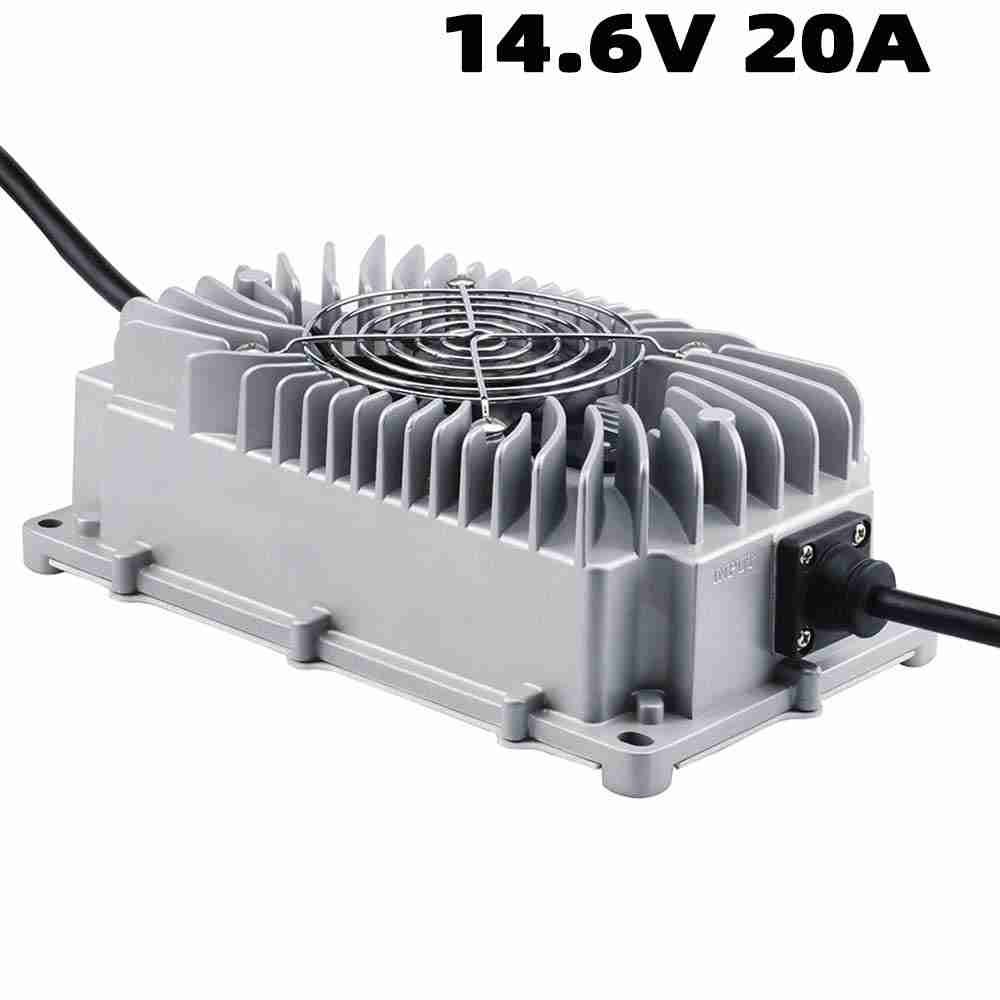
Output voltage: Maximum 14.6V ±0.2V
Output current: Maximum 20A ±0.2A
Maximum working power: 290W
Battery compatibility: 4S 12.8V LiFePO4 batteries
Housing: Aluminum alloy
Dimensions: 230 × 137 × 77 mm
Weight: 2.2 kg
Available colors: Black, silver, red, blue and green
Input plugs: US, EU, UK and AU options
Output connectors: XT60, XT90, crocodile clip, Anderson 50A, wire nose and 45A options
Why consider it? Its combination of a 20A output, aluminum enclosure and waterproof design makes it worth evaluating for applications where environmental protection is important.
Purchasing consideration: Confirm that the battery supports 14.6V charging and that the selected connector matches the battery terminal. Also verify the product’s actual environmental installation requirements before placing it in an exposed location.
Our recommendation: For marine, outdoor and equipment applications where water and dust protection matter, this configuration can be more valuable than simply purchasing a higher-amperage charger.
5. 30A High-Current 12V LiFePO4 Charger
A 30A charger is designed for users who need to replenish larger battery packs more quickly. It is particularly useful when equipment has limited charging downtime.
For a 100Ah battery, 30A represents a 0.3C charging rate. For a 200Ah battery, the same charger represents 0.15C.
Best applications: Medium-to-large RV systems, commercial backup equipment and off-grid installations.
Advantages: Faster charging potential than 10A and 20A configurations.
Limitations: Higher current increases the importance of cable sizing, connector ratings, thermal management and battery compatibility.
Our recommendation: Consider 30A when the battery capacity and charging schedule justify the additional output. It is not automatically better for a small 20Ah or 30Ah battery.
6. 40A High-Power 12V LiFePO4 Charger
A 40A charger is a higher-output solution intended for large battery packs and applications where charging speed is commercially important.
At 40A, a 100Ah battery experiences a 0.4C charging rate. A 200Ah battery experiences a 0.2C rate. These examples demonstrate why battery capacity should always be considered alongside charger current.
OHRIJA’s 14.6V 40A charger is designed for compatible 4S 12V LiFePO4 battery packs. It includes intelligent fan cooling with temperature-sensing speed control and multiple protection functions.
OHRIJA 14.6V 40A LiFePO4 Battery Charger
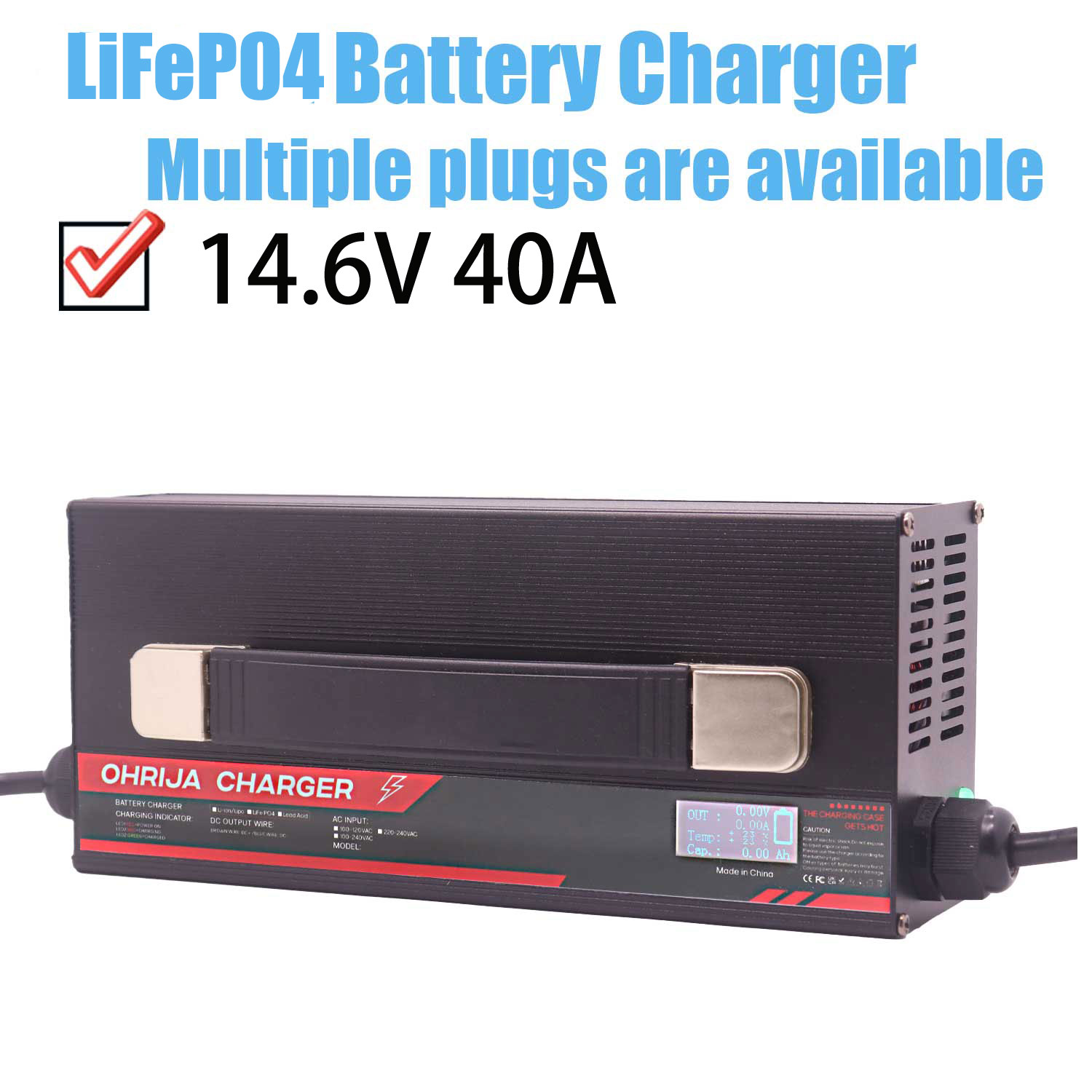
Input voltage: 110V/220V AC
Output voltage: 14.6V DC
Output current: 40A
Battery compatibility: 4S 12V LiFePO4 battery packs
Cooling system: Intelligent fan cooling with temperature-sensing speed control
Protection: Overvoltage protection (OVP), overcurrent protection (OCP), overtemperature protection (OTP), short-circuit protection (SCP) and reverse-connection protection
Applications: Industrial batteries, electric vehicles, energy storage systems and mechanical power applications
Why consider it? The 40A output is useful when charging larger battery packs within a limited service window. Intelligent fan cooling also addresses an important consideration in higher-output charging equipment: heat management.
Purchasing consideration: A 40A charger must not be selected simply because faster charging sounds attractive. Confirm the battery’s maximum permitted charging current, connector capacity and cable specifications first.
Our recommendation: For commercial users, larger battery installations and heavy-duty applications, a 40A charger can offer a meaningful operational advantage. For smaller batteries, a 20A model may be the more appropriate investment.
7. Smart Multi-Bank 12V LiFePO4 Charger
A multi-bank charger is designed to charge multiple batteries through separate charging channels. It is particularly useful in marine systems, RV installations and commercial equipment with more than one battery bank.
The important distinction is whether each charging channel operates independently. A charger with multiple physical connectors does not necessarily provide independent charging control.
For batteries with different states of charge, capacities or operating conditions, independent channels can make battery management considerably more practical.
Best applications: Boats, multiple-battery RV systems, service facilities and commercial battery installations.
Advantages: Centralized charging and potentially independent battery management.
Limitations: Higher purchase cost, more complicated installation and the need to confirm each channel’s chemistry compatibility.
Our recommendation: Buy a multi-bank charger only when you genuinely need to charge multiple independent battery banks. For a single 12.8V battery, a dedicated single-output charger is usually more economical.
4. 12V LiFePO4 Charger Comparison: 5A vs 10A vs 20A vs 30A vs 40A
When comparing 12V LiFePO4 chargers, charging current is one of the most important specifications. However, the right current depends on battery capacity, charging frequency and the maximum current permitted by the BMS.
| Charging Current | 20Ah Battery | 50Ah Battery | 100Ah Battery | 200Ah Battery |
|---|---|---|---|---|
| 5A | 0.25C | 0.10C | 0.05C | 0.025C |
| 10A | 0.50C | 0.20C | 0.10C | 0.05C |
| 20A | 1.00C | 0.40C | 0.20C | 0.10C |
| 30A | 1.50C | 0.60C | 0.30C | 0.15C |
| 40A | 2.00C | 0.80C | 0.40C | 0.20C |
C-rate = charging current divided by battery capacity in amp-hours. These figures are mathematical comparisons, not recommended charging rates. A charger must not exceed the battery manufacturer’s permitted current, even if the BMS appears capable of accepting it.
Which Charging Current Offers the Best Value?
For a 20Ah battery, a 20A charger represents 1C. That may exceed the battery’s permitted charging rate. A 5A or 10A charger may therefore be a more appropriate choice.
For a 100Ah battery, a 20A charger represents 0.2C, while a 40A charger represents 0.4C. If the battery manufacturer permits both rates, the 40A charger can reduce the theoretical charging time, although actual charging time will depend on the charging profile and battery conditions.
For a 200Ah battery, a 40A charger represents 0.2C. This can be a practical configuration for larger energy storage systems.
Our buying advice: Do not pay extra for 40A output if your battery can only accept 15A or 20A. The additional output capacity will not deliver its intended commercial benefit when the battery itself is the limiting factor.
5. Pros and Cons of 12V LiFePO4 Chargers
| Pros | Cons |
|---|---|
| Designed for the charging characteristics of lithium iron phosphate batteries. | Dedicated LiFePO4 chargers may cost more than basic power supplies. |
| Appropriate voltage control helps prevent charging outside specified limits. | Incorrect charging settings can still create battery compatibility problems. |
| Multiple current options accommodate different battery capacities. | High-current models require suitable wiring and connectors. |
| Protection features can reduce risks from abnormal operating conditions. | Protection features do not replace a properly designed battery BMS. |
| Specialized waterproof designs support demanding installation environments. | Waterproof ratings do not guarantee suitability for every outdoor installation. |
| Suitable charging equipment can support reliable battery maintenance. | Battery temperature and charging instructions must still be observed. |
Overall, a dedicated 12V LiFePO4 charger is worth purchasing when the existing charging equipment does not provide a compatible profile. For users who already own a programmable charger with the correct settings and protection features, upgrading may offer little additional benefit.
6. Benefits and Limitations of 12V LiFePO4 Chargers
Key Benefits
- Correct charging voltage: A suitable charger delivers the voltage required by the battery’s 4S configuration.
- Controlled charging current: Appropriate current selection helps users match charging performance to battery capacity.
- Improved system compatibility: Dedicated lithium charging profiles avoid relying on unsuitable lead-acid charging algorithms.
- Protection functions: OVP, OCP, OTP and SCP can help protect the charger and connected equipment from specified electrical faults.
- Application flexibility: Available output configurations support small portable batteries through larger industrial battery systems.
Important Limitations
A 12V LiFePO4 charger cannot compensate for a damaged battery, an unsuitable BMS or incorrect electrical installation.
It also cannot guarantee that a battery will charge at its maximum advertised rate. Battery temperature, state of charge, cell balance, BMS limits and cable voltage drop can all affect actual charging performance.
Cold-weather charging deserves particular attention. Some LiFePO4 batteries prohibit charging below 0°C, while other battery systems specify a different minimum operating temperature. A charger without temperature-based control cannot independently guarantee that a cold battery is safe to charge.
For commercial users, these limitations should be included in the equipment selection process rather than treated as afterthoughts.
7. How to Choose the Right 12V LiFePO4 Charger
We recommend evaluating six specifications before placing an order. These checks help avoid purchasing an oversized charger or an incompatible product.
1. Confirm the Battery Chemistry and Nominal Voltage
Verify that the battery is genuinely LiFePO4 and that it uses a 12.8V nominal, four-cell series configuration.
A 12V lead-acid charger, a 12V lithium-ion charger and a 12V LiFePO4 charger are not automatically interchangeable.
If you also work with other battery chemistries, compare the dedicated LiFePO4 battery charger range with Li-ion battery charging equipment rather than assuming that the products have the same output requirements.
2. Check the Required Charging Voltage
Many 4S LiFePO4 batteries use a charging voltage in the 14.2V–14.6V range. However, there is no single charging voltage that should be applied blindly to every 12.8V battery.
For example, Victron specifies 14.2V absorption voltage for its Lithium Smart batteries, while Battle Born provides a 14.2V–14.6V bulk/absorption range for its batteries.
This is why checking the battery manufacturer’s charging specifications is more important than choosing a charger solely because its label says 14.6V.
3. Match Charger Current to Battery Capacity
Use the following calculation:
Charging C-rate = Charger output current (A) ÷ Battery capacity (Ah)
Example: 20A ÷ 100Ah = 0.2C.
A lower C-rate generally means slower charging. A higher C-rate may reduce charging time, but it must remain within the battery manufacturer’s approved charging current.
4. Check the BMS Compatibility
The battery management system protects the battery against specified electrical and temperature conditions. However, a BMS is not a substitute for selecting the correct charger.
Check the battery’s maximum continuous charging current, voltage limits and temperature protection. For systems with external charging control, confirm whether the charger can respond to the BMS’s charging enable or disable signal.
5. Evaluate Cooling and Protection
Higher-output chargers generate more heat and require appropriate thermal management.
For 30A and 40A configurations, we recommend paying particular attention to cooling design, temperature protection and ventilation requirements.
At minimum, examine the available protection functions:
- Overvoltage protection (OVP).
- Overcurrent protection (OCP).
- Overtemperature protection (OTP).
- Short-circuit protection (SCP).
- Reverse-polarity or reverse-connection protection.
6. Verify Connectors, Input Voltage and Installation Conditions
A charger may have excellent electrical specifications but still be unsuitable for your installation because of connector incompatibility.
Check whether you need XT60, XT90, Anderson, crocodile clips or another connector type. Also confirm whether the charger supports your local AC input voltage and plug standard.
For outdoor installations, evaluate the enclosure rating, cable sealing, ventilation and mounting conditions together. A waterproof enclosure should not be assumed to make every connector or cable connection waterproof.
8. Common Mistakes When Buying and Using 12V LiFePO4 Chargers
Mistake 1: Using a Lead-Acid Charger Without Checking Its Profile
Some lead-acid chargers include equalization, desulfation and temperature-compensation functions. These functions can be inappropriate for lithium batteries.
Only use a multi-chemistry charger when it has a verified lithium profile or can be configured to match the battery manufacturer’s specifications.
Mistake 2: Assuming 14.6V Is Always the Best Charging Voltage
14.6V is commonly used for certain 4S LiFePO4 batteries, but it is not a universal requirement. Some battery manufacturers recommend 14.2V or another setting.
Using a higher charging voltage simply because it appears to charge faster is poor battery management.
Mistake 3: Buying Too Much Charging Current
A 40A charger is not automatically suitable for a 40Ah battery. In this example, the charger would deliver a nominal 1C rate, which may exceed the permitted charging current.
Check the battery documentation before upgrading to a higher-current charger.
Mistake 4: Ignoring Low-Temperature Charging
Charging LiFePO4 batteries below their specified minimum temperature can damage the cells. A BMS with low-temperature charge protection or an approved battery heating system can help manage this issue.
Do not assume that a charger with overtemperature protection also provides low-temperature battery protection. These are different functions.
Mistake 5: Choosing the Wrong Connector
Loose connections, undersized wiring and poorly matched connectors can create resistance and heat under high-current operation.
For a 40A charger, cable and connector selection should be based on current capacity, cable length, installation conditions and the manufacturer’s specifications.
Mistake 6: Confusing a Power Supply with a Battery Charger
An AC-to-DC power supply provides regulated DC output, but that does not necessarily mean it has the correct battery charging algorithm, charge termination or battery protection interface.
For example, a general-purpose 12V 30A power supply is not automatically a replacement for a dedicated 12V LiFePO4 charger.
Similarly, products designed for 48V or 60V systems should not be treated as interchangeable with 12V battery chargers. Always check the actual output specifications and intended application.
9. Why Consider OHRIJA for 12V LiFePO4 Charging Equipment?
When selecting battery charging equipment, the decision should extend beyond output voltage and current. Product compatibility, connector selection, cooling design and protection functions all influence whether a charger is suitable for long-term use.
OHRIJA provides charging equipment for different lithium battery configurations and applications. Its product range includes dedicated LiFePO4 chargers, lithium-ion chargers, battery charging accessories and power conversion products.
When to Choose the OHRIJA 14.6V 20A Model
The OHRIJA 14.6V 20A IP67 waterproof charger is worth considering when you need a dedicated charger for a compatible 4S 12.8V battery and require a waterproof-rated enclosure.
Its multiple connector options also make it easier to specify the output connection according to the battery installation. This is particularly useful for equipment manufacturers and users who need to match different battery ports.
When to Choose the OHRIJA 14.6V 40A Model
The OHRIJA 14.6V 40A charger is the more appropriate option when battery capacity and permitted charging current justify a higher-output solution.
Its intelligent fan cooling and temperature-sensing speed control are relevant considerations for higher-power charging equipment.
For industrial equipment manufacturers, the choice between these two products should be based on battery specifications, operating frequency and charging downtime rather than output current alone.
Other Charging Equipment Considerations
OHRIJA also provides other charging solutions for different battery voltages. For example, users working with electric bicycles may need a dedicated 54.6V 5A lithium-ion charger rather than a 12V LiFePO4 model.
Users evaluating different battery chemistries can also explore the lead-acid battery charger category and the golf car battery charger category for application-specific equipment.
The key purchasing principle remains the same: match the charger to the actual battery system instead of selecting products based on superficial similarities.
10. Expert Recommendation: Which 12V LiFePO4 Charger Should You Buy?
After comparing the seven configurations, our recommendation is to prioritize battery compatibility, appropriate charging current and installation conditions in that order.
| Your Situation | Recommended Charger Type | Why We Recommend It |
|---|---|---|
| Small portable battery | 5A or 10A | Lower current can be easier to match with small battery capacities. |
| Home backup battery | 10A or 20A | Practical charging speed for moderate-capacity systems. |
| RV or marine battery | 20A IP67 or suitable 20A standard charger | Balances output and installation requirements. |
| Large energy storage battery | 30A or 40A | Potentially reduces charging downtime. |
| Industrial battery equipment | 40A or application-specific charger | Supports higher-current charging when the battery permits it. |
| Multiple independent battery banks | Smart multi-bank charger | Provides a more organized charging arrangement. |
Is Upgrading from a 10A Charger to a 20A or 40A Charger Worth It?
It depends on how frequently you charge the battery and how much time your operation can afford to spend waiting.
For occasional home use, a 10A charger may already meet your needs. Spending more on a 40A model may not produce a meaningful financial return.
For commercial equipment that needs to return to service quickly, higher-current charging can reduce downtime. If a machine or battery-powered device is used throughout the working day, the value of faster charging may outweigh the additional equipment cost.
However, the upgrade only makes sense when the battery supports the higher current. Otherwise, you may pay for unused charger capacity.
OHRIJA’s final recommendation:
For general-purpose 12V LiFePO4 charging, start by evaluating a 20A charger. Consider the OHRIJA 14.6V 20A IP67 model when waterproof protection is important and the battery specifies a compatible charging profile. For larger battery systems and demanding commercial applications, evaluate the OHRIJA 14.6V 40A model, provided the battery’s maximum charging current and installation specifications support it.
11. Frequently Asked Questions About 12V LiFePO4 Chargers
1. What voltage should a 12V LiFePO4 battery charger have?
Most 12.8V nominal 4S LiFePO4 batteries use a charging voltage between approximately 14.2V and 14.6V. However, the correct setting depends on the battery manufacturer. Some manufacturers specify 14.2V, while others permit 14.6V. Always follow the battery documentation.
2. Can I use a regular 12V battery charger for LiFePO4?
Not necessarily. A regular 12V charger may be designed for lead-acid batteries and may include unsuitable equalization or desulfation functions. Use a dedicated LiFePO4 charger or a programmable charger with a verified compatible charging profile.
3. Is a 10A or 20A LiFePO4 charger better?
A 20A charger generally provides faster charging than a 10A charger when both are compatible with the battery. However, a 10A charger may be more appropriate for smaller battery packs. Choose based on battery capacity and permitted charging current.
4. Can I use a 40A charger on a 100Ah LiFePO4 battery?
Potentially, yes. A 40A charger represents a 0.4C charging rate for a 100Ah battery. However, you must confirm that the battery manufacturer permits at least 40A charging current and that the battery’s BMS and electrical connections support the configuration.
5. How long does it take to charge a 12V 100Ah LiFePO4 battery?
A simplified calculation using 100Ah divided by 20A gives five hours. With a 40A charger, the same calculation gives 2.5 hours. These are theoretical estimates, not guaranteed full-charge times. Actual charging takes longer depending on initial state of charge, the constant-voltage stage, temperature and battery limitations.
6. Can I leave a LiFePO4 battery connected to its charger?
Follow the battery and charger manufacturer’s maintenance instructions. Some LiFePO4 systems support a specified float setting, while others recommend stopping charging after completion. Do not assume that continuous charging is necessary or appropriate for every battery.
7. Can I charge a LiFePO4 battery in cold weather?
Only when the battery’s specified charging temperature range allows it. Many LiFePO4 batteries prohibit charging below freezing, although exact limits vary by manufacturer. Batteries with approved low-temperature heating and BMS protection may support charging in colder environments under specified conditions.
8. Is an IP67 waterproof LiFePO4 charger worth buying?
It can be worthwhile for marine, outdoor and industrial environments where dust and water exposure are realistic concerns. An IP67 rating indicates defined ingress protection under specified test conditions. It does not mean the charger is suitable for permanent underwater use or that every external connection is waterproof.
9. Does a LiFePO4 charger need a cooling fan?
Not every charger requires a fan. Cooling requirements depend on output power, enclosure design and operating conditions. Higher-current chargers, particularly 30A and 40A models, need an effective thermal management design. Intelligent fan cooling can help manage operating temperatures.
10. What protection functions should a 12V LiFePO4 charger have?
Important functions include overvoltage, overcurrent, overtemperature, short-circuit and reverse-connection protection. For applications involving low temperatures, verify that the battery or charging system also provides appropriate low-temperature charge protection.
12. Technical References and Further Reading
The following manufacturer documentation provides additional information about lithium charging profiles, battery operating conditions and charging-current selection.
- Victron Energy – Lithium Smart Battery: Charging and Operation. Manufacturer guidance covering recommended absorption voltage, float voltage, charging current, temperature compensation and battery charging temperature limits. Read Victron Energy Charging Guidelines
- Battle Born Batteries – Product Manual and Installation Guide. Technical documentation covering LiFePO4 charging profiles, bulk/absorption voltage, float voltage, equalization and charging temperature specifications. Read Battle Born Battery Manual
- Battle Born Batteries – The Basics of Charging LiFePO4 Batteries. Additional manufacturer guidance explaining lithium charging algorithms, voltage settings and compatibility considerations when selecting charging equipment. Read LiFePO4 Charging Guide
Final Thoughts
The best 12V LiFePO4 charger is not necessarily the most powerful or expensive model. It is the charger that matches your battery’s voltage requirements, permitted charging current, BMS capabilities and operating environment.
For beginners and small battery systems, 5A or 10A chargers may be sufficient. For general-purpose applications, 20A is a practical starting point. For larger batteries and commercial installations, 30A or 40A charging equipment can offer better operational efficiency when the battery supports it.
OHRIJA’s 14.6V 20A IP67 and 14.6V 40A charging solutions provide two configurations worth considering for compatible 4S LiFePO4 battery systems. Before purchasing, confirm your battery specifications, connector requirements and installation conditions to ensure the charger is the right fit.
Choose based on compatibility first, charging speed second, and price third. That is the more reliable way to invest in battery charging equipment.