

In the high-stakes realm of portable energy management, utilizing a substandard or mismatched power supply is an expensive, and potentially catastrophic, operational error. From our experience manufacturing industrial power systems, the fastest way to destroy a $1,000 lithium pack is by hooking it up to a generic, incompatible charger bought from a discount marketplace. In most professional situations, a charger is not merely a dumb electrical plug; it is an intelligent, algorithmic device communicating constantly with your battery’s internal Battery Management System (BMS). Choosing the right lithium battery charger requires a fundamental understanding of chemical formulations, peak voltage cutoffs, and amperage thresholds.
We strongly recommend ignoring universal “one-size-fits-all” chargers and instead applying strict commercial judgment to your procurement process. An incorrect charging profile will silently degrade your cellular capacity over a matter of months, slashing your return on investment. In this definitive guide, we will break down exactly how to evaluate, select, and deploy the correct charging hardware to maximize the lifecycle, performance, and physical safety of your high-density energy storage devices.
Quick Answer: The Procurement Mandate
Choosing the Right Lithium Battery Charger hinges on three absolute engineering rules: you must precisely match the chemistry (e.g., standard Lithium-Ion NMC vs. Lithium Iron Phosphate), you must match the exact peak voltage (e.g., a 54.6V charger for a 48V nominal Li-ion pack), and you must select an appropriate charging current (typically between 0.2C and 0.5C). You must never use a lead-acid charger on a lithium battery, as the desulfation cycles will permanently damage the lithium cells. Always verify that your hardware utilizes a dedicated Constant Current/Constant Voltage (CC/CV) algorithmic profile, includes a BMS wake-up function for depleted cells, and possesses verifiable safety certifications like CE or UL.
Table of Contents
- What is a Dedicated Lithium Charger?
- How the CC/CV Charging Algorithm Works
- 8 Tips for Choosing the Right Lithium Battery Charger
- Commercial Benefits of the Right Charger
- Limitations and Hardware Constraints
- Who Should Use It & Who Does Not Need It
- Common Procurement Mistakes
- Strategic Buying Considerations
- Summary & Comparison Tables
- Expert Recommendation from OHRIJA
- Frequently Asked Questions (FAQ)
What is a Dedicated Lithium Charger?
A dedicated lithium battery charger is a specialized electronic power converter engineered to execute a precise, two-stage charging sequence tailored exclusively to lithium-based chemistry. Unlike legacy lead-acid chargers that continuously push a slow “float” or “trickle” voltage into the battery indefinitely once it is full, a true lithium charger physically halts the flow of current when the battery pack reaches its absolute peak voltage threshold. This hard shut-off acts as the primary external safeguard against overcharging, internal cellular swelling, and the dangerous phenomenon known as thermal runaway. Whether you are maintaining a massive marine battery bank or a high-performance daily commuter eBike, the charger serves as the critical hardware bridge between grid alternating current (AC) and your battery’s internal direct current (DC) architecture.
How the CC/CV Charging Algorithm Works
Lithium cells do not absorb electrical current linearly. To maintain stability, they demand a rigid protocol known as the Constant Current / Constant Voltage (CC/CV) algorithm. Understanding this process is vital when determining how to efficiently replenish your system.
- Stage 1: Constant Current (The Bulk Charge): In our testing, the charger initiates the cycle by pushing a steady, maximum rated amperage into the depleted battery. Because the battery’s resistance is low when empty, it can absorb this massive influx of power rapidly. During this phase, the battery’s overall voltage steadily rises. This stage brings the battery to approximately 80% to 85% capacity in a very short timeframe.
- Stage 2: Constant Voltage (The Absorption Charge): Once the battery hits its predetermined peak voltage threshold (for example, 14.6V for a standard 12V LiFePO4 battery), the charger locks that voltage in place. It ceases to push maximum amperage; instead, as the internal resistance of the saturating battery increases, the current naturally tapers down. When the current drops to a negligible level (typically around 0.02C to 0.05C), the charger recognizes the battery is mathematically 100% full and completely terminates the charge cycle.
8 Tips for Choosing the Right Lithium Battery Charger
1. Match the Exact Chemistry Profile
A standard Lithium-Ion (NMC) battery and a Lithium Iron Phosphate (LiFePO4) battery possess entirely different cellular voltage curves. A common operational misconception leads users to ask can lithium charger charge LiFePO4 battery setups safely? The answer is absolutely not. A 48V standard Li-ion battery peaks at 54.6V (4.2V per cell), while a 48V LiFePO4 battery peaks at 58.4V (3.65V per cell). Hooking a Li-ion charger to a LiFePO4 battery will severely undercharge the unit, leaving significant capacity on the table. Conversely, hooking a LiFePO4 charger to an NMC battery will overcharge the cells, inevitably causing a catastrophic fire hazard. Ensure you are shopping in the correct Li-ion battery charger category or the dedicated LiFePO4 battery charger category based on your exact specifications.
2. Respect Nominal vs. Peak Voltage Designations
Never buy a charger based solely on the “nominal” voltage printed on the side of your battery casing. A 48V eBike battery requires a charger that outputs its maximum peak voltage, not its average operating voltage. For example, a standard 13S (13 cells in series) lithium-ion pack demands a 54.6V 5A eBike battery charger to reach a full 100% state of charge. Using a power supply that only outputs a flat 48.0V will result in a battery that is barely half full.
3. Select the Optimal Amperage (The C-Rate)
Charge speed is strictly dictated by amperage, but pushing maximum current is not always the best engineering decision. For heavy-duty applications, forcing excessive amps into a pack generates severe thermal waste and accelerates the degradation of the lithium cathode. We recommend charging at a rate between 0.2C and 0.5C (where ‘C’ represents the battery’s total amp-hour capacity). For a 20Ah battery, a 4A to 10A charger is the optimal window. For massive, high-capacity commuter packs, deploying a 48V 10A eBike charger strikes the perfect balance between rapid turnaround time and long-term battery lifecycle preservation.
4. Require a BMS Wake-Up Function
If your lithium battery is drained down to 0%, its internal BMS will automatically enter a deep “sleep mode” to protect the cells from irreversible deep-discharge damage. In this state, the external terminals will read 0 volts. Cheap, generic chargers cannot detect the presence of the sleeping battery and will simply refuse to turn on. A high-quality, professional-grade charger includes a “BMS wake-up” or “0V activation” pulse. It sends a micro-current into the dead terminals to reboot the BMS and safely initiate the bulk charging cycle.
5. Evaluate Active vs. Passive Thermal Management
If you have ever stopped mid-charge to ask why does my charger get hot, it is because AC-to-DC power conversion inherently generates massive thermal waste. For commercial users operating high-amperage rapid chargers (10A and above), active cooling via an internal fan is absolutely mandatory to prevent component meltdown. However, for outdoor, marine, or heavily dusted industrial environments, a sealed, fanless aluminum extrusion chassis (passive cooling) is vastly superior, as it prevents saltwater and conductive dust intrusion into the delicate circuitry.
6. Inspect the Physical Connector Terminals
Do not assume that all 3-pin connectors are wired identically across the industry. An XLR plug, an XT60, a GX16 aviation plug, and an Anderson connector all serve vastly different current thresholds. Furthermore, you must verify the pinout polarity (which specific pin is wired positive and which is negative) before plugging a new charger into your device. Reversing the polarity will instantly bypass your system fuses and permanently fry the BMS.
7. Refuse Universal and Legacy Lead-Acid Chargers
Never attempt to cut corners on voltage dynamics. We frequently hear clients ask can I charge a 36V battery with 12V charger hardware. It is physically impossible and electrically dangerous. More importantly, attempting to repurpose an old lead-acid (SLA or AGM) charger on a modern lithium pack is disastrous. Lead-acid chargers utilize high-voltage desulfation or equalization phases that will instantly destroy a lithium battery’s delicate internal architecture.
8. Prioritize Verified Safety Certifications
Only procure hardware from a recognized electric bicycle charger supplier that provides verifiable UL, CE, RoHS, and FCC certifications. These engineering marks guarantee the unit has undergone rigorous laboratory testing for short-circuit, over-voltage, reverse-polarity, and over-temperature protections. Uncertified chargers are a massive fire liability for any residential or commercial structure.
Commercial Benefits of the Right Charger
The operational benefits of upgrading to a premium, chemistry-specific algorithmic charger are immediate. By providing clean, ripple-free current, you ensure your battery achieves its maximum rated cycle life (often 2,000 to 4,000 cycles for premium LiFePO4 packs). It guarantees the cells are balanced correctly during the prolonged CV absorption phase, which maximizes your vehicle’s operational range and prevents premature voltage sag under load. Furthermore, learning exactly how to charge eBike battery safely with the correct hardware drastically reduces your liability regarding thermal runaway events.
Limitations and Hardware Constraints
We must use commercial and practical judgment: the primary limitation of high-quality lithium chargers is their initial capital cost. They are significantly more expensive than generic, uncertified power bricks. Additionally, they are strictly chemistry-dependent. You cannot swap them between different fleets. If you operate a mixed warehouse of 48V NMC scooters and 48V LiFePO4 forklifts, you must maintain two entirely separate charging infrastructures. Using the wrong charger will result in immediate equipment downtime.
Who Should Use It & Who Does Not Need It
For commercial users and heavy-duty applications: Fleet managers overseeing golf carts, marine installations, automated guided vehicles (AGVs), or off-grid solar storage arrays must deploy purpose-built, heavy-duty lithium chargers with robust aluminum housings and strict CC/CV profiles. Cutting costs on the power supply will directly destroy your expensive battery assets.
Who does not need it: If your portable device features an internal AC-to-DC converter and a built-in BMS that handles the algorithmic charging internally (such as a modern smartphone, a laptop, or certain portable power stations), you do not need an external smart charger; you simply need a standard power adapter that supplies the raw voltage requested by the device’s internal circuitry.
Common Procurement Mistakes
The most catastrophic mistake users make is ignoring the warning signs of a failing power supply. A charger that clicks repeatedly, fails to engage the cooling fan, or emits an acrid burning odor must be decommissioned immediately. Knowing exactly how to troubleshoot a 12V battery charger when the LED indicator lights behave erratically can prevent a facility fire. Never leave a malfunctioning or physically damaged charger plugged into an AC wall outlet unattended.
Strategic Buying Considerations
When procuring a charger, you must examine the intended operational environment. An IP67 waterproof and dustproof rating is absolutely critical for marine applications or open-air agricultural use, but it is an unnecessary expense for an indoor golf cart garage. Check the warranty terms meticulously, and verify the supplier has an in-house engineering team capable of customizing the charge profile (modifying the CV cutoff voltage or the taper current) if your highly specific commercial application demands it.
Essential Comparison & Buying Tables
| Battery Chemistry | Nominal Voltage (Per Cell) | Peak Charge Voltage (Per Cell) | Typical 48V Pack Peak Voltage |
|---|---|---|---|
| Lithium-Ion (NMC) | 3.6V / 3.7V | 4.20V | 54.6V (13S configuration) |
| Lithium Iron Phosphate (LiFePO4) | 3.2V | 3.65V | 58.4V (16S configuration) |
| Lithium Titanate (LTO) | 2.4V | 2.85V | Varies heavily by application |
| Feature | Dedicated Lithium Charger | Standard Lead-Acid Charger |
|---|---|---|
| Charging Algorithm | Strict CC/CV Profile | Multi-stage (often includes desulfation) |
| End of Charge Action | Hard shut-off (0 amps) | Continuous Trickle / Float charge |
| Compatibility | Safe for sensitive Lithium BMS | Will destroy Lithium cells via overvoltage |
| 0V Wake-Up Feature | Yes (on premium models) | No (will not detect sleeping batteries) |
| The Pros (Advantages) | The Cons (Disadvantages) |
|---|---|
| Drastically reduces equipment downtime and turnaround time. | Generates massive internal heat, accelerating cellular degradation. |
| Ideal for commercial fleets requiring multi-shift operations. | May not allow the BMS sufficient time to balance all cell groups perfectly. |
| Maximizes the utility of massive, high-capacity battery banks. | Requires active fan cooling, making the charger bulkier and noisier. |
| Total Battery Capacity (Ah) | Recommended Safe Charge Rate (Amps) | Estimated Charge Time (0 to 100%) |
|---|---|---|
| 10Ah – 15Ah | 2A – 3A | 4 to 6 Hours |
| 20Ah – 30Ah | 4A – 6A | 4 to 6 Hours |
| 40Ah – 50Ah | 8A – 10A | 4 to 6 Hours |
| 100Ah+ (Marine/Solar) | 20A – 30A | 4 to 6 Hours |
Expert Recommendation from OHRIJA
In most professional situations, the operational integrity of your entire energy storage system is absolutely dependent on the quality of your charger. You can purchase the most advanced cells on the market, but a compromised, uncalibrated charger will silently murder those expensive lithium cells over the course of a single season by continuously pushing the voltage beyond safe limits. We recommend entirely bypassing generic third-party vendors and sourcing your equipment directly from an established manufacturer that controls their entire R&D and production pipeline.
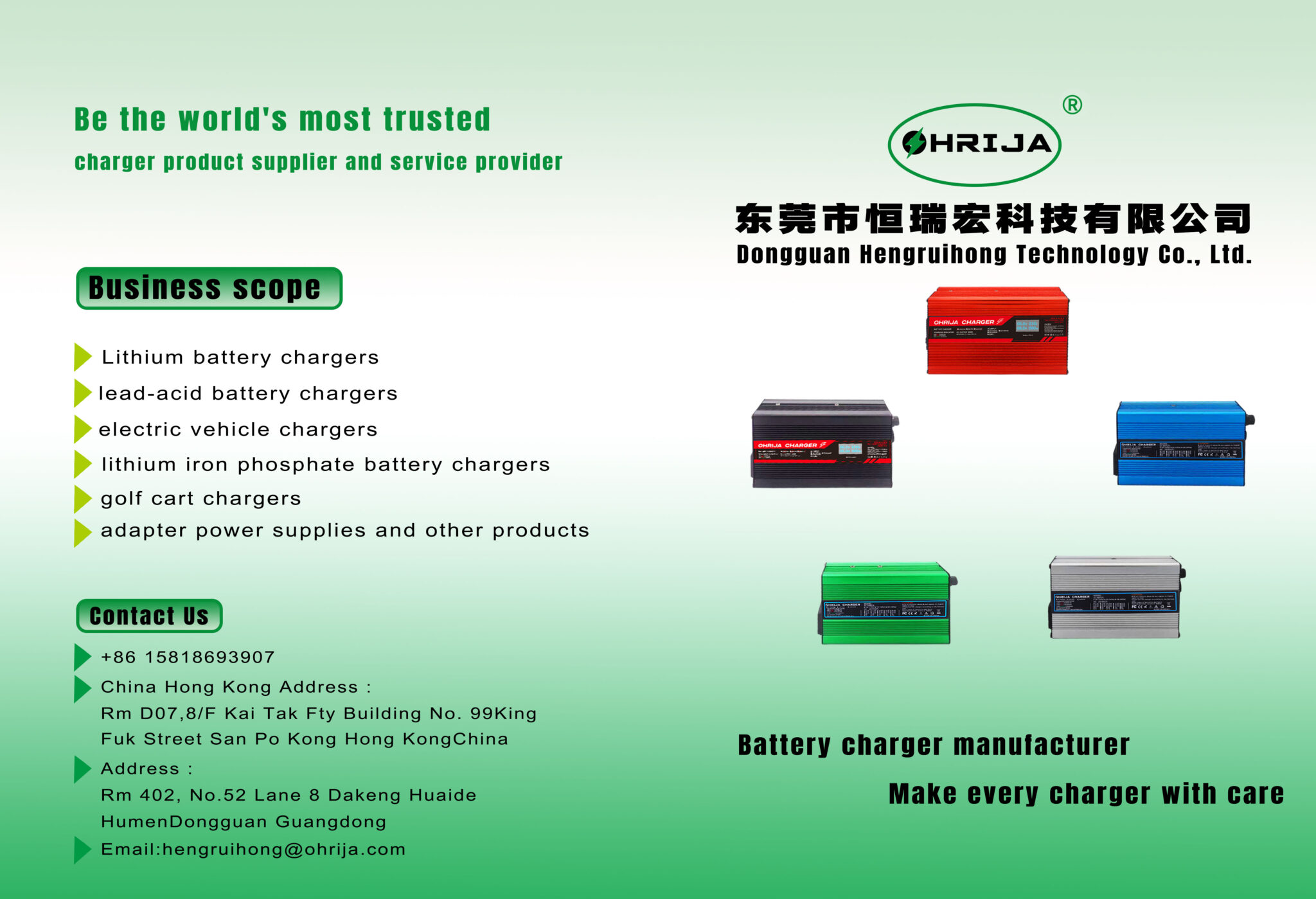
OHRIJA Lithium Battery Charger Manufacturer
OHRIJA brand belongs to Dongguan Hengruihong Technology Co., Ltd., which was established in 2020 and is headquartered in Dongguan, Guangdong Province, China. Our company is a high-tech enterprise integrating R&D, production, and sales. The company’s main products include high-performance lithium battery chargers, lithium iron phosphate battery chargers, heavy-duty lead-acid battery chargers, golf cart chargers, power adapters, and specialized switching power supplies designed for commercial durability.
Explore OHRIJA Manufacturing Capabilities
If you demand reliable, algorithmic charging hardware that complies with global safety standards and protects your capital investments, partnering with a dedicated manufacturer like OHRIJA ensures your fleets remain powered, balanced, and safe year after year.
Frequently Asked Questions (FAQ)
Can I use a lead-acid charger on my lithium battery?
No. Lead-acid chargers often use a multi-stage charging profile that includes a desulfation or equalization phase, which pulses high voltages into the battery. Subjecting a lithium battery to these high-voltage spikes will instantly destroy the Battery Management System (BMS) and potentially cause a critical thermal runaway event.
Why does my lithium battery charger shut off before reaching 100% on the display?
This usually indicates that the battery’s internal BMS has detected a cellular imbalance. If one cell group reaches its maximum voltage limit before the others, the BMS will sever the connection to protect that cell from overcharging, causing the charger to shut off prematurely. This highlights the importance of using a high-quality charger that holds a steady Constant Voltage (CV) phase to allow the BMS time to balance the cells.
What is the safest charging amperage for a lithium eBike battery?
In most professional situations, the safest and most efficient charge rate is between 0.2C and 0.5C (where C is the total amp-hour capacity of the battery). For a standard 20Ah eBike battery, a 4A to 10A charger provides an optimal balance between rapid turnaround time and minimizing thermal degradation of the cells.
Authoritative Industry References
To ensure your charging protocols and battery management systems adhere to the strictest global safety and engineering standards, we strongly advise consulting the following technical resources:
- Battery University (by Cadex Electronics) – Comprehensive technical breakdowns regarding the CC/CV algorithms required for safely charging various lithium-ion chemistries.
- IEEE Standards Association (IEEE 2405-2022) – The definitive engineering standard for the design, configuration, and performance characteristics of chargers used in stationary battery applications.
- U.S. Consumer Product Safety Commission (CPSC) – Federal safety guidelines, recall information, and consumer protection protocols regarding lithium-ion battery and charger safety to prevent thermal runaway incidents.