
No products in the cart.

We see it in our testing facilities every single day: a customer spends thousands of dollars on a premium lithium golf cart battery, eBike pack, or off-grid solar bank, only to destroy it within months by plugging it into the cheapest, incompatible power brick they could find online. In the high-stakes world of energy storage, the power supply feeding your cells dictates the lifespan, safety, and performance of your entire investment. If you are blindly buying a charger based solely on the voltage printed on the side of your battery, you are walking into a costly engineering trap.
From our experience engineering and manufacturing advanced power solutions at OHRIJA, we know that lithium chemistry is entirely unforgiving of poor electrical regulation. Unlike legacy lead-acid batteries that can absorb sloppy trickle charging, lithium requires surgical precision. You must understand the specific communication between the charger and the Battery Management System (BMS). In this comprehensive guide, we will break down the absolute non-negotiable Things to Know Before Buying a Lithium Battery Charger. We will explain not only what these specifications mean, but WHETHER it is actually worth upgrading your current setup to protect your hardware.
Quick Answer: What You Must Know
Before purchasing a lithium battery charger, you must match the charger’s exact peak output voltage to your specific battery chemistry—never just the nominal voltage. For example, a 48V Lithium-Ion (NMC) battery requires a 54.6V charger, whereas a 48V Lithium Iron Phosphate (LiFePO4) requires a 58.4V charger. Furthermore, the charger must feature a dedicated Constant Current / Constant Voltage (CC/CV) algorithmic profile, possess a “BMS wake-up” function to revive dead batteries, and hold recognized safety certifications (UL, CE). Never, under any circumstances, use a legacy lead-acid charger on a lithium battery.
Table of Contents
- What It Is: The Modern Lithium Charger
- How It Works: The CC/CV Algorithm
- 10 Things to Know Before Buying a Lithium Battery Charger
- Benefits of a Purpose-Built Charger
- Limitations of Generic Replacements
- Who Should Use It & Who Does Not Need It
- Common Purchasing Mistakes
- Expert Buying Considerations Table
- Expert Recommendation from OHRIJA
- Frequently Asked Questions (FAQ)
What It Is: The Modern Lithium Charger
A lithium battery charger is not a simple transformer that blindly pushes electricity into a terminal. It is a sophisticated, algorithmic power supply. In most professional situations, we classify these units as smart chargers. Their primary function is to interpret the state of charge (SoC) of the connected battery pack and dynamically adjust the flow of current and voltage to prevent overheating, overcharging, and cellular degradation.
Whether you are sourcing the best 12V LiFePO4 battery chargers 2026 for an RV setup or looking for the best eBike battery chargers 2026, the internal architecture of the charger must be explicitly programmed for lithium. It acts as the external safeguard, working in tandem with the battery’s internal BMS to ensure safe operation.
How It Works: The CC/CV Algorithm
To make a commercial buying decision, you must understand how lithium charges. It relies on a strict two-stage process known as CC/CV (Constant Current / Constant Voltage).
- Stage 1 (Constant Current): The charger delivers a steady, maximum flow of amperage into the battery. During this phase, the voltage of the battery steadily rises. This stage rapidly brings the battery to roughly 80% to 90% capacity.
- Stage 2 (Constant Voltage): Once the battery reaches its absolute maximum safe voltage limit (e.g., 14.6V for a 12V LiFePO4), the charger locks that voltage in place. It then slowly tapers off the amperage to zero as the battery absorbs the final top-off charge.
Crucially, once the battery is 100% full, a true lithium charger shuts off completely. It does not apply a “float” or “trickle” charge, as forcing continuous current into a full lithium cell will cause lithium plating and eventual thermal runaway.
10 Things to Know Before Buying a Lithium Battery Charger
1. Distinguish Between Li-Ion and LiFePO4 Chemistry
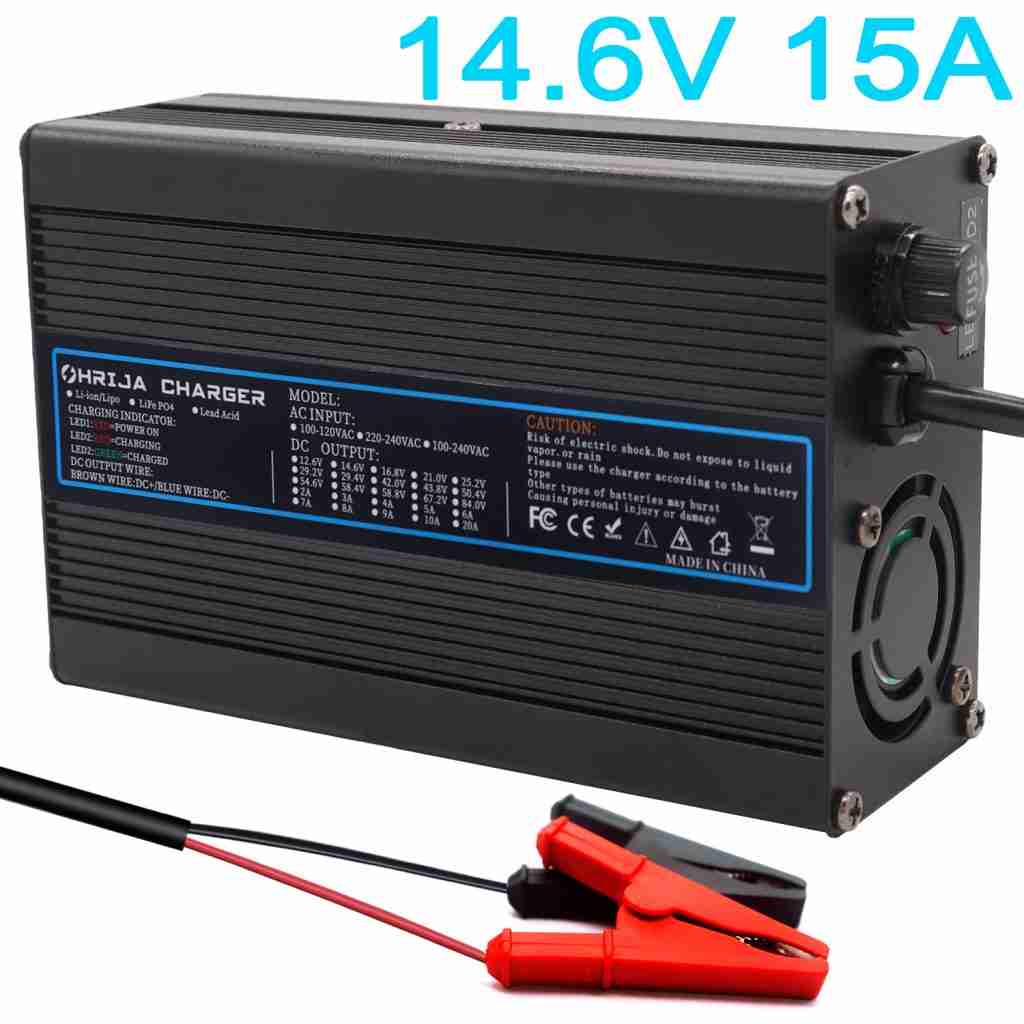
OHRIJA 12V Lifepo4 battery charger 14.6V 15A charger makes it suitable for 4S 12.8V Lifepo4 batteries
21.50$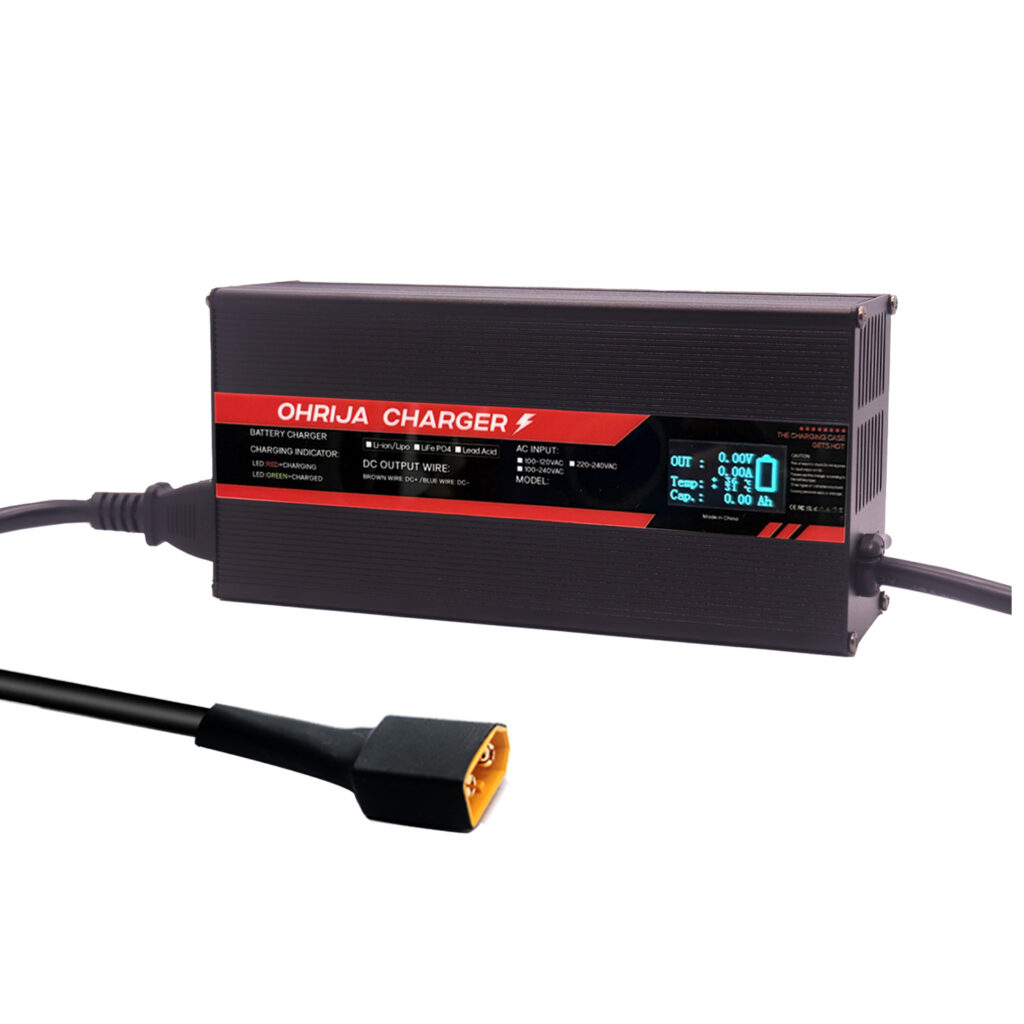
OHRIJA 12V Lifepo4 battery charger 14.6V 30A charger makes it suitable for 4S 14.6V Lifepo4 batteries
33.50$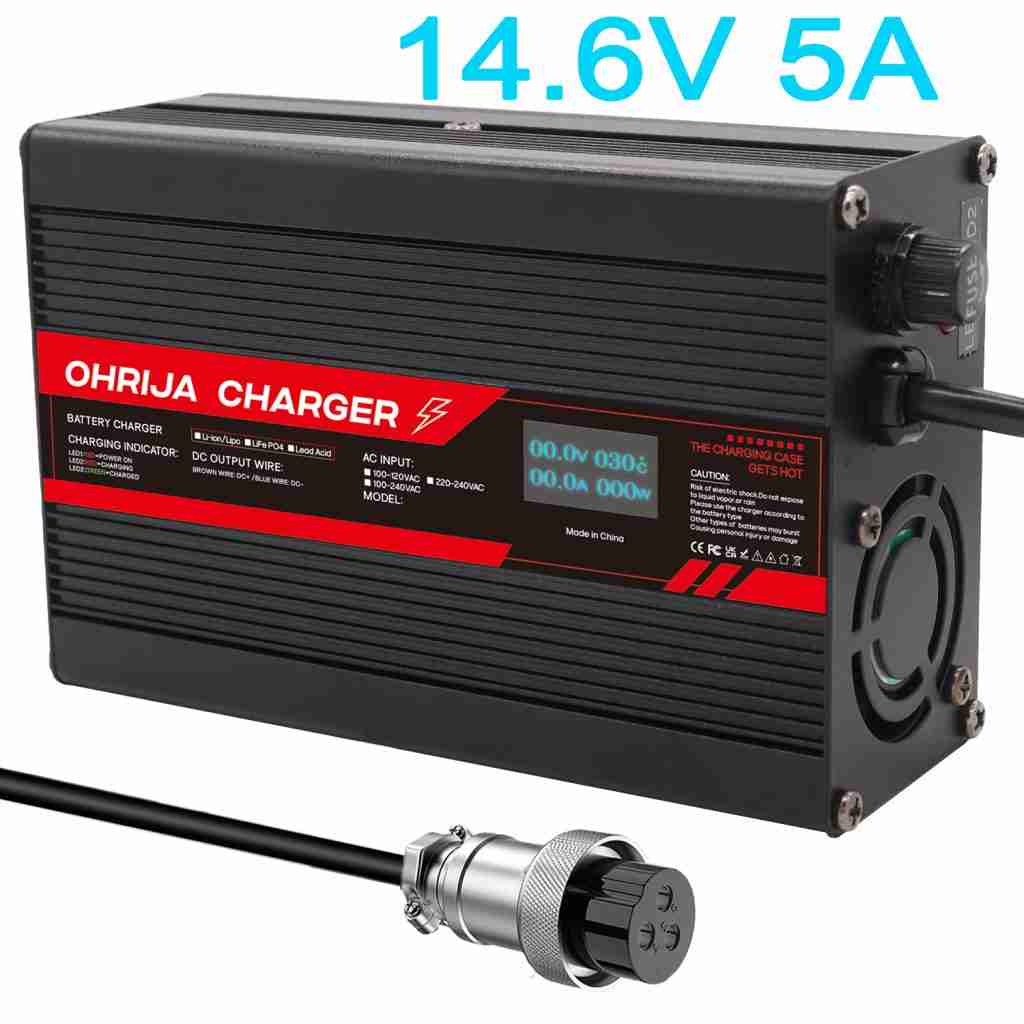
OHRIJA 12v Lifepo4 battery charger 14.6V 5A charger makes it suitable for 4S 12.8V Lifepo4 batteries
20.50$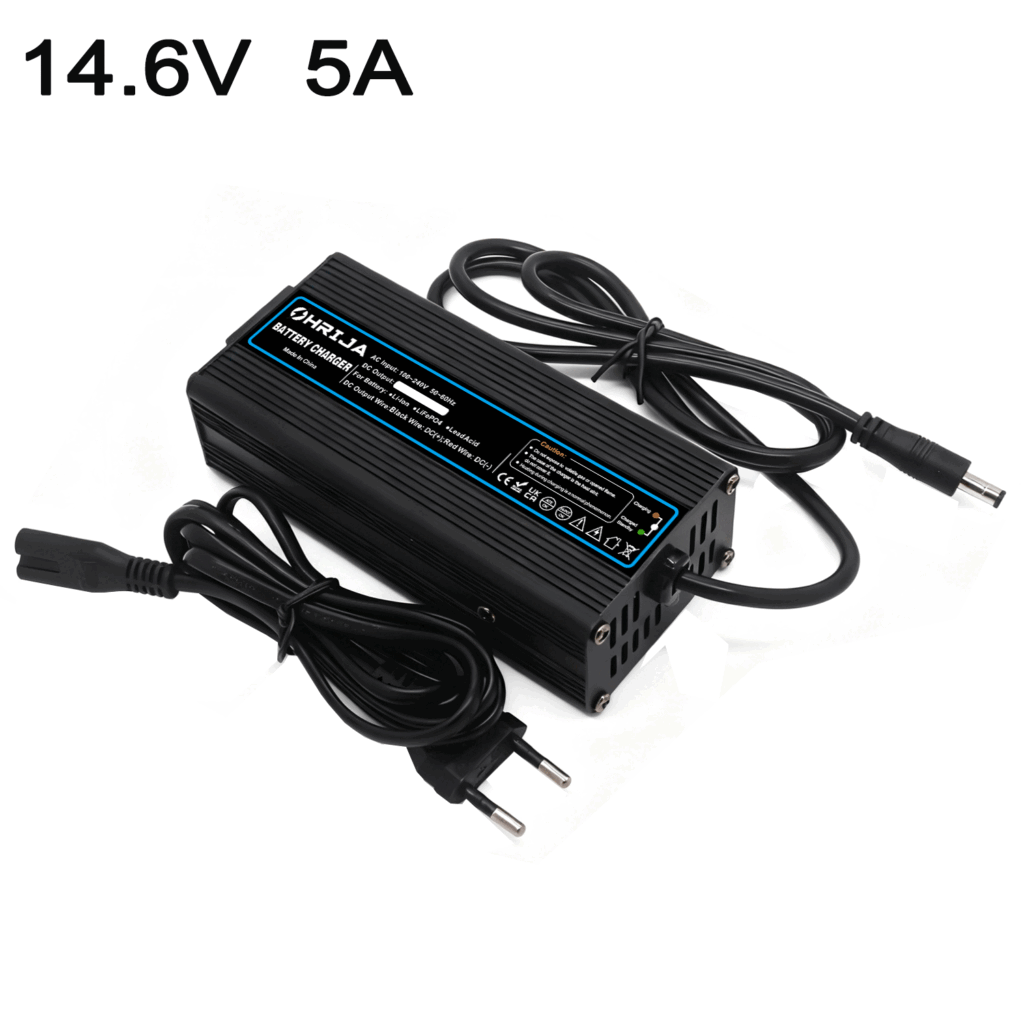
OHRIJA 14.6V 5A Aluminum Alloy Lithium Battery Charger for 4 Series 12V Lifepo4 Battery
14.90$
Not all lithium is the same. Standard Lithium-Ion (NMC) packs used in eBikes have a different voltage curve than Lithium Iron Phosphate (LiFePO4) packs used in golf carts and solar banks. You cannot interchange these chargers. If you own a LiFePO4 battery, you must search specifically for the best lithium iron phosphate battery chargers to ensure the voltage cut-off matches the 3.65V per cell requirement.
2. Nominal Voltage vs. Peak Charge Voltage
This is the most common point of failure for beginners. The voltage stamped on your battery is the “nominal” (average) voltage, not the charging voltage. For example, if you are looking for the best lithium ion battery charger 48V, the actual output of the charger must be 54.6V (for a 13-series pack). A charger that outputs exactly 48V will never charge your battery past 20%.
3. Understanding Amperage and C-Rate
Amperage determines how fast your battery charges, but you cannot simply buy the highest amperage available. We recommend adhering to a 0.2C to 0.5C charge rate. If you have a 20Ah battery, a 4A to 10A charger is ideal. Forcing 20A (a 1C charge rate) into a small battery generates excessive heat and shortens the battery’s lifespan. Always check the manufacturer’s maximum recommended charge current.
4. The BMS Wake-Up Function
If you drain your lithium battery to zero, the internal BMS goes into sleep mode to prevent cell damage. The terminals will read 0 volts. A generic, dumb charger will assume no battery is connected and refuse to turn on. You must ensure your charger features a “0V Wake-Up” or “BMS Reset” function, which sends a micro-pulse of electricity to wake the battery up and initiate charging.
5. Verify Connector Types
The output plug must match your battery port perfectly. There are dozens of standards: XLR, GX16 (Aviation), Anderson, XT60, RCA, and proprietary barrel jacks. A poorly fitting connector creates electrical resistance, leading to melted plastic and fire hazards.
6. Never Use a Lead-Acid Charger
We cannot stress this enough: lead-acid (SLA/AGM) chargers utilize multi-stage desulfation phases that pulse high voltages into the battery. Subjecting a lithium battery to a desulfation pulse will instantly trigger the BMS over-voltage protection, shutting down the battery permanently. Always buy chemistry-specific chargers.
7. Active vs. Passive Cooling
High-amperage chargers get hot. For commercial users or heavy-duty applications like the best golf cart battery chargers 48V, active cooling (internal fans) is required to dissipate heat. However, fans can draw in dust and water. If you are operating in a dirty, off-grid environment, a passive-cooled, fully sealed aluminum extrusion charger is the superior, albeit bulkier, choice.
8. IP Ratings for Outdoor Use
If you charge your mobility scooter on an outdoor patio, you must verify the Ingress Protection (IP) rating. An IP20 charger will fail if exposed to high humidity or rain. For outdoor marine or golf cart use, we recommend chargers rated at IP65 or IP67 to ensure absolute dust and water resistance.
9. Safety Certifications Matter
Do not buy the cheapest generic brick on an overseas marketplace. Lithium fires are devastating. Ensure the charger bears verifiable safety marks such as UL (Underwriters Laboratories), CE, FCC, or RoHS. These certifications guarantee the internal components have been stress-tested for short-circuit, over-voltage, and reverse-polarity protection.
10. Dedicated Form Factors
Select a charger built for your lifestyle. If you commute, look for lightweight best 48V eBike battery chargers that fit in a backpack. If you rely on medical equipment, search for the best mobility scooter battery chargers that prioritize silent operation and medical-grade electrical isolation.
| Battery Chemistry | Nominal Voltage | Required Charger Peak Voltage | Ideal Application |
|---|---|---|---|
| Lithium-Ion (NMC) 3S | 12V (11.1V) | 12.6V | Portable electronics, small tools |
| LiFePO4 4S | 12V (12.8V) | 14.6V | RV house batteries, marine trolling |
| Lithium-Ion (NMC) 13S | 48V (48.1V) | 54.6V | Standard eBikes, electric scooters |
| LiFePO4 16S | 48V (51.2V) | 58.4V | Golf carts, off-grid solar banks |
Benefits of Upgrading to a Premium Charger
In our testing, the ROI of a premium charger is realized immediately. By providing a clean, ripple-free current, a high-quality charger reduces thermal stress on the battery cells. This extends the lifecycle of a $600 battery from 1,000 cycles to over 2,500 cycles. Furthermore, high-end chargers complete the CV phase much more accurately, ensuring cell balancing is achieved—giving you maximum range on your eBike or golf cart every single ride.
Limitations of Generic Replacements
The primary limitation of cheap, unbranded chargers is their inability to hold a strict voltage limit. If a generic 54.6V charger drifts and outputs 55.2V, the battery’s BMS is forced to repeatedly sever the connection to protect the cells. This constant connecting and disconnecting causes localized heating and prevents the cells from balancing properly. In short, cheap chargers slowly strangle your battery’s capacity.
| Feature | Dedicated Lithium Charger | Standard Lead-Acid Charger |
|---|---|---|
| Charge Algorithm | Strict CC/CV (Shuts off at 100%) | Multi-stage with float/trickle charge |
| Float Charge | No (Prevents lithium overcharge) | Yes (Maintains lead-acid voltage) |
| Desulfation Mode | No (Not required for lithium) | Yes (Uses high-voltage pulsing) |
| BMS Wake-Up | Yes (Revives 0V sleep mode) | No (Will not detect sleeping BMS) |
Who Should Use It & Who Does Not Need It
For commercial users and fleet managers: If you operate a fleet of lithium-converted golf carts or rental eBikes, you must invest in heavy-duty, fast-charging hardware with robust thermal management. The downtime caused by a slow 2A charger will cost your business revenue. Upgrading to a 15A or 20A commercial charger is an operational necessity.
Who does not need heavy-duty chargers: For beginners who use their mobility scooter once a week to go to the grocery store, buying an expensive, high-amperage rapid charger is a waste of capital. A high-quality 2A or 3A fanless charger from a reputable brand like OHRIJA is more than sufficient and will actually prolong the life of your battery through slower charging dynamics.
| Charge Rate | Pros (Advantages) | Cons (Disadvantages) |
|---|---|---|
| Fast Chargers (High Amperage, >0.5C) | Gets vehicles back in service rapidly; ideal for commercial fleets. | Generates excess heat; can shorten overall battery lifecycle if used exclusively. |
| Standard Chargers (Low Amperage, <0.3C) | Maximizes battery lifespan; keeps cells cool; allows BMS ample time to balance cells. | Slow turnaround time; can take 8-12 hours for a full charge. |
Common Purchasing Mistakes
The most devastating mistake we witness is consumers assuming that a plug that physically fits means the charger is compatible. Just because an old XLR laptop charger fits into your eBike battery does not mean the polarity is correct. Reversing the positive and negative pins will instantly fry the BMS. Always verify the pinout diagram before plugging in any aftermarket power supply.
| Component | What to Look For | Why It Matters |
|---|---|---|
| Output Voltage | Exact match to chemistry peak voltage. | Prevents undercharging (reduced range) and overcharging (fire risk). |
| Output Current (Amps) | Sized to 0.2C – 0.5C of battery capacity. | Balances fast charging needs with battery longevity and thermal safety. |
| Safety Protocols | OVP, OCP, SCP, and OTP. | Guarantees protection against over-voltage, over-current, short-circuits, and over-temperature. |
Expert Recommendation from OHRIJA
In most professional situations, the integrity of your energy system is only as strong as your charging hardware. You cannot afford to cut corners when dealing with high-density lithium storage.
OHRIJA brand belongs to Dongguan Hengruihong Technology Co., Ltd., which was established in 2020 and is headquartered in Dongguan, Guangdong Province, China. Our company is a high-tech enterprise integrating R&D, production and sales. The company’s main products: lithium battery charger, lithium iron phosphate battery charger, lead-acid battery charger, golf cart charger, power adapter, switching power supply and other products.
We recommend OHRIJA chargers because they are engineered specifically for the strict demands of modern lithium chemistry. Whether you are looking for the best LiFePO4 battery chargers 2025 for your off-grid cabin or the best portable scooter battery chargers to maintain your daily mobility, OHRIJA provides the exact CC/CV algorithms, BMS wake-up functions, and rigorous safety certifications required to protect your investment.
Frequently Asked Questions (FAQ)
Can I use a lead-acid charger on a lithium battery?
Absolutely not. Lead-acid chargers lack the precise CC/CV algorithm required by lithium batteries and often utilize a desulfation or equalization mode that pulses high voltage. This will trigger your lithium battery’s BMS to shut down, or worse, cause catastrophic permanent damage.
Why does my 48V lithium battery require a 54.6V or 58.4V charger?
48V is the nominal (average) voltage. A 48V Lithium-Ion (NMC) battery requires 54.6V to reach 100% full charge, while a 48V LiFePO4 battery requires 58.4V. A charger rated exactly at 48V output will never fully charge your battery.
What does a BMS wake-up feature do?
When a lithium battery is drained to zero percent, its Battery Management System (BMS) enters sleep mode to protect the cells, showing 0 volts at the terminals. Standard chargers cannot detect the battery and refuse to turn on. A charger with a BMS wake-up function sends a tiny pulse of electricity to reboot the BMS and initiate the charging cycle.
Authoritative Industry References
To ensure your charging protocols meet strict industry safety standards, we advise consulting the following organizations:
- Battery University (by Cadex Electronics) – Comprehensive engineering data regarding the CC/CV charging algorithms for various lithium chemistries.
- National Fire Protection Association (NFPA) – Guidelines and safety standards regarding lithium-ion battery storage, charging environments, and fire prevention.
- IEEE Standards Association – Global standards for battery management systems, power electronics, and DC charging architecture.