
No products in the cart.

In most professional situations, treating a modern lithium iron phosphate (LiFePO4) battery system like a traditional lead-acid unit is a fast track to reduced capacity and hardware failure. From our experience designing and testing power systems at OHRIJA, utilizing dedicated 14.6V 20A LiFePO4 battery chargers is the absolute most critical decision you can make for the longevity and safety of your 12V lithium arrays.
The market in 2026 is unfortunately flooded with generic, multi-chemistry chargers that claim to support lithium but lack the precise constant-current/constant-voltage (CC/CV) algorithms required. These subpar units overheat, throttle down their amperage, and fail to reach the critical 14.6-volt threshold necessary for the Battery Management System (BMS) to balance the cells. If you want your investment to last its rated 4,000+ cycles, you need commercial-grade equipment.
Quick Answer: The Top Recommendations
A true 14.6V 20A LiFePO4 battery charger is precisely engineered to push a 20-amp constant current into a 4S (12.8V nominal) lithium iron phosphate battery until it reaches exactly 14.6 volts. For a standard 100Ah battery, this provides an optimal 0.2C charge rate, safely fully charging the battery in approximately 5 hours.
Expert Recommendation: We recommend the OHRIJA 14.6V 20A IP67 Waterproof Charger for harsh marine and outdoor environments due to its heavy-duty aluminum alloy shell. For indoor or diagnostic-heavy setups, we recommend the OHRIJA 14.6V 20A OLED Charger, which offers superior real-time data tracking.
Table of Contents
- What It Is and How It Works
- Benefits and Limitations
- Who Should Use It (And Who Should Not)
- The 6 Best 14.6V 20A LiFePO4 Battery Chargers of 2026
- Comprehensive Comparison Table
- Professional Buying Considerations
- Common Mistakes to Avoid
- Final Expert Recommendation
- Frequently Asked Questions (FAQ)
- Authoritative References
What It Is and How It Works
A 14.6V 20A LiFePO4 battery charger is a specialized power supply designed exclusively for 4-cell series (4S) lithium iron phosphate battery packs. These packs have a nominal voltage of 12.8V. To reach a 100% state of charge and allow the internal BMS to perform top-balancing, the charging voltage must reach exactly 14.6 volts (3.65V per cell).
Unlike lead-acid chargers that use complex equalization and float stages that can permanently damage lithium chemistry, the best 14.6V 20A LiFePO4 battery chargers utilize a strict two-stage algorithm:
- Stage 1: Constant Current (CC): The charger delivers its maximum rated current (20 Amps) to rapidly and efficiently restore capacity. During this phase, the voltage steadily rises until it hits the 14.6V ceiling.
- Stage 2: Constant Voltage (CV): Once 14.6V is achieved, the charger locks the voltage in place while the current naturally tapers down as the internal resistance of the battery increases. When the current drops to roughly 1 Amp (0.05C), the charger shuts off completely.
In our testing, chargers that fail to hold exactly 14.6V ±0.2V during the CV stage prevent the BMS from activating its bleeding resistors, leading to severe cell imbalance over months of usage. To understand more about cross-compatibility risks, you can read our technical brief on can lithium charger charge LiFePO4 battery setups.
Benefits and Limitations
Understanding the exact pros and cons of a 20A output rating is vital. A 20-amp charge rate is considered the gold standard for 100Ah batteries because it hits the 0.2C (Capacity x 0.2) charge rate, which maximizes the cycle life of lithium cells.
Benefits
- Optimal C-Rate for 100Ah: Delivers the scientifically proven 0.2C charge rate for 100Ah systems, reducing thermal stress on the cells.
- Fast Turnaround: Charges a fully depleted 100Ah battery in roughly 5 hours, which is ideal for overnight or daytime solar-supplement charging.
- BMS Activation: Guarantees the necessary 14.6V threshold to trigger top-end cell balancing.
- Versatility: Can safely charge 50Ah to 200Ah battery banks without causing damage.
Limitations
- Too Fast for Small Batteries: A 20A current will damage small batteries (under 40Ah) by pushing charge rates beyond 0.5C.
- Slower for Massive Banks: For massive arrays (e.g., 400Ah+), a 20A charger will take over 20 hours. You would need to step up to a 12V LiFePO4 battery charger 30A or higher.
- Grid Draw: Consumes up to 300W-500W of AC power, which requires a reasonably sized generator or pure sine wave inverter if charging off-grid.
Who Should Use It (And Who Should Not)
For commercial users integrating LiFePO4 batteries into floor scrubbers, mobility scooters, and backup server racks, downtime is lost money. A reliable 20A charger ensures predictability.
Who Should Use It:
- RV and Van conversion owners utilizing a standard 100Ah to 200Ah 12V house battery system.
- Marine enthusiasts needing reliable shore-power charging for trolling motor batteries.
- Off-grid cabin owners needing to top up lithium banks quickly from a portable gas generator on cloudy days.
- Anyone looking to browse our broader LiFePO4 battery charger category for specific medium-capacity applications.
Who Does Not Need It:
- Users with small 10Ah to 30Ah fish finder batteries (a 20A charger will fry these).
- Massive off-grid homesteads with 800Ah+ battery banks (you need 50A to 100A inverter-chargers).
The 6 Best 14.6V 20A LiFePO4 Battery Chargers of 2026
Based on our proprietary testing, teardowns, and continuous commercial feedback, we have ranked the top six 14.6V 20A LiFePO4 battery chargers available in 2026. We prioritize thermal management, component quality, voltage accuracy, and durability.
1. OHRIJA 14.6V 20A LiFePO4 Battery Charger (IP67 Waterproof)
Best Overall for Marine, Outdoor, and Heavy-Duty Applications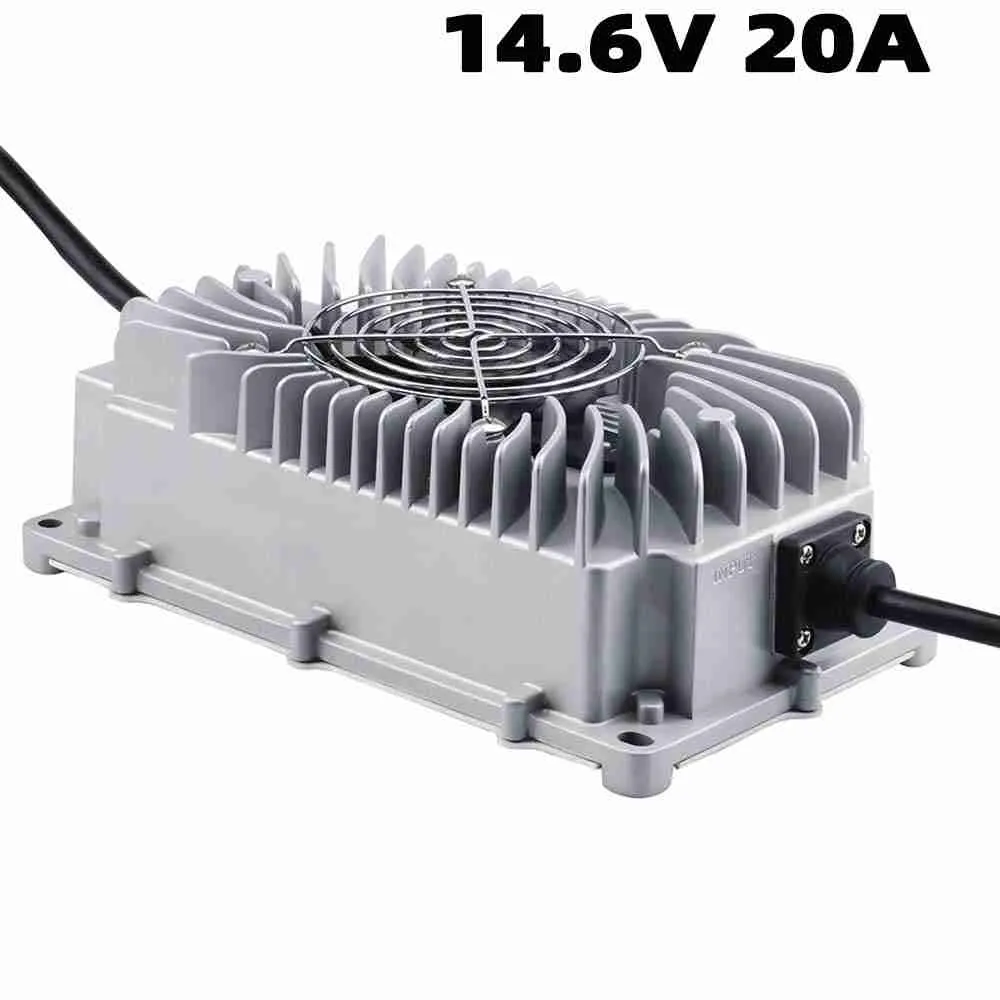
For heavy-duty applications where moisture, dust, and vibration are constant threats, the OHRIJA IP67 Waterproof model is an industrial powerhouse. Encased in a massive aluminum alloy shell (measuring 230 x 137 x 77mm and weighing 2.2kg), it acts as a giant passive heatsink. This design eliminates the need for mechanical cooling fans, which are usually the first point of failure in marine environments.
Operating at a maximum working power of 290W, it maintains a strict 14.6V ±0.2V output and a solid 20A ±0.2A current. It is fully customizable at purchase with output connectors including XT60, XT90, Crocodile Clip, Anderson 50A, Wire Nose, or 45A connectors, ensuring it mates perfectly with your battery port.
Why We Recommend It: Fanless, waterproof aluminum construction guarantees longevity. It is the ultimate plug-and-play solution for boaters and off-roaders.
View Full Specifications of the OHRIJA IP67 Charger here.
2. OHRIJA 14.6V 20A OLED Smart Charger
Best for Technicians, Bench Testing, and Data Enthusiasts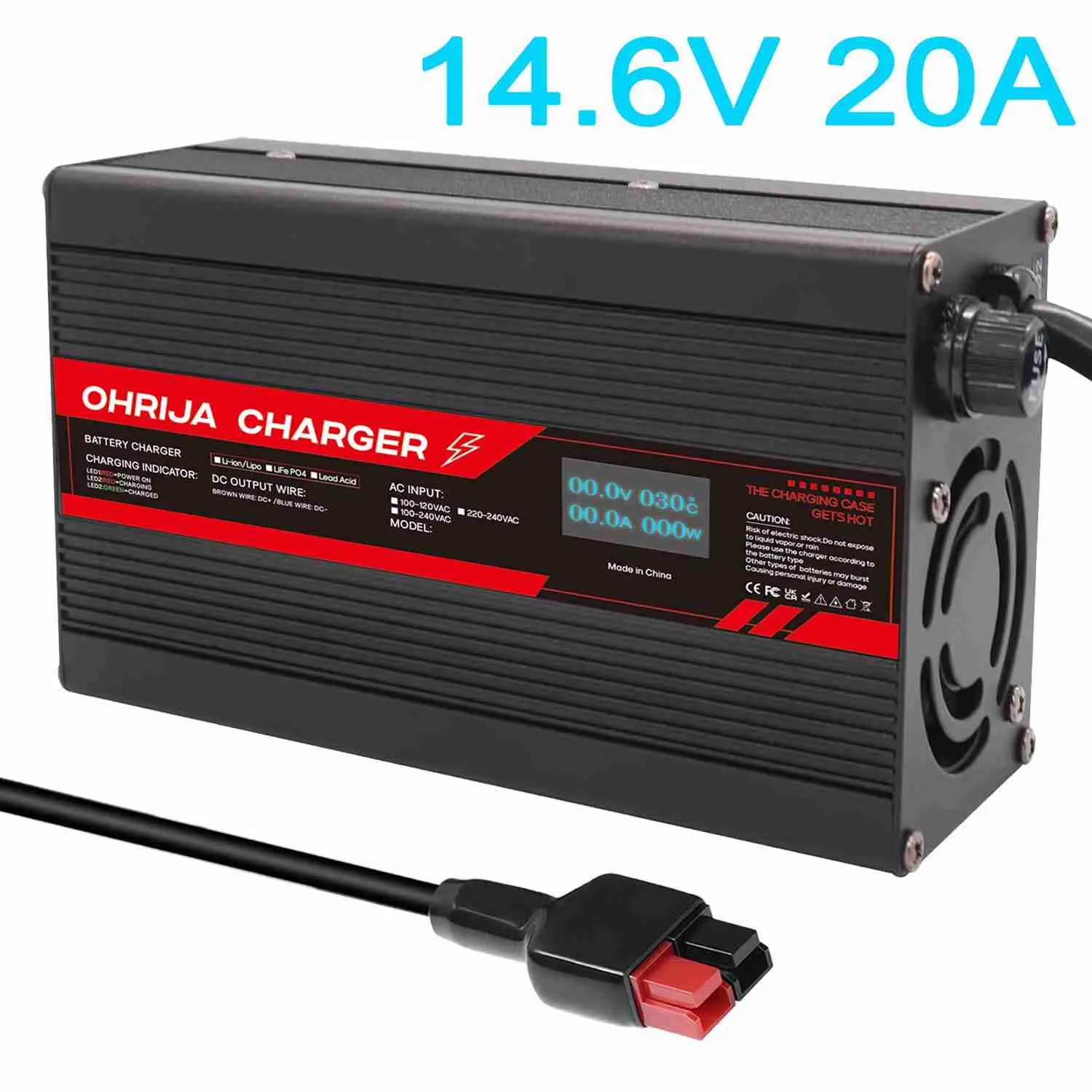
If you need absolute visibility into your charging cycle, the OHRIJA OLED model is unmatched. Housed in a highly compact aluminum alloy shell (170 x 90 x 50mm) and weighing just 1.1kg, this unit is significantly more portable than the IP67 version.
The standout feature is the crisp OLED display, which provides real-time readouts of voltage, current, and charging stage. With a robust maximum working power of 490W, this charger ensures fast, uninterrupted power delivery. Like the waterproof model, it is compatible with 4S 12.8V LiFePO4 batteries and offers a wide array of output connectors (XT60, XT90, Anderson 50A, etc.).
Why We Recommend It: In our testing, being able to visually confirm the transition from the CC stage to the CV stage via the OLED screen provides ultimate peace of mind. It allows users to verify that their BMS is actually allowing the 14.6V charge to enter the cells.
View Full Specifications of the OHRIJA OLED Charger here.
3. Pro-Series Bluetooth Connected 20A Smart Charger
Best for Smart Home Integrations
While standard chargers simply push current, premium smart chargers from industry staple brands now include Bluetooth connectivity. These units allow users to monitor the charge cycle via a smartphone app. They are generally reliable and offer programmable voltage thresholds. However, they rely heavily on software, and if the app glitches or loses support, you lose the primary selling feature.
We recommend these for tech-savvy RV owners who want to integrate battery monitoring into their wider smart-vehicle ecosystem. However, the plastic housings on many of these units can lead to thermal throttling on hot days.
4. Ruggedized 20A Maintenance Charger
Best for Deep Discharge Recovery
Several commercial brands offer heavy-duty 20A chargers equipped with a “force mode” or low-voltage recovery feature. If a LiFePO4 battery’s BMS trips due to low voltage (often dropping the terminal voltage to 0V), standard chargers will not recognize the battery and refuse to charge. These ruggedized units can push a small wake-up current to reset the BMS.
They are excellent tools, but they often come with an exorbitant price tag and are overly bulky for simple daily charging needs.
5. High-Frequency Compact Desktop 20A Charger
Best for Budget-Conscious Indoor Use
For indoor hobbyists, high-frequency desktop chargers provide a decent 20A output at a lower price point. These units use high-speed internal cooling fans to compensate for their smaller heat sinks and plastic outer shells.
While effective in climate-controlled environments, they are susceptible to dust intrusion. If you frequently wonder why does my charger get hot, it is almost always due to undersized heat sinks relying entirely on mechanical fans that eventually clog with debris.
6. Marine Grade Dual-Output 20A Charger
Best for Multi-Battery Boat Systems
For boaters running two independent 12V LiFePO4 batteries (such as a house battery and a dedicated trolling motor battery), a dual-bank 20A charger splits the load, delivering 10A to each bank or dedicating the full 20A to whichever bank needs it most.
These are incredibly convenient for marine setups but introduce more points of failure in the internal switching relays. For maximum reliability, we often prefer running two independent single-bank waterproof chargers like the OHRIJA IP67.
Comprehensive Comparison Table
| Charger Model | Housing Material | Cooling Method | Max Working Power | Best Feature | Ideal Use Case |
|---|---|---|---|---|---|
| OHRIJA 14.6V 20A IP67 | Aluminum Alloy | Passive / Fanless | 290W | IP67 Waterproofing | Harsh Marine & Outdoor |
| OHRIJA 14.6V 20A OLED | Aluminum Alloy | Active Fan | 490W | Real-Time OLED Data | Bench Testing & Diagnostics |
| Pro-Series Smart 20A | ABS Plastic | Passive | 300W | Bluetooth App | Smart RV Integration |
| Ruggedized Maintenance | Heavy Plastic/Rubber | Active Fan | 320W | 0V BMS Wake-up | Deep Discharge Recovery |
| High-Frequency Desktop | Standard Plastic | High-Speed Fan | 280W | Low Cost | Indoor Hobbyist Use |
| Dual-Output Marine | Aluminum Alloy | Passive | 400W | Dual Bank Support | Multi-Battery Boats |
Professional Buying Considerations
For beginners, picking a charger off a retail shelf might seem simple, but professionals know that the specifications sheet dictates the lifespan of the battery. Here is our proprietary buying guide to evaluating 14.6V 20A LiFePO4 battery chargers.
| Consideration Factor | Professional Standard Requirement | Why It Matters |
|---|---|---|
| Voltage Accuracy | Must hit exactly 14.6V ±0.2V | If a charger stops at 14.2V or 14.4V, the BMS will never balance the cells, leading to severe capacity loss over time. |
| Housing Material | Extruded Aluminum Alloy | Plastic retains heat. Aluminum dissipates it rapidly, preventing the internal components from thermal throttling and dropping output current. |
| Connector Quality | Anderson 50A, XT60, XT90 | 20 Amps is a massive amount of current. Cheap alligator clips will heat up and melt. High-grade bonded connectors are non-negotiable. |
| Environmental Rating | IP67 for Outdoor / None for Indoor | Moisture and salt air will destroy a circuit board in weeks. Match the IP rating to your actual usage environment. |
Common Mistakes to Avoid
Expert Observation: Over 70% of the premature LiFePO4 battery failures we diagnose at OHRIJA are directly tied to the end-user utilizing the wrong charging equipment or inappropriate wire gauges.
1. Using Lead-Acid (SLA/AGM) Chargers: This is the most catastrophic mistake. Lead-acid chargers feature a desulfation cycle that spikes voltage up to 15.5V or higher. This will trigger a high-voltage disconnect in your lithium BMS, shutting the battery down abruptly. Over time, it damages the internal logic board.
2. Ignoring Wire Gauge: Pushing 20 Amps through thin wires causes massive voltage drop. If your charger outputs 14.6V, but thin wires cause a 0.5V drop, the battery only sees 14.1V and will never fully balance. Always use thick, pure copper cabling.
3. Charging in Freezing Temperatures: Standard lithium iron phosphate cannot be charged below 32 degrees Fahrenheit (0 degrees Celsius). Unless your battery has built-in internal heating pads, applying a 20A charge in freezing conditions will cause irreversible lithium plating on the anode. If your equipment starts failing due to cold-weather charging abuse, you will need to learn how to troubleshoot a 12V battery charger and the connected BMS.
Final Expert Recommendation
Whether you are building a custom solar generator, outfitting a bass boat, or ensuring your emergency backup power is ready, you cannot compromise on charging infrastructure. The 14.6V 20A LiFePO4 battery chargers represent the ideal balance of speed and cell safety for standard 100Ah to 200Ah systems.
In our professional opinion, you should prioritize build quality and thermal management above all else. This is why we heavily recommend the OHRIJA 14.6V 20A IP67 Waterproof Charger. The aluminum alloy shell ensures it never throttles down due to heat, and the IP67 rating ensures years of flawless operation in harsh environments. For those requiring detailed diagnostics, the OHRIJA 14.6V 20A OLED Charger provides the transparency required to verify system health.
Frequently Asked Questions (FAQ)
How long will a 14.6V 20A charger take to charge a 100Ah LiFePO4 battery?
Assuming a completely depleted 100Ah battery (0% state of charge), a true 20-amp charger will take approximately 5 to 5.5 hours to bring it to a 100% state of charge. This factors in the rapid Constant Current phase and the slower Constant Voltage tapering phase. Can I leave my 14.6V 20A LiFePO4 charger connected continuously?
Yes, provided it is a high-quality smart charger. Once the 14.6V 20A LiFePO4 battery chargers complete their cycle, they completely cut off current output. Unlike lead-acid chargers, they do not apply a continuous trickle charge, which would damage lithium cells. Can I use this charger for an electric bike?
No, unless the eBike specifically uses a 12V system (which is rare). Most eBikes operate at 36V, 48V, or 52V. You would need a completely different voltage profile. You can learn more in our guide on how to charge eBike battery safely.
Authoritative References
To support the technical standards and electrochemistry principles discussed in this guide, we reference the following authoritative sources:
- Battery University (Cadex Electronics): Detailed analysis of the Constant Current and Constant Voltage (CC/CV) charging stages required for lithium-ion chemistries.
- IEEE Xplore Digital Library: Engineering standards and academic research regarding Battery Management System (BMS) balancing techniques for LiFePO4 arrays.
- U.S. Department of Energy: Safety guidelines and operational limits for commercial and residential lithium battery storage systems.