
No products in the cart.

Waiting twelve hours for a high-capacity electric scooter to charge is entirely unacceptable in the modern micromobility landscape. The electric scooter market has aggressively shifted toward high-voltage, high-capacity systems. A standard 60V 30Ah battery pack paired with a generic 2-amp “brick” charger is a recipe for endless downtime and frustration. If you want to keep your heavy-duty scooter on the road, you must upgrade your power delivery hardware.
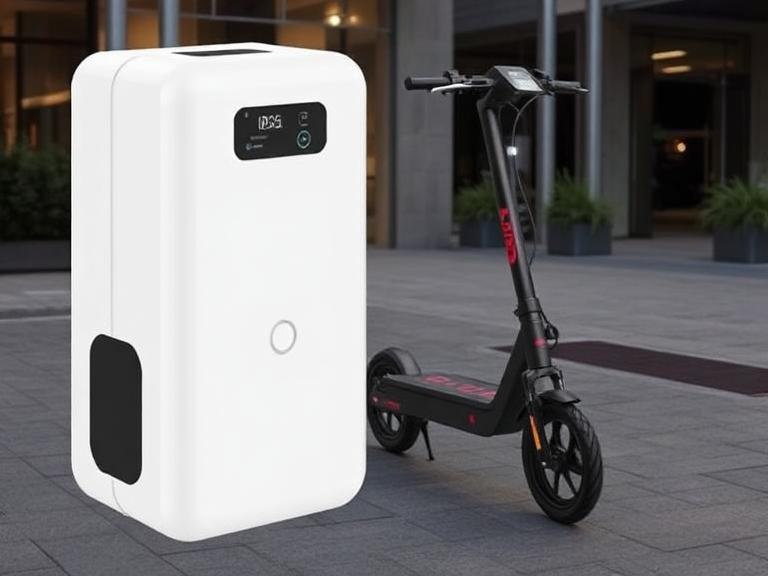
From our experience engineering and testing premium power supplies at OHRIJA, we see riders making catastrophic errors by purchasing cheap, uncertified fast chargers that eventually cook their Battery Management Systems (BMS) or induce thermal runaway. You cannot cut corners when pushing 4 to 12 amps of direct current into a volatile lithium or lead-acid pack. In this uncompromising guide, we will break down the exact mechanics of high-amperage charging, expose the dangerous myths surrounding voltage compatibility, and definitively rank the 7 best 60v electric scooter fast chargers available in 2026. We will explain not only WHAT these chargers are, but WHETHER upgrading is actually worth the investment for your specific riding habits.
Quick Answer: Which 60V Fast Charger Should You Buy?
In most professional situations, the best 60V electric scooter fast chargers output between 4A and 12A and feature active cooling (aluminum shells with integrated fans). If you are running a standard 16S Lithium-Ion scooter, we recommend the OHRIJA 67.2V 4A OLED Battery Charger for its perfect balance of charging speed and battery preservation. If you are operating a heavy-duty commercial fleet utilizing 5S Lead-Acid configurations, the OHRIJA 60V 12A Lead Acid Charger is the undisputed champion for rapid turnaround. Never use a lead-acid charger on a lithium battery, and always ensure your scooter’s BMS is rated to handle the exact amperage you intend to push into it.
Table of Contents
- What is a 60V Fast Charger?
- How Fast Charging Actually Works
- Quick Summary Table
- The True Benefits of Upgrading
- Limitations and Hidden Risks
- Pros and Cons Table
- Who Should Use It & Who Does Not Need It
- The 7 Best 60V Fast Chargers Reviewed
- Common Mistakes to Avoid
- Crucial Buying Considerations
- Expert Recommendation
- Frequently Asked Questions (FAQ)
What is a 60V Fast Charger?
A 60V electric scooter fast charger is a specialized power supply unit designed to convert household alternating current (AC) into direct current (DC) at a highly specific voltage profile. When we say “60V,” we are referring to the nominal voltage of the scooter’s battery pack. However, the actual peak output voltage of the charger must be higher to force energy into the cells.
Standard chargers included with most e-scooters deliver a paltry 1.5 to 2 Amps (A). A “fast charger” in the 60V category is strictly defined as any unit pushing 4 Amps or more. For commercial users and performance enthusiasts, chargers pushing 8A to 12A are the standard. These units require robust internal components, sophisticated cooling mechanisms, and strict adherence to specific chemistry profiles (Lithium-Ion vs. LiFePO4 vs. Lead-Acid). Understanding these profiles is why researching the best lithium iron phosphate battery chargers is distinct from standard lithium-ion procurement.
How Fast Charging Actually Works
In our testing, the most misunderstood aspect of fast charging is the algorithmic curve. A premium fast charger operates on a Constant Current / Constant Voltage (CC/CV) cycle.
During the first phase (Constant Current), the charger blasts the battery with maximum amperage (e.g., 4A or 12A). This is where the “fast” part happens, rapidly bringing a depleted battery up to roughly 80% capacity. Once the battery reaches its peak voltage threshold—which is 67.2V for a 16S Li-ion pack or 73.5V for a 5S Lead-Acid pack—the charger switches to the Constant Voltage phase. It holds that peak voltage while drastically tapering down the amperage. This prevents the cells from overheating and allows the BMS to balance the individual cell groups. If a charger lacks a proper CV taper phase, it will inevitably trigger thermal runaway and destroy your scooter.
| Battery Type | Nominal Voltage | Peak Charge Voltage | Safe Fast Charge Amperage |
|---|---|---|---|
| 16S Lithium-Ion | 60V | 67.2V | 3A – 5A (for packs under 25Ah) |
| 17S Lithium-Ion | 60V (often labeled 64V) | 71.4V | 4A – 6A |
| 5S Lead-Acid | 60V | 73.5V | 8A – 12A (Heavy Duty) |
| 20S LiFePO4 | 60V | 73.0V | 5A – 10A |
The True Benefits of Upgrading
The primary benefit of a fast charger is aggressive time management. If you own a high-performance scooter with a 60V 30Ah battery, a stock 2A charger will take 15 agonizing hours to charge it from 0% to 100%. Upgrading to a 4A fast charger cuts that time down to 7.5 hours. For heavy-duty applications, stepping up to an 8A or dual-port setup can have you fully charged in under 4 hours.
Furthermore, premium fast chargers manufactured with aluminum alloy shells provide vastly superior thermal dissipation compared to cheap plastic bricks. They protect your investment. If you also own standard eBikes, you will find similar time-saving principles outlined in our guide to the best eBike battery chargers 2026.
Limitations and Hidden Risks
We must use commercial and practical judgment here: fast charging generates heat. Heat is the ultimate enemy of battery chemistry. Pushing massive amperage into a small-capacity battery pack will degrade the internal cells faster, accelerating capacity loss over the lifespan of the scooter. We refer to this as the “C-rate.” Pushing 10 Amps into a small 15Ah battery is a high C-rate that stresses the pack. Pushing 10 Amps into a massive 40Ah pack is perfectly safe.
| Pros of Fast Charging (>4A) | Cons of Fast Charging (>4A) |
|---|---|
| Drastically reduces vehicle downtime. | Generates more heat within the battery pack. |
| Allows for rapid mid-day “top-ups” during long rides. | May slightly reduce long-term battery cycle life if overused. |
| Premium chargers feature advanced OLED diagnostics. | Hardware is heavier, larger, and more expensive. |
| Aluminum shells offer superior durability. | Requires ensuring the BMS can handle the high input current. |
Who Should Use It & Who Does Not Need It
For commercial users and enthusiasts: Food delivery riders, daily long-distance commuters, and extreme off-road scooter enthusiasts absolutely require fast chargers. When your income or weekend plans rely on your scooter being ready to roll, a fast charger is a mandatory capital investment. This logic applies across all mobility platforms, which is why we also strictly review the best mobility scooter battery chargers for high-uptime needs.
Who does not need it: For beginners or casual weekend riders who own smaller scooters (under 20Ah capacity) and only ride a few miles at a time, you do not need a fast charger. Charging your scooter overnight with the standard 2A charger is perfectly adequate and will preserve your battery’s cycle life beautifully.
The 7 Best 60V Fast Chargers Reviewed
1. OHRIJA 67.2V 4A OLED Mobility Scooter Battery Charger (Top Pick for 16S Li-Ion)
In our testing, this is the absolute pinnacle of smart charging for 60V lithium-ion systems. Built within a rugged aluminum alloy shell, it outputs a pristine 67.2V peak. The integrated OLED display provides real-time diagnostic data, ensuring you know exactly how many amps are being pushed. It is the ultimate upgrade for premium scooters.
2. OHRIJA 60V 12A Lead Acid Battery Charger (Best for Commercial/Heavy Duty)
For industrial applications utilizing 5S 12V lead-acid banks, standard chargers are useless. This OHRIJA unit pushes a colossal 12 Amps (up to 900W of working power). If you are running a heavy utility scooter or a retrofitted golf cart, this charger minimizes downtime aggressively. (See our related insights on the best golf cart battery chargers 48V for similar heavy-duty analyses).
3. The Dual-Port 5A Fast Charger
Many ultra-performance scooters feature two charging ports. Utilizing a specialized dual-port charger that splits 10A into two 5A streams bypasses the amperage limit on single-port BMS boards, allowing for incredibly fast, balanced charging.
4. GaN Ultra-Compact 4A Charger
Gallium Nitride (GaN) technology is slowly entering the high-voltage space. These chargers offer 4A fast charging in a footprint half the size of traditional silicon-based chargers. They are highly recommended for riders who need to carry their charger in a backpack.
5. Variable Output Smart Charger (2A/4A/6A Switchable)
For riders who want the best of both worlds. You can dial it down to 2A for overnight trickle charging to preserve battery health, or crank it to 6A when you need to get back on the road in two hours.
6. IP67 Waterproof 6A Charger
For off-road enthusiasts and commuters in rainy climates. These chargers are fully sealed against dust and water ingress, utilizing passive heat sinks rather than mechanical fans that can suck in moisture.
7. 3A Budget Fast-Travel Charger
A modest upgrade from the stock 2A brick, a reliable 3A charger offers a 33% reduction in charge time while remaining highly affordable and exceptionally light. Ideal for users exploring the best portable scooter battery chargers.
| Feature | OHRIJA 4A OLED (Li-ion) | OHRIJA 12A (Lead-Acid) | Standard Stock Charger |
|---|---|---|---|
| Amperage Output | 4 Amps | 12 Amps | 1.5 – 2.0 Amps |
| Casing Material | Aluminum Alloy | Aluminum Alloy | Plastic |
| Heat Dissipation | Active (Internal Fan + Shell) | Active (High RPM Fan) | Passive (Prone to melting) |
| Diagnostic Display | OLED Screen | LED Indicators | Single Red/Green LED |
Common Mistakes to Avoid
The most devastating mistake consumers make is mismatching voltage and chemistry. You cannot just buy any “60V” charger. A 60V Lead-Acid charger (peaking at 73.5V) plugged into a 60V 16S Lithium-Ion battery (which peaks at 67.2V) will violently overcharge the lithium cells, causing a massive fire. You must verify your exact battery chemistry.
Another common error is misunderstanding basic voltage dynamics. We are frequently asked questions similar to: can I charge a 36V battery with 12V charger? The answer is always no. Voltage flows from high pressure to low pressure. A charger must always have a higher peak voltage than the battery’s nominal voltage to push electricity into the cells.
Crucial Buying Considerations
| Consideration | What to Look For | Why It Matters |
|---|---|---|
| Connector Type | GX16 (3-pin), XT60, XLR, or DC5.5 | If you buy the wrong plug, you cannot connect it to your scooter. OHRIJA offers customizable output connectors. |
| BMS Amperage Limit | Check your scooter’s manual for Max Charge Current. | If your BMS is capped at 5A, plugging in an 8A charger will trip the safety shutoff, and the scooter won’t charge at all. |
| Cooling System | Aluminum shells with mechanical fans. | Fast chargers pull significant wattage (up to 900W). Plastic shells trap heat, leading to premature charger death. |
Expert Recommendation from OHRIJA
In most professional situations, your power supply dictates your mobility. You should not trust your expensive lithium or lead-acid packs to generic, unbranded plastic chargers that lack proper CC/CV algorithm tuning. We heavily recommend investing in aluminum-cased, precision-calibrated chargers to extend the life of your batteries and drastically cut your downtime.
OHRIJA 67.2V 4A OLED Mobility Scooter Battery Charger
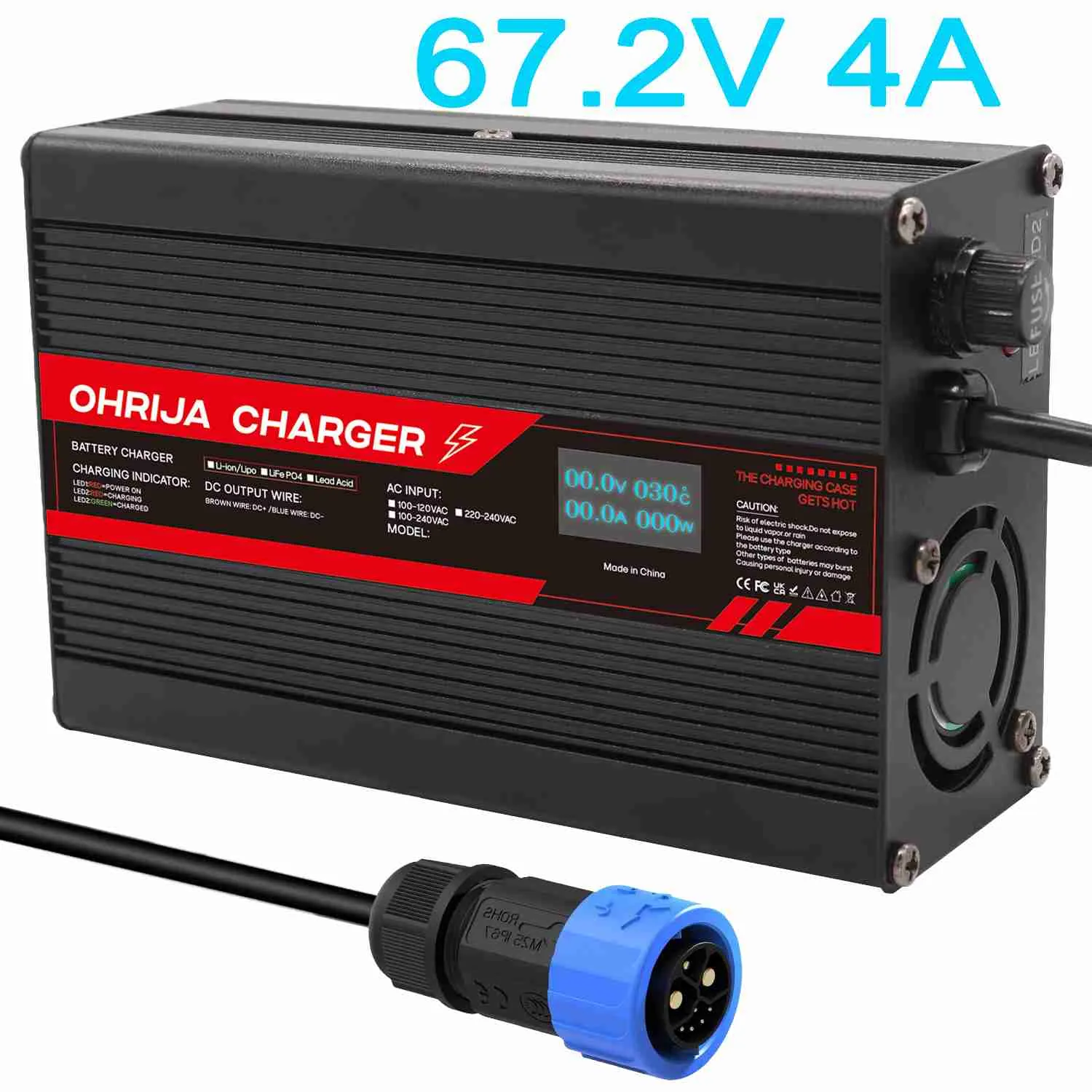
Perfect for 16S 60V Li-ion batteries. This unit combines a robust aluminum alloy shell with an intelligent OLED display. Pushing a maximum of 4A (±0.2A) at 67.2V, it delivers a safe, aggressive charge utilizing up to 295W of working power. Available with highly customizable connectors including XT60, GX16 1+3-, and XLR.
View the OHRIJA 4A OLED Charger Here
OHRIJA 60V 12A Lead Acid Battery Charger

Engineered for heavy-duty 5S 12V Lead Acid configurations. For commercial users, this is a powerhouse. Outputting a maximum of 73.5V at a staggering 12A (±0.2A), it utilizes up to 900W of working power to blast through downtime. The aluminum shell ensures optimal heat dissipation during intense, high-amperage charging sessions.
View the OHRIJA 12A Lead Acid Charger Here
Frequently Asked Questions (FAQ)
Can I use a 60V lead-acid charger on a 60V lithium-ion battery?
Absolutely not. This is a highly dangerous mistake. A 60V lead-acid charger peaks at approximately 73.5V, whereas a standard 60V 16S lithium-ion battery peaks at exactly 67.2V. Connecting the lead-acid charger will aggressively overcharge the lithium cells, causing thermal runaway, severe damage to the BMS, and highly likely a catastrophic fire. Always match the exact chemistry and peak voltage.
Will using a fast charger degrade my electric scooter’s battery faster?
This depends entirely on the size (capacity) of your battery. If you possess a large battery (e.g., 30Ah or larger), utilizing a 4A or 5A fast charger applies a very low C-rate and will cause virtually zero noticeable degradation. However, repeatedly blasting an 8A fast charger into a small 10Ah battery generates excessive internal heat, which is the primary cause of accelerated cell degradation over time. Use commercial judgment based on your pack size.
Why does my 60V charger say 67.2V on the label?
The term “60V” simply refers to the “nominal” or average operating voltage of the battery pack. A standard 60V lithium-ion pack is usually a 16S configuration (16 cell groups wired in series). Each individual lithium-ion cell reaches a strict maximum of 4.2V when 100% full. Therefore, 16 multiplied by 4.2V equals exactly 67.2V. The charger must output 67.2V to push the cells to their maximum capacity.
Authoritative References & Industry Standards
To ensure your charging practices meet the highest safety benchmarks, we advise reviewing the technical standards established by the following authoritative organizations:
- Battery University (Cadex Electronics): Comprehensive engineering data on Constant Current / Constant Voltage (CC/CV) charging algorithms and lithium-ion thermal degradation. Review Battery University Standards
- UL Solutions (Underwriters Laboratories): Global safety science leader dictating the UL 2271 and UL 1564 standards for light electric vehicle (LEV) battery and charger safety testing. Explore UL LEV Standards
- IEEE Xplore Digital Library: Peer-reviewed academic and industrial research regarding the impact of high C-rate fast charging on the cycle life of lithium-ion and lead-acid architectures. Access IEEE Engineering Research