

Replacing the power supply for a low-speed vehicle is a decision that directly impacts the lifespan of your most expensive component: the battery bank. Every day, consumers and fleet managers walk into a profound commercial error by purchasing power equipment based solely on voltage, entirely ignoring the critical role of amperage. If you force too much current into a battery bank, you risk thermal runaway and warped lead plates. If you deliver too little current, you induce chronic undercharging, which leads to irreversible sulfation. From our experience at OHRIJA, engineering precise charging solutions requires understanding the mathematical relationship between your battery’s capacity and the charger’s output.
In most professional situations, answering the question of what charger do I need for a 48 volt golf cart requires a basic audit of your vehicle’s specific energy storage. Whether you are driving a Club Car, an EZGO, or a Yamaha, the electrical principles remain absolute. You must apply commercial and practical judgment to select an amperage rating that balances charge speed with battery health. In this comprehensive guide, we will break down exactly how to calculate your required amperage, the mechanical differences between trickle and rapid chargers, and how to protect your investment for years to come.
Quick Answer: The 10% to 15% Rule
If you are wondering exactly what amp charger do I need for a 48 volt golf cart, the industry standard rule is to select a charger that outputs 10% to 15% of your total battery pack’s Amp-Hour (Ah) capacity.
- For large standard fleets (150Ah – 170Ah battery packs): A 15-Amp to 20-Amp charger is the standard requirement to complete a full charge in 8 to 10 hours overnight.
- For smaller packs, off-season maintenance, or trickle charging: A 5-Amp to 10-Amp charger is vastly superior. It delivers a slow, low-heat charge that maximizes the structural lifespan of the lead plates.
We recommend verifying your battery’s exact Ah rating before purchasing. Do not buy a high-amperage charger for a low-capacity pack, as the excessive heat generation will permanently damage the cells.
Table of Contents
- What It Is: Understanding Amperage and Voltage
- How It Works: The Charging Cycle
- Benefits of Selecting the Correct Amperage
- Limitations of Mismatched Chargers
- Who Should Use High vs. Low Amperage
- Who Does Not Need a Heavy-Duty Charger
- Common Mistakes in Charger Selection
- Commercial Buying Considerations
- Amperage Comparison Table
- Pros and Cons of Slow vs. Fast Charging
- Expert Recommendation & Product Spotlight
- Frequently Asked Questions
What It Is: Understanding Amperage and Voltage
Before you make a buying decision, you must define the metrics. Voltage (V) is the electrical pressure pushing power into your batteries. A 48V golf cart requires a charger that strictly outputs a peak voltage suitable for a 48V system (typically around 55.2V to 58.8V to overcome internal battery resistance). Amperage (A), on the other hand, is the volume or flow rate of that electricity. If voltage is the water pressure in a hose, amperage is the diameter of the hose delivering the water.
When you ask what amp charger do I need for a 48 volt golf cart, you are determining how fast you want to fill the “bucket” (your battery bank). However, batteries are chemical storage devices, not empty buckets. Pushing too much current (high amps) causes friction, which manifests as heat. Excessive heat boils the electrolyte solution in lead-acid batteries, degrading them rapidly. This is why understanding your exact capacity is non-negotiable.
How It Works: The Three-Phase Charging Cycle
Modern smart chargers do not push a flat rate of electricity. In our testing, high-quality units employ a strict three-phase charging algorithm to protect the battery chemistry:
- Bulk Phase: This is where the amperage rating of your charger matters most. The charger pushes its maximum rated amps (e.g., 5A, 15A, or 20A) into the battery to quickly restore it to roughly 80% capacity.
- Absorption Phase: The charger holds the voltage steady (around 58.8V for a 48V system) but gradually drops the amperage as the battery reaches full capacity, preventing over-pressurization of the cells.
- Float Phase: The charger drops both voltage and amperage to a minimal trickle (often under 1A) simply to counteract natural self-discharge, maintaining the battery at 100% without overcooking it.
If you purchase a 5A charger for a massive 200Ah battery bank, the bulk phase will take an incredibly long time (over 24 hours from zero). Conversely, if you use a 30A charger on a small 50Ah pack, the bulk phase will force too much current, bypassing the absorption safety buffer and violently heating the cells.
Benefits of Selecting the Correct Amperage
The primary benefit of calculating the exact charger do I need for a 48 volt golf cart is capital preservation. A set of six 8-volt lead-acid batteries costs upwards of $1,000 to $1,500. By matching the charger’s amperage to the 10-15% capacity rule, you eliminate thermal degradation. This extends the functional life of your battery pack by years.
Furthermore, selecting the right smart charger ensures energy efficiency. Older, heavy transformer-based chargers run hot and waste electricity. Modern switch-mode power supplies, similar to the architecture we use in our 12V 50A power supply 600W units, convert AC to DC with over 90% efficiency, lowering your utility bills.
Limitations of Mismatched Chargers
The limitations of a mismatched charger are severe. A charger with an amperage rating that is too low for the application will result in chronic undercharging. Lead-acid batteries that sit in a partially discharged state suffer from sulfation—where lead sulfate crystals harden on the battery plates, permanently reducing capacity.
On the other end of the spectrum, an excessively high-amp charger forces you to constantly check and refill the distilled water levels in flooded lead-acid batteries because the high heat boils the water away. For commercial users managing a fleet, this drastically increases labor maintenance costs.
Who Should Use High Amperage vs. Low Amperage
For Heavy-Duty Applications (15A to 20A): Golf courses operating carts 36 holes a day, security patrols, and industrial warehouse personnel need rapid turnaround times. If you deplete a 150Ah pack daily and need it ready by the next morning, a 15A to 20A charger is required to complete the bulk phase in a standard 8-hour overnight window.
For Low-Duty Applications and Maintenance (5A to 10A): Retirees using their cart for weekly neighborhood cruising, or owners putting their cart into winter storage, do not need high-speed charging. In fact, a 5A charger is vastly superior for these users. It provides a slow, gentle charge that keeps the battery chemistry active without generating destructive heat. This is a principle we apply across our entire catalog, including our 54.6V 5A eBike battery charger lines.
Who Does Not Need a Heavy-Duty Charger
If your golf cart has been converted to a smaller capacity, high-efficiency lithium pack (e.g., a 48V 60Ah LiFePO4 module), you absolutely do not need a 20A lead-acid charger. In fact, using a lead-acid charger on a lithium pack can damage the Battery Management System (BMS). Lithium batteries require highly specific charging curves. For lithium-specific applications, we always point clients toward dedicated lithium architecture, similar to our 12V LiFePO4 battery charger 30A units, engineered explicitly for that chemistry.
Common Mistakes in Charger Selection
From our experience, the most catastrophic mistake consumers make is ignoring the On-Board Computer (OBC) on older Club Car models. Certain Club Cars manufactured between 1995 and 2014 route the charging current through an internal computer. If you buy a modern “smart” charger without bypassing the OBC, the two computers will conflict, and the battery will not charge. You must either bypass the OBC or buy a “dumb” charger compatible with it.
Another profound commercial error is selecting the wrong plug. A 48V charger is useless if it cannot physically connect to your cart. EZGO RXV carts use a specific triangular plug, while Club Cars often use a round 3-pin connector, and Yamaha uses a 2-pin or 3-pin specific format. Always verify the physical connector before executing a purchase.
Commercial Buying Considerations
When you are evaluating options to find out exactly what charger do I need for a 48 volt golf cart, prioritize build quality. Look for an aluminum alloy shell rather than cheap plastic. Aluminum acts as a massive heat sink, passively cooling the internal components and prolonging the charger’s life. This is a standard we enforce strictly at our adjustable power supply manufacturer facilities.
Additionally, check the peak output voltage. For a standard 48V lead-acid system, the charger must be capable of reaching roughly 55.2V to 58.8V to complete the absorption phase. If the peak voltage is too low, the battery will never reach 100% capacity.
Amperage Comparison Table (Based on 150Ah Battery Pack)
| Charger Amperage | Estimated Charge Time (0% to 100%) | Heat Generation | Best Use Case |
|---|---|---|---|
| 5 Amps | ~30 Hours | Very Low | Winter storage, trickle maintenance, very small battery packs. |
| 10 Amps | ~15-18 Hours | Low | Light weekend usage, overnight charging with low urgency. |
| 15 Amps | ~10-12 Hours | Moderate | Standard residential daily use. The ideal balance of speed and battery health. |
| 20 Amps | ~8-9 Hours | High | Commercial fleets, heavy daily use requiring rapid overnight turnaround. |
Pros and Cons of Slow Charging (5A) vs. Fast Charging (20A)
| Charging Strategy | Pros | Cons |
|---|---|---|
| Low Amperage (5A) | Generates minimal heat. Prolongs the life of lead plates. Prevents water loss in flooded batteries. Excellent for off-season maintenance. | Takes significantly longer to charge deeply depleted batteries. Not suitable for commercial turnaround times. |
| High Amperage (20A) | Rapidly restores a deeply discharged battery. Keeps commercial fleets operational. Perfect for 36-hole daily driving. | Higher heat stresses the battery chemistry. Accelerates electrolyte evaporation in flooded lead-acid batteries. |
Expert Recommendation & Product Spotlight
If you are managing a cart that sees intermittent use, or if you are looking for a highly reliable maintenance charger to keep your batteries healthy during the off-season, we strongly recommend a lower-amperage smart charger. Pounding a battery with 20 amps when it only needs a slight top-off is a recipe for premature failure. For these specific scenarios, the OHRIJA 48V 5A unit is structurally and electrically superior.
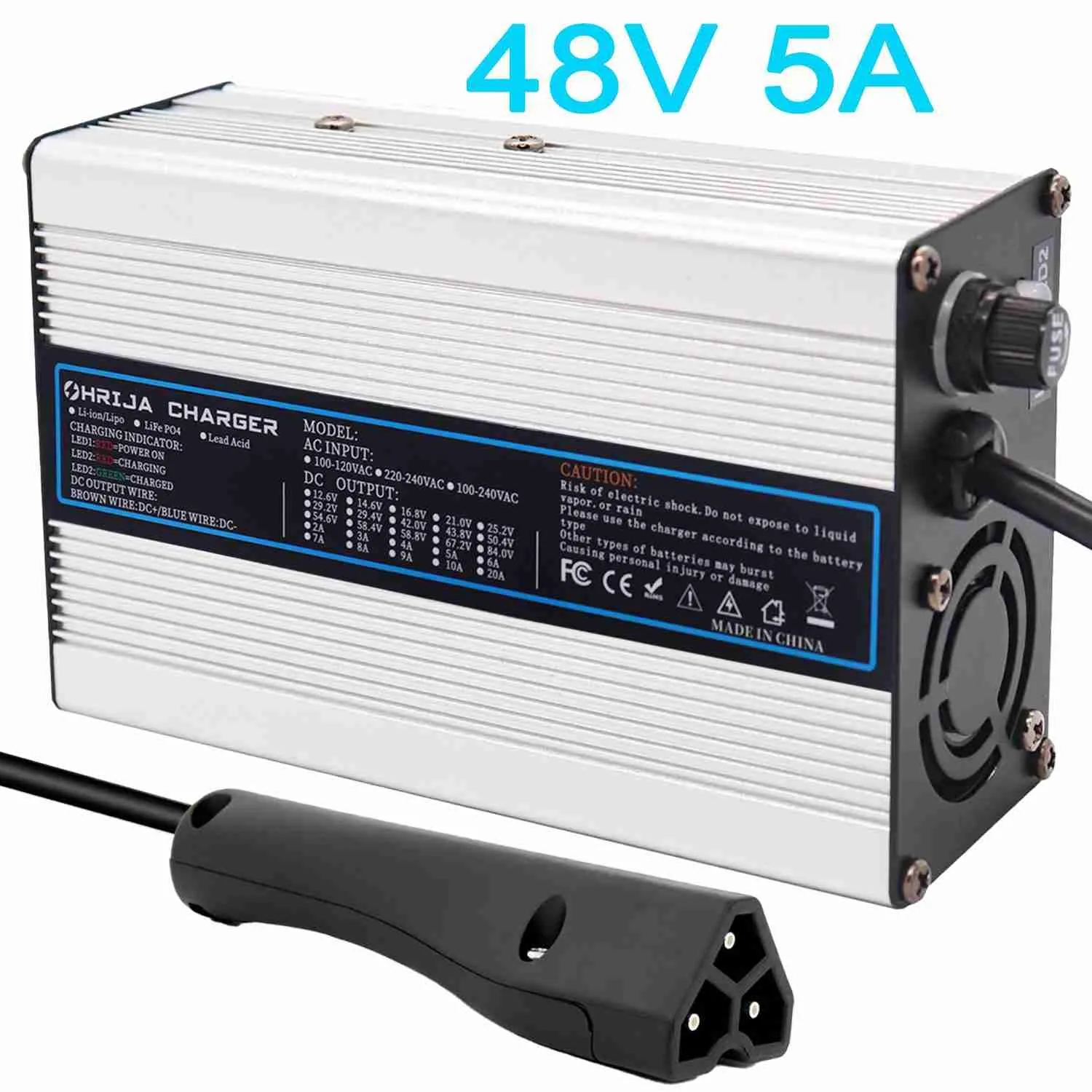
OHRIJA 48 Volt Charger for Golf Cart (48V 5A)
Engineered for maximum reliability and battery preservation, this 5-amp smart charger is the ideal solution for off-season maintenance, trickle charging, and smaller 48V capacity packs. Housed in a rugged aluminum alloy shell, it provides excellent passive cooling without the need for noisy fans.
- Output Specifications: Maximum 55.2/58.8V±0.2v at a steady 5Amp ±0.2a.
- Material: Premium aluminum alloy shell (0.9kg footprint).
- Compatibility: Specifically calibrated for 48V Lead Acid battery chemistries.
- Connector Options: Fully customizable for EZGO RXV, Crowfoot, CLUB CAR, YAMAHA G19/G29, and EZGO 48V TXT.
- Package Includes: Charger, DC 1m output cable, input cable, and manual.
View Specifications & Purchase
If you require insights into the broader scope of our manufacturing capabilities, or need specific connectors for alternative personal electric vehicles like a 67.2V scooter battery charger or an 84V electric scooter charger, we invite you to review the full Ohrija charger company profile.
Frequently Asked Questions
Can I use a 36 volt charger on a 48 volt golf cart?
Absolutely not. A 36V charger will never produce the required voltage (approx. 58.8V) needed to overcome the internal resistance of a 48V battery pack. The charger will fail to push any current into the batteries, leaving your cart completely dead. You must match the nominal voltage of the charger exactly to the nominal voltage of the battery bank.
What happens if I buy a charger with an amperage rating that is too high?
If the amperage significantly exceeds 15% of your battery pack’s total Amp-Hour capacity, the charger will push current faster than the battery chemistry can absorb it safely. This results in extreme internal heat, boiling of the electrolyte fluid, warped lead plates, and drastically reduced battery lifespan.
Why does my new smart charger not work on my Club Car?
Many older Club Car models utilize an On-Board Computer (OBC) to regulate the charge from older, “dumb” transformer chargers. Modern smart chargers have their own internal computers. When two computers try to regulate the same charge, they conflict, and the charger shuts down. You must perform an OBC bypass modification to use a modern smart charger on these specific vehicles. For more technical troubleshooting, consult our battery charger FAQs.
Is a 5 Amp charger enough for my golf cart?
A 5 Amp charger is excellent for battery health, but it charges slowly. If your battery pack is completely depleted (e.g., 150Ah capacity), a 5A charger will take over 30 hours to reach a full charge. It is best used for winter storage, maintaining the pack, or for users who only drive short distances and leave the cart plugged in for days at a time.
Industry References & Authoritative Guidelines
To ensure our charging specifications and safety guidelines adhere to the highest global standards, we reference data from the following authorities:
- Battery Council International (BCI): Setting the global standard for lead-acid battery manufacturing, testing, and proper charging protocols to prevent sulfation and thermal degradation. View BCI Standards
- U.S. Department of Energy (DOE): Providing comprehensive research on energy storage efficiency, electrical grid draw, and optimal battery maintenance strategies for electric vehicles. View DOE Electric Vehicle Research
- Institute of Electrical and Electronics Engineers (IEEE): Publishing rigorous academic and commercial standards regarding power supply engineering, switch-mode power conversion, and smart charger algorithms. View IEEE Technical Standards