
No products in the cart.

Choosing the correct charger for your golf cart is not a suggestion; it is a strict electrical necessity. Every year, we see thousands of dollars in battery damage caused by owners misunderstanding the core voltage requirements for golf cart chargers. A mismatched charger will either fail to engage entirely, chronically undercharge your pack resulting in sulfation, or catastrophically overcharge the cells, leading to thermal runaway or boiling acid.
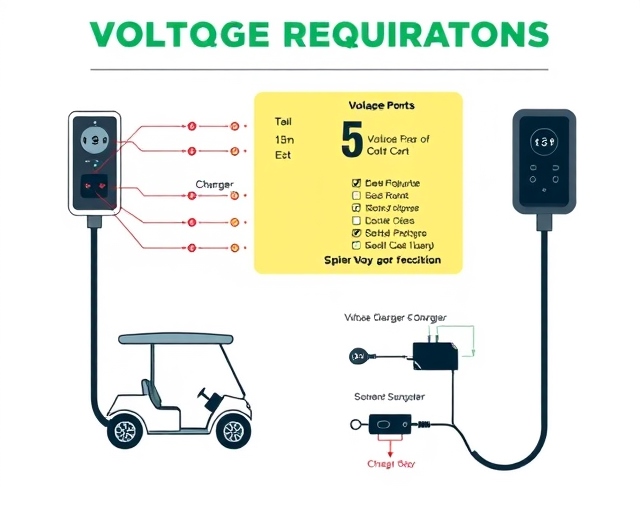
From our experience at OHRIJ manufacturing premium industrial chargers, relying on generic labels is a mistake. You must apply commercial and practical judgment when replacing your charging hardware. In most professional situations, determining your exact battery bank configuration—whether 36V, 48V, or 72V—is step one. Step two involves understanding that the nominal voltage of a battery pack is completely different from the actual peak output voltage a charger must deliver.
Quick Answer: What Are the Voltage Requirements for Golf Cart Chargers?
The voltage requirements for golf cart chargers demand a direct match between the charger’s nominal rating and the cart’s total battery pack voltage. However, the charger’s actual output voltage must be higher than the pack’s nominal voltage to push current into the cells.
- 36V Carts: Require a 36V nominal charger (actual peak charging output is around 41.4V to 45V).
- 48V Carts: Require a 48V nominal charger (actual peak charging output is around 55.2V to 58.8V).
- 72V Carts: Require a 72V nominal charger (actual peak charging output is around 82.8V to 88.2V).
You cannot use a 48V charger on a 36V cart, nor can you use a 36V charger on a 48V cart. Attempting to do so will severely damage your battery bank or trip the charger’s internal safety relays.
Table of Contents
- What It Is: Determining Your Cart’s Voltage
- How It Works: Nominal vs. Peak Output Voltage
- Quick Summary Table: Common Configurations
- The Benefits of Upgrading Your Charger
- Limitations of Older Charging Technology
- Who Should Use Smart Chargers
- Common Mistakes We See in the Field
- Comparison Table: 36V vs 48V vs 72V
- Pros and Cons of Higher Voltage Systems
- Crucial Buying Considerations
- Expert Recommendation & Product Spotlight
- Frequently Asked Questions
What It Is: Determining Your Cart’s Voltage
Before exploring the specific voltage requirements for golf cart chargers, you must accurately identify what is under the seat of your cart. For beginners, this process is incredibly simple. Do not guess based on the year or make of the cart, as previous owners frequently modify battery banks.
Lift the seat and count the number of water fill caps on a single battery. Each cap represents a 2-volt cell.
- If a battery has 3 caps, it is a 6-volt battery.
- If a battery has 4 caps, it is an 8-volt battery.
- If a battery has 6 caps, it is a 12-volt battery.
Next, count the total number of batteries and multiply by the voltage of a single battery. Six 8-volt batteries equal a 48V system. Six 6-volt batteries equal a 36V system. Four 12-volt batteries equal a 48V system. Your charger’s nominal voltage must match this total number exactly. If you are upgrading from lead-acid to lithium, ensure you browse the best golf cart battery chargers 48V to ensure chemistry compatibility alongside voltage matching.
How It Works: Nominal vs. Peak Output Voltage
A common point of confusion regarding the voltage requirements for golf cart chargers is the discrepancy between the label and a multimeter reading. If you measure the output of an active 48V charger, it will read well over 50 volts. This is intentional.
To charge a battery, the charger must exert a higher electrical pressure (voltage) than the battery’s current resting state. A fully depleted 48V lead-acid battery bank rests around 42V to 45V. A fully charged 48V bank actually rests around 50.9V to 51.2V. Therefore, a proper 48V charger must ramp its output voltage up to roughly 55.2V to 58.8V during the absorption phase to push the current (amperage) into the dense lead plates.
If the charger only output exactly 48.0V, it would never be able to fully charge the pack. This same principle applies to lithium chemistry, which is why we strictly categorize our LiFePO4 battery charger category separately from lead-acid; the peak voltage curves and cutoff algorithms are vastly different.
Quick Summary Table: Common Golf Cart Configurations
| Cart Type / Common Brand | Typical Battery Layout | Nominal Voltage Requirement | Peak Charger Output Voltage |
|---|---|---|---|
| Older EZGO TXT / Club Car DS | 6 x 6V Batteries | 36 Volts | ~41.4V – 45.0V |
| Modern Club Car Precedent / Yamaha Drive | 6 x 8V or 4 x 12V Batteries | 48 Volts | ~55.2V – 58.8V |
| Heavy-Duty Lifted Carts / Commercial | 6 x 12V Batteries | 72 Volts | ~82.8V – 88.2V |
The Benefits of Upgrading Your Charger
Using older, heavy transformer-style chargers (often affectionately called “boat anchors”) is outdated. Modernizing your charging setup offers massive benefits. Smart chargers utilize microprocessor controls to adjust the voltage dynamically based on battery temperature and resistance. This multi-stage charging process prevents the acid from boiling, significantly extending the lifespan of the battery pack.
For commercial users managing golf course fleets, upgrading to waterproof, high-frequency smart chargers reduces overall energy consumption and drastically lowers fleet maintenance costs. The precise voltage regulation ensures every cart is ready for a full 18 holes without mid-day voltage sagging.
Limitations of Older Charging Technology
The primary limitation of legacy chargers is their inability to read the battery’s exact state of charge accurately. They simply blast a high-voltage current on a timer. If you only drove the cart for ten minutes, the older charger will still run a full cycle, overcharging and drying out the lead plates. Furthermore, older chargers are highly sensitive to AC input fluctuations; a drop in your garage’s wall voltage will cause a proportional drop in the charger’s DC output voltage, resulting in a weak charge.
Who Should Use Smart Chargers (And Who Does Not Need Them)
Who Should Use It: We recommend that anyone with a 48V cart heavily invest in a modern, waterproof smart charger. If you use your cart daily, live in extreme climates, or rely on your cart for commercial utility, a smart charger that exactly meets the voltage requirements for golf cart chargers is mandatory to protect your $1,000+ battery investment.
Who Does Not Need It: If you are planning to sell your aging 36V cart next month and the original charger still functions adequately, upgrading to a high-end aftermarket charger will not significantly increase the resale value of the cart. Save the investment for your next 48V or 72V vehicle.
Common Mistakes We See in the Field
In our testing and daily interactions with customers, several critical errors occur repeatedly:
- Bypassing the OBC Incorrectly: Many Club Car models feature an On-Board Computer (OBC) that dictates the voltage flow from the charger. If you buy a modern smart charger (which has its own internal computer), you must bypass the cart’s OBC. Failing to do so causes the two computers to conflict, resulting in zero charge.
- Wrong Chemistry: The voltage requirements for golf cart chargers change drastically between Lead-Acid and Lithium. Using a lead-acid charger on a lithium pack will trigger the BMS (Battery Management System) to shut down due to incorrect voltage curves. Always select specialized chargers, such as the best lithium iron phosphate battery chargers for LiFePO4 setups.
- Ignoring Connector Types: You can have the perfect 48V charger, but if you order a Yamaha 2-pin plug for an EZGO RXV, it is useless. Always verify the physical plug type (e.g., Crowfoot, 3-pin Yamaha, RXV).
Comparison Table: 36V vs 48V vs 72V Systems
| System Voltage | Primary Use Case | Charger Amp Output (Typical) | Performance Characteristics |
|---|---|---|---|
| 36V | Flat terrain, light neighborhood cruising. | 15A – 21A | Slower speeds, struggles on steep hills. Lower overall efficiency. |
| 48V | Standard golf courses, varied terrain, lifted carts. | 15A – 20A | The industry standard. Excellent balance of torque, speed, and range. |
| 72V | Heavy-duty utility, high-speed street legal LSVs, steep inclines. | 12A – 15A | Maximum torque and efficiency. Minimal voltage drop under heavy load. |
Pros and Cons of 48V Systems vs 36V Systems
| 48V System & Charger Pros | 48V System & Charger Cons |
|---|---|
| Requires fewer amps to produce the same power, resulting in less heat generation. | Battery replacement costs are generally higher (six 8V vs six 6V). |
| Higher top speeds and significantly better hill-climbing torque. | Chargers require more precise voltage regulation to prevent overcharging. |
| Longer run times due to increased overall watt-hour capacity. | More susceptible to severe arcing if connections are loose or corroded. |
| The current industry standard, making parts and specialized chargers easy to source. | Requires an OBC bypass on older Club Car models when using aftermarket smart chargers. |
Crucial Buying Considerations
When purchasing a replacement, the voltage requirements for golf cart chargers dictate the baseline, but the amperage rating dictates the charging speed and thermal load. We recommend a 15A to 20A charger for a 48V system. If you select a charger with an amperage rating that is too low (e.g., 5A or 8A), the charger will have to run for 24 hours straight to replenish a deeply discharged bank, which can lead to thermal throttling.
For heavy-duty applications, such as hunting buggies, environmental protection is paramount. You need an IP-rated waterproof aluminum chassis that can handle dust, humidity, and direct water spray without short-circuiting. If you are also managing a fleet of smaller vehicles, keeping consistent, reliable charging infrastructure is key. Review our best mobility scooter battery chargers if you manage mixed-use facilities.
Expert Recommendation & Product Spotlight
In most professional situations, we demand that customers abandon cheap plastic chargers that lack thermal management. If you are running a 48V lead-acid system, your priority should be high-frequency conversion housed in a durable aluminum alloy shell. The OHRIJ 48V series perfectly matches the stringent voltage requirements for golf cart chargers while providing the exact multi-stage algorithms needed to preserve your battery pack.

OHRIJ Waterproof Club Car 48V Golf Cart Charger (15A/20A)
Engineered for maximum reliability, this aluminum alloy smart charger is calibrated precisely for 48V Lead Acid systems, delivering a safe peak of 55.2V to 58.8V to fully condition your battery plates without boiling.
- Output Voltage: Maximum 55.2/58.8V±0.2v (Perfect for 48V Lead Acid)
- Output Current: Maximum 15-20Amp ±0.2a (Fast, efficient charging)
- Material: Heavy-duty aluminum alloy shell (Waterproof)
- Compatibility: Available with EZGO RXV, Crowfoot, CLUB CAR, YAMAHA G19/G29, and EZGO 48V TXT connectors.
- Working Power: Maximum 900-1200W
View Charger & Select Connector
Frequently Asked Questions
Can I use a 48V charger on a 36V golf cart?
Absolutely not. The peak output of a 48V charger is over 55 volts. Pushing 55 volts into a 36-volt battery pack will cause the batteries to violently overcharge, boil the internal acid, warp the lead plates, and potentially cause a fire or explosion. The voltage requirements for golf cart chargers must be matched exactly to the cart.
Why does my 48V charger measure 58 volts with a multimeter?
This is normal and necessary. A charger must output a higher voltage than the battery’s resting voltage to push electrical current into the cells. For a 48V lead-acid system, the absorption charging phase requires the charger to reach between 55.2V and 58.8V to achieve a 100% state of charge.
Does a lithium golf cart battery require a different charger voltage?
Yes. While a 48V lithium pack and a 48V lead-acid pack share the same nominal voltage, their charging curves are completely different. A lead-acid charger will try to “trickle” or “float” charge at the end of the cycle, which can damage a lithium Battery Management System (BMS). You must buy a charger specifically rated for your exact lithium chemistry (like LiFePO4).
How many amps should a 48V golf cart charger be?
For most standard 48V golf cart battery banks, a 15-amp to 20-amp charger is ideal. This amperage provides a safe, overnight charge (typically 6 to 10 hours) without generating excessive heat that could damage the battery cells.
Industry References & Authoritative Sources
To ensure accuracy and adherence to safety protocols, the information regarding the voltage requirements for golf cart chargers in this guide aligns with standards set by the following organizations:
- Battery Council International (BCI): Establishes the technical standards, voltage profiles, and safety guidelines for lead-acid battery manufacturing and charging protocols. View BCI Standards
- Institute of Electrical and Electronics Engineers (IEEE): Provides comprehensive standards (IEEE 1184) for batteries and high-frequency charging systems used in electric vehicles and utility applications. View IEEE Standards
- U.S. Department of Energy (DOE): Research on advanced battery technologies, energy efficiency, and safe electric vehicle charging infrastructure. View DOE Electric Vehicle Research