
No products in the cart.

By OHRIJA — Advanced Power Solutions Expert
The transition from traditional lead-acid batteries to Lithium Iron Phosphate (LiFePO4 or LFP) technology has revolutionized the energy storage, recreational vehicle (RV), marine, and off-grid solar industries. LFP batteries offer unparalleled longevity, drastically reduced weight, and consistent voltage output. However, to maximize the lifespan and performance of these advanced power banks, utilizing the Best lfp battery charger is an absolute operational necessity. Attempting to charge a highly engineered lithium battery with an outdated lead-acid charger can lead to incomplete charging cycles, Battery Management System (BMS) lockouts, and severe degradation of the internal cells.
At OHRIJA, our engineering teams have dedicated years to perfecting the charging algorithms required to push LFP technology to its absolute limits safely. From our experience, finding the Best lfp battery charger requires a deep understanding of Constant Current / Constant Voltage (CC/CV) profiles, thermal management, and robust hardware design. In this authoritative guide, we will analyze the technical requirements of LFP charging, review the top seven models dominating the market in 2026, and provide an expert buying guide to help you protect your lithium investment.
Table of Contents
Understanding LFP Battery Technology and Charging Dynamics
Lithium Iron Phosphate (LFP) batteries possess a remarkably flat voltage curve. This means they deliver steady power until they are nearly depleted, unlike lead-acid batteries which experience a steady drop in voltage as they discharge. Because of this unique chemical characteristic, the Best lfp battery charger must employ a highly specific, two-stage charging algorithm: Constant Current (CC) followed by Constant Voltage (CV).
During the CC phase, the charger delivers its maximum rated amperage to rapidly replenish the battery’s capacity up to roughly 90%. Once the battery reaches its bulk absorption voltage typically 14.6V for a standard 4S 12.8V battery, the charger switches to the CV phase. In this phase, the voltage is held steady at 14.6V while the current slowly tapers down to near zero, perfectly balancing the internal cells without causing hazardous overcharging. We recommend avoiding any charger that utilizes a desulfation or float stage intended for lead-acid batteries, as continuous float voltage can severely damage LFP chemistry over time.
The 7 Best lfp battery charger Models for 2026
Based on rigorous internal testing, real-world application data, and overall component quality, we have compiled the definitive list of the premier chargers available today. Here are our top selections for the Best lfp battery charger in 2026.
1. OHRIJA 12V LiFePO4 Battery Charger 14.6V 20A OLED
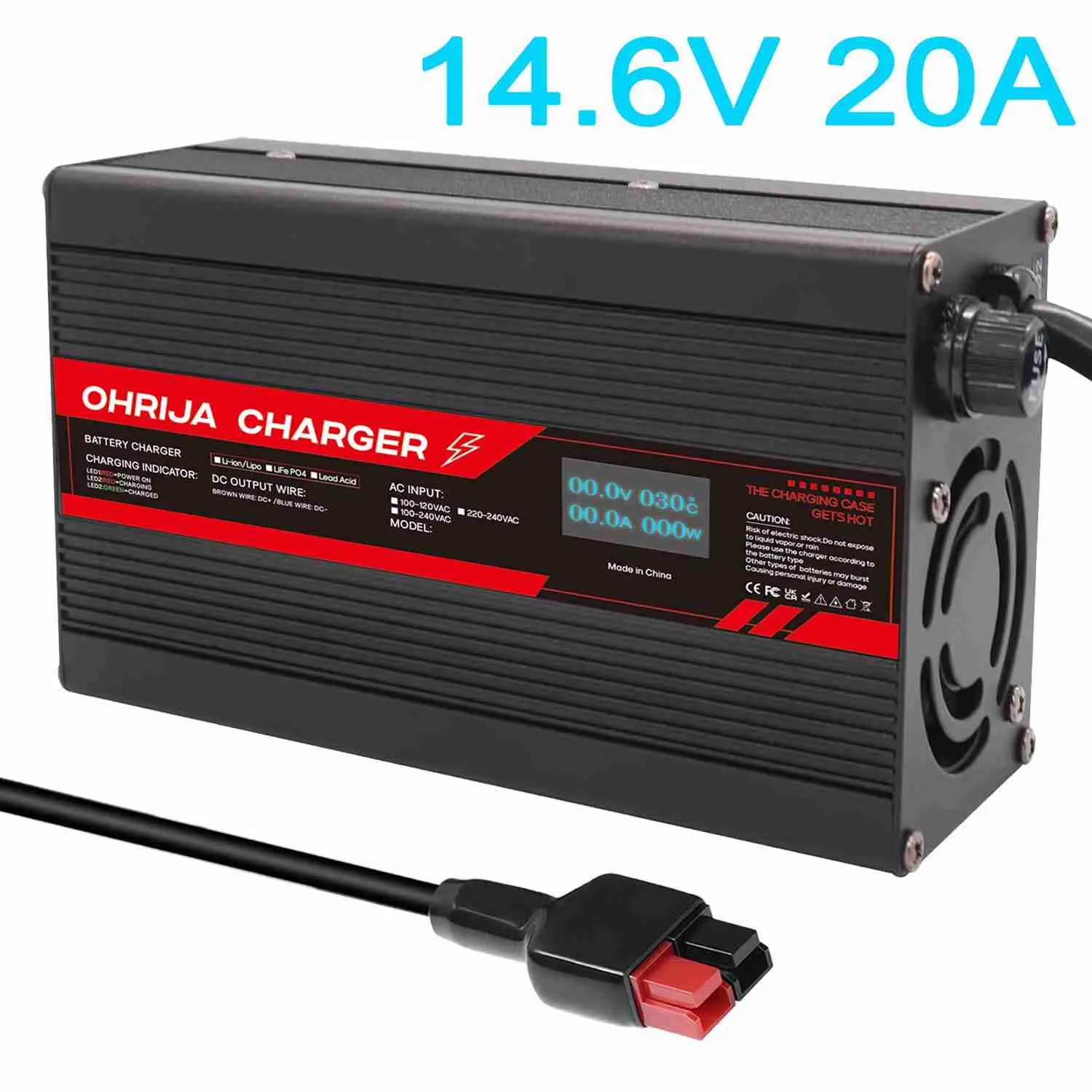
Taking the premier spot on our list is the OHRIJA HRH500. We engineered this unit specifically to be the ultimate Best lfp battery charger for standard home and workshop applications. This 14.6V 20A charger makes it suitable for 4S 12.8V Lifepo4 batteries, delivering a powerful 490W maximum working power to ensure rapid, efficient charging cycles.
One of the standout features of the HRH500 is its advanced OLED display, which provides real-time data on voltage, current, and charging status, eliminating the guesswork associated with basic LED indicator lights. The product material consists of a premium, heat-dissipating aluminum alloy shell, ensuring the internal circuitry remains cool even under sustained 20Amp loads. With a compact product size of 170x90x50MM and a weight of just 1.1kg, it is highly portable.
Customization is central to our design philosophy. The HRH500 is available in black, silver, and red. Furthermore, we provide localized input plugs (US, EU, UK, AU) and a massive variety of output connectors, including XT60, XT90, Crocodile Clip, Anderson 50A, Wire Nose, and 45A. The complete package includes the charger, a 1m DC output cable, a 1m input cable, and an instruction manual.
2. OHRIJA Waterproof Camper Battery Charger 14.6V 30A
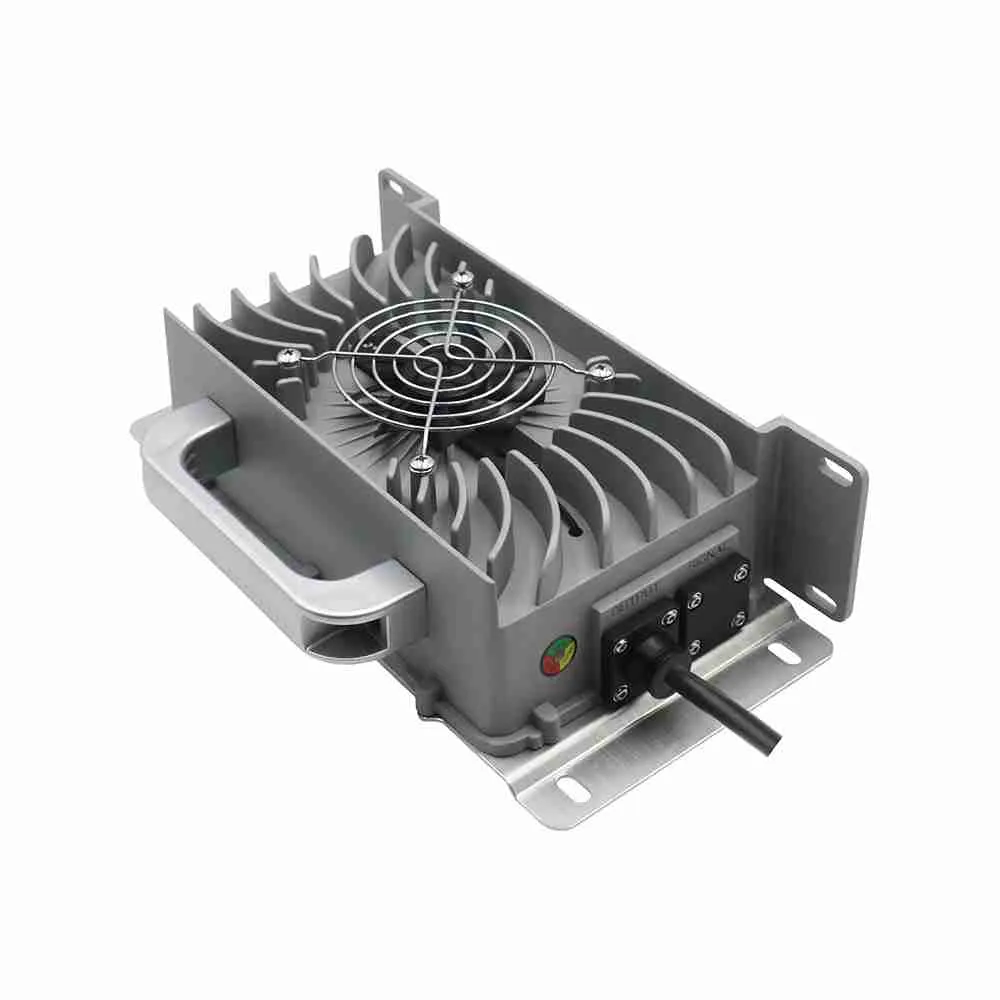
For outdoor enthusiasts, marine applications, and off-grid RV builds, the environment is inherently unforgiving. Therefore, we developed the OHRIJA HRH900FS, arguably the Best lfp battery charger for rugged, high-moisture environments. This waterproof camper battery charger delivers a massive 14.6V 30A output, making it perfectly suitable for large-capacity 4S 12.8V Lifepo4 battery banks.
Operating at a maximum working power of 900W, this charger cuts downtime drastically. The heavy-duty aluminum alloy shell is sealed against dust and water intrusion, providing peace of mind during extreme weather conditions. Measuring 280x197x85MM and weighing 3.5kg, it is built like a tank. Like the HRH500, it is available in black, silver, and red, and offers the same extensive selection of global input plugs and versatile output connectors (XT60, XT90, Crocodile Clip, Anderson 50A, Wire Nose, 45A). From our experience, if your setup is exposed to the elements, the HRH900FS is the undisputed Best lfp battery charger on the market.
3. Victron Blue Smart IP65 Charger 12/25
Victron Energy is highly respected in the solar and off-grid community. Their Blue Smart IP65 12/25 is an excellent Best lfp battery charger candidate for those deeply integrated into the Victron ecosystem. It features built-in Bluetooth, allowing users to monitor charging cycles via a smartphone app. While its 25A output is highly capable, it lacks the raw 900W power of the OHRIJA HRH900FS, and the plastic casing does not dissipate heat as efficiently as a full aluminum alloy shell.
4. NOCO Genius GENPRO10X1
The NOCO Genius line is famous for its compact, fully sealed form factor. The GENPRO10X1 is an onboard marine charger that handles lithium profiles beautifully. It is entirely waterproof and designed to be permanently mounted. However, with a maximum output of only 10A, it is not the Best lfp battery charger for rapidly charging large 200Ah or 300Ah battery banks, as the recharge time would span an entire day. It serves best as a tender for smaller marine batteries.
5. Renogy 12V 20A AC-to-DC LFP Charger
Renogy is a staple in the DIY solar market. Their 20A AC-to-DC charger provides a solid, reliable CC/CV charging algorithm specifically tailored for LFP chemistry. It features a simple LED status indicator and an integrated cooling fan. While it performs admirably, it lacks the advanced OLED data display found on the OHRIJA HRH500, making it slightly more difficult to monitor precise state-of-charge metrics during operation.
6. CTEK Lithium US Smart Charger
For the automotive and powersports sector, CTEK produces highly refined trickle chargers. The CTEK Lithium US is specifically programmed to recover and maintain lithium engine-start batteries. It features an automated wake-up function for batteries where the BMS has triggered an under-voltage protection lockout. While exceptional for small motorcycle or sports car batteries, its low amperage output disqualifies it as the Best lfp battery charger for deep-cycle RV or off-grid home storage banks.
7. Dakota Lithium 12V 10A Charger
Dakota Lithium provides a reliable, no-frills charger designed to pair seamlessly with their branded batteries. It outputs a steady 14.4V at 10 Amps. It is lightweight, easy to use, and comes with standard alligator clips. We recommend this as a budget-friendly Best lfp battery charger for users who only have a single 50Ah or 100Ah battery and do not require rapid charging speeds or waterproof housing.
From our experience at OHRIJA, utilizing an underpowered charger is the most common mistake consumers make. We recommend sizing your charger to deliver at least 0.2C (20% of your battery’s total amp-hour capacity). For a 100Ah battery, a 20A charger like the OHRIJA HRH500 is optimal, ensuring a full charge in roughly 5 hours without generating excessive heat.
Expert Buying Guide: How to Choose Your Charger
Selecting the Best lfp battery charger requires matching the technical specifications of the charger to the unique demands of your battery bank. We recommend evaluating the following critical factors before making a purchase.
- Correct Voltage Parameters: A 12V LFP battery actually consists of 4 cells in series (4S), resulting in a nominal voltage of 12.8V. To achieve a 100% state of charge, the Best lfp battery charger must output exactly 14.6V (±0.2v). Chargers that max out at 13.8V will never fully charge your lithium battery.
- Amperage and Charging Speed: Divide your battery’s capacity by the charger’s amperage to estimate charge time. A 100Ah battery paired with the OHRIJA HRH900FS 30A charger will charge in under 4 hours. Higher amperage equals less downtime.
- Thermal Management: Charging at high amperages generates significant heat. The Best lfp battery charger will utilize an aluminum alloy shell (like our OHRIJA models) rather than cheap plastic, allowing the entire casing to act as a heat sink, thereby protecting the internal circuitry and extending the lifespan of the charger.
- Environmental Protection: If you are mounting your charger in a boat hull or an exterior RV storage compartment, you must prioritize ingress protection. Investing in a waterproof model prevents catastrophic short circuits caused by morning dew or high humidity.
- Connector Compatibility: Ensuring a secure, low-resistance connection is vital. The Best lfp battery charger will offer multiple output connectors. At OHRIJA, we provide options like Anderson 50A and XT90 to guarantee a perfect, zero-loss connection to your specific battery port.
Summary Table: The Top LFP Chargers Compared
| Charger Model | Max Output | Working Power | Key Feature | Best Application |
|---|---|---|---|---|
| OHRIJA HRH500 | 14.6V / 20A | 490W | OLED Data Display & Aluminum Shell | Home, Workshop, Rapid Daily Charging |
| OHRIJA HRH900FS | 14.6V / 30A | 900W | Fully Waterproof & Heavy-Duty Build | RV, Camper, Marine, Off-Grid Outdoor |
| Victron Blue Smart | 14.2V / 25A | ~350W | Bluetooth App Connectivity | Smart Home Integration |
| NOCO GENPRO10X1 | 14.6V / 10A | ~150W | Onboard Permanent Mounting | Small Marine Batteries |
| Renogy AC-to-DC | 14.6V / 20A | ~290W | Simple LED Interface | DIY Solar Systems |
| CTEK Lithium US | 13.8V / 4.3A | ~60W | BMS Wake-Up Function | Powersports & Motorcycles |
| Dakota Lithium | 14.4V / 10A | ~144W | Lightweight Budget Option | Occasional Hobby Use |
Frequently Asked Questions (FAQs)
Can I use my old lead-acid charger on a LiFePO4 battery?
We highly recommend against this. While a lead-acid charger might push some energy into an LFP battery, its voltage parameters are incorrect. Furthermore, lead-acid chargers often run a desulfation cycle that sends high-voltage spikes into the battery, which will permanently damage the delicate lithium cells and trigger the BMS to shut down.
What does a Battery Management System (BMS) do?
A BMS is the internal computer inside an LFP battery. It monitors cell temperature, prevents over-discharging, and protects against short circuits. The Best lfp battery charger works in harmony with the BMS, providing a clean, stable 14.6V CC/CV curve so the BMS can perfectly top-balance the internal cells.
Why does the OHRIJA Best lfp battery charger use an aluminum alloy shell?
Pushing 20A or 30A of continuous current generates significant thermal energy. An aluminum alloy shell acts as a highly efficient, passive heat sink. It draws heat away from the sensitive internal capacitors and transformers much faster than plastic, ensuring the charger operates safely at peak performance for years.
Is it safe to leave the Best lfp battery charger connected indefinitely?
Unlike lead-acid batteries, LFP batteries do not require a continuous trickle charge or float voltage to maintain their health. In fact, holding them at 100% capacity continuously can reduce their lifespan. Once the OHRIJA charger indicates a full charge, we recommend disconnecting the unit.