

Consumers routinely destroy multi-hundred-dollar electric bicycle batteries by purchasing cheap, unverified power supplies from generic online marketplaces. The electrical engineering behind lithium and lead-acid battery management is unforgiving. Searching for a 48 volt charger suitable for e-bikes requires significantly more technical scrutiny than simply matching the number “48” on a product label. Supplying incorrect voltage or excessive amperage to a battery management system (BMS) does not just result in a slow charge; it actively degrades cell chemistry, voids manufacturer warranties, and in severe cases, induces catastrophic thermal runaway.
From our experience engineering and supplying professional power solutions at OHRIJA, we observe a dangerous lack of consumer education regarding nominal versus peak voltage. A battery labeled “48V” is rarely charged at exactly 48 volts. In this uncompromising guide, we will strip away the marketing jargon and explain the strict electrochemical requirements for safely charging your e-bike, how to select the precise equipment for your specific battery chemistry, and why investing in professional-grade chargers is non-negotiable for commercial and daily riders.
Quick Answer: Does a Suitable 48V E-Bike Charger Exist?
Yes, there is absolutely a 48 volt charger suitable for e-bikes, but “48V” is only the nominal voltage. To safely charge your battery, you must match the charger’s peak output voltage to your specific battery chemistry. If your e-bike uses a standard 13-series (13S) Lithium-Ion battery, you must use a charger with a peak output of exactly 54.6V. If your e-bike utilizes a 15S Lithium Iron Phosphate (LiFePO4) battery, you require a 58.4V charger. For older or heavy-duty e-bikes and scooters running a 4-series (4S) Sealed Lead Acid (SLA) array, you need a 55.2V output. You must also ensure the amperage (typically 2A to 5A for e-bikes) does not exceed your battery manufacturer’s maximum charge rate.
Table of Contents
- What It Is: Understanding the “48V” Misnomer
- How It Works: The CC/CV Charging Profile
- Benefits of a Professional-Grade Charger
- Limitations and Drawbacks of Fast Charging
- Who Should Upgrade Their Charger
- Who Does Not Need a Fast Charger
- Common Mistakes to Avoid
- Strict Buying Considerations
- Summary and Comparison Tables
- Expert Recommendation
- Frequently Asked Questions
What It Is: Understanding the “48V” Misnomer
A 48 volt charger suitable for e-bikes is a smart power supply designed to convert alternating current (AC) from your wall outlet into direct current (DC) at a highly specific voltage and amperage curve. The term “48V” is purely a nominal classification used for consumer simplicity. It represents the average operating voltage of the battery pack when it is roughly 50% depleted.
To push energy into a battery, the charger must supply a voltage higher than the battery’s current resting state. Therefore, a true 48V e-bike charger never outputs exactly 48 volts. Finding the best 48V eBike battery chargers requires understanding that your charger is actually a 54.6V (for standard Lithium-ion) or 58.4V (for LiFePO4) power supply. If you connect a power supply that strictly caps at 48.0V to your 48V e-bike, the battery will never charge past 20% capacity.
How It Works: The CC/CV Charging Profile
Professional chargers utilize a sophisticated algorithmic process known as Constant Current / Constant Voltage (CC/CV). This is not a passive trickle of electricity; it is a dynamic conversation between the charger and the battery’s internal BMS.
During the first phase (Constant Current), the charger delivers a steady flow of high-amperage current while the voltage slowly rises as the battery fills. This bulk charging phase is responsible for bringing the battery from 0% to roughly 80% capacity. Once the battery reaches its peak voltage (e.g., 54.6V), the charger switches to the second phase (Constant Voltage). The charger locks the voltage at the peak limit and gradually chokes the amperage down to near zero. This saturation phase ensures the individual cell groups are perfectly balanced without overcharging. Using cheap power adapters that lack this CC/CV curve is the leading cause of premature battery death.
Benefits of a Professional-Grade Charger
Upgrading from the generic 2-amp (2A) charger included with most consumer e-bikes to a smart, higher-amperage unit yields immediate operational dividends. The primary benefit is speed. A high-quality 5A charger will safely replenish a standard 15Ah e-bike battery in approximately three hours, compared to the grueling seven to eight hours required by a 2A brick.
Furthermore, evaluating the best eBike battery chargers 2026 has to offer reveals advanced safety protocols. Premium units incorporate active cooling fans, preventing the internal capacitors from overheating and mitigating the risk of thermal failure. They also feature overvoltage protection (OVP), overcurrent protection (OCP), and reverse-polarity protection, creating a fail-safe environment for your expensive lithium cells.
Limitations and Drawbacks of Fast Charging
We must use commercial and practical judgment: pushing high amperage into a battery generates heat, and heat is the absolute enemy of lithium chemistry. Upgrading to a massive 8A or 10A fast charger is a terrible idea for a standard 10Ah to 15Ah e-bike battery. A standard rule of thumb is to charge at a rate no higher than 0.5C (half the battery’s total amp-hour capacity).
If you force too much current into small cell groups, you induce lithium plating on the anode, permanently degrading the battery’s total capacity. Additionally, high-amperage chargers are physically larger, heavier, and utilize loud cooling fans, making them less ideal for carrying in a backpack during a commute. If you are constantly wondering why does my charger get hot, you are likely pushing the thermal limits of an under-specced plastic charging brick.
Who Should Upgrade Their Charger
For commercial users—such as food delivery couriers, cargo bike operators, and rental fleet managers—upgrading to a professional smart charger is mandatory. When your income relies on vehicle uptime, waiting eight hours for a charge is unacceptable. You require robust, fan-cooled chargers that can rapidly bulk-charge your fleet between shifts. Likewise, heavy-duty applications utilizing massive 20Ah+ batteries require higher amperage to charge within a practical overnight window.
Who Does Not Need a Fast Charger
For beginners or weekend recreational riders who ride ten miles on a Saturday and park their e-bike until the following weekend, a fast charger is entirely unnecessary. The 2A silent, passive-cooled charger provided by the manufacturer is the healthiest option for long-term cell preservation when charging speed is irrelevant.
Common Mistakes to Avoid
The most catastrophic error in e-bike maintenance is chemistry mismatching. We frequently see consumers ask if a can lithium charger charge LiFePO4 battery setups. The answer is an emphatic no. A standard Lithium-ion charger cuts off at 54.6V. A LiFePO4 battery requires 58.4V to balance properly. Using the wrong charger guarantees your battery will never fully charge and will eventually drift out of balance, triggering a BMS shutdown.
Another profound mistake is buying a charger with the wrong plug polarity. Just because a DC barrel plug physically fits into your e-bike’s charge port does not mean the positive and negative pins are wired correctly. Plugging in a reverse-polarity charger will instantly blow the BMS fuse, requiring expensive repairs.
Strict Buying Considerations
When selecting a 48 volt charger suitable for e-bikes, you must verify three absolute metrics before checkout:
- Peak Voltage: Must match your chemistry exactly (54.6V for Li-ion, 58.4V for LiFePO4, 55.2V for SLA). You can consult resources on the best lithium ion battery charger 48V to verify standard profiles.
- Charge Rate (Amperage): Ensure the amperage does not exceed your battery’s maximum safe charge current (check the label on your battery).
- Connector Type: Identify your port. Is it a 3-pin XLR, a 5.5×2.1mm DC barrel, an XT60, or a proprietary 3-prong plug? The connector must match flawlessly.
To understand proper safety protocols regarding location and temperature monitoring during the charge cycle, review how to charge eBike battery safely.
Summary and Comparison Tables
| Battery Chemistry | Nominal Voltage | Required Peak Charge Voltage | Common Application |
|---|---|---|---|
| Lithium-Ion (NMC/NCA) | 48V (13 Series) | 54.6V | Modern lightweight commuter e-bikes. |
| Lithium Iron Phosphate (LiFePO4) | 48V (15 Series) | 58.4V | Heavy-duty cargo bikes, solar setups. |
| Sealed Lead Acid (SLA/AGM) | 48V (4 Series) | 55.2V – 58.8V | Older generation scooters, utility carts. |
| Charger Output | Estimated 0-100% Time | Heat Generation | Battery Stress Level |
|---|---|---|---|
| 2 Amps (Standard) | 7.5 – 8.5 Hours | Very Low | Optimal for longevity. |
| 5 Amps (Fast Charge) | 3.0 – 3.5 Hours | Moderate to High | Safe, but slight increase in wear. |
| Pros (Advantages) | Cons (Limitations) |
|---|---|
| Drastically reduces downtime for commercial riders. | Physically larger and heavier to transport. |
| Active fan cooling prevents internal component failure. | Cooling fans generate noticeable ambient noise. |
| Aluminum housing is highly durable for shop environments. | Frequent fast-charging slightly degrades total cell lifespan. |
Expert Recommendation
We recommend entirely abandoning cheap, unbranded plastic charging bricks. If your livelihood depends on your light electric vehicle, your charging infrastructure must be industrial-grade. Ensure you identify your exact battery chemistry before procurement. If you are operating an older e-bike, a heavy-duty mobility scooter, or an industrial utility cart running a 48V lead-acid array, you cannot use a modern lithium charger. You require a dedicated lead-acid management system capable of handling high-capacity banks safely.
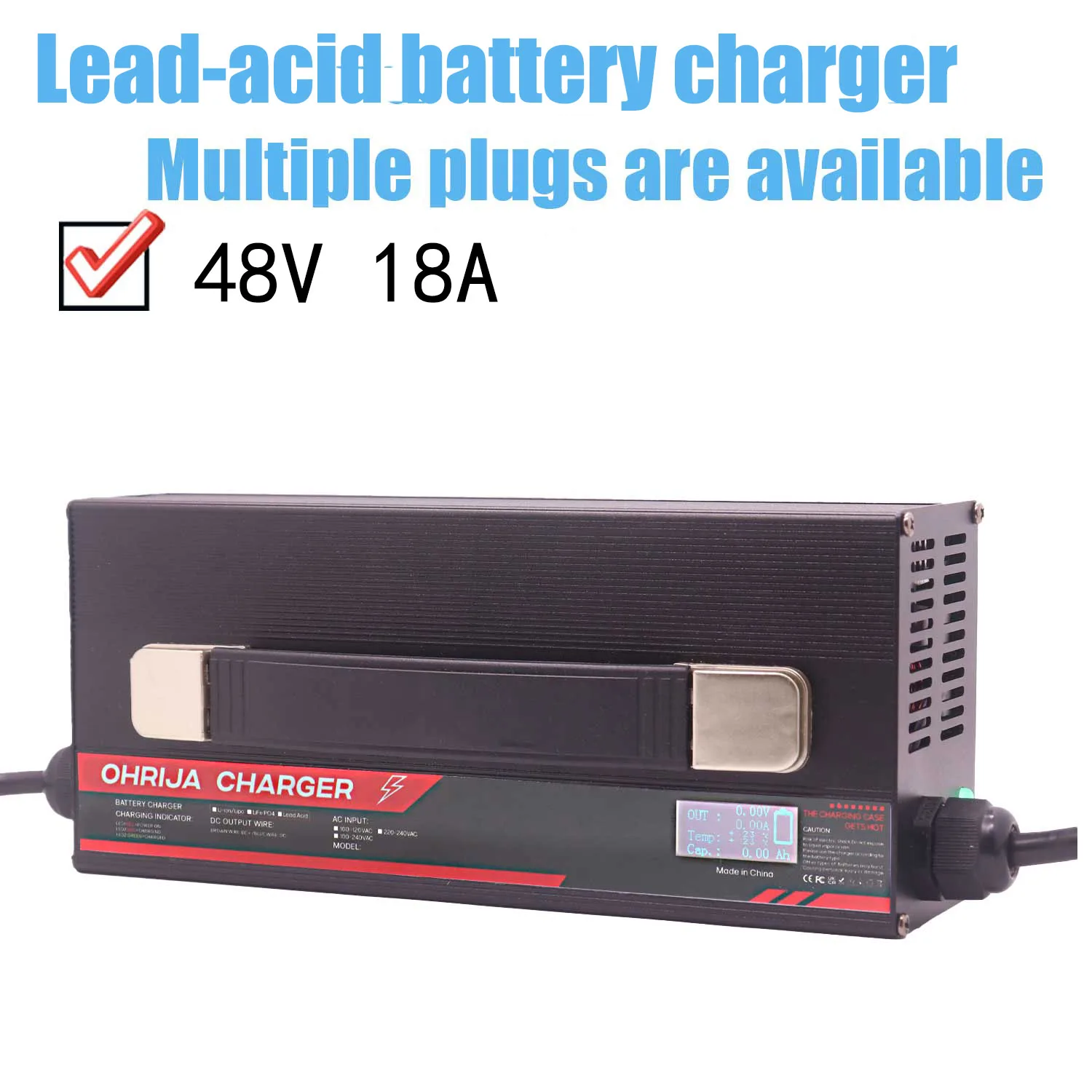
OHRIJA 48V Lead Acid Battery Charger 48V 18A Charger
For heavy-duty applications utilizing 4S 55.2V Lead Acid configurations, this is the uncompromising commercial solution. Delivering a massive 18A output, it rapidly replenishes high-capacity industrial banks while maintaining strict thermal control.
- Compatibility: Supports 4S 55.2V lead acid battery packs seamlessly.
- Cooling System: Intelligent fan cooling with temperature-sensing speed control prevents thermal throttling.
- Output: 48V DC nominal, equipped with a heavy-duty 18A high current configuration.
- Protection Functions: Comprehensive Overvoltage (OVP), Overcurrent (OCP), Overtemperature (OTP), Short circuit (SCP), and Reverse connection protection.
- Application Fields: Industrial batteries, heavy electric vehicles, utility carts, and energy storage systems.
View the OHRIJA 48V 18A Charger
Frequently Asked Questions
Can I use a 52V charger on a 48V e-bike battery?
Absolutely not. A 52V lithium-ion charger outputs 58.8V at its peak. A 48V lithium-ion battery is designed to max out at 54.6V. If your Battery Management System (BMS) fails to block the incoming overvoltage, the excess voltage will rapidly overcharge the cells, leading directly to catastrophic thermal runaway and fire.
Why does my new charger not turn green when the battery is full?
If your charger stays red indefinitely, it usually indicates that the battery’s internal cells are severely out of balance. The charger is lingering in the low-amperage Constant Voltage (CV) phase, trying to allow the BMS to bleed off high cells and bring up low cells. If it never turns green after 12 hours, either your charger is malfunctioning or your battery pack has dead cell groups.
Can I leave my 48V e-bike battery plugged in overnight?
While modern smart chargers and BMS units are designed to cut off power automatically when the battery reaches 100%, it is widely considered a poor safety practice to leave large lithium batteries charging unattended while sleeping. Furthermore, holding lithium cells at 100% maximum voltage for extended periods accelerates chemical degradation. It is best to unplug the charger shortly after the indicator light turns green.
Authoritative Industry References
To ensure our electrical guidelines and safety protocols adhere to global standards, we reference data from the following authoritative institutions:
- Battery University (Cadex Electronics) – Comprehensive engineering data regarding the strict Constant Current/Constant Voltage (CC/CV) charging profiles required to safely manage lithium-ion chemistries.
- National Fire Protection Association (NFPA) – Federal safety guidelines and fire prevention protocols regarding micromobility devices, e-bikes, and lithium-ion charging hazards.
- Institute of Electrical and Electronics Engineers (IEEE) – Global standards for battery management systems and safe power supply manufacturing.
For users operating high-capacity LiFePO4 systems, we highly recommend reading our guide on the best LiFePO4 battery chargers 2025 to ensure optimal longevity.