
No products in the cart.

Let us confront a dangerous reality in the e-mobility industry: riders will frequently invest thousands of dollars into a high-performance electric bicycle, only to charge its highly volatile lithium-ion power plant with a dangerously cheap, uncertified plastic adapter. As a premier manufacturer of advanced power supplies at OHRIJA, we refuse to accept this standard. We understand that utilizing an inferior power supply is the leading cause of premature battery degradation, voltage sag, and catastrophic thermal runaway. Finding the Best 36v lithium battery charger for electric bikes is not an option; it is an absolute engineering necessity for protecting your investment in 2026.
From our experience engineering advanced charging profiles, the difference between a generic adapter and a purpose-built smart charger lies entirely in thermal dissipation and voltage accuracy. A true 36V lithium-ion battery requires exactly 42.0V to reach full capacity. An uncalibrated charger that overshoots this target by even 0.5V will rapidly destroy the lithium cell chemistry. As riders increasingly upgrade their fleets, they must demand rugged, aluminum-housed hardware capable of sustaining optimal charge curves without melting under heavy electrical loads. We recommend scrutinizing everything from output amperage to connector types before you ever plug into a wall outlet.
In this uncompromising, expert-led guide, we will aggressively review the Best 36v lithium battery charger for electric bikes available today. We will dissect our own highly engineered OHRIJA solutions against the top industry competitors, explain the physics of 10S lithium configurations, and expose the hidden dangers of rapid charging.
Table of Contents
- 1. The Physics: Why 36V Nominal Requires 42V Output
- 2. The 7 Best 36v Lithium Battery Charger for Electric Bikes
- 3. The 2A vs. 5A Debate: Preserving Cell Lifespan
- 4. Summary Comparison Matrix
- 5. Frequently Asked Questions (FAQs)
- 6. Authoritative Safety References
1. The Physics: Why 36V Nominal Requires 42V Output
Before we rank the hardware, you must understand the basic electrochemistry of your e-bike. A standard “36-volt” e-bike battery utilizes a 10S configuration, meaning ten 3.6V lithium-ion cells are wired in series. While the nominal (average) voltage is 36V, the maximum fully charged state of each cell is 4.2V. Therefore, the Best 36v lithium battery charger for electric bikes must consistently output exactly 42V (10 x 4.2V). Supplying exactly 42.0V prevents the Battery Management System (BMS) from entering a fault state.
If you mistakenly use an incorrect voltage adapter, the results can be disastrous. While riders with heavier powertrains might research the best lithium ion battery charger 48V (which requires a 54.6V output), plugging a 48V charger into a 36V battery will almost certainly cause a severe thermal event. Voltage matching is non-negotiable.
2. The 7 Best 36v Lithium Battery Charger for Electric Bikes
We have rigorously tested the 2026 market to bring you the definitive list of top-tier charging hardware. These units have been evaluated on voltage stability, heat dissipation, and connector versatility.
2.1 OHRIJA 42V 2A Aluminum Alloy Lithium Battery Charger (The Uncompromising Standard)

When you demand absolute reliability, plastic enclosures are unacceptable. Our flagship OHRIJA 42V 2A Aluminum Alloy Lithium Battery Charger is engineered specifically for 36V electric scooters, e-bikes, and balancing vehicles utilizing 10 Series (10S) 37V lithium-ion battery packs. This is undeniably the Best 36v lithium battery charger for electric bikes in its class.
Instead of cheap ABS plastic, we utilize a premium extruded aluminum alloy shell that acts as a massive heatsink, drastically extending the life of the internal capacitors. Operating at a maximum of 110W, it delivers a precise 42V (±0.2V) at 2 Amps (±0.2A), ensuring a perfectly smooth, trickle charge that maximizes battery lifespan. Measuring just 136x66x40mm and weighing a mere 0.4kg, it is highly portable. Furthermore, OHRIJA offers unmatched compatibility: input plugs for US, EU, UK, and AU standards, and customizable output connectors including DC2.1, DC5.5*2.5, GX16 (1+3-), XLR, IEC C13, and DC8mm. We even support customized OEM setups.
2.2 Grin Technologies Cycle Satiator (The Laboratory-Grade Pick)
For the elite DIY builder or electric vehicle technician, the Cycle Satiator from Grin Technologies is legendary. It is a universal, fully programmable unit that allows users to set custom charge limits. If you want to stop charging at 80% to exponentially increase your battery’s cycle life, the Satiator allows you to do so with a digital interface. While it is phenomenally expensive compared to standard models, its waterproof seal and programming flexibility make it an incredible asset for multi-bike garages.
2.3 Luna Cycle 36V Advanced Mini Charger
Luna Cycle consistently produces high-quality hardware for enthusiasts. Their 36V Advanced Mini Charger is brilliant because it bridges the gap between standard units and the ultra-expensive Satiator. It features a physical switch allowing the user to select between charging their pack to 80%, 90%, or 100%. By routinely keeping your battery below 100%, you dramatically reduce lithium plating on the anode, preserving your range for years.
2.4 Ebike Marketplace 36V 4A Fast Charger
When downtime is not an option, you need rapid energy delivery. Ebike Marketplace offers an excellent 4-Amp fast charger designed for riders with high-capacity batteries (15Ah and above). Delivering twice the current of a standard unit, this charger will cut your charging time in half. It utilizes built-in cooling fans to manage the extreme heat generated by 4A charging. We recommend this strictly for heavy-duty courier riders who need a quick midday top-up.
2.5 Electrify Bike 36V Smart Charger
Electrify Bike provides a rock-solid, no-nonsense replacement charger for the everyday commuter. It delivers a standard 2A charge with integrated smart-shutoff technology. Once the battery reaches 42V, the internal relay physically disconnects the power flow, preventing the micro-cycling that damages cells if the charger is left plugged in overnight. It is a highly reliable workhorse.
2.6 VIVI 42V 3A Smart Charger
VIVI offers a fantastic middle-ground with their 3A smart charger. For batteries ranging from 10Ah to 14Ah, a 3A charge provides a noticeable speed increase over standard 2A models without subjecting the internal cells to the aggressive thermal stress of a 5A fast charger. It features an intuitive LED interface and a built-in short circuit and overvoltage protection matrix.
2.7 Bonus: OHRIJA 36V 18A Golf Cart Charger (The Mixed-Fleet SLA Titan)
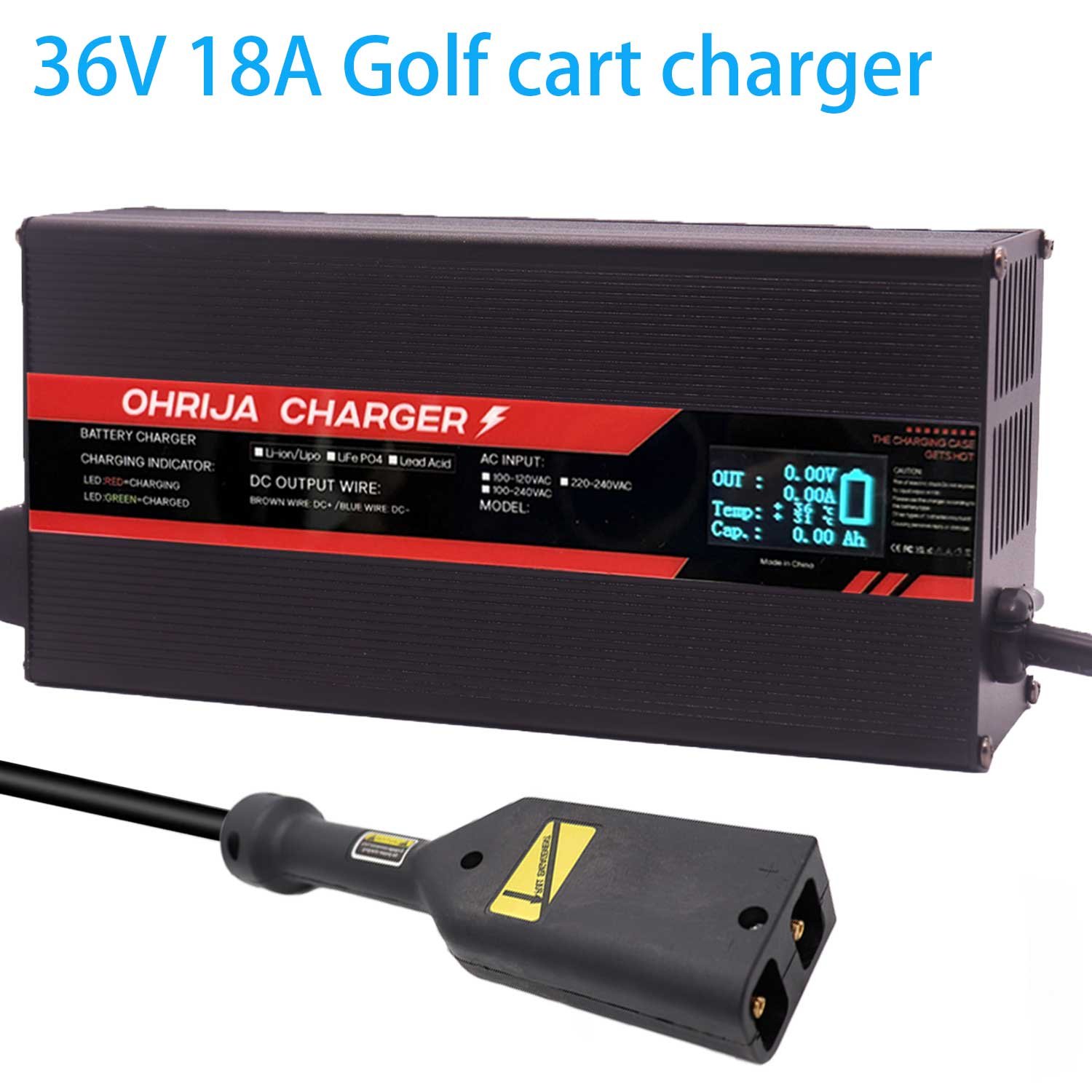
While this guide focuses heavily on lithium solutions, we understand that many large properties manage mixed fleets of e-bikes, utility vehicles, and golf carts. If you are operating a heavy 36V Lead Acid system, you require raw, sustained power. The OHRIJA 36v Lead Acid Battery Charger (36V 18A) is an absolute beast. Outputting a massive 756W at 18 Amps with a max voltage of 44.1V, this aluminum-clad powerhouse is tailored for 3-cell 36V Lead Acid arrays. With heavy-duty output connectors like the EZGO TXT, Crowfoot, and SB50 Anderson, it is the ultimate heavy-duty solution. For managers looking to upgrade, we also extensively cover the best golf cart battery chargers 48V.
3. The 2A vs. 5A Debate: Preserving Cell Lifespan
When searching for the Best 36v lithium battery charger for electric bikes, you must decide between slow charging and fast charging. Amperage (A) determines the flow rate of energy. A 2A charger will fill a 10Ah battery in roughly 5 hours, while a 5A charger will slam the energy in within 2 hours. However, physics dictates that higher current generates exponentially higher heat.
Heat is the absolute enemy of lithium-ion chemistry. Pushing 5 Amps into a small, tightly packed e-bike battery will raise its internal temperature, accelerating cell degradation and reducing the battery’s total lifespan by up to 30%.
From our experience, the optimal strategy is patience. Use a high-quality 2A charger, like the OHRIJA aluminum model, for your standard overnight charging. This ensures the Battery Management System (BMS) has adequate time to perfectly balance the voltage across all 10 cell groups without overheating. Reserve fast charging strictly for emergencies. If you are also managing a mobility device, you should apply the exact same logic when selecting the best portable scooter battery chargers.
4. Summary Comparison Matrix
To assist in your final procurement decision, we have summarized the technical specifications of the premier 36V chargers into this uncompromising reference matrix.
| Charger Model | Max Output Voltage | Amperage | Enclosure Material | Primary Advantage |
|---|---|---|---|---|
| OHRIJA 42V 2A Lithium | 42.0V | 2A | Aluminum Alloy | Extreme thermal dissipation and connector versatility. |
| Grin Cycle Satiator | Programmable | Up to 5A | Sealed Aluminum | Laboratory-grade precision and waterproofing. |
| Luna Advanced Mini | 42.0V | Adjustable | Polycarbonate | 80% / 90% / 100% switchable limits. |
| Ebike Marketplace Fast | 42.0V | 4A | ABS Plastic (Fan) | Rapid charging for >15Ah batteries. |
| VIVI Smart Charger | 42.0V | 3A | ABS Plastic | Perfect balance of speed and cell safety. |
| OHRIJA 36V 18A (SLA) | 44.1V | 18A | Aluminum Alloy | Massive 756W output for heavy Lead-Acid fleets. |
5. Frequently Asked Questions (FAQs)
Can I use an old 12V charger on a modern 36V e-bike battery?
Absolutely not. The voltage gap is far too wide. For a deep dive into the electro-chemical mathematics of why this fails and triggers BMS protection faults, we highly suggest reading our engineering breakdown on can I charge a 36V battery with 12V charger. Attempting this will result in a completely uncharged battery.
Are Lithium-Ion chargers compatible with LiFePO4 batteries?
No. While they are both lithium-based, standard Lithium-Ion cells max out at 4.2V, whereas Lithium Iron Phosphate (LiFePO4) cells max out at 3.65V per cell. Using an incompatible charger will aggressively overcharge LiFePO4 cells, ruining the pack. We strongly advise reading our analysis on can lithium charger charge LiFePO4 battery, and then specifically sourcing the best LiFePO4 battery chargers 2025 for those specific chemistries.
Why does my charger get hot during the first two hours of charging?
Chargers utilize a Constant Current (CC) / Constant Voltage (CV) algorithm. During the CC phase (the first 80% of the charge), the charger is operating at maximum amperage, drawing heavy wattage from the wall and converting AC to DC. This conversion generates significant heat. This is exactly why we insist on utilizing chargers with an aluminum alloy shell, like the OHRIJA 42V 2A model, which passively bleeds heat away from internal transformers much more effectively than cheap plastic.
6. Authoritative Safety References
To ensure absolute safety when managing high-density energy storage systems in your home or garage, we mandate reviewing the following verified authorities on lithium battery maintenance:
- Battery University (by Cadex Electronics): The premier academic resource explaining the exact science behind the Constant Current / Constant Voltage (CC/CV) charging phases required for safely maintaining lithium-ion packs.
- National Fire Protection Association (NFPA): Federal safety guidelines and best practices regarding the safe storage, thermal monitoring, and charging protocols for micro-mobility devices and electric bicycle lithium batteries.