
No products in the cart.

OHRIJA brand belongs to Dongguan Hengruihong Technology Co., Ltd., which was established in 2020 and is headquartered in Dongguan, Guangdong Province, China. Our company is a high-tech enterprise integrating R&D, production and sales. The company’s main products: lithium battery charger, lithium iron phosphate battery charger, lead-acid battery charger, golf cart charger, power adapter, switching power supply and other products. You can learn more about our manufacturing capabilities by visiting the Ohrija charger company profile.
As an industry practitioner dealing with power conversion, commercial electronics, and battery charging infrastructure on a daily basis, I witness companies making the same critical error: treating power supplies as an afterthought. When procurement managers ask us to specify a 12 volt dc switching power supply, they often assume all silver-box industrial units or black desktop adapters are created equal. This is a severe misconception. The choice between a heavily engineered, certified power module and a generic knock-off dictates whether your automated CNC machine runs flawlessly for a decade, or whether your expensive LED arrays burn out due to excessive voltage ripple.
In this professional guide, we will cut through the marketing jargon. We will explain exactly what internal topology to look for, how to match specific form factors to your operational environment, and whether it is actually worth upgrading your legacy systems to modern, high-efficiency models. We will also break down the 9 best applications and types of a 12 volt dc switching power supply available on the market today to help you make a definitive buying decision.
Quick Answer: The 12V DC SMPS Landscape
- What it is: An electronic circuit that uses a high-frequency switching regulator to convert alternating current (AC) into a highly stable 12-volt direct current (DC).
- Is it worth buying? Yes. In most professional situations, upgrading from older, heavy linear power supplies to a modern 12 volt dc switching power supply provides up to 90% energy efficiency, drastically reduces physical weight, and stabilizes output under fluctuating AC input.
- Our Top Recommendation: For heavy-duty applications, we recommend the 12V 50A power supply 600W. It offers immense thermal headroom, ensuring that industrial motors and vast lighting arrays receive clean, uninterrupted amperage.
- Crucial Buying Rule: Never run a power supply at 100% of its rated capacity. Always apply the 80% load rule to prevent thermal degradation of the internal electrolytic capacitors.
Table of Contents
- What It Is and How It Works
- Benefits and Limitations
- Who Should Use It & Who Does Not Need It
- Common Mistakes in Power Sourcing
- The 9 Best 12 Volt DC Switching Power Supply Types
- Pros and Cons Table: Switching vs. Linear
- Comparison Table: 12V Power Supply Topologies
- Critical Buying Considerations
- Expert Recommendation
- The Bottom Line
- Frequently Asked Questions (FAQ)
What It Is and How It Works
A 12 volt dc switching power supply—commonly referred to as an SMPS (Switch Mode Power Supply)—is an active electronic power conversion device. Older “linear” power supplies use a massive, heavy iron-core transformer to step down 120V or 220V AC mains to a lower voltage, then dissipate the excess energy as wasted heat to regulate the output to 12V. This is highly inefficient.
How an SMPS works is fundamentally different. It takes the incoming AC wall power, immediately rectifies it into a high-voltage DC, and then uses semiconductor switches (like MOSFETs) turning on and off thousands of times per second (typically 50 kHz to 1 MHz) to chop that high voltage into high-frequency pulses. These pulses are fed through a much smaller, lightweight, high-frequency ferrite transformer. The output is then rectified and smoothed into a perfectly flat 12V DC output. A feedback loop constantly monitors the 12V output; if you suddenly turn on a heavy motor and the voltage sags, the internal controller instantly widens the switching pulses (Pulse Width Modulation) to pump more energy through and stabilize the voltage back to 12V in milliseconds.
Benefits and Limitations
The primary benefit of utilizing a 12 volt dc switching power supply is efficiency. Because the power transistors are either fully “ON” or fully “OFF”, they dissipate very little heat compared to linear regulators. Modern SMPS units routinely achieve 85% to 93% efficiency. This results in a massive reduction in size, weight, and cooling requirements. Furthermore, they feature wide-input ranges; a single unit can often accept anywhere from 85V AC to 264V AC, meaning you can export your machinery globally without worrying about voltage selector switches.
However, there are limitations. The aggressive, high-frequency switching action inherently creates electromagnetic interference (EMI) and high-frequency voltage ripple. If a 12 volt dc switching power supply is poorly engineered or lacks proper LC filtering on the output stage, this electrical “noise” will bleed into your connected equipment. In our testing, cheap, generic power supplies are the number one cause of flickering in LED installations and data corruption in sensitive logic controllers.
Who Should Use It & Who Does Not Need It
For commercial users and industrial technicians: You absolutely must use an SMPS. If you are powering factory automation sensors, 3D printers, telecommunications routers, or large-scale retail display lighting, the thermal efficiency and compact size of a 12 volt dc switching power supply make it the only commercially viable choice.
Who does not need it: Audiophiles running highly sensitive analog pre-amplifiers or laboratory technicians operating precision oscilloscopes. In these rare, hyper-sensitive analog scenarios, the absolute zero-noise characteristic of a heavy, inefficient linear power supply is still preferred over a switching supply.
Common Mistakes in Power Sourcing
From our experience consulting with manufacturing clients, the most expensive hardware failures result from easily avoidable procurement mistakes:
- Ignoring the 80% Derating Rule: If your equipment draws a continuous 10 Amps (120 Watts), do not buy a 10A power supply. Running an SMPS at 100% capacity pushes the internal electrolytic capacitors to their thermal limits, drastically shortening their lifespan. Always oversize by at least 20%. Buy a 12A or 15A unit.
- Using an SMPS as a Direct Battery Charger: A standard 12 volt dc switching power supply outputs a flat 12V. You cannot use it to properly charge a lithium battery pack, which requires a specific Constant Current / Constant Voltage (CC/CV) algorithmic curve and a higher termination voltage. If you are managing energy storage, you must source a dedicated Li-ion battery charger category device, or specifically a 12V LiFePO4 battery charger 30A, designed by an established LiFePO4 battery charger category leader.
- Suffocating Enclosed Units: Buying a high-wattage, fanless power supply and locking it inside a sealed, plastic junction box without ventilation. Heat destroys semiconductors; ensure proper ambient airflow.
The 9 Best 12 Volt DC Switching Power Supply Types and Applications
There is no “one size fits all” form factor. The best 12 volt dc switching power supply for your operation depends entirely on the installation environment. Here are the 9 best variants and use cases for 2026:
1. The Industrial Heavyweight: High-Wattage Enclosed SMPS
For heavy-duty applications like powering expansive server cooling fans or massive CNC router control boards, you need raw, sustained amperage. A ventilated aluminum chassis with active fan cooling is required. We strongly recommend upgrading to a robust 12V 50A power supply 600W to guarantee absolute thermal stability during 24/7 commercial operations.
2. The Automation Standard: DIN Rail Mount
If you are building an industrial PLC control cabinet, you cannot have loose power bricks laying around. A DIN rail 12 volt dc switching power supply snaps securely onto standard 35mm metal rails. They are tall, narrow, and designed for efficient vertical heat convection, ensuring neat wire management alongside circuit breakers.
3. The Outdoor LED Champion: IP67 Waterproof SMPS
For exterior landscape lighting or illuminated commercial signage, moisture is your enemy. An IP67 waterproof 12 volt dc switching power supply is fully potted—meaning the entire internal circuit board is encased in a solid block of thermally conductive epoxy. It keeps rainwater out while wicking heat away from the components.
4. The Precision Lab Tool: Adjustable Output SMPS
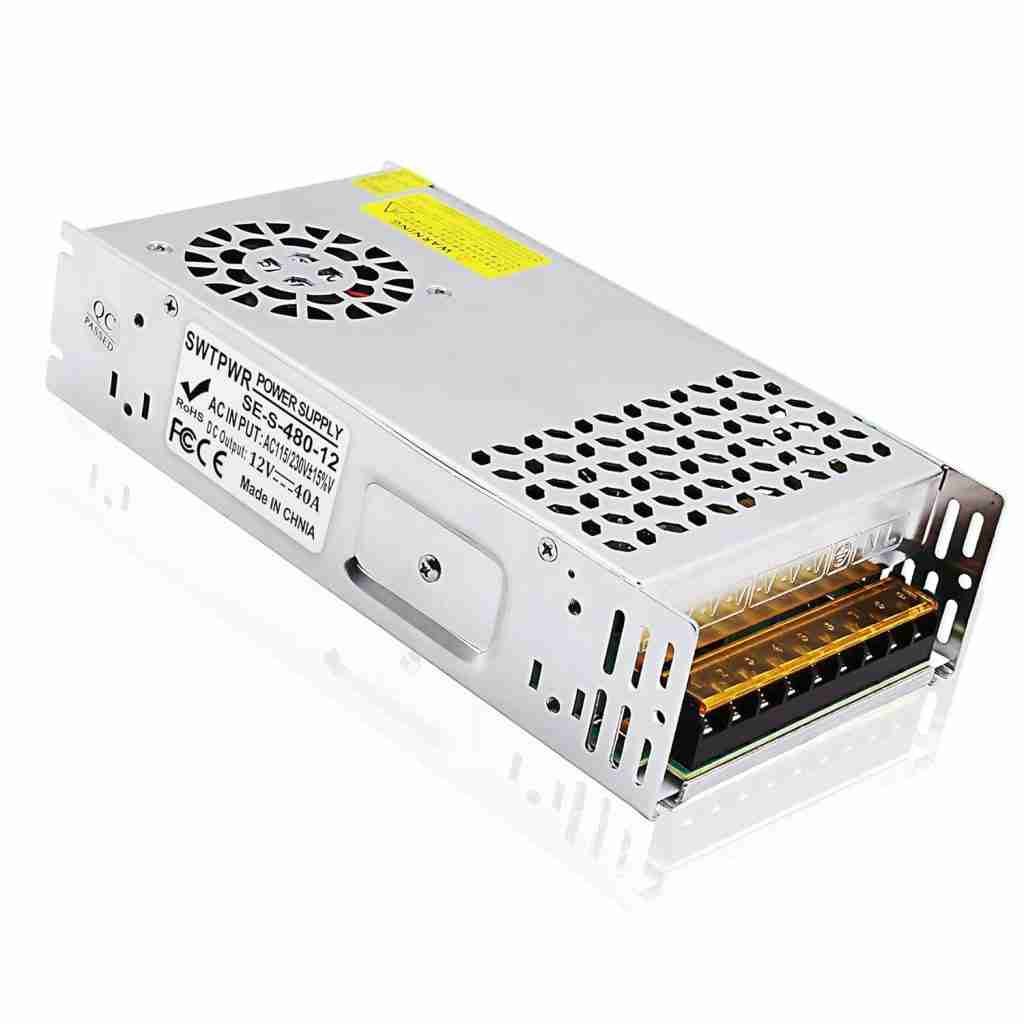
12V Power Supply 12V 40A 480W 50A 600W AC to DC Converter 110V/120V to 12V Transformer LED Driver Smart Cooling Fan Designed for LED Strip CCTV and Car Devices
Price range: 13.90$ through 14.90$
12V Power Supply 12V 50A 600W AC to DC Converter 110V/120V to 12V Transformer LED Driver Smart Cooling Fan Designed for LED Strip CCTV and Car Devices (DC12V, 12V-50A-600W)
Price range: 23.90$ through 29.90$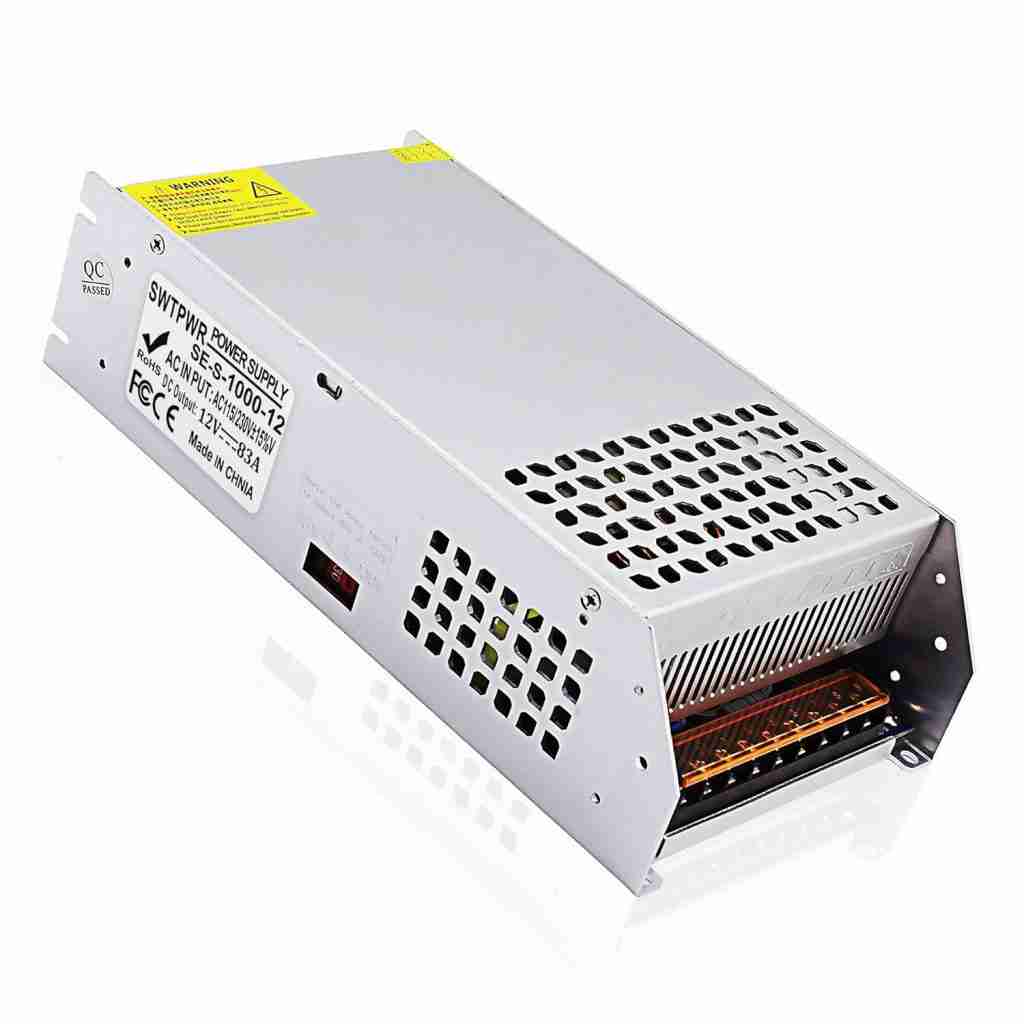
12V Power Supply 12V 83A 1000W AC to DC Converter 110V/120V to 12V Transformer LED Driver Smart Cooling Fan Designed for LED Strip CCTV and Car Devices
Price range: 29.90$ through 54.90$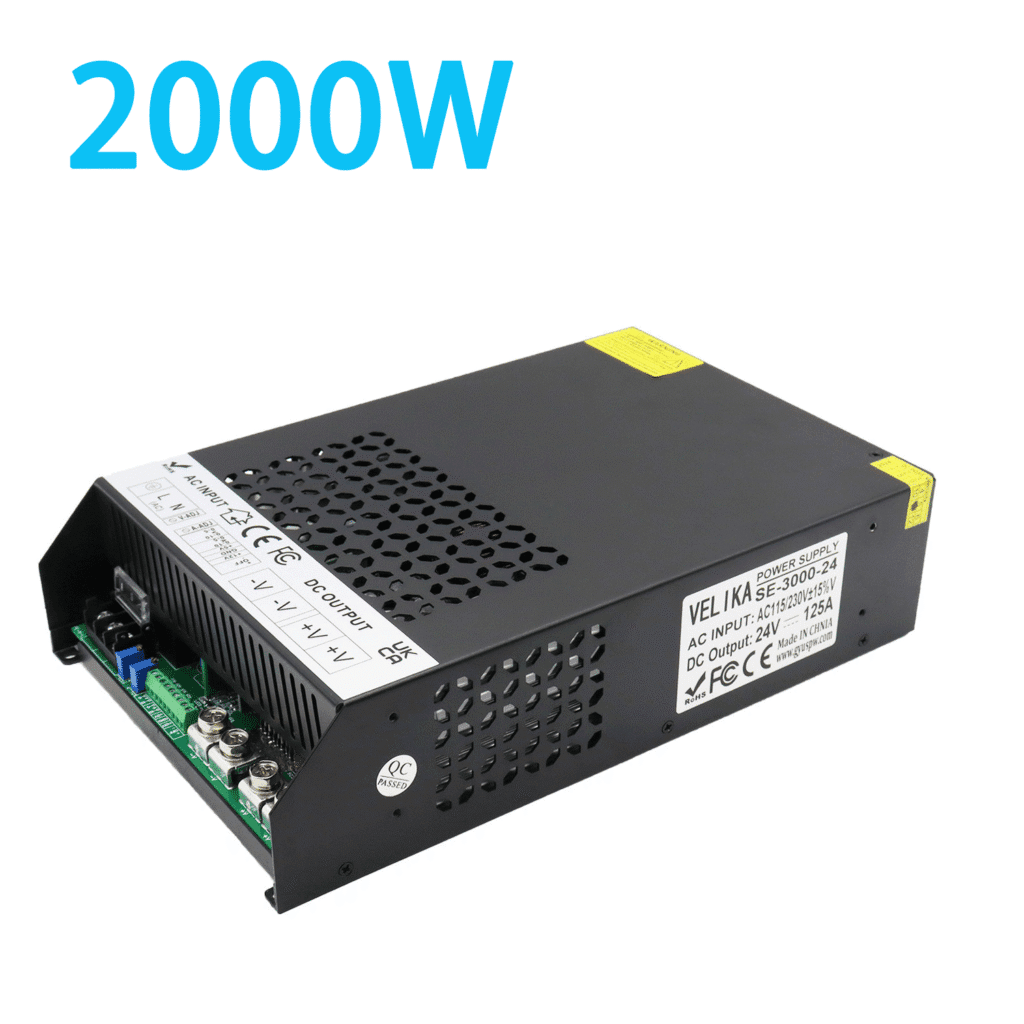
2000 Series 2000W High Power AC‑DC Switching Power Supply | AC185‑265V Input, Multiple DC Output 12V 24V 36V 48V 60V 72V 80‑120V & Custom Voltage For Industrial Equipment
Price range: 64.80$ through 69.80$
In R&D and repair environments, voltage drop across long testing cables means setting a supply to exactly 12.0V might result in only 11.5V reaching your device. Sourcing from a reliable adjustable power supply manufacturer allows you to precisely dial the voltage up to 12.5V to compensate for cable loss, ensuring perfect power delivery.
5. The Security Workhorse: Multi-Channel CCTV Distribution Box
Using individual wall-adapters for a 16-camera security system is an amateur setup. The professional choice is a central 12 volt dc switching power supply housed in a wall-mounted metal cabinet with individually PTC-fused outputs. If one exterior camera is vandalized and shorts out, the fuse trips only for that channel, keeping the rest of the building’s surveillance online.
6. The Medical Grade Supply: 2x MOPP Certified
Powering dental equipment or patient monitors requires an SMPS with reinforced isolation and incredibly low leakage current to meet strict IEC 60601-1 safety standards. Never use a standard industrial 12 volt dc switching power supply in a clinical patient-care environment; the risk of electrical shock is too high.
7. The Versatile Mid-Range Integrator
For mid-tier robotics and 3D printing, a compact, convection-cooled enclosed unit is perfect. For example, our robust AC to DC power supply 24V 15A represents the pinnacle of mid-range engineering; procuring the 12V equivalent provides the exact same rugged reliability for lower voltage setups, operating silently without mechanical fans.
8. The Consumer Electronics Standard: Desktop Adapter
For monitors, audio interfaces, and external hard drives, a “brick” style desktop 12 volt dc switching power supply is standard. They are fully enclosed in plastic, require no hardwiring (using standard 5.5×2.1mm barrel jacks), and meet strict Level VI global efficiency standards for standby power consumption.
9. The Mobile DC-DC Converter
When operating in the e-mobility sector, you often have massive 48V or 72V main battery packs. To power the 12V headlights, horns, and GPS trackers on the vehicle, you must use a step-down DC-DC switching power supply. As a premier electric bicycle charger supplier and developer of electric wheelchair charger solutions, we understand how vital clean 12V step-down conversion is when running alongside high-voltage motor controllers.
Pros and Cons Table: Switching vs. Linear Power Supplies
| Specification | Switching Power Supply (SMPS) | Linear Power Supply |
|---|---|---|
| Energy Efficiency | Excellent (85% to 95%) | Poor (30% to 60%) |
| Physical Size & Weight | Very compact and lightweight | Extremely heavy and bulky (Large iron transformer) |
| Output Noise (Ripple/EMI) | Moderate to High (requires good internal filtering) | Exceptionally low (Ideal for sensitive audio) |
| Input Voltage Range | Universal AC (85V – 264V typically) | Narrow (Requires specific 110V or 220V winding) |
Comparison Table: 12V Power Supply Topologies
| Form Factor | Best Use Case | Cooling Method | Installation Requirement |
|---|---|---|---|
| Enclosed Aluminum Chassis | CNC, 3D Printers, Industrial Motors | Active Fan or Convection | Hardwired via screw terminals |
| DIN Rail Mount | Factory PLC Automation Cabinets | Convection (Vertical Airflow) | Snaps onto 35mm metal rails |
| IP67 Encapsulated | Outdoor LED Signage, Landscape Lighting | Conduction (Potted in epoxy) | Hardwired with waterproof wire nuts |
| Desktop “Brick” Adapter | Consumer Electronics, Monitors | Convection (Sealed plastic) | Plug-and-play (Barrel connector) |
Critical Buying Considerations
When you are ready to purchase a 12 volt dc switching power supply, apply commercial scrutiny to the specification sheet. First, verify the presence of an active PFC (Power Factor Correction) circuit if the unit is over 100W. PFC ensures the power supply draws AC current smoothly, minimizing stress on your building’s electrical wiring and meeting European harmonic distortion standards. Second, look closely at the operating temperature range. A high-quality supply should guarantee full output power up to at least 45°C (113°F) before requiring derating.
Finally, never confuse a power supply with a dedicated battery charger. If you own an electric vehicle, you cannot charge it with a standard SMPS. You must use specialized hardware featuring the correct voltage termination curves, such as a 54.6V 5A eBike battery charger, a high-capacity 48V 10A eBike charger, a 67.2V scooter battery charger, or an extreme 84V electric scooter charger. Likewise, 24V mobile systems require a dedicated 24V lithium battery charger 10A. Power supplies deliver constant voltage; chargers manage chemical energy.
Expert Recommendation
Invest in Thermal Reliability and Verified Components
From our experience manufacturing millions of power conversion units at OHRIJA, we strongly advise commercial buyers against prioritizing the lowest price per watt. The internal electrolytic capacitors dictate the lifespan of a 12 volt dc switching power supply. Cheap, unverified capacitors will dry out and burst within 18 months under continuous industrial loads. We recommend purchasing power supplies that utilize 105°C-rated premium capacitors and feature robust extruded aluminum chassis. Paying a 15% premium upfront for thermal reliability will save you thousands of dollars in emergency equipment replacement and downtime.
The Bottom Line
A high-quality 12 volt dc switching power supply is the beating heart of any modern electronic infrastructure. Whether you are running a heavy-duty automation line, installing an outdoor LED facade, or powering a critical security camera network, selecting the correct SMPS form factor and properly derating the wattage load guarantees years of flawless operation. By understanding the core technology, respecting the difference between constant voltage supplies and dedicated battery chargers, and sourcing from proven manufacturers like OHRIJA, you ensure that your capital investments are protected by clean, stable, and highly efficient power.
Frequently Asked Questions (FAQ)
Can I run a 12 volt dc switching power supply at its maximum rated wattage?
Technically yes, but practically no. Operating an SMPS at 100% load continuously will generate excessive heat, pushing the internal components to their thermal limits and drastically reducing the unit’s lifespan. In most professional situations, we enforce an 80% rule: if your equipment draws 100W, you should purchase a power supply rated for at least 125W to ensure longevity.
Why does my LED lighting flicker when connected to a new switching power supply?
Flickering is usually caused by one of two issues: either the 12 volt dc switching power supply is underpowered and is repeatedly triggering its Over Current Protection (hiccup mode), or the power supply is outputting excessive high-frequency ripple voltage because it was built with cheap, sub-standard filtering capacitors. Ensure you are using a high-quality, appropriately sized unit.
What is the difference between a switching power supply and a constant current LED driver?
A standard 12 volt dc switching power supply provides Constant Voltage (CV), meaning it will hold exactly 12V and supply whatever amperage the device asks for up to its limit (ideal for LED strips with built-in resistors). A Constant Current (CC) LED driver allows the voltage to float up and down to push an exact, unvarying amount of amperage (e.g., 700mA) into raw LED chips. Using a CV supply on raw LEDs will cause thermal runaway and destroy them.
Authoritative Industry References
- Institute of Electrical and Electronics Engineers (IEEE) – Global standards and technical literature on power electronics, switch-mode conversion topologies, and thermal management in semiconductor devices.
- Underwriters Laboratories (UL) – Safety certification standards (such as UL 62368-1) dictating the isolation, leakage current, and fire-resistance requirements for commercial power supplies.
- Energy Star (U.S. EPA) – Regulatory guidelines and efficiency requirements (Level VI standards) for external power supplies and active mode power consumption.