
No products in the cart.

Choosing the right lead-acid battery charger comes down to three things: matching the battery’s nominal voltage, selecting a charging profile designed for its chemistry and construction, and choosing a current that suits its capacity and operating requirements. A charger that fits the connector but uses the wrong voltage or charging algorithm can leave a battery undercharged, shorten its service life, or create a safety risk.
This matters whether you are charging a mobility scooter, electric wheelchair, golf cart, backup power battery, or industrial equipment. A 12V lead-acid battery and a 24V lead-acid battery do not use the same output voltage, and flooded, AGM, and gel batteries may have different charging requirements even when their nominal voltage is identical.
Quick Answer: How Do You Choose the Right Lead-Acid Battery Charger?
Start by reading the battery label and manufacturer’s datasheet. Confirm the nominal battery voltage, battery type, capacity in amp-hours (Ah), recommended charging current, and required charging profile. Then check the charger’s output voltage, current limit, charging stages, connector polarity, and safety protections.
For most users, the best charger is not automatically the one with the highest amperage. It is the charger that follows the battery manufacturer’s charging specifications and fits the equipment’s actual duty cycle. For sealed AGM or gel batteries, verify the permitted charging voltage carefully. For flooded batteries, confirm whether the battery requires a specific absorption, float, or equalization procedure.
| Selection Factor | What to Check | Why It Matters |
|---|---|---|
| 1. Battery voltage | 12V, 24V, 36V, 48V, or another nominal rating | Determines the appropriate charger output range |
| 2. Battery construction | Flooded, AGM, gel, or another specified lead-acid type | Charging profiles and voltage limits can differ |
| 3. Battery capacity | Rated Ah and recommended charging current | Helps determine a suitable charging rate |
| 4. Charging algorithm | Bulk, absorption, float, and any permitted additional stages | Supports appropriate charging without exceeding battery limits |
| 5. Output current | Maximum current and current regulation | Affects charging time and battery compatibility |
| 6. Connector and polarity | Connector model, pinout, and positive/negative wiring | Prevents incompatible connections and electrical damage |
| 7. Safety protections | Overvoltage, overcurrent, short-circuit, and temperature protection as applicable | Reduces foreseeable operating risks |
| 8. Operating environment | Ventilation, temperature, moisture, and duty cycle | Affects safe operation and long-term reliability |
Table of Contents
- What a lead-acid battery charger does
- Tip 1: Match the battery voltage
- Tip 2: Identify the battery type
- Tip 3: Choose the correct charging current
- Tip 4: Check the charging algorithm
- Tip 5: Verify the connector and polarity
- Tip 6: Evaluate safety protections
- Tip 7: Consider the operating environment
- Tip 8: Match the charger to the application
- Lead-acid charger comparison table
- Pros and cons of smart chargers
- Buying advice and cost-benefit analysis
- OHRIJA charger example
- Common mistakes to avoid
- Frequently asked questions
- References
What Is a Lead-Acid Battery Charger and How Does It Work?
A lead-acid battery charger converts input electrical power into controlled DC output suitable for recharging a lead-acid battery. Unlike a basic power supply that simply provides a fixed voltage, a purpose-built battery charger manages the charging process according to its design and the battery’s requirements.
Many automatic lead-acid chargers use a multi-stage process. During bulk charging, the charger supplies current within its programmed limits while battery voltage rises. During absorption, it holds a specified voltage while current gradually tapers. A float stage may then maintain the battery at a lower specified voltage for standby use. The exact sequence and voltage settings depend on the battery type, charger design, temperature, and manufacturer recommendations.
Not every charger uses the same algorithm, and not every battery needs every stage. Equalization, for example, is appropriate only for certain flooded batteries when the manufacturer specifies it. It should not be applied casually to sealed AGM or gel batteries, which can be damaged by unsuitable charging conditions.
For users comparing chargers, the most important principle is simple: a lead-acid charger must be designed for the battery it will charge. Matching the plug and nominal voltage is necessary, but it is not enough.
Tip 1: Match the Charger Voltage to the Battery Bank
Battery voltage is the first specification to confirm. Common lead-acid systems include 6V, 12V, 24V, 36V, and 48V battery banks. The charger’s nominal system rating must match the battery bank, while its actual charging voltage must be high enough to charge the battery and remain within the manufacturer’s permitted range.
A 12V lead-acid battery typically requires a charging voltage above its nominal voltage. The exact value depends on whether it is flooded, AGM, or gel, along with temperature and the manufacturer’s instructions. This is why choosing a charger solely because its output is labeled “12V” can be misleading: the charger must deliver the correct charging profile, not just a nominal number.
How to check voltage correctly
- Read the nominal voltage printed on the battery or equipment label.
- Confirm the total voltage of the complete battery bank, especially when multiple batteries are connected in series.
- Check the charger datasheet for its actual charging-voltage range and supported battery system.
- Verify that the equipment manufacturer permits the selected charger.
For a 24V electric wheelchair, for example, the correct charger is not necessarily a unit with a fixed 24V output. A suitable charger may have a higher regulated output voltage for the charging stages. Confirm the battery specification before choosing the output.
If your equipment uses lithium rather than lead-acid chemistry, choose a charger designed for that chemistry. OHRIJA’s lithium-ion battery chargers and LiFePO4 battery chargers are separate categories for a reason: charging profiles should not be treated as interchangeable.
Tip 2: Identify Whether the Battery Is Flooded, AGM, or Gel
“Lead-acid” describes a family of batteries, not one universal charging profile. The most common types include flooded lead-acid, absorbed glass mat (AGM), and gel batteries. Each has different construction and may have different recommended charging voltages, current limits, and temperature requirements.
Flooded lead-acid batteries
Flooded batteries contain liquid electrolyte and typically require suitable ventilation and periodic maintenance. Some designs support equalization charging under manufacturer-defined conditions. Equalization should never be assumed necessary for every battery or applied without checking the battery documentation.
AGM batteries
AGM batteries are sealed, valve-regulated lead-acid batteries that immobilize electrolyte in a glass mat. They commonly suit applications that need reduced routine maintenance, but they still have defined voltage and temperature limits. Excessive charging voltage can cause venting and permanent capacity loss.
Gel batteries
Gel batteries use a gelled electrolyte and can be sensitive to charging voltage that is too high. A charger intended for a flooded battery may use settings that are unsuitable for a particular gel model. Verify compatibility instead of relying on a generic “sealed battery” label.
From our experience, battery type is one of the easiest specifications to overlook when buyers compare products online. Two chargers may share the same nominal voltage and connector but behave differently during absorption and float charging. If the battery label is unclear, identify the battery model and obtain the manufacturer’s charging instructions before purchasing.
Tip 3: Choose the Right Charging Current for Battery Capacity
Charging current, measured in amperes (A), affects how quickly the charger can replenish the battery. A higher-current charger may shorten charging time, but only if the battery is designed to accept that current and the charger operates within the battery manufacturer’s limits.
A useful starting point is to compare the charger’s rated current with the battery capacity in amp-hours. Some battery manufacturers recommend a charging rate expressed as a fraction of capacity, but the appropriate value varies by battery design and operating conditions. Do not apply one universal current-to-capacity rule to every lead-acid battery.
For example, a 10A charger supplies more current than a 5A charger under suitable conditions. That does not automatically make the 10A model the better choice for a small battery. If the battery’s permitted charging current is lower, the larger charger may be inappropriate.
Estimate charging time realistically
A rough planning estimate is:
Estimated charging time (hours) ≈ amp-hours that need to be restored ÷ average charging current.
This is only a rough estimate. Real charging takes longer because current may taper during absorption, charging efficiency is below 100%, and the charger may reduce output under certain conditions.
Suppose a battery needs approximately 20Ah restored. Dividing 20Ah by 5A gives four hours as a simplified calculation, but the actual time may be longer. The battery’s state of charge, age, temperature, charging algorithm, and absorption period all affect the result.
For fleet equipment that must return to service quickly, a higher current may be worthwhile if the battery manufacturer allows it. For occasional overnight charging, a lower-current charger may be sufficient and easier to match to the battery’s requirements.
Tip 4: Check the Charging Algorithm and Automatic Features
A charger should do more than deliver the correct nominal voltage. Its charging algorithm must suit the battery type and intended use. Many modern chargers use automatic stages, while simpler models may provide less sophisticated control. The right choice depends on how the battery is used and what its manufacturer requires.
Features worth checking
- Bulk charging: Supplies current within the charger’s designed limits while the battery voltage rises.
- Absorption charging: Holds a defined voltage while charging current declines.
- Float charging: Maintains a suitable voltage for batteries designed for standby or continuous maintenance charging.
- Temperature compensation: Adjusts charging voltage according to temperature when the charger and battery specifications support it.
- Automatic shutoff or maintenance mode: Helps manage charging when the battery reaches the programmed target, depending on charger design.
For batteries used in emergency lighting or backup power, a suitable float or standby mode can be important. For a mobility scooter charged after each day’s use, automatic control can make routine charging more convenient. However, “smart charger” is not a substitute for a documented compatible charging profile.
Ask for the charger’s technical datasheet rather than relying only on marketing terms such as “intelligent,” “fast,” or “universal.” Confirm which battery types the charger supports and whether its profile can be selected or adjusted.
Tip 5: Verify the Connector, Pinout, and Polarity
Even a charger with the correct voltage and charging profile may be unusable if its output connector does not match the equipment. Common connector styles include alligator clips, Anderson connectors, XLR connectors, DC barrel plugs, and proprietary plugs used by particular mobility equipment or industrial systems.
The physical connector is only part of the check. Two plugs that look similar may use different pin assignments, and connector housings do not guarantee matching polarity. A mismatched connection can prevent charging or damage equipment.
What to confirm before ordering
- Connector type and dimensions, including the number of pins or contacts.
- Positive and negative pinout according to the equipment documentation.
- Whether the equipment uses a dedicated charging port or a combined power connector.
- Current rating of the connector and output cable.
- Whether an adapter is explicitly approved for the charger and battery system.
For commercial buyers, specifying the connector in writing helps avoid preventable returns. Provide the charger supplier with the equipment model and a clear connector specification, then confirm compatibility before production or shipment. Do not rely on appearance alone or improvise wiring on an unfamiliar battery system.
Where a specialized connector or cable arrangement is required, review the relevant connector removal charger options and confirm the exact application with the supplier.
Tip 6: Evaluate Safety Protections and Certification
A lead-acid battery charger operates around electrical energy and a chemical battery system. Safety features matter, particularly in mobility equipment, workshops, warehouses, and charging areas where units may be used frequently or left charging unattended.
Depending on the charger design, useful protections may include overvoltage protection, current limiting, short-circuit protection, reverse-polarity protection, overtemperature protection, and appropriate input-side safeguards. Do not assume every charger includes every feature; check the product documentation.
Look for applicable safety and regulatory compliance for the destination market. In the United States, buyers may encounter relevant UL or other recognized certification requirements depending on the product and application. In other markets, different national or regional requirements may apply. A supplier should be able to identify the standards or conformity documentation relevant to the actual model.
Safe charging practices
- Charge in the environment recommended by the battery and charger manufacturers.
- Keep the charging area appropriately ventilated, particularly for flooded batteries that may release gas during charging.
- Keep sparks, flames, and smoking materials away from battery charging areas.
- Inspect cables, plugs, and enclosures for damage before use.
- Do not use a charger that becomes abnormally hot, smells burnt, or shows signs of damage.
- Follow the equipment manufacturer’s instructions for charging and disconnection.
Safety features reduce risk, but they do not make incorrect charging settings acceptable. The charger must still be compatible with the battery, and the charging environment must be suitable.
Tip 7: Consider Temperature, Ventilation, and Duty Cycle
Battery charging performance changes with temperature. Many lead-acid batteries require temperature-dependent charging voltage, and charging at unsuitable temperatures can reduce performance or damage the battery. The exact operating and charging limits vary by battery type and model.
Check the specified ambient temperature range for both the charger and the battery. A charger installed in a hot equipment compartment may face different conditions from one used in a cool, ventilated workshop. If the equipment operates outdoors or in seasonal temperature extremes, the manufacturer’s environmental limits become particularly important.
Ventilation also matters. Flooded lead-acid batteries can release hydrogen during charging, so they should be charged in a suitable area with adequate ventilation and appropriate precautions against ignition sources. Sealed batteries are not completely risk-free and still require correct charging.
Match the charger to how often the battery is used
For a mobility scooter charged once a day, the charger may need a straightforward automatic routine and enough time to complete charging between uses. For a golf cart fleet, chargers may need to support frequent cycles, reliable connections, and predictable charging windows. For standby batteries, the maintenance or float behavior may be more important than maximum charging speed.
In most professional situations, operating conditions should be written into the purchase specification. A charger that works adequately in a climate-controlled room may not be suitable for a hot, dusty workshop or a damp outdoor installation.
Tip 8: Match the Charger to the Equipment and Duty Cycle
The battery is the starting point, but the equipment’s requirements also matter. Mobility scooters, electric wheelchairs, golf carts, floor-cleaning machines, and standby systems can have different charging routines, connector designs, and installation constraints.
Electric wheelchairs and mobility scooters
Confirm the battery bank voltage, chemistry, capacity, and original charger specifications. Check the connector and polarity carefully because replacement chargers must fit the particular equipment. For more application-specific guidance, compare suitable mobility scooter battery chargers and verify the exact model’s compatibility.
Golf carts and utility vehicles
Golf carts may use different battery-bank voltages and battery chemistries depending on the model and configuration. A fleet manager should confirm the battery system, permitted current, connector, and expected turnaround time before choosing a replacement charger. OHRIJA’s golf car battery charger range is a relevant starting point when researching this application.
Backup power and standby systems
For backup power, the battery may spend long periods connected to a charger. In that situation, compatibility with standby charging and float-voltage requirements is essential. A charger intended only for intermittent charging may not be suitable for continuous connection.
Do not use a lead-acid charger for a lithium battery just because the nominal voltage seems similar. Lithium-ion and LiFePO4 batteries require appropriate charging controls and protection systems. Review the chemistry-specific Li-ion charger range or the dedicated LiFePO4 charger range when the battery is lithium-based.
Lead-Acid Battery Charger Comparison: Which Type Is Right for You?
| Charger Type | Best Use | Advantages | Limitations | Buying Advice |
|---|---|---|---|---|
| Basic manual charger | Supervised charging where the user understands the process | Simple design and direct control | Requires careful monitoring and correct settings | Choose only when the operator can follow the battery procedure |
| Automatic smart charger | Routine charging for compatible batteries | Controls charging stages with less manual intervention | Profiles vary; not every model supports every battery type | Verify the exact chemistry and charging settings |
| Low-current charger | Small batteries or slower charging schedules | May suit batteries with lower permitted charge current | Longer recharge time | Check the battery’s recommended charging current |
| Higher-current charger | Suitable larger batteries or faster turnaround | Can reduce charging time when the battery permits it | May be unsuitable for smaller batteries or restricted charge rates | Confirm current limits and thermal conditions |
| Standby or float charger | Compatible batteries in backup or standby service | Designed for maintenance charging | Not necessarily appropriate for every cyclic-use battery | Check continuous-connection suitability |
| Application-specific charger | Mobility equipment, golf carts, or specialized systems | May match the equipment connector and charging needs | Can be less interchangeable between models | Confirm the exact equipment and battery model |
For most consumers, an automatic charger with a documented compatible lead-acid profile is the most convenient option for routine use. A manual charger can work in the right hands, but it places more responsibility on the operator. For commercial fleets, prioritize reliability, correct charging profiles, connector compatibility, and predictable turnaround over headline amperage alone.
Pros and Cons of Automatic Lead-Acid Battery Chargers
| Pros | Cons | Practical Impact |
|---|---|---|
| Automates charging stages on supported battery types | May not support every flooded, AGM, or gel battery | Confirm the exact battery profile before purchase |
| Can reduce the need for constant manual monitoring | Incorrect settings can still damage a battery | Automation is not a substitute for compatibility checks |
| May include current and temperature protections | Protection features vary by model | Read the datasheet rather than assuming features are included |
| Useful for routine equipment charging | Electronics can add cost and complexity | Pay for features that support the real operating requirement |
| Some models support maintenance or float operation | Not all models are designed for continuous connection | Check the manufacturer’s instructions for standby use |
Buying Advice: How to Compare Chargers and Calculate Value
Price matters, but a charger is part of a battery system. A low-cost unit may be economical for occasional use if it meets the required specifications and safety standards. For equipment that must be available every day, charger failure or extended charging time can cost more than the initial savings.
Compare total cost, not just purchase price
For a fair comparison, consider:
- Initial charger price and any connector or cable costs.
- Expected charging time and whether it fits the operating schedule.
- Compatibility with the current battery and any planned replacement battery.
- Warranty terms, repair options, and replacement availability.
- Energy use and charging efficiency, where relevant and documented.
- Downtime costs if the charger fails or the battery is not ready for use.
For a single mobility scooter, convenience and compatibility may matter more than shaving a small amount off the purchase price. For a fleet of golf carts or industrial equipment, standardized chargers and connectors may simplify training and maintenance, provided every battery system is compatible with the selected model.
When is upgrading a charger worthwhile?
Upgrade when the existing charger is incompatible with the battery, lacks a required charging stage, cannot deliver an appropriate current, has damaged cables or unreliable operation, or does not meet the equipment manufacturer’s requirements. Do not upgrade solely because a new charger has a higher amperage rating.
If a battery repeatedly fails to reach full charge, first investigate the battery’s condition, charging connections, operating temperature, and the charger’s actual output. A new charger will not restore a battery that has reached the end of its useful life or has been damaged by prolonged undercharging.
OHRIJA 24V 10A Electric Wheelchair Charger: What Buyers Should Check
OHRIJA offers a 24V 10A electric wheelchair charger specified for a 24V lead-acid battery application. The supplied product details list an aluminum alloy shell, maximum output current of 10A, and output voltage options described as up to 27.6V or 29.4V ±0.2V. Those voltage figures need to be checked against the exact product configuration and the battery manufacturer’s requirements before ordering.
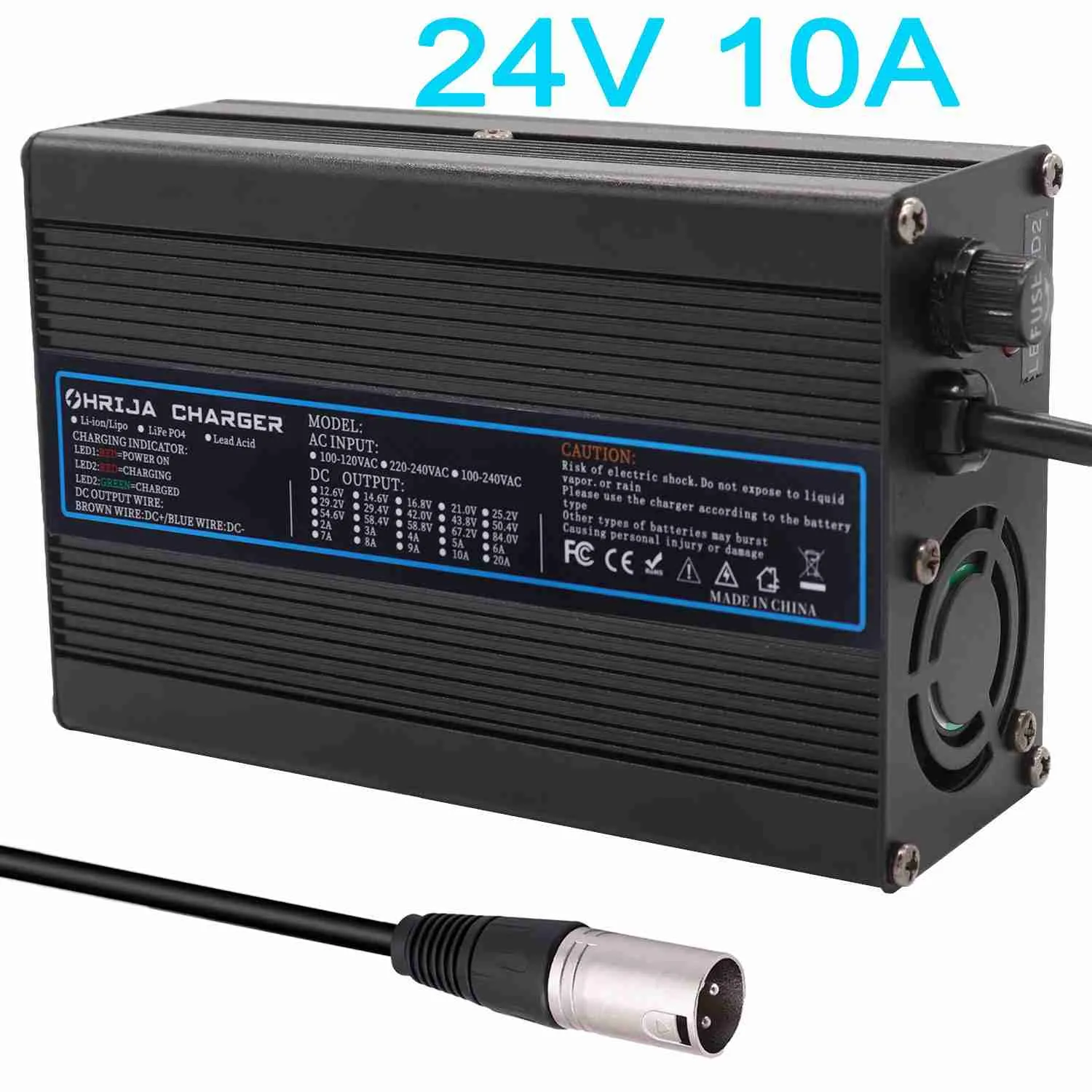
OHRIJA 24V 10A Electric Wheelchair Charger
This charger is listed for 24V lead-acid battery applications, with a maximum rated output current of 10A and a maximum working power of 290W. Its stated dimensions are 135 × 90 × 50 mm, with a listed weight of 0.9 kg. Available shell colors are listed as black, silver, red, blue, and green.
Input plug options include US, EU, UK, and AU types. Listed output connector options include XT60, XT90, crocodile clips, Anderson 50A, wire nose, DC 5.5 × 2.5, GX16 1+3, XLR, IEC C13, and 45A connectors. The correct plug and output connector must be selected for the destination market and the actual battery port.
Important compatibility check: The listed output-voltage options are not interchangeable assumptions. Confirm which voltage configuration applies to the exact unit, whether the charger supports the battery’s lead-acid subtype, and whether its charging algorithm matches the battery datasheet.
View the OHRIJA 24V 10A Electric Wheelchair Charger
Who should consider this charger?
It may be worth evaluating for users who need a replacement charger for compatible 24V lead-acid electric wheelchair batteries and whose battery specifications permit the listed output current and voltage. It is not a universal charger for every 24V battery or wheelchair.
Before purchase, provide OHRIJA or the supplier with the battery model, chemistry, capacity, required charging voltage, and connector details. Ask for confirmation of the exact charging profile and connector wiring. If the battery manufacturer specifies a different output voltage or maximum current, follow that specification rather than selecting the charger by nominal voltage alone.
Common Mistakes When Choosing a Lead-Acid Battery Charger
- Matching nominal voltage only: The charger’s actual charging voltage and profile must also suit the battery.
- Assuming all lead-acid batteries are the same: Flooded, AGM, and gel batteries can have different charging requirements.
- Choosing the highest amperage: The battery’s permitted charging current sets the limit, not the charger’s marketing claim.
- Ignoring the connector pinout: Similar-looking plugs may have different wiring or polarity.
- Using a lithium charger on a lead-acid battery—or vice versa: Charging algorithms and protection requirements differ by chemistry.
- Overlooking temperature: Charging voltage and performance can change with temperature, and both battery and charger have operating limits.
- Assuming automatic means foolproof: An automatic charger can still be wrong for the battery if its profile is incompatible.
- Ignoring battery condition: A failing battery may not recover even when connected to a compatible charger.
- Skipping the technical datasheet: Output voltage, current, charging stages, safety features, and connector details should be confirmed before ordering.
Expert Recommendation: Select for Compatibility First, Speed Second
Our recommendation is to treat battery compatibility as a pass-or-fail requirement. First verify the battery’s nominal voltage, type, capacity, charging-voltage limits, and connector. Then compare chargers that meet those requirements on current, charging time, protection features, warranty, and cost.
For beginners, an automatic charger with a clearly documented profile for the exact battery type is generally the easier option. For commercial users, evaluate reliability, service support, connector standardization, and charging turnaround across the complete fleet. For heavy-duty applications, obtain the battery and equipment manufacturer’s written requirements before specifying a replacement charger.
Choose a higher-current model only when the battery permits it and faster charging provides a real operational benefit. If the existing charger already follows the correct profile and meets the operating schedule, replacing it with a more powerful unit may offer little value. A compatible charger that operates correctly is a better investment than a faster charger that exceeds the battery’s requirements.
Frequently Asked Questions About Choosing the Right Lead-Acid Battery Charger
How do I know which lead-acid battery charger I need?
Check the battery’s nominal voltage, chemistry, capacity, recommended charging current, charging-voltage limits, and connector. Then select a charger with a documented compatible profile and suitable safety features. Confirm the exact model against the battery manufacturer’s instructions. Can I use a 12V charger on a 12V AGM battery?
Only if the charger is designed for the battery’s charging requirements. The nominal voltage alone is not sufficient; the charging voltage, algorithm, current, and temperature limits must be compatible with the AGM battery specification. Is a higher-amp lead-acid charger better?
Not automatically. A higher-current charger may reduce charging time if the battery is designed to accept that current. If the current exceeds the battery’s permitted limit, the charger may be unsuitable. Follow the battery manufacturer’s recommendation. How long does it take to charge a lead-acid battery?
Charging time depends on battery capacity, depth of discharge, charger current, battery condition, temperature, and charging stages. Dividing the amp-hours that need to be restored by average current gives only a rough estimate because current often tapers during absorption. Can I leave a lead-acid battery connected to a charger overnight?
Only when the charger and battery manufacturers permit that use. A compatible automatic charger designed for the relevant charging or maintenance mode may support overnight charging, but a manual charger or a unit without suitable control may require supervision. Can one charger charge flooded, AGM, and gel batteries?
Some chargers provide selectable profiles for multiple lead-acid battery types, but not all do. Confirm that the specific model supports the exact battery type and uses the correct charging settings. Never assume a generic lead-acid setting is appropriate for every battery. Can I use a lead-acid charger for a LiFePO4 battery?
Do not assume compatibility. LiFePO4 batteries require an appropriate lithium charging profile and protection arrangement. Use a charger explicitly specified for the battery chemistry and model. What should I check when replacing an electric wheelchair charger?
Verify the battery voltage, chemistry, capacity, required charging voltage and current, connector dimensions, pinout, and polarity. Confirm the replacement charger’s profile and input plug for the destination market before ordering.
References
Use the battery and charger manufacturers’ technical documentation as the final authority for model-specific charging limits. The following organizations provide relevant safety and technical resources.
- Battery University — educational resources on rechargeable battery behavior, charging principles, and battery care.
- UL Solutions — information on product safety evaluation and certification relevant to electrical equipment.
- U.S. Occupational Safety and Health Administration (OSHA) — workplace safety guidance relevant to electrical hazards and safe battery-handling practices.