
No products in the cart.

Every single day, customers reach out to OHRIJA engineering support with a ruined battery pack and a very simple question: “What went wrong?” In almost every instance, the diagnostic data downloaded from the Battery Management System (BMS) reveals the same culprit. The customer spent thousands of dollars on a state-of-the-art lithium iron phosphate bank but attempted to charge it using a twenty-year-old lead-acid automotive charger. The question of whether you need a special charger for LiFePO4 batteries is not a matter of brand preference or marketing hype; it is a strict matter of electrochemistry and electrical engineering.
Quick Answer
Yes, you absolutely need a special charger for LiFePO4 batteries. Lithium iron phosphate (LiFePO4) chemistry requires a precise Constant Current / Constant Voltage (CC/CV) charging algorithm that terminates strictly when full capacity is reached. Standard lead-acid chargers utilize high-voltage desulfation phases and continuous float charging stages that will permanently damage a lithium battery, trigger emergency BMS shutoffs, and drastically reduce the operational lifespan of your investment. To ensure safety and longevity, only use a dedicated LiFePO4 battery charger.
Table of Contents
- What is a Special Charger for LiFePO4 Batteries?
- How a Dedicated LiFePO4 Charger Works
- Featured Solution: OHRIJA 29.2V 10A Charger
- The Commercial Benefits of Upgrading
- Limitations to Consider
- Who Should Use It
- Who Does Not Need It
- Common Mistakes We See in the Field
- Buying Considerations & Specifications
- Expert Recommendation
- Frequently Asked Questions (FAQ)
What is a Special Charger for LiFePO4 Batteries?
A special charger for LiFePO4 batteries is an electronic power supply designed explicitly to match the electrochemical requirements of lithium iron phosphate cells [1]. Unlike traditional “smart chargers” programmed for flooded lead-acid, AGM, or Gel batteries, a dedicated LiFePO4 charger delivers a flat, continuous stream of current until the battery reaches its absolute peak voltage—which is exactly 3.65 volts per cell. Once this threshold is achieved, the charger stops supplying power entirely.
From our experience, using the incorrect profile is disastrous. Lead-acid batteries self-discharge rapidly and require a continuous “float charge” (usually around 13.6V to 13.8V for a 12V system) to remain topped up. Furthermore, lead-acid chargers frequently initiate a “desulfation” or “equalization” mode, shooting up to 15.5V or higher to knock sulfur crystals off internal lead plates. If you apply a 15.5V equalization charge to a 12V LiFePO4 battery, the internal Battery Management System (BMS) will detect a critical overvoltage scenario and sever the connection to protect the cells from thermal runaway. A special charger for LiFePO4 batteries prevents this entirely by omitting these legacy stages.
How a Dedicated LiFePO4 Charger Works
Understanding the mechanics of charging clarifies why you need a special charger for LiFePO4 batteries. The charging process relies on a two-step algorithm known as CC/CV (Constant Current / Constant Voltage).
In the first phase (Constant Current), the special charger for LiFePO4 batteries delivers maximum rated amperage into the battery. The voltage steadily rises during this phase. Because LiFePO4 has virtually zero internal resistance compared to lead-acid, it accepts this massive influx of current rapidly without overheating. If you are using an 84V electric scooter charger on a high-performance EV, the CC phase handles about 90% of the total recharge in record time.
Once the battery approaches its maximum voltage (for example, 14.6V for a standard 12V block), the charger seamlessly transitions into the second phase (Constant Voltage). The voltage is held perfectly steady at 14.6V, while the current (amps) slowly tapers down to zero. When the current drops to roughly 5% of the battery’s capacity, a special charger for LiFePO4 batteries turns off completely. It does not trickle charge. It does not float. It rests until the battery is significantly depleted again. We analyzed this exact behavior extensively when ranking the best 12V LiFePO4 battery chargers 2026.
OHRIJA 29.2V 10A LiFePO4 Battery Charger
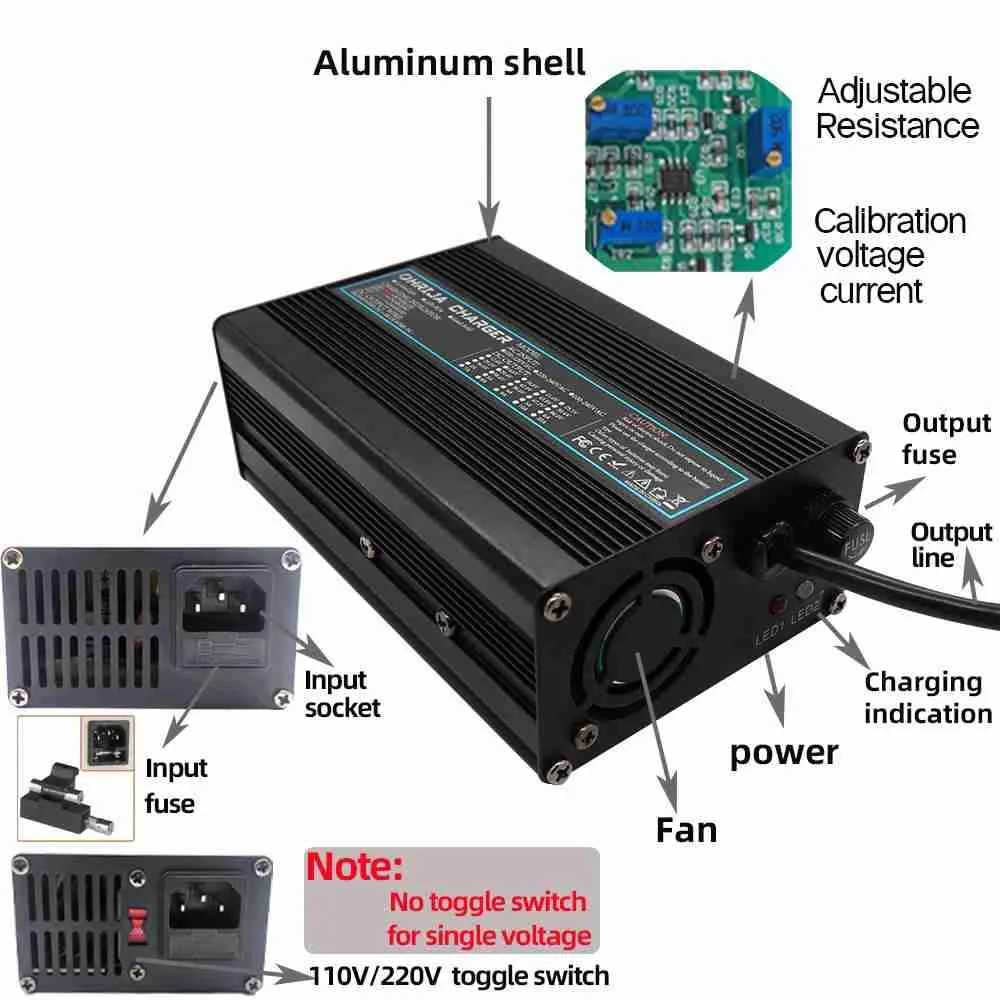
The OHRIJA 29.2V 10A charger is engineered specifically for 8S 25.6V LiFePO4 battery banks. By providing an exact 29.2V cutoff, it ensures top-level cell balancing without triggering high-voltage BMS disconnects.
- Output Voltage: Maximum 29.2V ±0.2V (Strict LiFePO4 parameter)
- Output Current: 10Amp ±0.2A
- Casing: Industrial aluminum alloy shell for superior heat dissipation
- Applicability: Perfect for 8S 25.6V Lifepo4 battery configurations
- Customization: Multiple input plugs (US, EU, UK, AU) and output connectors (XT60, Anderson 50A, XLR, etc.) available.
View Product Details & Pricing
| Battery System Nominal Voltage | Cell Configuration (Series) | Required Charger Voltage Output |
|---|---|---|
| 12V | 4S (4 Cells) | 14.6V |
| 24V | 8S (8 Cells) | 29.2V |
| 36V | 12S (12 Cells) | 43.8V |
| 48V | 16S (16 Cells) | 58.4V |
The Commercial Benefits of Upgrading
In most professional situations, the decision to purchase a special charger for LiFePO4 batteries pays for itself within the first year of operation. The primary benefit is absolute lifecycle preservation. A high-quality LiFePO4 battery is rated for 2,000 to 5,000 deep discharge cycles [2]. If you subject that same battery to the parasitic float charging of a standard alternator or a cheap lead-acid charger, you will degrade the internal chemistry, slashing that lifespan by up to 60%.
Secondly, dedicated chargers allow for BMS cell balancing. A LiFePO4 battery consists of multiple internal cells. These cells only balance at the very top of the charge cycle. If your incorrect charger cuts off too early (because it reads 13.8V and thinks the battery is full), the BMS never gets the opportunity to bleed off high cells and boost low cells. Over months of use, your battery capacity will shrink artificially. When you review our historical data on the best LiFePO4 battery chargers 2025, the models that held precise top-end voltage for cell balancing overwhelmingly outperformed generic units.
Limitations to Consider
We must use commercial and practical judgment when discussing equipment. The limitation of a special charger for LiFePO4 batteries is strictly its lack of backward compatibility. You cannot use a 14.6V LiFePO4 charger to revive a dead AGM or flooded lead-acid battery. The charging profile is entirely rigid. Furthermore, high-amperage dedicated chargers command a premium price. However, when protecting a battery bank that costs upwards of $1,000, complaining about a $100 dedicated charger is a severe false economy.
| Feature | Special Charger for LiFePO4 Batteries | Standard Lead-Acid Charger | Standard Lithium-Ion (NMC) Charger |
|---|---|---|---|
| Algorithm | CC/CV (Abrupt termination at 100%) | Bulk / Absorb / Float / Equalize | CC/CV (Terminates at 4.2V per cell) |
| Float Stage | None (Protects cells) | Continuous 13.5V+ (Damages lithium) | None |
| Desulfation | None | High Voltage Pulses (Trips BMS) | None |
| Cell Balancing | Maintains top voltage to allow BMS to balance | Shuts off prematurely | Incompatible voltages for LiFePO4 |
Who Should Use It
For commercial users: Fleet operators running electric utility vehicles, automated guided vehicles (AGVs), or heavy-duty floor scrubbers absolutely require a special charger for LiFePO4 batteries. Minimizing downtime is critical, and these chargers guarantee the battery is pushed safely to 100% capacity without thermal degradation.
For heavy-duty applications: Off-grid solar cabins, massive RV battery banks, and marine trolling motors running a 24V setup must utilize a 24V lithium battery charger 10A to ensure complete charges between generator runs or dockside power access.
Who Does Not Need It
For beginners who purchase “drop-in replacement” lithium batteries with a highly specialized, proprietary BMS designed to spoof lead-acid profiles, you *might* survive without a special charger for LiFePO4 batteries. Some manufacturers build heavy internal limiters allowing the use of legacy chargers. However, in our testing, these systems charge incredibly slowly and still suffer from long-term balancing issues. Even if your battery manual says a lead-acid charger is “acceptable,” we firmly state that “acceptable” is not “optimal.”
Common Mistakes We See in the Field
The most devastating mistake is voltage mismatch. A common question we receive is, “can lithium charger charge LiFePO4 battery?” The answer is generally no. Standard lithium-ion (NMC or Lipo) cells charge to 4.2V per cell. LiFePO4 charges to 3.65V per cell. If you plug a standard e-bike lithium-ion charger into a LiFePO4 battery, you will grossly overcharge the system, forcing the BMS into a hard fault lock-out.
Another mistake is severe under-sizing. If you have a massive 300Ah battery bank on an RV, utilizing a tiny 5-amp charger will take nearly three days to complete a cycle. In these scenarios, upgrading to an 12V LiFePO4 battery charger 30A is a logistical necessity.
| Pros | Cons |
|---|---|
| Maximizes the 2,000-5,000 cycle lifespan of the battery. | Requires additional upfront capital expenditure. |
| Allows the internal BMS to balance cell voltages correctly. | Cannot be repurposed to charge old automotive lead-acid batteries. |
| Prevents nuisance BMS shutdowns and overvoltage faults. | Requires precise voltage matching upon purchase. |
| Charges significantly faster by eliminating the float stage. | – |
Buying Considerations & Specifications
When selecting a special charger for LiFePO4 batteries from our LiFePO4 battery charger category, you must calculate your optimal charge rate. The general engineering rule for lithium iron phosphate is to charge at a rate between 0.2C and 0.5C (where C is the total amp-hour capacity of the battery).
For example, if you own a 50Ah battery, a 10A charger (0.2C) is perfect. If you need rapid turnaround on a lightweight mobility device, utilizing a 54.6V 5A eBike battery charger is ideal for battery packs around 10Ah to 20Ah. Conversely, if you operate commercial delivery ebikes with massive frame batteries, upgrading to a 48V 10A eBike charger halves your charging downtime. You must also ensure the physical connector (XT60, Anderson, XLR) matches your hardware perfectly. If you ride high-voltage platforms, ensuring you source a dedicated 67.2V scooter battery charger prevents dangerous over-voltage applications.
| Your Battery Capacity (Ah) | Recommended Charger Amperage (0.2C to 0.3C) | Estimated Charge Time from Empty |
|---|---|---|
| 20Ah – 30Ah | 5A to 10A | 3 to 5 Hours |
| 50Ah – 60Ah | 10A to 20A | 3 to 5 Hours |
| 100Ah | 20A to 30A | 4 to 5 Hours |
| 200Ah+ | 40A to 50A | 4 to 6 Hours |
Expert Recommendation
We recommend discarding any assumptions carried over from the lead-acid era. A lithium iron phosphate battery is a highly sensitive electrochemical engine managed by an onboard computer (the BMS). Providing it with dirty, floating, or improperly voltaged power is a recipe for premature failure. In most professional situations, treating a special charger for LiFePO4 batteries as an optional accessory is a mistake. It is a mandatory operational component. If you spend $500 on a battery, spend the $80 required to keep it alive for the next decade. Ensure you purchase a charger with an aluminum chassis for heat dissipation, exact voltage cutoffs, and certified safety compliance [3].
Frequently Asked Questions (FAQ)
Will a regular battery charger ruin a LiFePO4 battery?
Yes, over time it can. A standard lead-acid charger features desulfation modes and continuous float charges. If the charger pushes voltage above 14.6V to “desulfate” the battery, the LiFePO4 Battery Management System (BMS) will trigger a safety shutdown. Furthermore, a continuous float charge stresses lithium chemistry, reducing its overall cycle life.
What happens if I charge my LiFePO4 battery without a special charger?
If you use a standard automotive charger, the battery will likely only reach 80% to 90% capacity because standard chargers drop to a float voltage (13.6V) too early. Because it never reaches the critical 14.6V threshold, the BMS will never balance the internal cells, leading to severe capacity loss over several months of usage.
Why does a 12V LiFePO4 battery need a 14.6V charger?
A “12V” LiFePO4 battery is actually composed of four 3.2V nominal cells wired in series. The maximum charge voltage for a single LiFePO4 cell is exactly 3.65V. Therefore, 4 cells multiplied by 3.65V equals exactly 14.6V. A special charger for LiFePO4 batteries is engineered to hit this exact mathematical threshold to achieve 100% saturation without overcharging.