
No products in the cart.

Choosing between switching power supplies and linear power supplies is not simply a question of buying the newer technology. The right choice depends on load current, output stability, electrical noise, heat, available space and the demands of the equipment being powered. A compact switching supply is often the practical choice for battery chargers and modern electronic products, while a linear supply can still make sense when exceptionally low noise and straightforward regulation matter more than efficiency.
Quick Answer: Switching vs. Linear Power Supplies
A switching power supply converts electrical power by rapidly switching semiconductor devices and controlling the resulting energy through inductive and capacitive components. A linear power supply regulates voltage by operating a transistor in its linear region. Switching designs generally deliver higher efficiency, less heat and a smaller size. Linear designs usually offer lower switching noise and simpler output behavior. For most commercial battery chargers, adapters and compact DC equipment, we recommend a properly designed switching power supply. Choose linear regulation when noise sensitivity is the deciding factor and the power level is manageable.
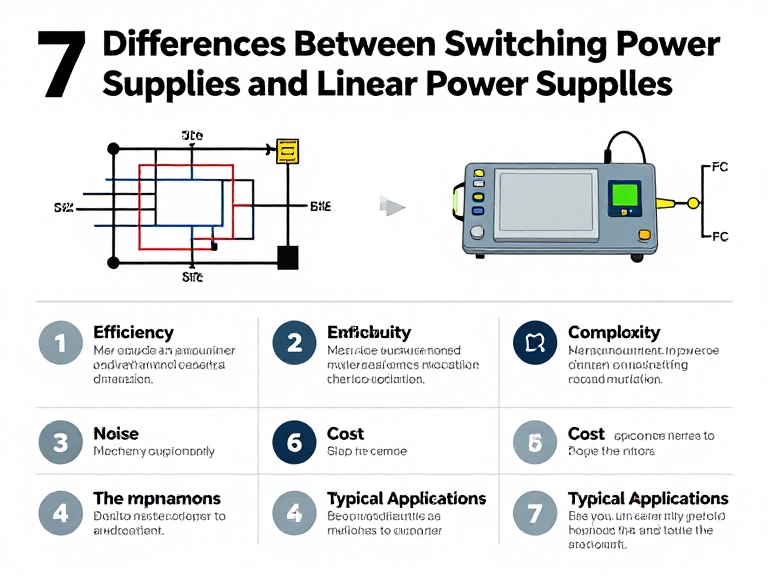
Table of Contents
- What is the difference between switching and linear power supplies?
- How the two power supply types work
- 7 key differences explained
- Switching vs. linear comparison table
- Pros and cons of each design
- Best applications and who should use each type
- Common selection mistakes
- How to choose a power supply
- Where OHRIJA fits into the decision
- Frequently asked questions
- References
What Is the Difference Between Switching Power Supplies and Linear Power Supplies?
The main difference between switching power supplies and linear power supplies is how they regulate and convert electrical energy. A switching power supply uses high-frequency switching to transfer energy efficiently. A linear power supply controls the voltage drop across a regulating transistor to maintain a stable output.
That difference affects almost every practical buying consideration. Switching power supplies are usually more efficient, lighter and better suited to higher-power applications. Linear power supplies are often easier to design for very low-noise output, but they can waste substantial energy as heat, particularly when the input-to-output voltage difference is large.
For example, consider a manufacturer building a 48V battery charger. A switching design is generally the more sensible starting point because it can handle useful charging power without requiring an oversized heat sink. By contrast, a laboratory engineer powering a sensitive analog circuit may prefer a linear supply for a particularly quiet output rail.
Neither technology is automatically better. The important question is whether the supply’s characteristics match the electrical requirements of the device.
How Switching and Linear Power Supplies Work
How a Switching Power Supply Works
A switching power supply rapidly turns power semiconductor devices on and off. Its control circuit adjusts the switching operation to regulate the amount of energy delivered to the output. Depending on the topology, components such as transformers, inductors, capacitors, rectifiers and feedback circuits transfer and condition that energy.
In an isolated AC-to-DC design, the input is typically rectified before a switching stage transfers energy through a high-frequency transformer. The secondary side then rectifies and filters the output. Feedback continuously monitors the output and adjusts switching behavior when the load or input changes.
This approach makes it possible to build compact supplies with a wide input range and relatively high output power. It is widely used in adapters, industrial equipment, battery chargers and electronic products.
How a Linear Power Supply Works
A linear power supply generally uses a transformer or another suitable source to provide a voltage above the required output. The input is rectified and filtered, then a regulating element controls the voltage delivered to the load.
The regulating transistor operates in its linear region, effectively dropping excess voltage while maintaining the required output. This can produce a low-noise supply, but the voltage dropped across the regulator becomes heat. The larger the voltage difference and load current, the more heat the circuit must dissipate.
That is why a linear supply delivering substantial current from a relatively high input voltage can become heavy and inefficient. Its simplicity at the regulation stage does not mean that the complete product is always simple or inexpensive to build.
Recommended products

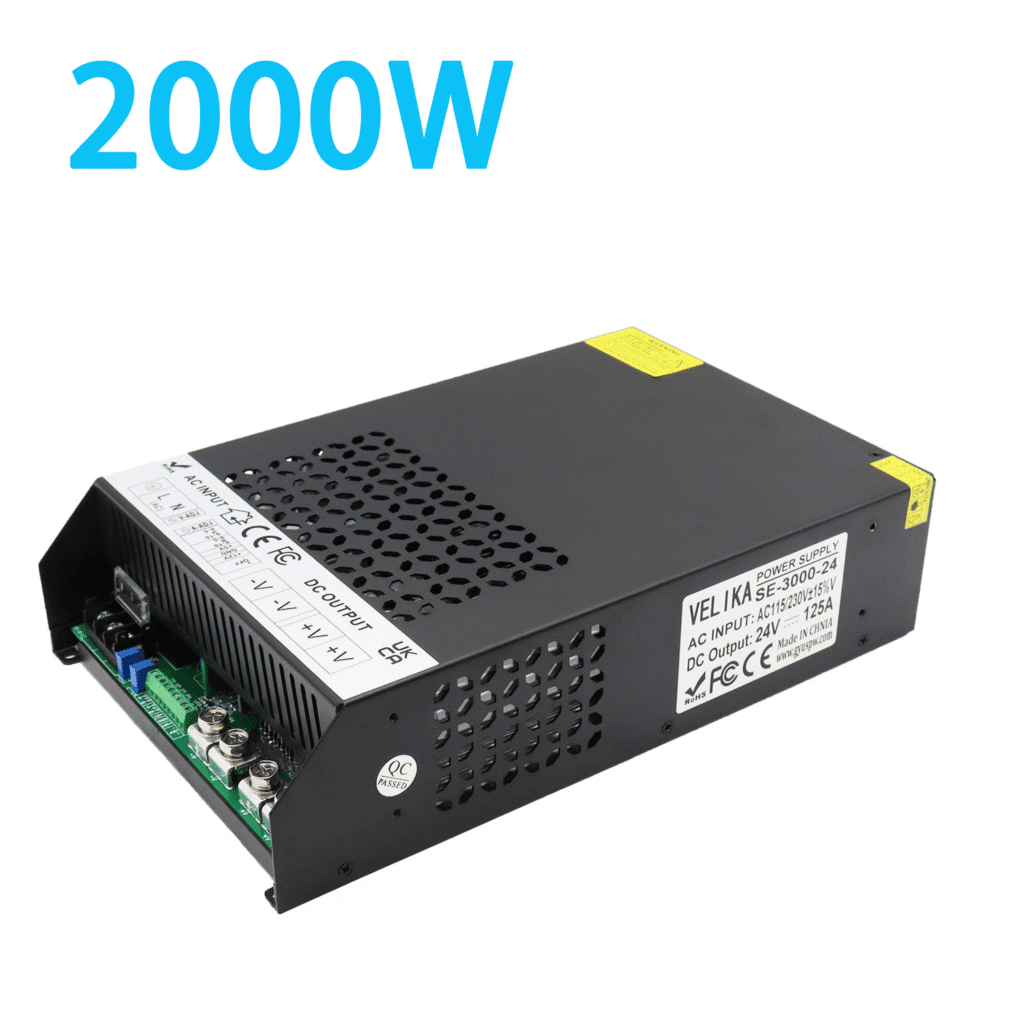
2000 Series 2000W High Power AC‑DC Switching Power Supply | AC185‑265V Input, Multiple DC Output 12V 24V 36V 48V 60V 72V 80‑120V & Custom Voltage For Industrial Equipment
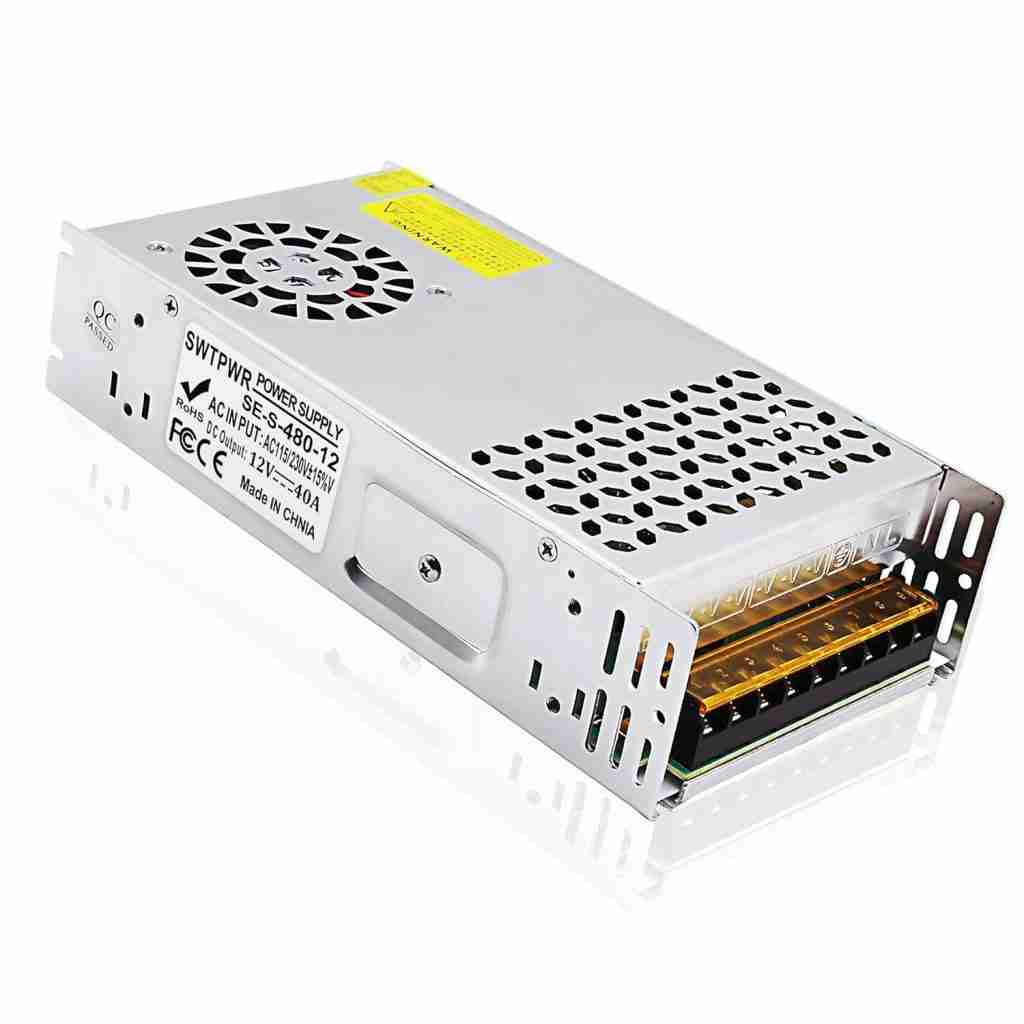
Price range: 64.80$ through 69.80$12V Power Supply 12V 40A 480W 50A 600W AC to DC Converter 110V/120V to 12V Transformer LED Driver Smart Cooling Fan Designed for LED Strip CCTV and Car Devices
Price range: 13.90$ through 14.90$Intelligent adjustable voltage and current charger 9.6 – 88.2V 2 – 20A high-power DC adjustable power supply charger with digital display, constant current and constant voltage automatic switching. Suitable for lithium batteries / lead-acid batteries / batteries.
49.90$
-1024x1024.jpg "7 Differences Between Switching Power Supplies and Linear Power Supplies 4")
7 Key Differences Between Switching Power Supplies and Linear Power Supplies
1. Energy Efficiency
Efficiency is usually the most commercially important difference. Switching power supplies are generally more efficient because their main switching devices spend much of their operating time either fully on or fully off. This reduces the power lost in the switching devices, although real losses still occur in semiconductors, magnetic components, control circuits and other parts.
Linear supplies continuously dissipate power across the regulating element. If a regulator drops 10V while supplying 2A, it must dissipate approximately 20W as heat, before accounting for other losses. That heat is energy the system has paid for but cannot deliver to the load.
Our recommendation: For equipment that operates for long periods or charges batteries regularly, prioritize an efficient switching design. The energy savings and reduced thermal burden can be significant over the product’s service life.
2. Output Noise and Electromagnetic Interference
Switching power supplies generate high-frequency switching signals. These can create conducted and radiated electromagnetic interference if the circuit layout, filtering, grounding and shielding are not properly engineered. Output ripple and switching-related noise also need to be controlled.
Linear supplies do not have the same high-frequency switching action in their regulation stage. They can therefore be easier to use in low-noise analog circuits, precision measurement equipment and sensitive audio applications.
However, a linear supply is not automatically noise-free. Rectifier ripple, transformer coupling, grounding problems and poor filtering can still affect its output. Likewise, a well-designed switching supply can meet demanding noise and EMC requirements.
Our recommendation: If the load is sensitive to noise, check the actual ripple, noise spectrum and EMC performance rather than choosing based on the technology label alone.
3. Size and Weight
Switching power supplies usually have a clear advantage in size and weight, particularly as output power increases. Their high-frequency operation allows the use of smaller magnetic components than those typically required by traditional low-frequency transformer-based linear supplies.
Linear supplies often need a larger transformer and heat sink. These components add weight and make compact product integration more difficult.
For portable equipment, enclosed battery chargers and products with limited internal space, the physical difference can influence the entire product design. A smaller supply may also reduce packaging and installation constraints.
Our recommendation: For portable or space-constrained equipment, start by evaluating switching power supplies. A linear design should have a clear technical reason to justify its additional bulk.
4. Heat Generation and Thermal Management
Heat is closely connected to efficiency, but it deserves separate attention because it affects reliability, enclosure design and component life.
A linear regulator can generate considerable heat when it supplies high current or drops a large voltage. The designer may need a substantial heat sink, ventilation or a larger enclosure. High internal temperatures can place additional stress on nearby components.
Switching supplies generally produce less heat for the same useful output power when efficiency is higher. They still require careful thermal design: transformers, MOSFETs, rectifiers, inductors and capacitors all have temperature limits.
Our recommendation: Compare measured temperature rise at the intended load, input voltage and ambient temperature. Do not assume a supply is suitable for continuous operation just because its rated output current looks adequate.
5. Circuit Complexity and Design Requirements
A basic linear regulator circuit can be relatively straightforward. Its design is often easier to understand, troubleshoot and adapt for low-noise applications. That simplicity can be useful in low-power equipment and specialist electronics.
A switching power supply requires more attention to switching frequency, feedback-loop stability, magnetic design, PCB layout, component selection, EMI filtering and protection. Poor layout or inadequate control-loop design can cause noise, instability or excessive component stress.
However, circuit complexity should not be confused with product quality. A properly engineered switching supply is a mature commercial solution. The real concern is whether the manufacturer has the design capability and production controls to deliver consistent performance.
Our recommendation: When purchasing a switching supply, assess the manufacturer’s engineering capability, validation process and documentation—not just the price per unit.
6. Cost and Total Cost of Ownership
The initial purchase price does not tell the whole story. A linear supply may be attractive for a low-power, low-volume application, especially when the design is simple and the required output is modest. But the transformer, heat sink, enclosure and thermal requirements can increase its total cost.
Switching supplies may require more sophisticated design and testing. In commercial production, however, their smaller size, lower heat generation and higher efficiency can reduce system-level costs.
For a battery charger used every day, the cost of wasted energy and thermal management matters over time. For a low-duty-cycle laboratory instrument, the energy difference may be less important than low output noise.
Our recommendation: Calculate total cost of ownership using purchase price, energy consumption, cooling requirements, maintenance, operating hours and expected service life.
7. Voltage Regulation and Load Response
Both technologies can provide regulated output, but their dynamic behavior depends on the circuit design. Linear regulators can offer excellent regulation and fast response for suitable applications. Switching supplies can also provide accurate regulation, but their performance depends on topology, feedback design, operating conditions and output filtering.
When a load suddenly changes, the output may briefly move away from its target voltage before the control system responds. The size and duration of that deviation are important when powering processors, communication equipment, motors or battery systems.
For battery charging, stable voltage and current control are essential. The supply must also match the battery chemistry and charging profile. A generic regulated DC supply should not be treated as a suitable battery charger unless the charging control and protection functions are specifically designed for that battery.
Our recommendation: Compare load regulation, line regulation, transient response, ripple and protection behavior using the actual operating conditions—not a single headline voltage rating.
Switching Power Supplies vs. Linear Power Supplies: Comparison Table
The table below summarizes the practical differences. These are general tendencies, not guarantees: specific performance depends on the design, components, operating range and manufacturer quality.
| Comparison Factor | Switching Power Supply | Linear Power Supply | Practical Advantage |
|---|---|---|---|
| Efficiency | Generally higher | Often lower, especially with large voltage drops | Switching |
| Output noise | Requires control of switching ripple and EMI | Can achieve very low noise with suitable filtering | Linear for noise-sensitive loads |
| Size and weight | Usually compact and lightweight | Often larger and heavier | Switching |
| Heat generation | Usually lower at comparable output power | Can be substantial | Switching |
| Design complexity | More demanding switching, layout and EMI design | Often simpler regulation stage | Linear for basic circuits |
| High-power suitability | Generally well suited | Can become bulky and thermally demanding | Switching |
| Typical applications | Adapters, chargers, industrial DC supplies | Low-noise analog and laboratory circuits | Depends on load requirements |
| System cost | Often favorable in compact, efficient products | Can be economical for simple, low-power designs | Depends on total ownership cost |
Pros and Cons of Switching and Linear Power Supplies
| Technology | Advantages | Disadvantages | Best Fit |
|---|---|---|---|
| Switching power supply | High efficiency, compact size, lower heat at comparable output, suitable for a broad range of power levels | More demanding EMI control, switching ripple, more complex design and troubleshooting | Battery chargers, adapters, industrial equipment and compact DC systems |
| Linear power supply | Low-noise output potential, straightforward regulation, useful for sensitive analog applications | Lower efficiency in many designs, more heat, larger transformer and heat sink requirements | Precision analog circuits, low-noise instruments and selected low-power systems |
For most mainstream commercial products, the switching design offers the stronger balance of efficiency, size and usable output power. The linear option earns its place when low noise is a genuine system requirement—not simply because it sounds like a simpler technology.
Which Power Supply Should You Use?
Choose a Switching Power Supply for Battery Chargers
Battery chargers often need to deliver meaningful power while keeping the product compact and thermally manageable. Switching technology is therefore widely used in modern lithium-ion, LiFePO4 and lead-acid charger designs.
For example, a charger designed for a golf cart or mobility product may need to operate for several hours and deliver a controlled charging profile. A well-designed switching charger can provide efficient power conversion in a practical enclosure.
Explore OHRIJA’s lead-acid battery chargers and golf car battery chargers when comparing charger categories for these applications.
Choose a Linear Power Supply for Sensitive Analog Equipment
Some audio, measurement and analog circuits are sensitive to power-supply noise. In those cases, a linear supply may reduce the filtering burden and simplify the noise-control strategy.
That does not mean every audio or measurement device needs a linear supply. Many modern instruments use switching conversion followed by additional filtering or linear post-regulation. The right solution is the one that meets the noise specification at an acceptable cost.
Choose According to the Output Requirements of Industrial Equipment
Industrial applications require more than a nominal voltage and current rating. Input range, continuous-load capability, transient response, isolation, operating temperature, protection functions and electrical compliance all matter.
For adjustable laboratory or production equipment, compare suitable adjustable power supplies. For fixed DC systems, review the available DC power supply options and match the specification to the load.
Who Does Not Need a Linear Power Supply?
You probably do not need a linear supply if the application is a conventional battery charger, compact adapter, general-purpose DC system or a product where efficiency and size are important but exceptionally low noise is not a requirement. Paying for a larger, hotter supply without a measurable benefit is poor engineering economics.
Common Mistakes When Comparing Switching and Linear Power Supplies
Mistake 1: Assuming Switching Supplies Always Have Poor Output Quality
Switching supplies can produce ripple and EMI, but that does not make them inherently unsuitable for sensitive equipment. Good filtering, shielding, grounding, PCB layout and control-loop design can deliver stable, low-noise output. Evaluate measured performance against the load’s tolerance.
Mistake 2: Assuming Linear Supplies Are Always More Reliable
A linear design may have a simpler regulation stage, but high operating temperatures can shorten component life. Reliability depends on component ratings, thermal margins, manufacturing quality and operating conditions. A well-designed switching supply can be highly reliable.
Mistake 3: Choosing Only by Rated Wattage
A 200W rating does not tell you whether a supply can handle a particular load continuously. Check output voltage, rated current, peak load capability, ambient temperature, cooling conditions and derating curves. For motor-driven or capacitive loads, startup current may be particularly important.
Mistake 4: Confusing a DC Power Supply with a Battery Charger
A regulated DC power supply provides electrical output within its designed limits. A battery charger must also control the charging process according to battery chemistry, voltage limits, current limits, temperature considerations and protection requirements. Do not connect a generic power supply to a battery and assume it will charge safely.
Before selecting a charger, understand the chemistry and battery management requirements. Our guide on charging a LiFePO4 battery with a lithium charger explains why charger compatibility matters.
Mistake 5: Ignoring the Installation Environment
Dust, moisture, vibration, poor ventilation and extreme ambient temperatures can affect power-supply performance. A supply used outdoors or in a washdown environment needs appropriate enclosure protection and installation practices. Check the actual IP rating and the manufacturer’s stated operating conditions rather than relying on a generic description.
For applications where moisture exposure is a concern, compare purpose-built waterproof chargers and confirm that their protection rating matches the real installation conditions.
How to Choose Between Switching and Linear Power Supplies
In most professional situations, the selection process should begin with the load specification—not with a preferred technology. Use the following checks before requesting quotations or approving a design.
1. Confirm the Required Output Voltage and Current
Record the nominal output voltage, minimum and maximum operating current, startup demand and expected continuous load. Allow appropriate headroom, but do not oversize the supply without a reason. An oversized product can increase cost and may operate outside its most efficient region.
2. Define Acceptable Ripple and Noise
Check the load manufacturer’s ripple and noise limits. Make sure the measurement bandwidth and test method are understood when comparing specifications. A ripple figure without a stated measurement method may not be directly comparable with another manufacturer’s result.
3. Calculate the Thermal Requirements
Consider ambient temperature, enclosure size, airflow, mounting position and duty cycle. Request derating information for high-temperature operation. For continuous-duty applications, thermal performance should be part of the purchase specification rather than an afterthought.
4. Check Protection and Safety Features
Depending on the application, relevant features may include overvoltage protection, overcurrent protection, short-circuit protection, overtemperature protection, reverse-polarity protection and electrical isolation. Confirm which functions are built in and how the supply behaves when a fault occurs.
5. Verify Compliance and Documentation
Ask for the technical datasheet, installation instructions, applicable safety and EMC documentation, test reports where relevant, and clear model identification. The required standards depend on the end product, destination market and intended use. A logo or general compliance statement is not a substitute for documentation that applies to the exact model.
6. Evaluate the Manufacturer, Not Just the Product Listing
For commercial buyers, supplier capability can be as important as the circuit design. Check whether the manufacturer can explain the topology, operating range, thermal limits and protection functions. Ask about production testing, component traceability, warranty handling and engineering support.
If your application needs more than a standard unit, discuss the required electrical parameters and mechanical constraints before ordering. OHRIJA offers product categories covering power supplies and power inverters, which can help buyers identify the appropriate product family before confirming a specification.
7. Compare Total Cost Rather Than Unit Price
Include energy use, cooling, enclosure space, wiring, installation, maintenance and expected service life in your comparison. For high-volume equipment, a small efficiency improvement can become meaningful across thousands of operating hours. For low-volume specialist equipment, low-noise performance may justify a higher initial price.
Cost-Benefit Analysis: When Is Switching Technology Worth It?
Consider a device that needs a regulated DC output and operates for eight hours each working day. A switching supply with higher efficiency can reduce energy lost as heat. It may also reduce the size of the enclosure and the amount of thermal management required.
Now consider a low-power analog test circuit used intermittently. If its noise requirements are strict, the energy savings from switching conversion may be insignificant compared with the engineering effort required to filter and validate the output. A linear supply may be the more economical solution overall.
For commercial users, the useful calculation is not simply which technology has the higher efficiency percentage. It is the combined cost of power consumption, product size, cooling, compliance testing, serviceability and downtime. That is the basis on which a power supply should be selected.
Practical decision rule: Choose switching conversion when efficiency, output power, compact size and thermal performance dominate. Choose linear regulation when very low noise is essential and the power level and heat dissipation are acceptable. If both efficiency and low noise matter, consider a switching front end with appropriate filtering or linear post-regulation.
OHRIJA: Power Supply and Battery Charger Solutions
OHRIJA is a battery charger and power electronics brand belonging to Dongguan Hengruihong Technology Co., Ltd., established in 2020 and headquartered in Dongguan, Guangdong Province, China.
The company integrates research and development, production and sales. Its product range includes lithium battery chargers, LiFePO4 battery chargers, lead-acid battery chargers, golf cart chargers, power adapters and switching power supplies.
For buyers comparing charger and power supply options, the important step is to match the product’s electrical characteristics to the battery or equipment—not simply choose a model based on appearance or advertised wattage.
Explore OHRIJA battery charger solutions.
When to Discuss a Switching Power Supply with a Manufacturer
Contact a manufacturer when your project has defined requirements for input voltage, output voltage, current, operating temperature, enclosure dimensions or charging profile. Providing these details early helps the engineering team determine whether a standard switching supply is suitable or whether a customized design is necessary.
For battery charger projects, also specify the battery chemistry, nominal voltage, capacity, charging current, connector, communication requirements and protection expectations. A charger should be selected as a complete charging solution, not merely as a power conversion module.
For beginners, a standard, documented product is usually a better starting point than a custom design. For commercial users with repeat orders or specialized equipment, a manufacturer with engineering and production capabilities may offer better long-term value.
Expert Recommendation: Which Technology Should You Choose?
Our recommendation is straightforward: choose a switching power supply for most modern commercial power conversion applications, but do not treat efficiency as the only performance target. The supply must also meet output stability, EMI, thermal, safety and reliability requirements.
Choose a linear supply when your circuit genuinely benefits from very low noise and the power level is modest enough to manage the heat and physical size. It is a specialist choice, not a universal upgrade.
If your project needs both efficient conversion and a quiet output, a hybrid approach may be worth evaluating. A switching stage can handle the main power conversion, while additional filtering or a linear post-regulator can reduce noise for sensitive loads. This approach adds design considerations, so it should be validated against the actual load and cost target.
Before placing an order, request the full datasheet and verify performance under realistic input, load and temperature conditions. For a battery charger, confirm battery chemistry compatibility and the complete charging profile. Those checks are more valuable than choosing a product simply because its label says switching or linear.
Frequently Asked Questions
1. What is the main difference between switching power supplies and linear power supplies?
A switching power supply regulates energy by rapidly switching semiconductor devices, while a linear power supply regulates output by controlling a voltage drop across a transistor. Switching designs are generally more efficient and compact. Linear designs can offer lower output noise for suitable applications.
2. Are switching power supplies more efficient than linear power supplies?
Generally, yes. Switching power supplies usually waste less energy during voltage conversion, especially when supplying higher current or converting between substantially different voltages. Actual efficiency depends on topology, load level, input conditions and component quality.
3. Why are linear power supplies often quieter?
A linear supply does not use the same high-frequency switching action in its regulation stage, so it can produce less switching-related noise. However, transformer coupling, rectifier ripple, grounding and filtering still affect output quality. A well-designed switching supply can also achieve low noise.
4. Which power supply is better for battery chargers?
Switching power supplies are commonly better suited to modern battery chargers because they can provide efficient power conversion in a compact enclosure. The charger must still support the correct battery chemistry, charging voltage, current profile and protection functions.
5. Do switching power supplies generate more heat?
Not usually at comparable output power and operating conditions. Switching supplies are generally more efficient and therefore produce less waste heat. They still need thermal management because switching devices, magnetic components and rectifiers generate heat during operation.
6. Can a switching power supply be used for sensitive electronic equipment?
Yes, provided its ripple, noise, transient response and electromagnetic compatibility meet the equipment’s requirements. Sensitive circuits may need additional filtering, shielding, grounding improvements or linear post-regulation.
7. Are linear power supplies outdated?
No. Linear supplies remain useful in low-noise analog circuits, precision instruments and selected low-power applications. They are less attractive where high efficiency, compact size and substantial output power are priorities.
8. Can I use a switching power supply as a battery charger?
Only if the product includes or is paired with the charging control required for the specific battery. A standard regulated power supply does not automatically provide the correct charging stages, voltage limits, current control or battery protection. Use a charger designed for the battery chemistry and application.
9. What should I check before buying a switching power supply?
Check input range, output voltage and current, continuous-load rating, efficiency, ripple and noise, transient response, operating temperature, isolation, protection features, safety and EMC documentation, warranty and manufacturer support. For battery charging, also verify chemistry and charging-profile compatibility.
10. Is a hybrid switching and linear power supply a good option?
It can be. A switching stage can provide efficient main conversion, while filtering or a linear post-regulator can reduce noise for sensitive loads. The added components, heat and cost should be justified by measured performance requirements.
References
Use the following authoritative resources when checking power supply safety, electromagnetic compatibility and applicable product requirements. The exact standards and conformity obligations depend on the equipment type and market.
- International Electrotechnical Commission (IEC) — International electrotechnical standards and technical work relevant to electrical equipment and power conversion.
- European Commission — Electromagnetic Compatibility — Information on the EU EMC framework and harmonised standards relevant to equipment placed on the European market.
- U.S. Department of Energy — Standby Power — Background on electricity consumption associated with powered and standby electronic equipment.
Final takeaway: Switching power supplies are the practical choice for most efficient, compact and higher-power commercial applications. Linear power supplies remain valuable when low noise is the primary requirement. Choose based on measured electrical performance, thermal conditions and the needs of the equipment—not on assumptions about either technology.
