
No products in the cart.

There is more than one way to charge a 48V battery, but there is only one rule you should never compromise: the charging equipment must match the battery chemistry, cell configuration, voltage limits and permitted charging current. A device labelled “48V” is not automatically suitable for every 48V battery.
For most owners, a dedicated battery charger is the safest and simplest solution. Solar charging makes sense for off-grid systems, while a properly configured DC-DC charger is useful when charging from a vehicle or another DC source. A programmable bench power supply can work in controlled technical environments, but it is not the option we recommend for everyday users.
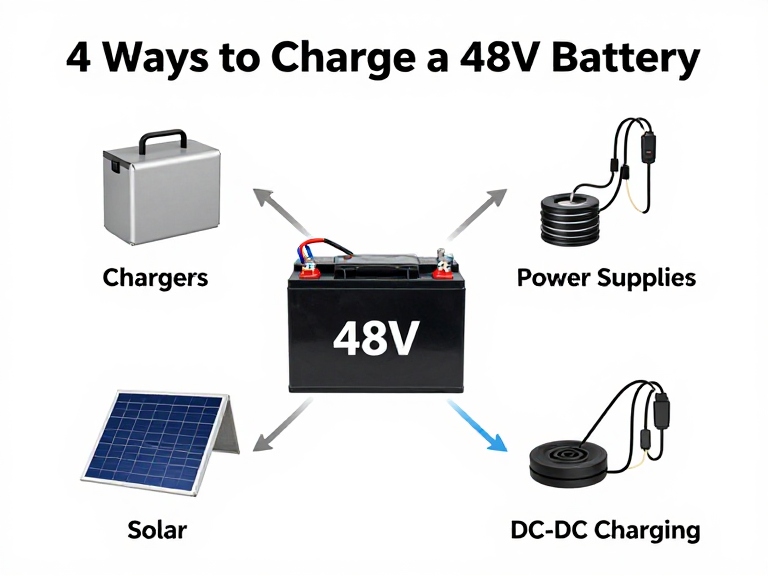
Quick Answer: What are the four ways to charge a 48V battery?
- Dedicated AC battery charger: Connects to mains electricity and uses a charging profile designed for the battery chemistry. Best for everyday charging.
- Programmable DC power supply: Uses controlled voltage and current settings. Suitable for technicians who understand CC/CV charging and battery protection.
- Solar panel with an MPPT charge controller: Converts solar energy into a controlled charging output. Best for off-grid and renewable-energy systems.
- DC-DC battery charger: Charges the battery from another DC source, such as a vehicle alternator or auxiliary battery. Best for mobile and vehicle-based systems.
Our recommendation: identify the battery chemistry and exact full-charge voltage first. For a common 13-series lithium-ion battery, the charging voltage is typically 54.6V. A 16-series LiFePO4 battery commonly requires 58.4V. These are different charging requirements, even though both systems are often marketed as 48V.
The most important thing to check before charging
“48V” describes a nominal battery voltage, not a universal charging voltage. Before selecting a charger, check the battery label or datasheet for chemistry, series configuration, maximum charging voltage, recommended charging current and connector polarity.
For example, OHRIJA’s 54.6V lithium battery charger is specified for a 13S 48.1V lithium-ion battery. It should not be treated as a universal charger for every 48V lithium battery or for a 16S LiFePO4 pack.
In this guide
- What does a 48V battery mean?
- How 48V battery charging works
- Four ways to charge a 48V battery
- Comparison table: which method is best?
- Charging voltage by battery chemistry
- How to choose the right charging current
- Common 48V battery charging mistakes
- What to check before buying a charger
- OHRIJA charger options
- Our expert recommendation
- Frequently asked questions
- References
What Is a 48V Battery?
A 48V battery is a battery pack designed to operate around a nominal voltage of 48 volts. It may be used in electric bicycles, scooters, mobility equipment, golf carts, backup power systems, solar energy storage and industrial equipment.
The important distinction is that the nominal voltage does not tell you the complete electrical specification. A 48V battery can use different cell chemistries and series configurations. Those differences determine its full-charge voltage, discharge limits, charging algorithm and temperature requirements.
Why two 48V batteries may need different chargers
A typical 13S lithium-ion battery uses 13 cell groups connected in series. With conventional 4.2V maximum-charge lithium-ion cells, its full-charge voltage is 54.6V. A common 16S LiFePO4 battery uses 16 series cells, each with a typical maximum charging voltage of 3.65V, giving a pack charging voltage of 58.4V.
Lead-acid batteries have their own charging requirements, which vary with battery construction and the manufacturer’s recommended absorption and float settings. AGM, gel and flooded batteries should not automatically share the same charging profile.
In other words, buying a charger simply because its product title contains “48V” is not enough. The battery specification must match the charger specification.
How Does Charging a 48V Battery Work?
Most lithium battery chargers use a controlled constant-current/constant-voltage process, commonly called CC/CV. During the constant-current stage, the charger supplies a controlled current while the battery voltage rises. When the pack reaches its specified charging voltage, the charger holds that voltage while current gradually decreases.
This is why a proper charger is more than a power adapter. It controls the charging process, limits current, manages the voltage target and terminates or reduces charging according to its design.
What does the battery management system do?
A lithium battery management system (BMS) monitors important battery conditions, which may include cell-group voltage, temperature and current. Depending on the design, it can disconnect charging or discharging when a protection threshold is reached.
However, a BMS is not a substitute for the correct charger. It should be treated as a protection layer, not as permission to connect an unsuitable power supply. Repeatedly relying on BMS cut-offs to stop overcharging is poor charging practice.
Professional rule: the charger should control the normal charging process within the battery manufacturer’s limits. The BMS provides an additional protection function. Both need to be compatible with the battery.
4 Ways to Charge a 48V Battery
1. Use a dedicated 48V battery charger
For most users, a dedicated charger is the best way to charge a 48V battery. It converts AC mains electricity into a controlled DC output and applies a charging profile designed for a specific battery chemistry and voltage configuration.
For example, a 13S lithium-ion battery commonly requires a 54.6V charger. A 16S LiFePO4 battery commonly requires a 58.4V charger. A lead-acid battery requires a charger with a suitable lead-acid charging profile rather than a lithium CC/CV profile.
How to use a dedicated charger
- Read the battery label or datasheet and confirm its chemistry and maximum charging voltage.
- Check that the charger’s output voltage and current are within the battery manufacturer’s permitted limits.
- Confirm connector type and polarity before connecting the charger.
- Place the battery in a dry, ventilated area away from heat and combustible materials.
- Connect the charger according to the battery and charger instructions, then connect the AC input as specified by the manufacturer.
- Monitor the charging indicators and disconnect or allow automatic termination according to the charger’s instructions.
Benefits: straightforward operation, purpose-designed charging control, lower setup complexity and less risk of incorrect manual settings.
Limitations: a dedicated charger may only support one battery voltage configuration, chemistry or connector. A 54.6V charger is not interchangeable with a 58.4V charger simply because both batteries are described as 48V.
Who should use it? Electric bicycle and scooter owners, mobility equipment users, golf cart owners and anyone who wants a practical everyday charging solution.
Our recommendation: choose a dedicated charger with the correct charging profile, adequate current rating and matching connector. For regular personal use, this is the option we would choose first.
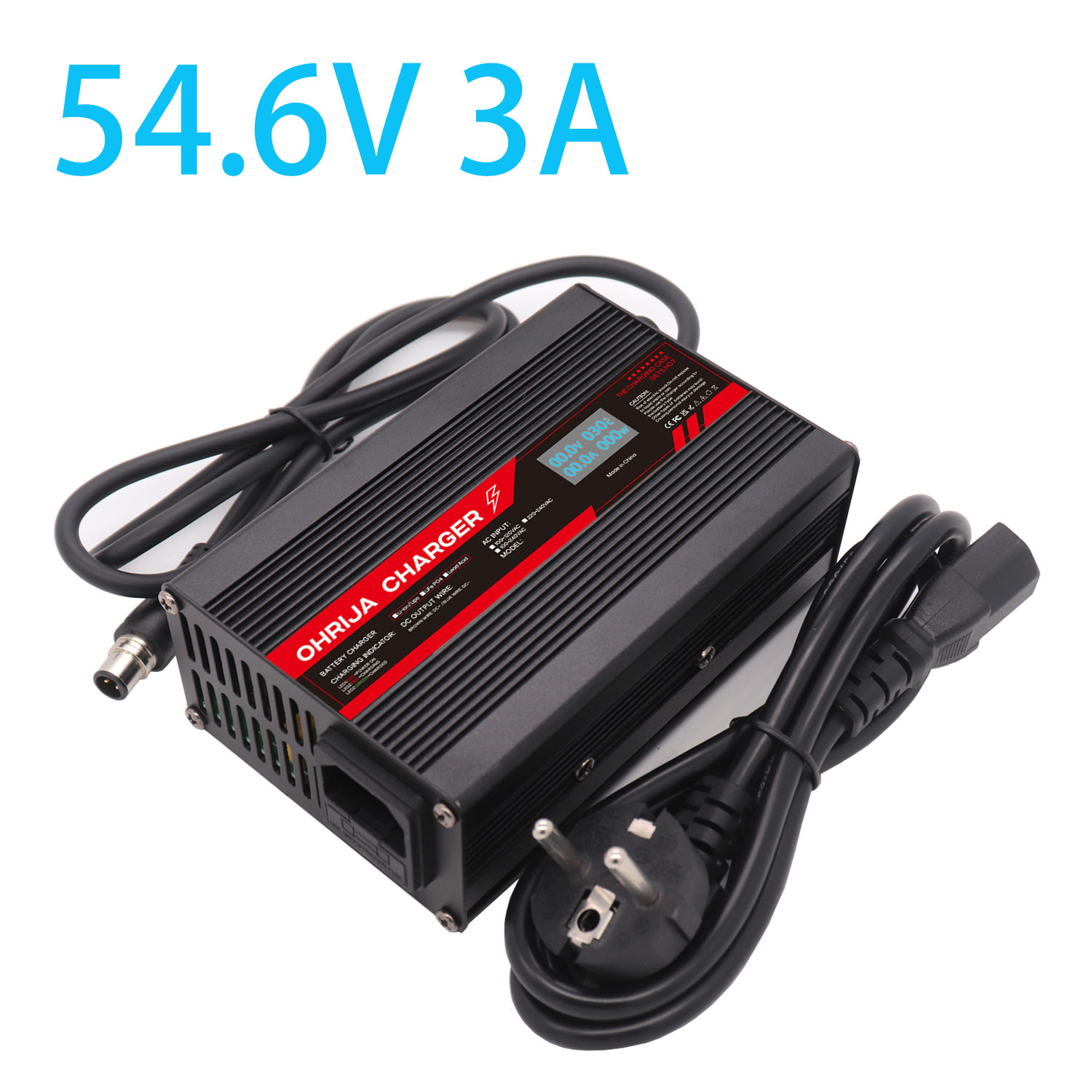
OHRIJA 54.6V lithium-ion charger
The OHRIJA 54.6V 2A, 2.5A and 3A lithium battery charger is specified for 13S 48.1V lithium-ion battery packs. It features an aluminium alloy shell, LCD digital display and AC 100–240V input.
Available output connector options include XT60, XT90, Anderson 50A, crocodile clips, DC 5.5 × 2.5, GX16 and XLR. Select the connector that matches the battery port and confirm polarity before use.
Important: this product is for compatible 13S lithium-ion packs. Do not use it as a 16S LiFePO4 or lead-acid charger.
2. Use a programmable DC power supply
A programmable DC power supply can charge a 48V battery when it supports the required voltage and current limits and can operate with a suitable CC/CV charging method. This approach is more common in electronics laboratories, repair workshops, battery development and controlled engineering environments than in ordinary home charging.
A technician may set a voltage ceiling and current limit that match the battery manufacturer’s charging specification. The supply then provides controlled DC power within those limits. The operator must still account for the battery chemistry, BMS behaviour, temperature limits, connector polarity and charge termination requirements.
How to use a DC power supply for battery charging
- Confirm the battery’s exact chemistry, series configuration and charging specification.
- Use a power supply with a suitable adjustable output range and a verified current limit.
- Set the correct voltage ceiling and current limit before connecting the battery.
- Use appropriate cables, connectors, overcurrent protection and polarity checks.
- Monitor voltage, current and battery temperature throughout the process.
- Stop charging in accordance with the battery manufacturer’s termination requirements.
Do not connect a fixed-voltage industrial power supply directly to a battery unless the manufacturer explicitly specifies that it is suitable for battery charging. A supply rated at 48V is not automatically a 54.6V or 58.4V charger. A power supply without a suitable charging algorithm may also fail to provide the correct termination behaviour.
Benefits: adjustable voltage and current, useful for controlled testing, and flexibility across different projects when the equipment is properly specified.
Limitations: requires technical knowledge, careful configuration and monitoring. It may lack battery-specific features such as temperature compensation, chemistry profiles, cell-balancing support or automatic charge termination.
Who should use it? Experienced technicians, engineers and repair professionals who understand CC/CV charging and the battery manufacturer’s limits.
Who does not need it? Most electric bike, scooter and mobility battery owners. A dedicated charger is simpler and usually a better purchase.
OHRIJA offers DC power products such as the DC 48V 20A 1000W power supply and DC 60V 16A 1000W power supply. These are power-supply products, not automatically battery chargers. Check their output specifications and intended use carefully before considering them for any battery-charging application.
3. Charge with solar panels and an MPPT charge controller
Solar charging is a practical way to charge a 48V battery when mains electricity is unavailable or when the battery is part of an off-grid energy system. However, solar panels should not be connected directly to a battery. Their output changes with sunlight, temperature, panel orientation and load conditions.
A solar charge controller sits between the solar array and the battery. An MPPT controller (Maximum Power Point Tracking) adjusts the electrical operating point of the panels to make better use of available solar power while regulating the battery-charging output.
What equipment is required?
- Solar panels with a suitable voltage and power rating.
- An MPPT controller designed for the battery system voltage and chemistry.
- A battery with a compatible charging specification and BMS, where applicable.
- Correctly rated cables, connectors, fuses and circuit protection.
For a 48V system, check that the controller supports the actual battery charging voltage, not just a nominal 48V label. Its maximum PV input voltage, charging current, solar array power limit and battery profile must also match the installation.
Benefits: can reduce reliance on grid electricity, supports off-grid operation and works well with solar storage systems.
Limitations: charging speed depends on sunlight and panel capacity. Initial equipment costs are higher, and incorrect controller settings can damage the battery or reduce its service life.
Who should use it? RV owners, off-grid households, solar storage users and commercial installations with a suitable photovoltaic system.
Our recommendation: choose an MPPT controller with a documented battery profile or configurable charging settings. Do not assume that every controller labelled 48V supports every lithium battery configuration.
4. Use a DC-DC battery charger
A DC-DC charger allows a 48V battery to be charged from another DC power source. Common applications include vehicles, boats, mobile workshops and specialist equipment where the charging source may be an alternator, a separate battery bank or another DC supply.
Unlike a simple cable connection, a proper DC-DC charger regulates the input and output. It can convert one DC voltage range to another and apply a charging profile suitable for the receiving battery.
How DC-DC charging works
The input side connects to the source, while the output side connects to the 48V battery through the correct protection and wiring. The charger manages the conversion and charging limits. Depending on the model, it may also support battery chemistry selection, temperature sensing and alternator-control features.
For example, a vehicle system may have a nominal 12V or 24V electrical supply while the auxiliary battery is a 48V pack. A compatible boost-type DC-DC charger can raise the voltage to the required charging level. The actual input and output limits must be checked against the manufacturer’s specifications.
Benefits: enables charging away from mains electricity, supports mobile installations and provides regulated conversion between different DC voltage systems.
Limitations: requires a correctly rated DC-DC charger, suitable wiring and input protection. The source must be capable of supplying the required power without overloading its alternator or battery.
Who should use it? Vehicle converters, marine users, mobile service operators and off-grid installations with an existing DC power source.
Our recommendation: use a dedicated DC-DC battery charger rather than a generic voltage converter. A voltage converter alone does not necessarily provide a suitable battery-charging algorithm.
Comparison Table: Which 48V Charging Method Is Best?
Each method solves a different problem. The best option is the one that matches how and where you use the battery, not necessarily the one with the highest power rating.
| Charging method | Best use case | Ease of use | Control requirements | Our verdict |
|---|---|---|---|---|
| Dedicated AC charger | Daily charging at home or work | Easy | Correct chemistry, voltage, current and connector | Best choice for most users |
| Programmable DC power supply | Laboratory testing and technical servicing | Advanced | Manual CC/CV settings and continuous monitoring | For qualified users |
| Solar + MPPT controller | Off-grid and renewable-energy systems | Moderate to advanced | Panel sizing and battery-specific controller settings | Best when solar charging is needed |
| DC-DC battery charger | Vehicles, boats and mobile installations | Moderate | Input/output compatibility and wiring protection | Best for charging from another DC source |
Pros and Cons of the Four Charging Methods
| Method | Pros | Cons |
|---|---|---|
| Dedicated charger | Simple operation; chemistry-specific charging; convenient for regular use | Usually designed for a specific battery voltage and chemistry |
| DC power supply | Adjustable output; useful for testing and technical work | Requires expertise; may lack battery-specific charging and termination functions |
| Solar MPPT | Uses renewable energy; useful away from the grid | Weather-dependent; higher system cost; installation and configuration required |
| DC-DC charger | Works with vehicle and other DC sources; regulated voltage conversion | Requires compatible source, wiring and additional equipment |
What Voltage Do You Need to Charge a 48V Battery?
This is the most important technical question in the entire process. The charging voltage depends on the chemistry and cell configuration. The following values are common examples, not universal settings for every battery sold under these descriptions.
| Battery type | Typical configuration | Common charging voltage | Important note |
|---|---|---|---|
| Conventional lithium-ion | 13S | 54.6V | Typical for 13-series packs using 4.2V maximum-charge cells |
| LiFePO4 | 16S | 58.4V | Based on 3.65V per cell; follow the pack manufacturer’s limits |
| Lead-acid | 48V nominal bank | Profile-dependent | Absorption and float voltages depend on AGM, gel or flooded construction and manufacturer guidance |
Do not select a charger based on a voltage estimate alone. Some battery manufacturers specify lower charge limits to improve service life, and some packs use configurations that differ from the common examples above.
Can you use a 54.6V charger on a 58.4V battery?
Not as a correct full-charge solution. A 54.6V charger is generally intended for a compatible 13S lithium-ion pack. A typical 16S LiFePO4 battery requires a different charging voltage and profile. Using the wrong charger may leave the battery undercharged or create other compatibility problems.
Can you use a 58.4V charger on a 54.6V battery?
No, not unless the battery manufacturer explicitly specifies that charging voltage. A 58.4V output can exceed the maximum charging voltage of a conventional 13S lithium-ion pack. This is not a safe way to charge faster or achieve a fuller charge.
Does a 48V label mean the charger must output exactly 48V?
No. Nominal voltage and charging voltage are different specifications. The charger must reach the voltage required by the battery’s charging profile, which is often higher than its nominal voltage.
How to Choose the Right Charging Current for a 48V Battery
Voltage determines whether the charger can reach the correct charging level. Current determines how quickly energy can be transferred, subject to the battery’s permitted charging rate and the charger’s output capability.
Battery capacity is commonly expressed in amp-hours (Ah). A 20Ah battery charged at 2A would take approximately 10 hours in an idealised calculation. Actual charging takes longer because charging current may reduce during the constant-voltage stage, and charging efficiency and battery condition also affect the result.
Simple charging-time estimate
Use this as a rough planning formula:
Estimated bulk charging time (hours) = Battery capacity (Ah) ÷ Charging current (A)
Example: 20Ah ÷ 3A = approximately 6.7 hours before allowing for the final charging stage and other losses.
| Battery capacity | 2A charger | 3A charger | 5A charger |
|---|---|---|---|
| 10Ah | 5 hours | 3.3 hours | 2 hours |
| 15Ah | 7.5 hours | 5 hours | 3 hours |
| 20Ah | 10 hours | 6.7 hours | 4 hours |
| 30Ah | 15 hours | 10 hours | 6 hours |
These are simplified capacity/current calculations, not guaranteed full-charge times. Actual times depend on starting state of charge, battery chemistry, charger behaviour, temperature and the battery manufacturer’s permitted charging current.
For example, a 3A charger may be perfectly suitable for a 20Ah electric scooter battery if the battery manufacturer permits that charging current and the owner does not need rapid turnaround. A commercial user who needs several charging cycles each day may require a higher-current charger, but only if the battery, BMS, connector and wiring all support it.
We recommend choosing current based on the battery datasheet rather than buying the highest-current charger available. Faster charging is not automatically better for battery life.
Common Mistakes When Charging a 48V Battery
1. Treating all 48V lithium batteries as identical
This is the most common and potentially costly mistake. A 13S lithium-ion battery and a 16S LiFePO4 battery have different charging-voltage requirements. Check the chemistry and series configuration before buying a charger.
2. Using a power supply instead of a battery charger
A DC power supply may provide a stable output, but that does not automatically make it suitable for charging. Battery charging requires the correct voltage and current control, as well as appropriate termination and protection arrangements.
3. Choosing excessive charging current
A higher current rating does not mean the battery will safely accept that current. Check the maximum continuous charging current specified by the battery manufacturer. Also check the connector, cables and BMS ratings.
4. Ignoring connector polarity
Connectors that look similar may have different pin assignments. Confirm positive and negative polarity using the manufacturer’s wiring information. Never assume that colour, connector shape or a previous installation is sufficient proof.
5. Charging a damaged or unusually hot battery
Do not charge a battery that is swollen, physically damaged, leaking, producing an unusual smell or behaving abnormally. Stop using it and follow the manufacturer’s safety instructions. If the battery becomes unusually hot during charging, disconnect power if it is safe to do so and investigate the cause before using it again.
6. Charging lithium batteries outside their permitted temperature range
Temperature limits vary by cell and battery design. Some LiFePO4 batteries, for example, prohibit charging below freezing unless they have an approved low-temperature charging system. Follow the exact battery manual rather than assuming that all lithium batteries have the same temperature limits.
7. Leaving an unsuitable charger connected indefinitely
Do not assume every charger has the same automatic shut-off or maintenance behaviour. Use the charging procedure specified by the manufacturer and avoid leaving a battery unattended in an unsuitable environment.
What to Check Before Buying a 48V Battery Charger
From our experience with battery charging products, a charger should be selected by its complete specification rather than its product title. The following checklist is useful whether you are buying for an electric bike, scooter, mobility device, golf cart or energy storage system.
- Battery chemistry: confirm lithium-ion, LiFePO4, AGM, gel or flooded lead-acid.
- Nominal voltage and cell configuration: establish whether the pack is 13S, 16S or another arrangement.
- Maximum charging voltage: match the battery manufacturer’s specified value.
- Charging current: choose an output that stays within the battery’s permitted charging rate.
- Connector and polarity: confirm the exact plug, pin assignment and cable arrangement.
- AC input range: check compatibility with the local mains supply and plug standard.
- Charging protection: review overvoltage, overcurrent, short-circuit and temperature protections where specified.
- Cooling and enclosure: consider ventilation, operating environment and expected charging frequency.
- Certification and documentation: review applicable safety approvals, product documentation and warranty terms.
- Supplier support: choose a supplier that can help verify compatibility before purchase.
Which charger current should you buy?
For beginners and ordinary personal use, a lower-current charger may be adequate if overnight charging is acceptable. For commercial users, fleet operators and equipment that must return to service quickly, a higher-current charger can reduce downtime. However, it is only a worthwhile upgrade when the battery is rated to accept the higher current.
For a broader product comparison, see our guide to 48V 20Ah electric bike chargers. If your battery uses lithium iron phosphate chemistry, compare the options in our LiFePO4 battery charger guide.
OHRIJA 48V Battery Charger Options
OHRIJA supplies charging products for different battery applications, including lithium-ion, LiFePO4 and lead-acid battery categories. The correct product depends on the battery chemistry and charging specification, not simply the nominal voltage printed on the battery.
For 13S lithium-ion batteries
The OHRIJA 54.6V 2A/2.5A/3A lithium-ion charger is designed for compatible 13S 48.1V lithium-ion battery packs. Its maximum specified output current is 3A, and its input supports AC 100–240V, 50/60Hz. Connector choices include XT60, XT90, Anderson 50A, crocodile clip, GX16, XLR and other listed options.
This product is worth considering when the battery specification matches the 54.6V charging output and the selected current is within the battery’s permitted range. It is not a universal 48V charger.
For LiFePO4 batteries
LiFePO4 packs need a compatible lithium iron phosphate charging profile. A common 16S 48V-class LiFePO4 pack uses a 58.4V maximum charging voltage, subject to the battery manufacturer’s instructions. See the OHRIJA 58.4V 3A LiFePO4 battery charger for a product option in this category.
For other battery chemistries and applications
OHRIJA also provides dedicated product categories for lithium-ion battery chargers, LiFePO4 battery chargers and lead-acid battery chargers. For golf cart applications, explore the golf car battery charger range.
When comparing products, provide the battery model, chemistry, nominal voltage, full-charge voltage, capacity, maximum charging current and connector type. This makes it easier to identify a compatible charger and avoid an unnecessary return or replacement.
Who Should Use Each Charging Method?
| User or application | Recommended method | Why |
|---|---|---|
| Electric bike owner | Dedicated AC charger | Simple daily charging with a battery-specific profile |
| Electric scooter owner | Dedicated AC charger | Convenient charging when the correct voltage and connector are confirmed |
| Battery repair technician | Programmable DC supply or dedicated service charger | Allows controlled testing when operated by a qualified person |
| Off-grid property owner | Solar MPPT controller | Uses solar generation with regulated battery charging |
| RV or vehicle owner | DC-DC battery charger | Charges from an available vehicle DC source |
| Golf cart operator | Dedicated golf cart charger | Designed around the cart battery system and its charging requirements |
Our Expert Recommendation: Which Is the Best Way to Charge a 48V Battery?
For most people, a dedicated AC battery charger is the right answer. It is easier to use, avoids unnecessary manual configuration and can be selected to match the battery’s chemistry and charging limits.
Choose solar charging if your priority is off-grid energy or renewable power. Choose a DC-DC charger if you need to charge from a vehicle or another DC source. Use a programmable DC power supply only when you have the technical knowledge and equipment needed to control and monitor the charging process.
We would not recommend trying to make a generic power supply work as a universal battery charger. The initial saving is rarely worth the compatibility and safety uncertainty.
The decision in one minute
- For everyday charging: buy a dedicated charger that matches the battery chemistry and full-charge voltage.
- For 13S lithium-ion: a compatible 54.6V charger is a common choice.
- For 16S LiFePO4: a compatible 58.4V charger is a common choice.
- For solar systems: use a correctly configured MPPT charge controller.
- For vehicle charging: use a suitable DC-DC battery charger.
- For technical testing: use a programmable DC supply only with correct CC/CV settings and appropriate monitoring.
The safest purchase is not the charger with the biggest current rating or the lowest price. It is the charger whose output and charging profile match the battery manufacturer’s specifications.
Frequently Asked Questions About Charging a 48V Battery
1. Can I charge a 48V battery with a 12V charger?
No, a standard 12V battery charger is not suitable for directly charging a 48V battery pack. You need charging equipment designed for the battery’s actual voltage and chemistry. A specialised DC-DC conversion system is a different arrangement and must be correctly rated.
2. What voltage is needed to charge a 48V lithium-ion battery?
A common 13S lithium-ion battery requires a maximum charging voltage of 54.6V. However, not every battery marketed as 48V uses a 13S configuration. Confirm the exact cell arrangement and charging voltage in the battery datasheet.
3. Can I use a 54.6V charger for a 48V LiFePO4 battery?
Do not assume it is suitable. A common 16S LiFePO4 battery has a 58.4V maximum charging voltage, so a 54.6V charger will not provide the specified full-charge voltage. Use a charger designed for the exact LiFePO4 pack specification.
4. Can I use a 58.4V charger for a 48V lithium-ion battery?
Not for a conventional 13S lithium-ion battery with a 54.6V maximum charging voltage. A 58.4V charger may exceed the battery’s specified charging limit. Match the charger output to the battery chemistry and series configuration.
5. How long does it take to charge a 48V 20Ah battery?
Charging time depends on the battery chemistry, starting charge level and charger current. As a rough estimate, 20Ah divided by 2A gives 10 hours of idealised bulk charging time. The actual full-charge time will usually be longer because current reduces during the final charging stage.
6. Is a 3A charger suitable for a 48V 20Ah battery?
It can be suitable if the battery manufacturer permits a 3A charging current and the charger has the correct voltage and charging profile. For a compatible 20Ah pack, 3A represents a relatively moderate charging rate, but the battery specification remains the deciding factor.
7. Can I charge a 48V battery directly with solar panels?
No. Solar panels should normally connect to a suitable solar charge controller, such as an MPPT controller, which regulates the output for the battery. The controller must support the battery’s chemistry, charging voltage and current requirements.
8. Can a DC power supply charge a 48V battery?
A programmable DC power supply can be used in controlled technical applications if it supports the required CC/CV settings and all battery limits are respected. A generic fixed-voltage power supply should not be assumed to be a suitable battery charger.
9. Is it safe to leave a 48V battery charging overnight?
Only follow the battery and charger manufacturer’s instructions. Use compatible equipment with appropriate protection, charge in a suitable ventilated location and avoid charging damaged batteries or using equipment with uncertain specifications. Do not assume every charger is designed for unattended charging.
10. How do I know whether my 48V battery is lithium-ion or LiFePO4?
Check the battery label, model number or manufacturer’s datasheet. Look for the chemistry designation, series configuration and maximum charging voltage. Do not identify the chemistry from nominal voltage alone.
11. Can I use a higher-amp charger to charge faster?
Only if the battery, BMS, connector and wiring are rated for the higher charging current. A higher-current charger does not force the battery to accept more current safely. Follow the battery manufacturer’s maximum charging-current specification.
12. What is the best charger for a 48V electric scooter?
The best charger is the one specified for the scooter’s exact battery chemistry, full-charge voltage, charging current and connector. Some 48V-class scooters use 13S lithium-ion packs and require 54.6V charging; other configurations may differ. Check the original charger label or battery manual before ordering a replacement.
References and Technical Resources
The following manufacturer documentation provides further technical guidance on battery charging profiles, solar controller configuration and LiFePO4 battery limits. Always give priority to the datasheet for your exact battery model when its specifications differ from general examples.
- Victron Energy – Lithium Battery Smart: Charging and recommended charger settings. Manufacturer guidance on chemistry-specific charging profiles, absorption voltage, float voltage and charging current.
- EPEVER – Tracer AN MPPT Solar Charge Controller Manual. Technical documentation covering battery settings and solar charge-controller configuration.
- ATB Lithium – LiFePO4 Battery Installation and Operation Manual. Manufacturer reference for LiFePO4 pack voltage, charging limits and operating precautions.
This guide provides general product-selection information. Battery charging must follow the instructions and limits for the exact battery, charger and installation. If the battery is damaged, its specifications are unknown or the wiring requires modification, consult a qualified battery technician.