
No products in the cart.

A LiFePO4 battery can be durable, efficient and relatively easy to maintain, but those advantages depend on charging it correctly. Using a LiFePO4 battery charger with the right voltage, current limit and charging profile is not a minor accessory choice. It is part of protecting the battery, getting predictable charging performance and avoiding compatibility problems that can shorten service life.
Direct Answer: Is a Dedicated LiFePO4 Charger Worth Using?
Yes. For most LiFePO4 battery systems, a charger specifically designed for lithium iron phosphate is the sensible choice. It is configured for the battery chemistry’s voltage limits and charging behavior, rather than relying on a generic lithium-ion or lead-acid profile. That matters whether you are charging a 12V RV battery, a solar storage battery, an electric utility vehicle or a golf cart pack.
However, do not buy by the words “LiFePO4 charger” alone. The charger’s output voltage must match the battery’s series-cell configuration, its current must stay within the battery manufacturer’s limit, and its connector and polarity must be correct. A charger described as 12V LiFePO4 is not suitable for every battery that happens to be marketed as 12V.
Quick Answer
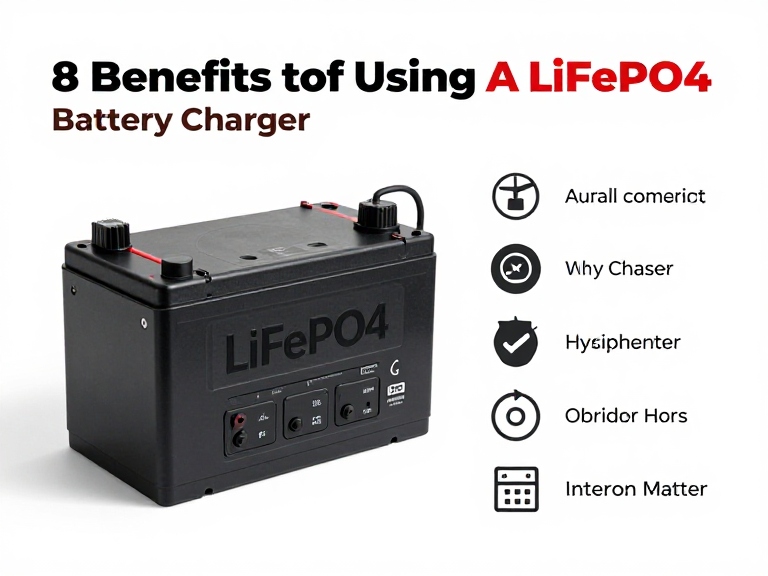
Using a LiFePO4 battery charger offers eight practical benefits: chemistry-specific voltage control, more appropriate charging stages, reduced risk of overcharging, better compatibility with the battery management system (BMS), more predictable charging, less unnecessary maintenance, improved system reliability and potentially better long-term battery value.
Choose the charger by the battery’s specified charge voltage and maximum charge current—not by nominal voltage or connector shape alone. Follow the battery manufacturer’s instructions whenever they differ from general guidance.
Table of Contents
- What Is a LiFePO4 Battery Charger?
- How It Works
- 8 Benefits of Using a LiFePO4 Battery Charger
- LiFePO4 Charger vs. Other Charger Types
- Limitations and Compatibility Checks
- Who Should Use One?
- Common Charging Mistakes
- Buying Considerations
- OHRIJA Expert Recommendation
- Frequently Asked Questions
- References
What Is a LiFePO4 Battery Charger?
A LiFePO4 battery charger is a power supply designed to charge lithium iron phosphate batteries using voltage and current limits appropriate to that chemistry. LiFePO4 is a type of lithium-ion battery chemistry, but its charging requirements are not interchangeable with every other lithium-ion chemistry. A charger intended for a different lithium battery pack may use a different target voltage.
Battery labels can also cause confusion. “12V,” “24V” and “48V” usually describe nominal system voltage. They do not necessarily describe the charger’s required output voltage. For example, a common four-cell-series LiFePO4 battery sold as 12.8V nominal typically has a full-charge voltage around 14.4–14.6V, subject to the battery manufacturer’s specification. A common 16-cell-series pack sold as 51.2V nominal may specify a charge voltage around 58.4V.
That is why a charger should be matched to the exact battery model or its documented electrical specifications. A correct chemistry label is necessary, but it is not sufficient.
How Does a LiFePO4 Charger Work?
Most dedicated LiFePO4 chargers use controlled current and voltage. During the main charging stage, the charger supplies current while the battery voltage rises. As the battery approaches its specified upper voltage, the charger regulates voltage and the charging current naturally tapers. The charger then terminates or manages the charge according to its design.
Unlike many lead-acid charging systems, LiFePO4 batteries generally do not need a continuous float charge to remain healthy. Some chargers include a standby or maintenance mode; others stop charging after completion. Neither behavior should be assumed to be suitable for every battery. Check the battery maker’s guidance, particularly if the battery will remain connected for long periods.
The battery’s BMS provides another layer of protection. It may monitor cell voltage, temperature and current, and can interrupt charging when a limit is reached. The BMS is not a substitute for a correctly matched charger: routine charging should stay within the battery’s specified limits rather than repeatedly relying on the BMS to disconnect an unsuitable power source.
8 Benefits of Using a LiFePO4 Battery Charger
1. It Uses a Charging Voltage Suited to LiFePO4 Chemistry
The first and most important benefit is correct voltage targeting. A dedicated charger is designed around LiFePO4 charging limits, reducing the chance of applying a profile intended for another chemistry. This is especially important when replacing an older lead-acid battery and keeping the same vehicle, solar or backup-power setup.
From our experience with charger selection, voltage mismatch is one of the easiest mistakes to make because product listings often emphasize nominal battery voltage. Always compare the charger’s actual DC output voltage with the battery’s specified charge voltage. If the figures do not match, stop and confirm compatibility before connecting it.
2. It Helps Reduce the Risk of Overcharging
LiFePO4 cells have an upper voltage limit. A charger configured for the correct pack voltage regulates its output around the battery’s permitted charging range. This helps avoid sustained charging above the recommended limit, which can trigger BMS protection and may stress the cells if the system is poorly designed.
A dedicated charger does not make overcharging impossible. A defective charger, incorrect settings, damaged wiring or a battery with a failed BMS can still create a hazard. The benefit comes from using the right equipment as part of a properly designed system—not from assuming the charger label guarantees safety.
3. It Works More Appropriately With the Battery Management System
The BMS is responsible for monitoring and protecting the battery pack. A suitable LiFePO4 charger operates within the limits that the battery manufacturer specifies, so the BMS is less likely to be forced into repeated emergency cutoffs during normal charging.
For commercial users, this distinction matters. Repeated BMS trips can interrupt equipment availability and make a battery or charger appear unreliable. A compatible charger, sound wiring and a correctly rated BMS work together. Do not choose a charger with a higher current rating simply because the BMS might limit it; the battery’s permitted charge current remains the controlling specification.
4. It Can Make Charging More Predictable
A charger with a suitable current rating and charging profile gives users a more consistent charging routine. This is useful for fleets, workshop equipment, mobility devices and off-grid systems where batteries need to be ready at a known time.
Charging time is determined by more than the charger label. Battery capacity, state of charge, temperature, BMS limits and the charger’s actual output all matter. As a rough planning estimate, divide the capacity in amp-hours by the charging current in amps, then allow extra time for the final voltage-regulation stage and system losses. For example, a 100Ah battery charged at 20A will not necessarily take exactly five hours from empty to full.
5. It Avoids Unnecessary Lead-Acid Charging Behaviors
Many lead-acid chargers use absorption, float and sometimes equalization stages. These are designed around lead-acid battery behavior. Applying those stages to a LiFePO4 battery without explicit approval from its manufacturer is not a good shortcut.
A dedicated LiFePO4 charger is generally configured without the routine equalization behavior used by some lead-acid chargers. It also avoids assuming that a battery should be held indefinitely at a float voltage. This is a practical advantage for users upgrading a boat, RV, solar bank or cart from lead-acid to lithium.
6. It Supports Better Long-Term Battery Management
Battery life is influenced by temperature, depth of discharge, charge and discharge current, storage state and the quality of the battery itself. A suitable charger cannot eliminate all aging, but it helps keep charging within the limits selected by the battery manufacturer.
For heavy-duty applications, we recommend treating charger compatibility as part of the battery system specification. Do not evaluate the battery, charger, BMS and wiring as unrelated purchases. If the charger routinely exceeds the battery’s permitted voltage or current, the system is not properly matched—even if it appears to work at first.
7. It Can Reduce Troubleshooting and Downtime
When the charger is correctly matched, users can rule out one major source of charging problems. That makes it easier to diagnose other causes, such as a loose connector, a blown fuse, damaged cable, low-temperature charging protection or a BMS cutoff.
For a business operating several electric carts or battery-powered machines, reducing avoidable charging faults can save staff time. A consistent charger model across compatible battery systems can also simplify training and spare-parts management. Standardize only where the battery voltage, chemistry, charge current and connector specifications are genuinely the same.
8. It Can Improve the Total Cost of Ownership
A dedicated charger may cost more than a generic power supply, but the purchase price is only one part of the decision. Consider the value of the battery being charged, the cost of downtime, the risk of buying a replacement battery early and the time spent diagnosing compatibility issues.
For a low-cost battery used occasionally, the financial difference may be modest. For an expensive golf cart, solar storage or commercial battery bank, selecting a compatible charger is a relatively small part of protecting the complete system investment. We recommend prioritizing correct electrical specifications and reliable protection over the cheapest advertised price.
LiFePO4 Charger vs. Other Charger Types
The comparison below is a practical selection guide, not a claim that every charger in a category behaves identically. Programmable chargers and manufacturer-approved multi-chemistry chargers may support more than one battery type, but only when the correct profile is selected and verified.
| Charger type | Typical suitability for LiFePO4 | Main concern | Our recommendation |
|---|---|---|---|
| Dedicated LiFePO4 charger | Designed for a specified LiFePO4 voltage range | Must still match pack voltage, current and connector | Best default choice for a fixed battery system |
| Generic lithium-ion charger | Only if its output profile exactly matches the battery maker’s requirements | Different lithium chemistries can have different voltage limits | Do not assume compatibility from the word “lithium” |
| Lead-acid charger | Usually unsuitable unless explicitly approved for the battery | Float, equalization or desulfation modes may be inappropriate | Avoid as a default LiFePO4 charger |
| Programmable multi-chemistry charger | Can be suitable with a verified LiFePO4 profile | Wrong settings can defeat the benefit of programmability | Good for trained users managing multiple battery types |
| Basic DC power supply | Only in a properly engineered charging setup with suitable limits and controls | May lack battery-specific termination and protection behavior | Not a casual substitute for a battery charger |
Quick Summary Table
| Decision factor | What to look for | Why it matters |
|---|---|---|
| Battery chemistry | LiFePO4 / lithium iron phosphate profile | Ensures the charging behavior is intended for the chemistry |
| Nominal voltage | 12.8V, 25.6V, 38.4V, 51.2V or the actual battery rating | Identifies the battery system class, not the full-charge voltage |
| Charge voltage | Exact value specified by the battery manufacturer | Prevents voltage mismatch |
| Charge current | At or below the battery’s maximum permitted charge current | Controls charging rate and electrical stress |
| Temperature limits | Charger or battery protection appropriate to the operating environment | Charging may be restricted at low or high temperatures |
| Connector and polarity | Correct plug, pinout and polarity | Prevents connection damage and unsafe workarounds |
| Protection and certification | Documented protections and applicable regional approvals | Supports safer installation and use |
Pros and Cons of Using a Dedicated LiFePO4 Charger
| Pros | Cons |
|---|---|
| Charging profile is intended for LiFePO4 chemistry. | A dedicated model may not charge other battery chemistries. |
| Helps keep voltage and current within specified limits. | Incorrect voltage or current selection can still make it unsuitable. |
| Can reduce compatibility-related BMS interruptions. | It cannot compensate for a defective battery or damaged wiring. |
| Supports a more consistent charging process. | Higher-current models may require heavier cables and suitable outlets. |
| Can help protect the value of an expensive battery system. | May cost more than a generic, non-specialized power supply. |
Limitations: What a LiFePO4 Charger Cannot Do
A dedicated charger is not a universal fix. It cannot repair damaged cells, restore a failed BMS, correct undersized wiring or make an incompatible battery safe to charge. It also cannot guarantee a particular battery lifespan. Battery quality, operating temperature, discharge habits and system design remain important.
Low-temperature charging deserves particular attention. Many LiFePO4 batteries restrict or prohibit charging below a specified temperature unless they include an approved heating system or other manufacturer-defined protection. Do not assume that a charger with a low-temperature feature can override the battery’s own limits. The battery documentation and BMS behavior must govern the decision.
Important: Never select a charger solely because its plug fits. Confirm output voltage, polarity, maximum current, battery chemistry and the battery maker’s approved charging range before use. If the battery label or manual is missing, identify the exact battery model before connecting a charger.
Who Should Use a LiFePO4 Battery Charger?
Recommended for these users
- RV and marine owners: Especially when replacing lead-acid house batteries with LiFePO4 and retaining some existing electrical equipment.
- Solar and backup-power users: A correctly configured charger is useful for grid or generator charging when the system’s inverter/charger does not already provide an approved LiFePO4 profile.
- Golf cart and utility vehicle operators: Battery packs are valuable components, and charger mismatch can cause avoidable downtime.
- Commercial equipment operators: Consistent charging specifications make maintenance and charger replacement easier to manage.
- DIY battery-system builders: A dedicated charger is a straightforward way to avoid improvising a charging circuit.
Who may not need a separate charger?
You may not need to buy another charger if your existing inverter/charger or integrated charging system already has a manufacturer-approved LiFePO4 profile, the correct voltage settings and sufficient current capacity. Verify the exact model and settings rather than relying on a salesperson’s general statement that it “supports lithium.”
You also do not need a high-current charger simply because a faster option is available. For occasional home use, a lower-current charger that meets the battery specification may be the more economical and practical choice.
Common Mistakes When Using a LiFePO4 Battery Charger
- Confusing nominal voltage with charge voltage. A 12.8V nominal battery commonly needs a charging voltage around 14.4–14.6V, not a 12V output. Always verify the battery’s stated value.
- Assuming all lithium chargers are interchangeable. Lithium-ion is a broad family of chemistries. Confirm that the charger’s profile is explicitly compatible with LiFePO4.
- Choosing excessive current. A charger with a higher amp rating is not automatically better. Stay within the battery’s maximum charge-current specification and consider any BMS limit.
- Using a lead-acid equalization mode. Do not run equalization or desulfation functions on a LiFePO4 battery unless its manufacturer explicitly instructs you to do so.
- Ignoring temperature restrictions. Check the permitted charging temperature and any built-in low-temperature cutoff or heater requirements.
- Leaving a damaged setup connected. Stop charging if cables, connectors or the battery become unusually hot, swollen, damaged or emit an unusual odor. Disconnect power safely and seek qualified service.
- Assuming the BMS makes every charger safe. The BMS is a protection layer, not permission to use an incorrectly specified charger.
If your charger becomes unusually hot, review the load, ventilation, cable condition and operating environment. See our practical guide on why a battery charger gets hot. If charging fails, use a systematic diagnostic process rather than repeatedly reconnecting the battery; our guide to troubleshooting a 12V battery charger covers common checks.
Buying Considerations: How to Choose the Right LiFePO4 Charger
1. Confirm the battery’s actual charge voltage
Ask the battery manufacturer for the recommended charge voltage, not just the nominal voltage printed in the product title. A typical 12.8V four-cell LiFePO4 battery may specify 14.4–14.6V, while other pack configurations require different outputs. Treat these as common examples, not universal settings.
2. Match the current to the battery’s permitted limit
Check the battery’s maximum continuous charge current and any lower limit imposed by the BMS. A 30A charger is not appropriate for a battery rated for a lower charge current. Conversely, a modest current may be perfectly adequate if charging speed is not critical.
3. Decide whether speed is worth the cost
Higher-current chargers can shorten charging time when the battery supports that current and the electrical installation is suitable. But faster charging may require heavier cables, better connectors and a power source capable of supplying the input demand. For occasional use, a lower-current charger can offer better value. For a commercial fleet, downtime may justify a higher-current model if the battery maker approves it.
4. Check temperature and protection features
Look for documented over-voltage, over-current, short-circuit and over-temperature protection. Confirm how the charger behaves at completion and whether it automatically restarts. For batteries used outdoors or in cold environments, verify the battery’s low-temperature charging restrictions separately.
5. Verify the connector, pinout and cable rating
Connector appearance is not enough. Two plugs can look identical while using different pin assignments or polarity. Confirm the positive and negative terminals, cable gauge, connector current rating and any communication pins before ordering.
6. Evaluate the supplier’s technical support
A reliable supplier should be able to provide a clear specification sheet, output tolerance, charging profile, protection details and connector options. For OEM or bulk orders, ask about sample testing, customization boundaries, production consistency, warranty terms and the documentation supplied with each shipment.
Choosing a Charger by Application
Do not use a charger intended for an unrelated battery system simply because the voltage number looks close. The examples below illustrate how to approach selection by application; always confirm the battery’s exact specifications before purchase.
| Application | What to verify | Practical buying direction |
|---|---|---|
| 12V LiFePO4 storage battery | Often 14.4–14.6V charge voltage; confirm current limit | Choose a dedicated 12V LiFePO4 charger with an output matched to the battery |
| 24V battery system | Pack configuration and specified charge voltage | Do not substitute a 12V charger or infer the output from nominal voltage |
| Golf cart battery pack | Pack voltage, BMS current limit, connector and communication requirements | Use a charger specifically approved for that cart battery system |
| eBike or scooter battery | Battery chemistry, series-cell count, output voltage and connector pinout | Use the exact charger specification from the battery or vehicle manufacturer |
| Solar or backup storage | Inverter/charger profile, charge current, temperature settings and system controls | Use an integrated or standalone charger with a verified LiFePO4 profile |
For users comparing charger categories, our guides to 48V lithium golf cart battery chargers and portable mobility scooter battery chargers provide useful starting points. For an eBike or scooter, the correct output is determined by the battery pack—not by the vehicle’s marketing description.
OHRIJA Expert Recommendation
Our recommendation is straightforward: buy the charger that matches the battery manufacturer’s electrical specification, then choose the current rating based on how quickly you genuinely need to recharge. Do not pay extra for unnecessary amperage, and do not accept a generic “lithium compatible” claim without a documented LiFePO4 charging profile.
OHRIJA is a battery charger brand belonging to Dongguan Hengruihong Technology Co., Ltd., established in 2020 and headquartered in Dongguan, Guangdong, China. The company integrates R&D, production and sales, with products including lithium battery chargers, lithium iron phosphate battery chargers, lead-acid battery chargers, golf cart chargers, power adapters and switching power supplies.
For customers comparing charger options, start with the battery’s chemistry, charge voltage, maximum current and connector requirements. OHRIJA’s battery charger product range can be reviewed as part of that selection process. For a 12V LiFePO4 application, see the 12V LiFePO4 battery charger 30A and confirm that 14.6V and 30A are both supported by your specific battery. A 30A output is not suitable for every 12V battery.
Explore OHRIJA Battery Charger Solutions
Review charger options for lithium batteries, LiFePO4 systems, golf carts and other applications. Match the model’s output voltage, current and connector to your battery before ordering.
For commercial buyers, we recommend requesting a written compatibility confirmation before placing a volume order. Provide the battery model, nominal voltage, charge voltage, maximum charge current, connector type and intended operating environment. This is a much more reliable process than selecting a charger from a product title alone.
Frequently Asked Questions
1. Why should I use a dedicated LiFePO4 battery charger?
A dedicated LiFePO4 charger uses a charging profile intended for lithium iron phosphate batteries. It helps keep voltage and current within the battery maker’s specified limits and avoids unsuitable lead-acid charging stages. You must still match the charger to the exact battery voltage and current requirements.
2. Can I use a regular lithium-ion charger for a LiFePO4 battery?
Not automatically. Different lithium-ion chemistries can have different voltage limits. A regular lithium-ion charger is suitable only if its output profile exactly matches the LiFePO4 battery manufacturer’s requirements. Read our guide on whether a lithium battery charger can charge a LiFePO4 battery.
3. Can I use a lead-acid charger on a LiFePO4 battery?
Do not assume that you can. Some lead-acid chargers use float, equalization or desulfation modes that are not appropriate for LiFePO4. Use one only when the battery manufacturer explicitly approves the charger and its selected mode.
4. What voltage should a 12V LiFePO4 battery charger have?
A common 12.8V nominal, four-cell LiFePO4 battery specifies a full-charge voltage around 14.4–14.6V. The exact setting depends on the battery manufacturer. Check the battery label or manual rather than relying on the nominal “12V” description.
5. Is a higher-amp LiFePO4 charger better?
Only when the battery supports the higher charging current and faster charging is useful. A charger must not exceed the battery’s maximum charge-current specification or any lower BMS limit. For occasional charging, a lower-current model may be more economical and place fewer demands on the electrical installation.
6. Can I leave a LiFePO4 battery connected to its charger?
Follow the battery and charger manufacturers’ instructions. Some systems are designed for connected standby operation, while others terminate charging and should not be treated as continuous float chargers. Do not assume every charger is suitable for indefinite connection.
7. Can LiFePO4 batteries be charged in cold weather?
Charging may be restricted below the battery manufacturer’s minimum temperature. Some batteries include low-temperature charge protection or integrated heating, but the allowed operating range varies. Check the battery documentation and never bypass its temperature protection.
8. How do I know whether my charger is compatible?
Compare five items: chemistry, specified charge voltage, maximum charge current, connector and polarity, and temperature requirements. If any item is unknown, contact the battery or charger supplier before connecting the equipment.
References
- Victron Energy – LiFePO4 battery compatibility and charging guidance. Manufacturer guidance on system compatibility and lithium battery charging considerations.
- Battle Born Batteries – Charging Your LiFePO4 Battery. Practical manufacturer information on charging voltage, current and battery management.
- U.S. Department of Energy – Energy Storage. Government background on energy storage technologies and battery systems.