
No products in the cart.

Every motorhome owner, overland adventurer, and commercial fleet operator eventually learns the brutal reality of mobile electrical systems: you can purchase the most expensive lithium or AGM battery bank on the market, but if your charging architecture is mismatched, your entire off-grid investment will fail. In real-world travel, your battery charger is not a passive accessory; it is the vital power-conditioning link between volatile shore power, fluctuating camp generators, and your delicate onboard living habitat. Far too many RV owners rely on factory-installed single-stage converters that boil lead-acid plates, trip modern lithium Battery Management Systems (BMS), or take twelve agonizing hours of generator runtime to replenish a basic house bank. When you approach Choosing a Charger for Recreational Vehicles, you are engineering the operational lifespan, safety, and rapid turnaround of your off-grid energy storage. As power electronics engineers, charging hardware fabricators, and off-grid electrical specialists who calibrate voltage setpoints, run thermal dissipation stress tests, and inspect power factor correction circuits daily at Ohrija, we cut through the retail sales jargon. Here is our practitioner-grade evaluation of the seven essential factors you must master when Choosing a Charger for Recreational Vehicles, detailing the physical mechanics, electrical formulas, and commercial hardware specifications you need to guarantee clean, rapid, and dependable power wherever the road takes you.
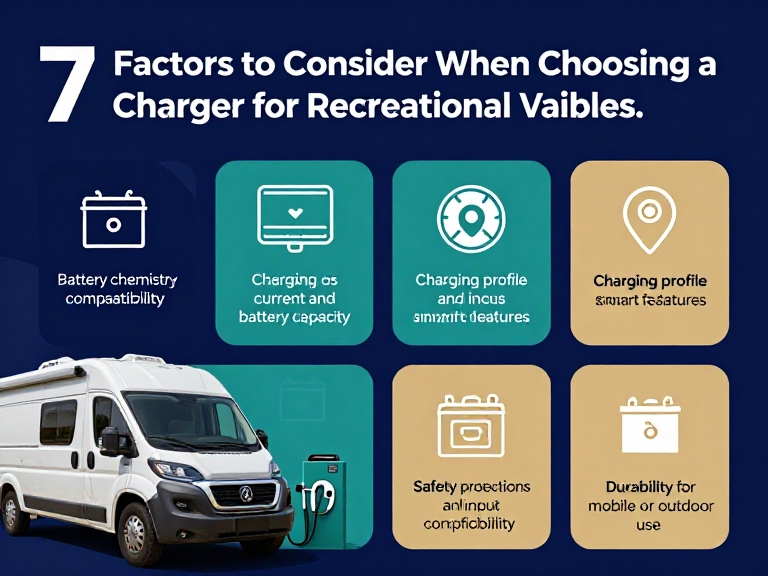
Quick Answer: What Matters Most When Choosing a Charger for Recreational Vehicles?
When Choosing a Charger for Recreational Vehicles, your decision must be driven by seven non-negotiable electrical and environmental benchmarks: (1) Battery Chemistry Calibration (matching dedicated profiles for LiFePO4, NMC, AGM, or Flooded to prevent undercharging or BMS lockouts); (2) System Voltage & Multi-Bank Topologies (aligning precisely with 12V, 24V, 36V, or 48V banks); (3) Charging Amperage & Sizing Math (targeting 0.2C to 0.5C for lithium, and 0.1C to 0.2C for lead-acid to balance generator runtime with cell longevity); (4) Multi-Stage Algorithm Control (verifying true programmable Bulk, Absorption, Float, and Storage parameters); (5) Thermal Management & Mechanical Ruggedness (demanding anodized aluminum alloy heat-sink enclosures and active intelligent fan cooling over flimsy plastic shells); (6) Input Power Tolerance & Generator Cleanliness (requiring wide 90V–264V AC inputs and active Power Factor Correction to handle dirty camp power); and (7) Industrial Connectors & Multi-Tier Circuit Protections (utilizing heavy-gauge Anderson or XT connectors with hardware-level over-voltage, reverse polarity, and short-circuit safeguards). Sourcing an engineered, adjustable unit like the Ohrija 29.4V 10A Aluminum Alloy Charger gives you the calibrated voltage precision needed to protect specialized mobile battery investments.
Article Directory
- Electrical Physics: What an RV Charger Actually Does
- Quick Summary Table: The 7 Factors for Choosing an RV Charger
- The 7 Decisive Factors in RV Charger Selection Analyzed
- Featured Engineering Spotlight: Ohrija 29.4V 10A Aluminum Alloy Charger
- Direct Technical Comparison: Modern Smart Chargers vs. Stock RV Converters vs. Inverter-Chargers
- Pros and Cons: Dedicated Smart Charging Hardware vs. Stock Converters
- Operational Realities: Rapid Replenishment vs. Heat & Alternator Stress
- Who Must Upgrade Their RV Charger vs. Who Can Keep Factory Gear
- Costly Mistakes RV Owners Make When Buying Battery Chargers
- Essential Pre-Purchase Sourcing & Wire-Gauge Checklist
- Expert Engineering Verdict: The Ultimate RV Power Blueprint
- Frequently Asked Questions
- Authoritative References & Mobile Electrical Standards
Electrical Physics: What an RV Charger Actually Does
To evaluate the technical criteria for Choosing a Charger for Recreational Vehicles with true professional competence, you must look past simple amp ratings and examine mobile electrical dynamics. In a recreational vehicle, your power demands are chaotic: one hour you are connected to high-end 50-amp pedestal shore power at a luxury resort, the next you are running an open-frame portable generator in sub-freezing temperatures, and the next you are boondocking off-grid in the desert with house batteries deeply depleted by residential 12V fridges and inverter loads.
A battery charger in an RV performs two distinct electrical conversions:
- AC to DC Rectification & Galvanic Isolation: It takes fluctuating, dirty alternating current (typically 110V–120V AC in North America or 230V AC in Europe) and transforms it into low-voltage, high-current direct current (DC) while maintaining galvanic isolation to protect your living quarters from dangerous ground loops and chassis electrical shorts.
- Precision Impedance & Voltage Regulation: Batteries are dynamic electrochemical loads whose internal resistance ($R_{int}$) shifts continuously as chemical ions shuttle between the cathode and anode. A charger must regulate current flow through high-frequency pulse-width modulation (PWM) switching circuits, adjusting terminal voltage across millivolt boundaries to maximize ion transfer without inducing thermal runaway or boiling electrolyte solution.
From our experience on test benches, legacy stock converters found in factory-built campers are often nothing more than rudimentary linear power supplies. They dump a static 13.6 volts into the bank continuously. If you connect modern lithium or high-purity AGM batteries to these primitive units, your cells will degrade prematurely. Mastering Choosing a Charger for Recreational Vehicles means matching modern solid-state power conversion to the exact electrochemical demands of your house bank. If you also carry electric mobility gear on your adventures, review our operating manual on how to charge eBike battery safely to apply the same electrical discipline across all your mobile equipment.
Quick Summary Table: The 7 Factors for Choosing an RV Charger
| Selection Factor | Primary Technical Metric | Standard Target Benchmark | Critical Failure Prevented | Practical RV Impact |
|---|---|---|---|---|
| 1. Chemistry Profile | Algorithm matching (CC/CV vs. 3-Stage) | Dedicated LiFePO4, NMC, or Lead-Acid curve | BMS high-voltage disconnect or plate sulfation | Ensures 100% full capacity and maximizes cycle life |
| 2. Voltage & Topology | Nominal DC voltage & cell count ($S$) | Exact match (12V/4S, 24V/8S, 36V, 48V/16S) | Catastrophic over-voltage or zero current flow | Prevents dangerous mismatches across specialized banks |
| 3. Charging Amperage | C-rate ratio relative to Amp-hour bank | 0.2C – 0.5C (Lithium) | 0.1C – 0.2C (Lead) | Thermal cell stress or excessive generator runtime | Cuts off-grid generator burn time from 10h to 3h |
| 4. Multi-Stage Staging | Bulk, Absorption, Float, Storage setpoints | Automatic voltage transition based on current tail | Electrolyte dry-out, cell boiling, float degradation | Allows continuous plug-in storage without damage |
| 5. Thermal Architecture | Enclosure metallurgy & active cooling CFM | Extruded aluminum alloy + intelligent fan | Thermal throttling and premature component failure | Maintains full output in hot 40°C (104°F) compartments |
| 6. Input AC Resilience | Operational voltage window & Active PFC | 90V–264V AC range; Power Factor > 0.95 | Charger trips on sagging, low-voltage camp pedestals | Reliably charges from cheap, surging portable generators |
| 7. Protections & Plugs | OVP, OCP, SCP, reverse polarity, connectors | Hardware-level auto-recovery; Anderson / XT rated | Electrical fires, fried control boards, melted terminals | Guarantees fail-safe, arc-free high-current operation |
The 7 Decisive Factors in RV Charger Selection Analyzed
1. Battery Chemistry Profile: Matching Electrochemical Algorithms
The single most destructive mistake when Choosing a Charger for Recreational Vehicles is treating all battery chemistries as interchangeable. A Lead-Acid battery (Flooded, AGM, or Gel) and a Lithium battery (Lithium Iron Phosphate / LiFePO4 or Lithium Nickel Manganese Cobalt / NMC) possess fundamentally divergent charging physics.
Examine the charging curves:
- Lead-Acid (Flooded/AGM): Demands a 3-stage or 4-stage profile: Bulk (constant current) driving voltage up to roughly 14.4V–14.8V, Absorption (constant voltage holding until current tapers to near zero), Float (dropping to 13.2V–13.6V to counter self-discharge without boiling electrolyte), and periodic high-voltage Equalization (15.5V+) to dissolve lead sulfate crystals. If you operate legacy chemistries, sourcing a dedicated LEAD ACID BATTERY CHARGER with proper thermal compensation is non-negotiable.
- Lithium Iron Phosphate (LiFePO4): Operates on a strict Constant Current / Constant Voltage (CC/CV) profile. LiFePO4 has virtually zero chemical memory and low internal resistance. It accepts maximum current straight up to 14.4V–14.6V (for a 12V/4S pack), holds briefly for cell balancing, and then terminates. LiFePO4 must never be subjected to continuous float voltages above 13.6V, and must never experience an equalization cycle, which will trip the internal BMS or permanently degrade the cathode.
Understanding cross-chemistry compatibility is critical for modern retrofits; dive deeper into our engineering assessment on whether a can lithium charger charge LiFePO4 battery before upgrading your hardware. For general lithium applications, always specify an authentic, dedicated LIFEPO4 BATTERY CHARGER or LI ION BATTERY CHARGER.
2. System Voltage and Bank Topology: 12V, 24V, 36V, or 48V?
While traditional travel trailers and motorhomes were built on standard 12-volt house systems, modern off-grid recreational vehicles, large overland expedition trucks, and converted campervans are rapidly migrating to 24-volt and 48-volt architectures. Higher system voltages reduce physical current ($I = P / V$), allowing builders to use significantly thinner, lighter copper wiring while reducing dangerous resistive heat losses ($P_{loss} = I^2R$) across long cable runs powering residential induction cooktops and high-output air conditioners.
When Choosing a Charger for Recreational Vehicles, you must match the exact nominal voltage and series cell count ($S$) of the bank:
- 12V Systems (4S LiFePO4 / 6-cell Lead-Acid): Charging terminal voltage targets 14.4V to 14.6V max.
- 24V Systems (8S LiFePO4 / 7S NMC): Requires chargers calibrated to 29.2V (for 8S LiFePO4) or 29.4V (for 7S 25.9V NMC lithium-ion).
- 36V & 48V Systems: Common in high-end overland rigs and utility toy-haulers carrying specialized support vehicles. If you manage auxiliary equipment, explore our troubleshooting guide on can I charge a 36V battery with 12V charger configurations.
Never attempt to charge a multi-battery series string with an undersized voltage supply; you will either trigger low-voltage charger shutdown faults or create severe cell-level voltage imbalances.
3. Charging Amperage and Sizing Math (The C-Rate Calculation)
How fast do you need your RV batteries to recharge when the generator is humming? Amperage dictates replenishment speed, but bigger is not always better. Sizing your charger current requires calculating the C-rate—the ratio of charging current relative to the total Amp-hour (Ah) capacity of the battery bank.
In our testing across mobile installations, follow these empirical sizing parameters:
- For Lithium (LiFePO4) Banks: We recommend a charge rate between 0.2C and 0.5C. If you operate a 200Ah lithium bank, a 0.2C charge rate equals 40 Amps ($200Ah \times 0.2 = 40A$), while 0.5C equals 100 Amps. A 50A charger will restore a 200Ah bank from 20% to 100% capacity in approximately 3.5 hours, minimizing campground generator noise. While lithium can theoretically accept 1C, sustained high-amp charging accelerates cell degradation and elevates internal cell temperatures.
- For AGM and Flooded Lead-Acid Banks: You must restrict charge current strictly to 0.1C to 0.2C (e.g., 20A to 40A on a 200Ah bank). Lead-acid has high internal chemical resistance; pushing more than 0.2C causes violent electrolyte boiling, water loss, plate shedding, and severe thermal buildup.
4. Multi-Stage Charging Profiles and Programmable Setpoints
Factory RV converter-chargers are notorious for their blunt, fixed charging profiles. A high-performance charger designed for recreational vehicles must provide a sophisticated multi-stage algorithm that transitions automatically based on real-time voltage and current feedback.
The four vital operational stages include:
- Bulk Stage (Constant Current): The charger supplies its maximum rated amperage while terminal voltage climbs steadily, restoring roughly 80% of battery capacity rapidly.
- Absorption Stage (Constant Voltage): The charger locks voltage at the target absorption ceiling (e.g., 14.4V for AGM or 14.6V for LiFePO4). Current naturally tapers downward as internal cell resistance balances against applied voltage.
- Float / Standby Stage: For lead-acid, voltage drops to a safe maintenance level (13.4V) to maintain charge without gassing. For lithium, high-grade chargers either shut off entirely or drop to an idle storage voltage (13.3V–13.4V) to prevent stressing the cell cathode during months of parked storage.
- Equalization / De-Sulfation (Lead-Acid Only): A timed, high-voltage controlled overcharge that dissolves crystalline lead sulfate from plates. This stage must be physically lockable or disabled when lithium is selected to prevent catastrophic BMS over-voltage lockouts.
If your charger fails to transition cleanly between these phases, consult our field guide on how to troubleshoot a 12V battery charger to diagnose relay and voltage sensing faults.
5. Thermal Management and Enclosure Metallurgy
An RV is a challenging mechanical and thermal environment. Battery chargers are frequently installed in tight under-bed storage bays, unventilated front pass-through compartments, or exterior utility cabinets where ambient summer temperatures routinely exceed 45°C (113°F). Converting 500 to 1,000 Watts of AC power into high-amperage DC power generates substantial waste heat due to MOSFET switching inefficiencies.
In most professional situations, never purchase a plastic-housed battery charger for permanent RV installation. Plastic is a thermal insulator; trapped heat causes internal components to cook, triggering premature thermal throttling where the charger cuts its output current by 50% to save itself. Demand heavy-duty extruded aluminum alloy enclosures featuring integrated external cooling fins paired with high-flow, thermostatically controlled dual ball-bearing fans. Aluminum acts as a continuous structural heat sink, conducting heat away from power electronics. To understand the thermal physics governing component heating under sustained load, review our analysis on why does my charger get hot.
6. Input AC Power Resilience and Generator Compatibility
In a brick-and-mortar home, grid power is exceptionally stable: pure sine wave, 120V AC ±3%, 60Hz. In an RV, your input power is frequently abysmal: RV park pedestals with long, undersized distribution lines often drop to 102V under peak summer air-conditioning loads, while cheap open-frame portable generators deliver “dirty” modified sine waves riddled with high-voltage harmonic spikes and frequency fluctuations (56Hz to 64Hz).
When Choosing a Charger for Recreational Vehicles, mandate:
- Wide Input Voltage Windows: Hardware rated for continuous, full-capacity operation from 90V to 264V AC at 47Hz to 63Hz. A wide window ensures the charger will not trip or reset when camp pedestal voltage sags during hot afternoons.
- Active Power Factor Correction (PFC): Look for chargers with an active PFC rating greater than 0.95. Active PFC aligns voltage and current waveforms, drawing clean, sinusoidal power from your generator. This allows a small 2,000-watt inverter generator to run your battery charger at full capacity without bogging down the engine or tripping internal circuit breakers.
7. Industrial Connectors, Wiring Safety, and Multi-Tier Protections
The final factor separates professional-grade hardware from fire hazards: connector metallurgy and internal fail-safe circuitry. Pushing 20 to 60 Amps of continuous direct current through loose, low-grade terminals creates severe electrical resistance. High resistance generates concentrated thermal heat, leading to melted plastic housings, terminal arcing, and RV fires.
Ensure your chosen charger utilizes genuine high-current industrial connectors:
- Anderson Powerpole (50A / 120A): The gold standard for mobile DC connections, featuring silver-plated copper contacts and hermaphroditic locking housings that resist extreme vehicle road vibration.
- XT60 / XT90 Connectors: High-temperature nylon connectors with gold-plated bullet pins, ideal for high-drain lithium applications. Sourcing hardware equipped with specialized CONNECTOR REMOVAL CHARGER lines ensures safe, modular disconnects during maintenance.
- Hardware-Level Circuit Protections: Demand active Over-Voltage Protection (OVP), Over-Current Protection (OCP), Short-Circuit Protection (SCP) with auto-recovery, and Reverse Polarity Protection via electronic relays or replaceable automotive fuses.
If you utilize auxiliary utility vehicles at your campsite, review dedicated charging standards across our commercial GOLF CAR BATTERY CHARGER and ELECTRIC WHEELCHAIR CHARGER product portals.

Engineering Spotlight: Ohrija 29.4V 10A 24V Aluminum Alloy Smart Charger
Engineered specifically for demanding 24-volt mobile platforms, the Ohrija 29.4V 10A Smart Charger solves the thermal and voltage-drift problems common in recreational vehicle auxiliary systems. Built inside a rugged, heat-dissipating aluminum chassis with internal potentiometer calibration, it provides precision charging for 7S 25.9V lithium-ion battery banks.
| Chassis Architecture | Heavy-duty, extruded aluminum alloy shell with high-efficiency thermal conduction |
| Voltage Regulation | Maximum 29.4V ±0.2V (Internal potentiometer allows fine-tuning calibration) |
| Current Output | Continuous 10.0 Amps ±0.2A (Maximum working power: 290 Watts) |
| Applicable Battery Chemistry | 7S 25.9V Lithium-Ion (NMC) packs; fully compatible with high-drain storage banks |
| Dimensions & Net Weight | Ultra-compact 135 × 90 × 50 mm profile; lightweight 0.9 kg (Vibration-resistant) |
| Terminal Options | Anderson 50A, XT60, XT90, Heavy-Duty Crocodile Clips, GX16, or XLR custom plugs |
| Global Grid Ready | Universal AC input with region-specific cords (US, EU, UK, AU standard certified) |
Engineer’s Purchasing Advice: Stop relying on plastic chargers that throttle power under heat. Protect your 24V lithium banks by ordering the calibrated Ohrija 29.4V 10A 24V Charger directly, or explore broader mobile power options in our high-output ELECTRIC BICYCLE CHARGER collection.
Direct Technical Comparison: Modern Smart Chargers vs. Stock RV Converters vs. Inverter-Chargers
| Performance Characteristic | Dedicated Smart Charger (Ohrija Series) | Factory Stock RV Converter/Charger | Integrated Marine Inverter-Charger |
|---|---|---|---|
| Charging Algorithm Type | Microprocessor CC/CV & Programmable Multi-Stage | Single-Stage Static (or Crude 2-Stage) | Full Multi-Stage Programmable (PFC) |
| LiFePO4 Chemistry Compatibility | 100% Native (Calibrated absorption & zero float) | Extremely Poor (Undercharges; fails to balance) | High (Requires software/dip-switch setup) |
| Thermal Dissipation Enclosure | Extruded Aluminum Alloy + Forced Fan | Stamped sheet metal or plastic housing | Heavy cast aluminum heat-sink chassis |
| Dirty Generator Power Handling | Exceptional (Active PFC; wide 90V–264V AC) | Poor (Hums, buzzes, trips on frequency shifts) | High (Includes AC pass-through transfer relay) |
| Physical Weight & Footprint | Compact & Portable (0.9 kg – 3.0 kg) | Bulky (Integrated into distribution panel) | Extremely Heavy (15 kg – 30+ kg) |
| Average Equipment Investment | $80 – $250 (High cost-to-performance ROI) | $0 (Pre-installed factory equipment) | $1,200 – $3,500+ (High initial CapEx) |
Pros and Cons: Dedicated Smart Charging Hardware vs. Stock Converters
| Hardware Architecture | Practical Field Advantages (Pros) | Real-World Operational Liabilities (Cons) |
|---|---|---|
| Dedicated High-Efficiency Smart Chargers (e.g., Ohrija Aluminum Series) | Delivers exact chemical cutoff voltages, maximizing battery cycle life. Aluminum enclosures eliminate thermal throttling in hot RV compartments. Modular portability: can be mounted permanently or used as bench chargers. Cuts off-grid generator fuel consumption by speeding up Bulk phase. Interchangeable industrial connectors (Anderson, XT60, XT90). | Requires dedicated wiring directly to the DC battery distribution bus. Does not invert DC back to 120V AC (Dedicated charger only). |
| Factory Stock Converter-Chargers (Standard Factory RV Install) | Pre-wired into the camper’s power center from the assembly plant. Zero additional upfront cost when buying a new recreational vehicle. Powers basic 12V ceiling lights directly while on shore power. | Chronic undercharging of modern lithium battery banks (70% max SOC). Dangerous constant-float voltage degrades lead-acid and lithium cells. Cheap plastic internal cooling fans are loud and fail frequently. Zero voltage calibration adjustments; cannot adapt to voltage drop. |
Operational Realities: Rapid Replenishment vs. Heat & Alternator Stress
Every commercial hardware installation involves balancing physical trade-offs. Upgrading your RV battery charging infrastructure provides unmatched off-grid independence, but experienced overlanders must navigate practical electrical boundaries.
The Real Off-Grid Payoffs:
- Generator Fuel and Noise Minimization: If you dry-camp on public lands, running a noisy gas generator for eight hours a day to slowly trickle-charge a dead battery bank destroys the wilderness experience and burns expensive fuel. Sizing a smart charger capable of a clean 40A to 60A continuous Bulk charge replenishes a depleted 200Ah lithium bank in under three hours, allowing you to shut the generator down and enjoy silent wilderness camping.
- Preserving Multi-Thousand-Dollar Battery Investments: Quality lithium house banks cost between $800 and $3,000. Subjecting those cells to uncalibrated factory converters with noisy ripple voltages degrades cathode coatings and causes cell drift. A dedicated smart charger with precision voltage limits protects your battery warranty and guarantees your cells achieve their rated 3,000 to 5,000 cycle lifespan.
The Inescapable Electrical Limitations:
- DC Voltage Drop Over Distance: At low direct-current voltages (12V or 24V), voltage drop across copper conductors is severe. If your charger is installed eight feet away from your battery bank and you use cheap 10 AWG wire, pushing 40 Amps will cause a 0.6V drop over the wire. The charger thinks the battery is at 14.6V and terminates, while the actual battery terminal is sitting at only 14.0V! You must install chargers as physically close to the battery bank as possible and size DC cabling generously.
- The RV Alternator Conflict: Upgrading your house bank to high-capacity lithium while keeping a high-output charger does not solve vehicle charging while driving. Because lithium has near-zero internal resistance, connecting a depleted lithium house bank directly to your vehicle’s starter battery while driving will pull maximum current from your vehicle’s engine alternator, overheating and burning out the alternator stator within sixty miles. You must separate house charging from engine charging using a dedicated DC-to-DC charger.
Who Must Upgrade Their RV Charger vs. Who Can Keep Factory Gear
Every dollar allocated to your recreational vehicle should match your travel style, electrical consumption, and camping destinations. Knowing whether Choosing a Charger for Recreational Vehicles demands an immediate equipment upgrade prevents unnecessary capital waste.
Campers Who Must Upgrade to a Dedicated Smart Charger Immediately:
- Lithium (LiFePO4) Battery Retrofitters: If you removed factory lead-acid batteries and dropped in modern lithium iron phosphate batteries, you cannot keep your stock lead-acid converter. You need a dedicated charger with a true CC/CV profile to achieve 100% state of charge and allow the internal BMS cell-balancing circuitry to function.
- Off-Grid Boondockers & Dry Campers: If you camp without shore-power hookups on BLM lands, national forests, or remote beaches and rely on a portable generator to replenish power, you need high-amperage, high-efficiency charging to minimize generator run hours.
- Expedition Vehicles with 24V or 48V High-Voltage Systems: Specialized overlanding platforms operating high-voltage banks for split-unit air conditioners demand precision aluminum-cased chargers calibrated to exact series cell configurations.
Campers Who Can Safely Keep Factory-Installed Hardware:
- Weekend RV Park “Pedestal Campers”: If you exclusively travel between established commercial RV resorts, plug into 30A or 50A shore power 100% of the time, and only use your 12V battery to run water pumps and LED lights while driving between parks, your factory-installed converter is adequate.
- Basic Lead-Acid Flooded Battery Users: If you use inexpensive group-24 marine starting batteries that you replace every two years, investing in an expensive, high-precision programmable charger provides marginal commercial return.
Costly Mistakes RV Owners Make When Buying Battery Chargers
Field Engineering Advisory: The “Voltage Drop Calibration” Trap
The most common mistake we witness in mobile electrical retrofits is mounting a charger several feet away from the battery bank using undersized factory wiring. If your charger puts out 14.6 volts, but resistive wire loss drops the voltage to 14.1 volts at the battery terminal, the charger will prematurely switch into float mode, leaving your lithium cells chronically un-balanced and undercharged. Always measure voltage directly across the battery posts with a calibrated digital multimeter while the charger is pushing full rated current. Choose chargers with internal calibration potentiometers (like the Ohrija Aluminum series) to dial in exact terminal voltages under real-world load.
- Failing to Account for Continuous 12V House Loads: Sizing a charger based purely on battery capacity without calculating simultaneous DC loads. If your RV’s 12V refrigerator, vent fans, and furnace blower pull 18 Amps continuously, and you install a 20-Amp charger, only 2 Amps of net current reach the battery bank! Your batteries will take days to charge. Always add a 20A to 30A buffer above baseline parasitic house loads when sizing your charger.
- Charging Lithium Batteries in Sub-Freezing Temperatures: Attempting to charge a LiFePO4 battery when cell temperatures drop below 0°C (32°F). Forcing charge current into frozen lithium cells causes permanent metallic lithium plating on the graphite anode, inducing internal short circuits and catastrophic fire risks. Ensure your system utilizes low-temperature charging disconnect sensors or heated battery blankets before applying charge current in winter.
- Using Thin Wire Gauges on High-Amperage DC Lines: Wiring a 50-Amp battery charger with 10 AWG or 12 AWG copper wire. High current demands heavy copper: a 50A run requires at least 6 AWG or 4 AWG fine-stranded marine-grade tinned copper cable to prevent extreme fire hazards and eliminate resistive voltage sag.
- Ignoring AC Circuit Breaker Limits on Shared Outlets: Plugging a massive 1,500-watt, 100-amp battery charger into the same RV branch circuit that powers a microwave or electric water heater. When both appliances engage simultaneously, the shared 15A or 20A AC circuit breaker will trip instantly. Dedicate a separate AC circuit breaker for high-output charging hardware.
Essential Pre-Purchase Sourcing & Wire-Gauge Checklist
Before issuing payment for any hardware claiming to be the ultimate solution for Choosing a Charger for Recreational Vehicles, audit prospective equipment against these four non-negotiable engineering benchmarks:
1. Conductor Sizing and American Wire Gauge (AWG) Standards
Never connect high-amperage chargers using thin automotive wiring. Demand fine-stranded, tinned-copper marine cable (SAE J1127 / ABYC compliant) sized to hold voltage drop beneath 2 percent:
- Up to 20 Amps (Under 5 ft run): Minimum 10 AWG Marine Tinned Copper.
- 20 to 40 Amps (Under 5 ft run): Minimum 8 AWG to 6 AWG Marine Tinned Copper.
- 40 to 70 Amps (Under 5 ft run): Minimum 4 AWG to 2 AWG Marine Tinned Copper.
- Always install a continuous Class T or high-amperage MRBF fuse within 7 inches of the positive battery post to protect the cabling from catastrophic dead shorts.
2. Certified Mobile Safety and Flammability Standards
Ensure that the charger chassis and internal power supply components comply with recognized international electrical standards:
- Compliance with American Boat & Yacht Council (ABYC) E-11 AC & DC Electrical Systems Standards for vibration resistance and moisture proofing.
- Adherence to National Fire Protection Association: NFPA 1192 Standard on Recreational Vehicles and NEC Article 551 electrical codes.
- UL 1564 (Industrial Battery Chargers) or UL 1236 certification, guaranteeing high-voltage dielectric insulation breakdown protection.
3. Real-World Electrical Efficiency and Total Harmonic Distortion (THD)
Examine the technical datasheet for conversion efficiency. Settle for nothing less than 88% to 94% electrical efficiency. Inefficient chargers waste electricity as heat, baking internal capacitors and straining your camp generator. Verify that Total Harmonic Distortion (THD) remains under 5% to prevent electrical noise from interfering with sensitive RV satellite systems, audio receivers, and control monitors. Review baseline battery charging standards through the Battery Council International (BCI).
4. Enclosure IP Ingress Protection and Vibration Dampening
RVs experience continuous vibration, washboard road shaking, and fine dust intrusion. Plastic clips and loose internal circuit boards will shake apart within thousands of highway miles. Demand solid-state potted electronics or heavy-gauge conformal-coated circuit boards mounted inside an extruded aluminum housing rated to at least IP54 or IP65 for dust and splash protection.
Expert Engineering Verdict: The Ultimate RV Power Blueprint
In our professional assessment across thousands of mobile power system installations, the verdict is definitive: settling for generic factory converters or cheap plastic chargers is the single greatest point of failure in modern recreational vehicle ownership. When you treat your battery charger as an active electrical conditioning asset, you unlock rapid generator turnaround, maximize battery lifespan, and eliminate off-grid power anxiety forever.
Here is your clear, actionable procurement roadmap:
- Identify Your Exact Chemistry and Voltage: Never guess your battery parameters. If you run LiFePO4, mandate a charger with a strict CC/CV profile and zero continuous float. If you run 24V or 48V banks, verify series cell count ($S$) before purchasing hardware.
- Size Amperage Between 0.2C and 0.4C: Match your charger current output to your battery capacity and your generator output. For a 200Ah lithium bank, a 40A to 60A charger provides the optimal balance of fast off-grid replenishment and gentle cell longevity.
- Demand Extruded Aluminum Alloy Construction: Eliminate plastic chargers from your camper. Demand heavy-duty, finned aluminum alloy housings paired with high-flow intelligent cooling fans to prevent thermal throttling inside hot RV utility bays.
- Verify Voltage at the Battery Terminal: Install short, heavy-gauge tinned copper cables protected by Class T fuses. Use chargers with internal voltage calibration controls (such as the Ohrija Aluminum Alloy series) to eliminate voltage drop and ensure that what the charger emits is what your battery cells actually receive.
Align your mobile electrical setup with rigorous power electronics engineering, respect the chemistry of your battery bank, and enjoy reliable, uninterrupted power across every off-grid horizon.
Frequently Asked Questions
Can I use a standard lead-acid factory converter to charge an RV LiFePO4 battery?
In most professional situations, no. Factory lead-acid converter-chargers lack the proper Constant Current/Constant Voltage (CC/CV) algorithm required by lithium iron phosphate. They terminate charging at lower absorption voltages (typically 13.6V to 14.2V), leaving LiFePO4 batteries chronically undercharged at 70% to 80% state of charge. Furthermore, their continuous float voltages or desulfation pulses can trigger the internal Battery Management System (BMS) into high-voltage disconnect shutdowns.
How do I calculate the correct charger amperage for my RV battery bank?
For lithium (LiFePO4) banks, we recommend sizing charger amperage between 0.2C and 0.5C (20% to 50% of the total Amp-hour capacity). A 200Ah lithium bank pairs optimally with a 40A to 60A charger, allowing a complete recharge in 4 to 5 hours from a generator or shore power. For flooded or AGM lead-acid banks, limit charge current to 0.1C to 0.2C (10% to 20% of capacity) to prevent excessive thermal boil-off and plate off-gassing.
Why is temperature compensation necessary when choosing an RV battery charger?
Battery internal resistance and chemical acceptance shift dramatically across temperature extremes. Lead-acid batteries require higher charging voltages in freezing temperatures to achieve full chemical conversion and lower voltages in hot weather to prevent electrolyte dry-out. For lithium batteries, cold-temperature sensors are safety-critical to shut down charging below 0°C (32°F), preventing catastrophic lithium metal plating on the graphite anode.
What causes an RV battery charger to get extremely hot during operation?
A charger runs hot during the sustained Bulk charging phase when it operates at maximum rated current. If the unit uses a cheap plastic enclosure without heat-sinking fins, is installed in an unventilated compartment, or operates below 85% electrical efficiency, thermal buildup accelerates. High-grade aluminum alloy enclosures with internal thermostatically controlled cooling fans dissipate this heat safely.
Authoritative References & Mobile Electrical Standards
- American Boat & Yacht Council (ABYC): Standard E-11 – AC and DC Electrical Systems on Mobile Structures and Marine Craft
- National Fire Protection Association (NFPA): NFPA 1192 Standard on Recreational Vehicles & NEC Article 551
- Battery Council International (BCI): Technical Manual – Battery Charging Algorithms, C-Rate Specifications, and Failure Modes