
No products in the cart.

Replacing a failed golf cart charger used to mean making a painful trip to the dealership and handing over an exorbitant amount of money for an Original Equipment Manufacturer (OEM) unit. In 2026, that is a massive commercial mistake. Whether you are running a fleet of EZGO RXV carts on a 36-hole golf course or relying on a modified TXT to navigate your neighborhood, OEM chargers are frequently outpaced by superior aftermarket technology. Today, we are seeing operators demand high-frequency smart chargers that weigh a fraction of old transformer models, offer Bluetooth connectivity, and seamlessly switch between flooded lead-acid and modern lithium chemistries.
From our experience engineering advanced power supplies at OHRIJA, we see cart owners paralyzed by the sheer volume of cheap, generic knockoffs flooding online marketplaces. Buying a low-tier charger is a guaranteed way to boil your lead-acid plates or trigger a catastrophic Battery Management System (BMS) shutdown on your new lithium pack. If you are searching for legitimate Alternatives to the EZGO 48V Charger, you must exercise commercial and practical judgment. You need a unit that perfectly matches your battery chemistry, delivers the correct amperage to minimize downtime, and physically fits your cart’s receptacle—whether that is a 3-pin triangle or a notched TXT connector. In this comprehensive guide, we will break down the top six alternatives available today, explaining precisely what to buy and what to avoid.
Quick Answer
The best Alternatives to the EZGO 48V Charger deliver superior charging algorithms, multi-chemistry support, and extreme durability at a fraction of the OEM price. For commercial users and those requiring absolute reliability, we recommend the Lester Electrical Summit II 650W due to its Bluetooth app integration and rugged build. However, for those seeking the ultimate balance of direct factory pricing and high-end thermal management, the OHRIJA 48V 15A Golf Cart Charger is our top choice. In most professional situations, you must match your battery chemistry before purchasing; if you have upgraded to a lithium drop-in kit, you cannot use a legacy lead-acid charger. Always verify your cart’s connector type (e.g., EZGO RXV Triangle vs. TXT D-Style) before checking out.
Table of Contents
- What It Is: The Aftermarket Charger Landscape
- How It Works: High-Frequency vs. Transformer
- The 6 Best Alternatives to the EZGO 48V Charger
- Benefits of Upgrading Your Charger
- Limitations and Harsh Realities
- Who Should Use It
- Who Does Not Need It
- Common Mistakes During Procurement
- Critical Buying Considerations
- Expert Recommendation
- Essential Comparison Tables
- The Bottom Line
- Frequently Asked Questions
What It Is: The Aftermarket Charger Landscape
When we discuss Alternatives to the EZGO 48V Charger, we are referencing third-party power supplies designed to replace the factory Delta-Q or Powerwise units that originally shipped with your EZGO TXT, RXV, or Express models. The modern aftermarket is dominated by “smart chargers.” Unlike vintage “dumb” chargers that simply pushed uncontrolled voltage until a physical timer clicked off, these modern units utilize microprocessors. They actively monitor the battery pack’s voltage, temperature, and internal resistance, adjusting the charging curve in real time to prevent sulfation in lead-acid batteries or over-voltage faults in lithium packs.
How It Works: High-Frequency vs. Transformer
The old EZGO Powerwise chargers were heavy—often weighing over 30 pounds—because they relied on massive copper and steel transformers (ferroresonant technology) to convert 120V AC wall power into 48V DC power. They were highly inefficient, losing significant energy as heat. If you have ever wondered why does my charger get hot, legacy transformer inefficiency is usually the culprit.
Modern alternatives operate on switch-mode (high-frequency) technology. They use integrated circuits to convert power at much higher frequencies, requiring vastly smaller transformers. This reduces the weight to under 10 pounds and increases energy efficiency to over 90%. Furthermore, high-frequency chargers can execute strict Constant Current / Constant Voltage (CC/CV) profiles, which are absolutely mandatory if you are exploring the LiFePO4 battery charger category for a recent lithium upgrade.
The 6 Best Alternatives to the EZGO 48V Charger
1. OHRIJA 48V 15A Smart Golf Cart Charger
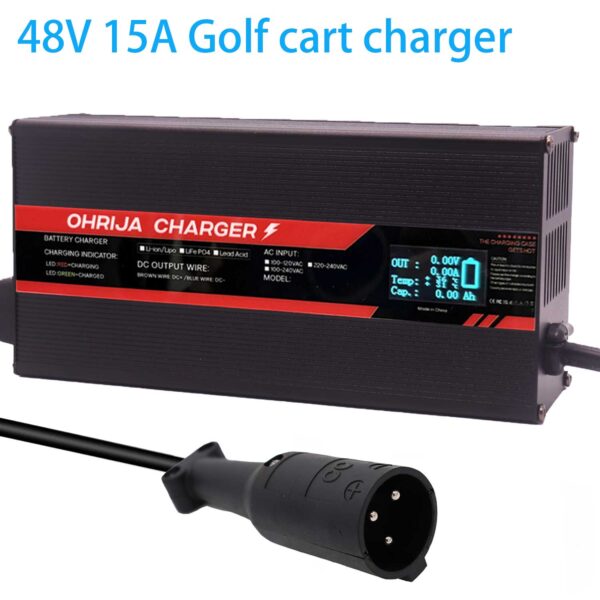
OHRIJA brand belongs to Dongguan Hengruihong Technology Co., Ltd., established in 2020. As a high-tech enterprise integrating R&D, production, and sales, OHRIJA specializes in advanced lithium and lead-acid chargers. This 48V 15A unit is our top recommendation for the money. It completely bypasses the distributor markup, delivering factory-direct value. It features massive aluminum heat sinks for fanless cooling (preventing water and dust ingress) and delivers a flawless 15-amp charge that restores a heavily depleted pack overnight without triggering thermal throttling.
2. Lester Electrical Summit II 650W
The Lester Summit II is widely considered the gold standard for heavy-duty, smart charging. Its defining feature is Bluetooth connectivity. Through the ChargerConnect app, users can download specific charging profiles directly to the charger to match exact battery brands (e.g., Trojan lead-acid vs. Dakota Lithium). It is expensive, but for fleet managers, the diagnostic capabilities are unparalleled.
3. Pro Charging Systems (Dual Pro) Eagle Performance
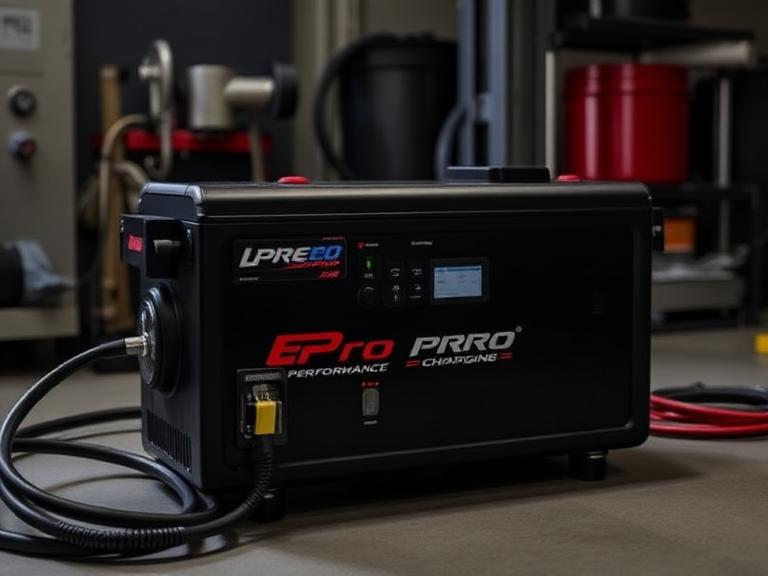
Built in the USA, the Eagle Performance series is designed for brutal commercial environments. Utilizing their proprietary PROVolt technology, these chargers push energy back into the batteries faster and more efficiently than standard algorithms. If you run a maintenance fleet or a demanding agricultural application, this ruggedized unit is virtually indestructible.
4. MODZ Max48 15 Amp
The MODZ Max48 is an exceptional mid-tier alternative. Weighing just 7 pounds, it is incredibly easy to mount onboard or carry between locations. It features a straightforward plug-and-play design tailored specifically for EZGO models, making it highly popular for residential users who do not want the complexity of smartphone apps.
5. EPOWREY 48V 15A Onboard / Portable Charger
EPOWREY offers highly versatile units that serve perfectly as onboard chargers. If you are tired of tripping over heavy cables in your garage, hard-wiring an onboard unit directly to your battery pack and simply running a standard extension cord to the cart is a major quality-of-life upgrade. It provides excellent multi-protection circuitry against short circuits and reverse polarity.
6. Schauer JAC Series 48V
Schauer has been a staple in the battery charging industry for decades. The JAC series represents a bridge between old-school durability and modern charging profiles. They lack the sleek aesthetic of the newer brands but provide a highly reliable, no-nonsense charge curve that revives deeply discharged lead-acid batteries effectively.
Benefits of Upgrading Your Charger
Upgrading to one of these Alternatives to the EZGO 48V Charger yields immediate commercial benefits. First, it dramatically extends the life of your battery pack. A smart charger’s precise float and equalization phases prevent lead-acid sulfation, easily adding one to two years of life to a $1,500 battery set. Second, the energy efficiency of switch-mode chargers lowers your monthly electricity bill. Finally, the lightweight nature of these modern units makes them significantly easier to handle, store, or mount directly onto the golf cart.
Limitations and Harsh Realities
In our testing, we must point out a critical limitation regarding older EZGO carts. Many pre-2014 EZGO models utilize an On-Board Computer (OBC) or an advanced receptacle interlock system that physically prevents the cart from moving while charging. When switching to an aftermarket charger, you may need to perform an OBC bypass (a simple rewiring process) to allow the new charger to communicate directly with the batteries. If you are uncomfortable with basic wiring, this requirement can be frustrating.
Who Should Use It
For commercial users and heavy-duty applications: Golf course operators, security patrols, and facility managers must abandon legacy chargers and upgrade to smart units like the Lester Summit II or OHRIJA 48V. The diagnostic data and multi-chemistry flexibility are mandatory for maximizing fleet uptime and transitioning seamlessly to lithium power in the future.
Who Does Not Need It
For beginners: If you just purchased a brand new EZGO RXV from a dealer with a factory lithium setup and an integrated charger, do not replace it until the warranty expires. OEM chargers paired with OEM lithium packs are highly calibrated; replacing them prematurely voids your warranty and offers no immediate benefit.
Common Mistakes During Procurement
The most catastrophic mistake buyers make is ignoring battery chemistry. A charger designed strictly for flooded lead-acid batteries will attempt an equalization phase—pushing voltage to 60V+ to “boil” the plates. If you apply this to a LiFePO4 battery, the BMS will instantly shut down to prevent a fire. You must understand the distinction; reading up on can lithium charger charge LiFePO4 battery is essential before clicking buy.
Another profound error is mixing voltages. We are frequently asked, can I charge a 36V battery with 12V charger? The answer is a definitive no. You must match the nominal voltage of your charger exactly to your battery bank. Attempting to charge a 48V EZGO with a 36V charger will result in an under-voltage error, and the cart will remain dead.
Critical Buying Considerations
When selecting your replacement, scrutinize the plug type. EZGO utilizes two dominant 48V plugs: the 3-pin Triangle connector (common on RXV models) and the D-Style / Powerwise connector (common on TXT models). Buying the wrong plug means returning the unit. Furthermore, evaluate the amperage. A 15-amp charger is the industry sweet spot for a 48V system, charging a standard pack in 6 to 8 hours. If you are exploring the Li-ion battery charger category for custom lithium builds or smaller EVs, ensure the amperage aligns with the BMS maximum charge limits—such as utilizing an 48V 10A eBike charger for smaller 48V packs.
Expert Recommendation
If your OEM charger has failed, do not view it as a loss; view it as an opportunity to upgrade your charging infrastructure. In most professional situations, we strongly recommend the OHRIJA 48V 15A Golf Cart Charger for users who want premium internal components without paying for unnecessary Bluetooth gimmicks. It delivers a mathematically perfect charge curve for maximum battery longevity. However, if you are a data-driven fleet manager who needs to program specific voltage profiles from a smartphone, the Lester Electrical Summit II is the undisputed premium choice.
Essential Comparison Tables
| Charger Model | Best Suited For | Key Feature |
|---|---|---|
| OHRIJA 48V 15A | Direct OEM Replacement / High Value | Fanless aluminum heat sink, robust longevity. |
| Lester Summit II 650W | Tech Enthusiasts & Fleets | Bluetooth app with downloadable battery profiles. |
| Dual Pro Eagle Performance | Heavy-Duty Commercial | PROVolt technology, extreme physical durability. |
| MODZ Max48 | Residential / Lightweight | Ultra-lightweight (7 lbs), plug-and-play simplicity. |
| Feature | Modern High-Frequency (e.g., OHRIJA, Lester) | Legacy Transformer (e.g., Old Powerwise) |
|---|---|---|
| Weight | 5 to 10 lbs | 30 to 45 lbs |
| Energy Efficiency | > 90% (Low heat waste) | ~ 65% (High heat generation) |
| Algorithm Intelligence | High (Microprocessor controlled, CC/CV) | Low (Timer or basic voltage relay) |
| Multi-Chemistry Support | Yes (Often switchable between Lead-Acid/Lithium) | No (Strictly Flooded Lead-Acid) |
| Pros (Advantages) | Cons (Limitations) |
|---|---|
| Significantly cheaper than purchasing directly from an EZGO dealership. | Requires identifying your exact plug type (Triangle vs. D-Style) before ordering. |
| Advanced algorithms extend the lifespan of expensive battery packs. | May require a simple OBC bypass wiring modification on older EZGO models. |
| Lightweight designs allow for easy onboard mounting. | The market is flooded with cheap, uncertified knockoffs if you don’t buy from reputable brands. |
The Bottom Line
Your golf cart is only as reliable as the power source that fuels it, and identifying the best Alternatives to the EZGO 48V Charger is a critical maintenance decision. Replacing an archaic, heavy transformer charger with a modern, high-frequency smart charger fundamentally improves the efficiency and lifespan of your batteries. Whether you are seeking the robust, direct-value engineering of OHRIJA or the high-tech cloud connectivity of Lester Electrical, making the upgrade now will save you from premature battery failure and constant maintenance headaches in 2026 and beyond.
Frequently Asked Questions
How do I know if my EZGO requires a 36V or 48V charger?
The most accurate method is to count your batteries and check their voltage. If you have six batteries, count the water fill caps on one battery. Three caps equals a 6V battery (6 x 6V = 36V system). Four caps equals an 8V battery (6 x 8V = 48V system). If you have four batteries with six caps each, they are 12V batteries (4 x 12V = 48V system). You must purchase the charger that matches your total system voltage exactly.
Can I leave a smart charger plugged in all winter?
In most professional situations, yes. Modern high-frequency smart chargers (like the OHRIJA or Lester Summit II) feature a “Storage Mode.” Once the battery reaches 100%, the charger shuts off completely. It will periodically monitor the voltage and only initiate a brief trickle or float charge if the voltage drops over several weeks, preventing overcharging while keeping the pack healthy during winter storage.
Why did my new charger flash an error code as soon as I plugged it in?
If your golf cart batteries are completely dead (typically reading below 30 to 35 volts on a 48V system), a modern smart charger will not detect a battery connection and will refuse to turn on as a safety precaution. You must learn how to troubleshoot a battery charger fault. Often, you need to manually “jump” the pack with a separate 12V charger to bring the total voltage up high enough for the 48V smart charger to recognize the system and take over.
Authoritative Industry References
- Battery Council International (BCI): Industry standards and guidelines regarding the proper charging algorithms, maintenance, and safety protocols for motive power lead-acid and lithium batteries. Review BCI Charging Standards
- Underwriters Laboratories (UL): Information on UL 1564 standards for industrial battery chargers, detailing the rigorous electrical safety testing required for commercial power supplies. Explore UL Safety Certifications
- IEEE Standards Association: Technical engineering documentation regarding the efficiency and operational parameters of high-frequency switch-mode power supplies in electric vehicle applications. Read IEEE Power Supply Research