
No products in the cart.

The global shift toward electrification has created a massive influx of battery-powered devices, from daily commuter eBikes to heavy-duty industrial golf carts. However, with this transition comes a dangerous misunderstanding of power electronics. We see it daily: consumers and procurement managers purchase premium lithium battery packs, only to destroy them by connecting them to cheap, mismatched chargers bought from unverified online marketplaces. Ignoring critical Battery Charger Specifications is not just a financial liability—it is a severe safety hazard that frequently leads to thermal runaway and electrical fires.
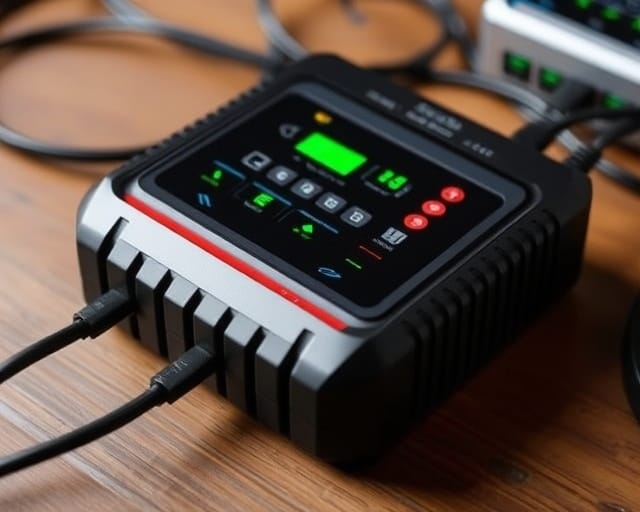
From our experience at OHRIJA, operating as a leading electric bicycle charger supplier and manufacturer, treating a charger as a generic “plug-and-play” accessory is a fundamental engineering error. A battery charger is a sophisticated power delivery system that must communicate perfectly with your battery’s internal chemistry. You must exercise commercial and practical judgment before making a purchase. In this definitive guide, we take an uncompromising, expert position on the exact Battery Charger Specifications you must scrutinize. We will decode the technical jargon, explain why specific algorithms matter, and provide you with the exact criteria needed to protect your energy investments in 2026.
Quick Answer: The 3 Non-Negotiable Specifications
If you are in a rush to replace a broken charger, you cannot afford to guess. The most critical Battery Charger Specifications are:
- Peak Output Voltage: This must match your battery pack perfectly. A 48V Lithium-ion battery requires a 54.6V charger peak. Using a 48V output charger will leave your battery severely undercharged.
- Output Amperage (Current): This dictates charge speed. A 5A charger charges twice as fast as a 2.5A charger, but you must ensure your battery’s BMS (Battery Management System) can handle the higher current without overheating.
- Chemistry Compatibility: Never cross-contaminate profiles. A Lithium Iron Phosphate (LiFePO4) charger operates on a different algorithmic curve than a standard Lithium-ion (Li-ion) or Lead-Acid charger.
We recommend absolutely verifying these three metrics on your battery’s specification label before even looking at the price tag of a replacement unit.
Table of Contents
- What It Is: Understanding Charger Specs
- How It Works: The CC/CV Algorithm
- The 10 Critical Battery Charger Specifications
- Benefits of Spec Matching
- Limitations of Fast Charging
- Who Should Use Advanced Chargers
- Who Does Not Need Them
- Common Procurement Mistakes
- Expert Buying Considerations
- Summary and Comparison Tables
- Expert Recommendation & Sourcing
- Frequently Asked Questions
What It Is: Understanding Battery Charger Specifications
Battery Charger Specifications are the technical parameters that define exactly how electrical power is converted from your wall outlet (AC) into usable storage energy (DC) for your battery. They dictate the maximum threshold of voltage applied, the volume of current pushed into the cells, the thermal management of the device, and the specific software algorithm used to safely taper the power as the battery reaches full capacity.
How It Works: The CC/CV Algorithm
How it works is deeply tied to the CC/CV (Constant Current / Constant Voltage) charging profile—the industry standard for lithium-based chemistry. When you plug an empty battery into a compliant charger, it enters the Constant Current (CC) phase. The charger pushes its maximum rated amperage (e.g., 5 Amps) into the battery while the voltage slowly rises.
Once the battery reaches its peak voltage (e.g., 54.6V for a 13-series Li-ion pack), the charger switches to the Constant Voltage (CV) phase. Here, the voltage is held strictly at 54.6V, and the amperage is slowly tapered down to zero as the cells balance and absorb the final percentage of capacity. If a charger’s specifications do not explicitly mention CC/CV architecture for lithium batteries, it is obsolete technology that will ruin your pack.
The 10 Critical Battery Charger Specifications
In our testing and daily manufacturing operations, these are the 10 parameters you must audit to ensure safe and efficient power delivery.
1. Nominal vs. Peak Output Voltage
This is where most beginners fail. Batteries are marketed by their “Nominal” (average) voltage, but they require a higher “Peak” voltage to charge. For example, a standard 48V eBike battery (13S configuration) requires a specific 54.6V 5A eBike battery charger. If you buy a charger that peaks at 48V, your battery will only charge to 50% capacity.
2. Output Amperage (Charge Rate)
Amperage determines the speed of the charge. A 10A charger will fill a 20Ah battery in roughly 2 hours, whereas a 2A charger will take 10 hours. For commercial fleets requiring rapid turnaround, a high-amperage unit like an 84V electric scooter charger rated at 10A is a necessity. However, you must verify your battery’s BMS can accept high current.
3. Chemistry Specificity (Li-ion, LiFePO4, Lead-Acid)
Never mix charging profiles. Lithium Iron Phosphate (LiFePO4) has a different peak voltage per cell (3.65V) compared to standard Lithium-ion (4.2V). If you are building a solar storage array or an RV setup, you must use a dedicated 12V LiFePO4 battery charger 30A. Applying a standard Li-ion profile to a LiFePO4 battery will permanently degrade it.
4. Input Voltage Tolerance (AC Range)
If you travel internationally or operate in industrial environments with dirty power, your charger must have a wide input voltage range (usually 100V-240V AC). A charger locked at 110V will instantly blow its internal fuses if plugged into a 220V European or heavy-industrial outlet.
5. Active vs. Passive Cooling Systems
Power conversion generates heat. Cheap chargers use sealed plastic boxes that trap heat, leading to premature component failure. Premium high-amperage units utilize built-in, temperature-controlled cooling fans or extruded aluminum heat sinks to dissipate thermal load effectively during the intense Constant Current phase.
6. Connector Types and Polarity
The physical plug matters. XLR, XT60, Anderson, and DC barrel connectors are not interchangeable. Furthermore, you must verify polarity (which pin is positive and which is negative). Reversing polarity on a battery without a robust BMS will cause an instant short circuit.
7. Standby Power Consumption
For commercial users running massive charging bays, the standby power draw of the chargers when batteries are disconnected impacts the energy bill. High-efficiency chargers drop their power consumption to near zero when an active battery load is not detected.
8. Power Supply Utility (AC to DC)
Some industrial applications require constant voltage without the CC/CV charging algorithm. In these cases, you are looking for an AC to DC power supply 24V 15A rather than a dedicated battery charger. Know the difference between powering a motor directly and charging a cell.
9. IP Rating (Ingress Protection)
If you are mounting a charger onboard a boat, a golf cart, or an agricultural drone rig, standard indoor chargers will fail due to moisture. Look for IP65 or IP67 ratings, which indicate the internal electronics are potted in waterproof resin, protecting them from dust and water jets.
10. Safety Certifications (UL, CE, RoHS)
This is non-negotiable. Uncertified chargers lack essential safety circuits, such as over-voltage protection, short-circuit protection, and reverse-polarity protection. Always verify the presence of recognized testing laboratory marks.
Benefits of Spec Matching
The primary commercial benefit of meticulously matching your Battery Charger Specifications to your battery pack is lifespan extension. Lithium cells degrade based on heat and over-voltage stress. By utilizing a charger with an accurate voltage cut-off and an appropriate amperage limit, you can extend the usable cycle life of a $500 eBike battery by up to 40% compared to using a cheap, poorly calibrated alternative.
Limitations of Fast Charging
We must apply practical judgment: faster is not always better. The limitation of pushing high amperage (fast charging) is the generation of extreme internal heat within the battery cells. While a 10A charger is incredibly convenient, if your battery pack lacks active thermal management, regular high-amp charging will accelerate lithium plating and capacity loss. Standard overnight charging at lower amperages remains the healthiest practice for cell chemistry.
Who Should Use Advanced Chargers
For Commercial Users & Fleet Managers: If you operate a fleet of electric scooters, delivery eBikes, or industrial automated guided vehicles (AGVs), you cannot afford downtime. You must invest in high-reliability units from a verified adjustable power supply manufacturer. Fleet management requires robust aluminum-cased, high-amperage chargers that can run 24/7 without thermal throttling.
Who Does Not Need It
For Beginners with Single Consumer Devices: If you own a single, low-capacity hoverboard or a basic 36V entry-level eBike that you ride once a week, you do not need to invest $150 in an ultra-fast, fan-cooled smart charger. The standard 2A passive-cooled charger provided by the manufacturer is entirely sufficient for casual, overnight top-ups.
Common Procurement Mistakes
From our experience, the most catastrophic mistake consumers make is attempting to charge a modern lithium battery with a legacy lead-acid charger. Lead-acid chargers often feature a “desulfation” or “equalization” phase that intentionally pulses high voltages to clean lead plates. If you apply this high-voltage pulse to a lithium battery, it will instantly destroy the BMS and can trigger a dangerous thermal runaway event. Never cross chemistries.
Expert Buying Considerations
When selecting your hardware, read the fine print. Verify if the charger has a “pre-charge” feature. If you have a deeply depleted battery that has fallen below its safe voltage threshold, a premium charger will recognize this and apply a tiny “trickle” current to safely wake the BMS up before blasting it with full amperage. Cheap chargers will simply refuse to charge an over-discharged battery, leading users to falsely believe their battery is dead.
Summary and Comparison Tables
Comparison Table: Charge Speed vs. Amperage (Example for a 20Ah Battery)
| Charger Output (Amps) | Estimated Charge Time (0-100%) | Heat Generation | Best Application |
|---|---|---|---|
| 2 Amps (Standard) | 10 Hours | Very Low | Overnight residential charging |
| 5 Amps (Fast) | 4 Hours | Moderate | Daily commuters, quick top-ups |
| 10 Amps (Ultra-Fast) | 2 Hours | High (Requires Fan) | Commercial fleets, heavy-duty usage |
Pros and Cons of Smart BMS-Communicating Chargers
| Pros | Cons |
|---|---|
| Dynamically adjusts voltage and current based on battery temperature data. | Significantly more expensive than standard CC/CV “dumb” chargers. |
| Prevents charging if ambient temperatures drop below freezing (protecting lithium cells). | Requires a battery pack with a compatible smart BMS and data communication pins. |
| Provides precise diagnostic data via screens or Bluetooth applications. | Higher complexity means more potential points of electronic failure. |
Expert Recommendation & Hardware Solutions
Are the extra dollars spent on premium Battery Charger Specifications actually worth it? Emphatically, yes. A high-quality charger protects the most expensive component of your electric vehicle: the battery itself. We recommend abandoning uncertified, plastic-cased replacement chargers found on budget marketplaces. Instead, align your procurement with a manufacturer that understands power electronics intimately.
OHRIJA: Precision Power Solutions
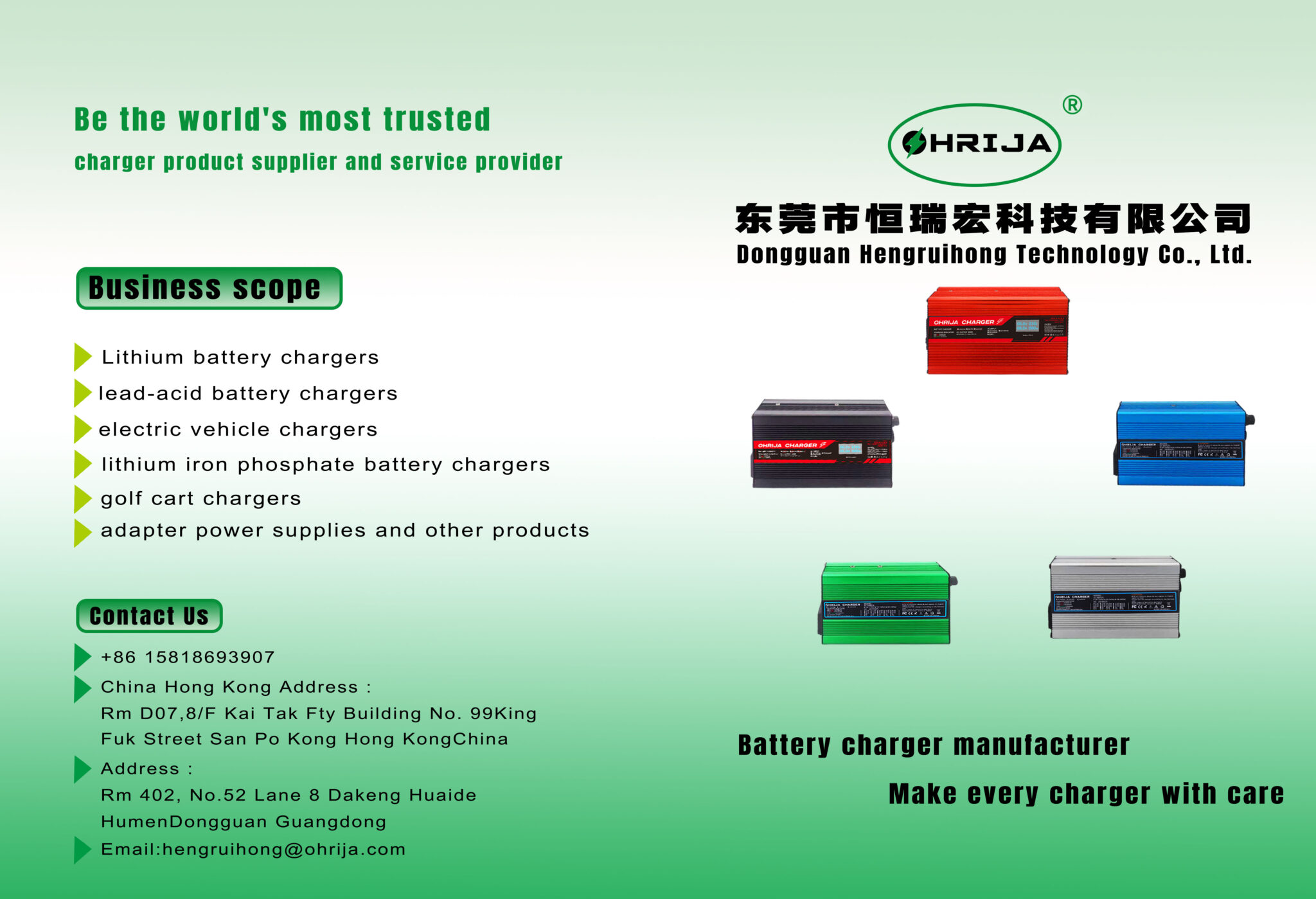
The OHRIJA brand belongs to Dongguan Hengruihong Technology Co., Ltd., established in 2020 and headquartered in Dongguan, Guangdong Province, China. We are a high-tech enterprise integrating R&D, production, and sales.
Our core manufacturing focuses on delivering exact, reliable specifications. Our main products include: lithium battery chargers, lithium iron phosphate (LiFePO4) battery chargers, lead-acid battery chargers, golf cart chargers, power adapters, and advanced switching power supplies.
Whether you need a consumer-grade replacement or a 12V 50A power supply 600W for heavy industrial use, our products are engineered for thermal stability and uncompromised safety.
Explore the OHRIJA Company Profile
If you still have specific technical questions regarding connector types, LED indicator meanings, or specific voltage cutoffs, we highly encourage you to review our comprehensive battery charger FAQs before finalizing your purchase.
Frequently Asked Questions
Can I use a higher amperage charger than my original one?
In most professional situations, you can increase the amperage slightly to achieve faster charge times, provided it does not exceed the maximum C-rate specified by the battery manufacturer. However, pushing too much current creates excess heat, which degrades lithium cells prematurely. Always verify your battery’s maximum charge current limit.
What is the difference between peak voltage and nominal voltage in Battery Charger Specifications?
Nominal voltage is the average operating voltage (e.g., 48V). Peak voltage is the absolute maximum voltage required to achieve a 100% state of charge (e.g., 54.6V for a 48V lithium-ion pack). Your charger output must match the peak voltage exactly, not the nominal voltage.
Why shouldn’t I use a lead-acid charger on a lithium battery?
Lead-acid chargers feature a ‘desulfation’ or ‘equalization’ phase that pulses high voltage to clean lead plates. If you apply this high-voltage pulse to a lithium battery, you will instantly destroy the internal Battery Management System (BMS) and risk catastrophic thermal runaway.
Does leaving my charger plugged in after the light turns green damage the battery?
A high-quality smart charger will automatically cut off power once the CV phase is complete and the current drops to near zero. However, relying on the BMS to constantly block voltage is bad practice. We recommend unplugging the charger once the cycle is complete to prevent continuous micro-cycling.
Industry References & Authoritative Guidelines
To ensure our electrical engineering guidance meets the highest global safety standards, OHRIJA aligns its technical documentation with the following authoritative organizations:
- Battery University (by Cadex Electronics): The definitive educational resource for battery chemistry, providing peer-reviewed data on the CC/CV charging algorithms and the effects of charge rates on lithium-ion longevity. Review Battery University Guidelines
- Underwriters Laboratories (UL): The global safety science leader defining the rigorous testing standards (such as UL 1310 for Class 2 Power Units) required for consumer and industrial battery chargers to prevent fire hazards. Review UL Safety Standards
- Institute of Electrical and Electronics Engineers (IEEE): Professional association publishing advanced technical standards regarding power electronics, thermal management, and smart grid charging infrastructure. Review IEEE Engineering Data