

As the electric mobility sector rapidly evolves into 2026, the 48V architecture has cemented itself as the gold standard for electric bicycles. Delivering an optimal balance of torque, speed, and efficiency, these powertrains require sophisticated energy management. However, the most critical component determining the lifespan and safety of your expensive power pack is often the most overlooked: the charger. Utilizing a generic or mismatched power supply can lead to accelerated cell degradation, unbalanced series groups, and severe thermal hazards. To maximize your investment, selecting the best 48V Lithium Battery Charger for Electric Bike applications is an absolute necessity.
Authored by OHRIJA — A global leader in power electronics, dedicated to manufacturing premium, high-efficiency lithium battery chargers for electric mobility, ensuring safety, longevity, and peak performance for riders worldwide.
From our experience engineering advanced charging algorithms, a premium 48V Lithium Battery Charger for Electric Bike must execute a flawless Constant Current/Constant Voltage (CC/CV) charge cycle. It must feature robust thermal management, typically through an extruded aluminum alloy shell, and offer precise voltage cut-offs to prevent overcharging. In this authoritative industry guide, we will leverage our technical expertise to review the top models available on the market, detail the underlying battery chemistry of 13S and 12S packs, and provide you with the knowledge required to select the perfect 48V Lithium Battery Charger for Electric Bike.
Table of Contents
- Summary Table: Top 7 Chargers of 2026
- Understanding 48V Lithium Battery Architectures (13S vs. 12S)
- In-Depth Reviews: The 7 Best Chargers
- Expert Buying Guide: Selecting the Right 48V Lithium Battery Charger for Electric Bike
- Frequently Asked Questions (FAQs)
- Industry References
Summary Table: Top 7 Chargers of 2026
To assist you in rapid procurement and comparison, we have compiled the core specifications of the top-performing units. When seeking a reliable 48V Lithium Battery Charger for Electric Bike, aligning the maximum output voltage and amperage with your specific battery pack is the first step.
| Rank | Brand & Model | Max Output Voltage | Output Current | Ideal Use Case |
|---|---|---|---|---|
| 1 | OHRIJA HRH600 OLED | 54.6V (13S) | 10A | Heavy-duty fast charging for large capacity packs |
| 2 | OHRIJA HRH300 | 54.6V (13S) | 5A | Optimal daily charging with balanced thermal metrics |
| 3 | OHRIJA HRH120 | 50.4V (12S) | 2A | Trickle charging for 12S systems and balancing |
| 4 | Grin Satiator | Variable | Up to 8A | Custom builds requiring multi-voltage programming |
| 5 | Bosch Standard 4A | Varies by proprietary BMS | 4A | OEM replacement for closed Bosch systems |
| 6 | Luna Advanced Mini | 54.6V (13S) | 3A | Travel and portable charging needs |
| 7 | Shimano EC-E8004 | Proprietary | 4A | OEM replacement for Shimano STEPS systems |
Understanding 48V Lithium Battery Architectures (13S vs. 12S)
A common point of confusion in the e-mobility sector is the definition of “48V”. Lithium-ion cells possess a nominal voltage of 3.6V or 3.7V, and a maximum charge voltage of 4.2V. When constructing a 48V pack, engineers typically place 13 groups of cells in series (13S). A 13S pack has a nominal voltage of 48.1V, but when fully charged, it reaches 54.6V (13 x 4.2V). Therefore, the standard 48V Lithium Battery Charger for Electric Bike must output exactly 54.6V.
However, some legacy scooters and specialized balancing vehicles utilize a 12S architecture. A 12S pack has a nominal voltage of 44.4V and requires a peak charge voltage of 50.4V. Using a 54.6V charger on a 12S pack will cause severe overvoltage, resulting in thermal runaway or immediate battery management system (BMS) shutdown. We recommend verifying your battery’s series count (S-count) before purchasing any 48V Lithium Battery Charger for Electric Bike.
In-Depth Reviews: The 7 Best Chargers
1. OHRIJA 54.6V 10A OLED Charger (Model: HRH600)

Securing the premier spot on our list is our flagship heavy-duty unit. When dealing with high-capacity 13S 48V Li-ion batteries (typically 20Ah and above), standard 2A chargers can take upwards of 12 hours to complete a cycle. The OHRIJA HRH600 operates at a maximum of 590W, delivering a massive 10Amp (±0.2a) output current, slashing charge times by up to 80%.
From our experience, pumping 10 amps into a battery generates significant heat within the charging unit. To combat this, the HRH600 is encased in a premium aluminum alloy shell measuring 170*90*63MM and weighing 1.4kg. This casing acts as a massive heat sink. Furthermore, it features an advanced OLED display, providing real-time telemetry on voltage and amperage. With customizable output connectors including XT60, XT90, Anderson 50A, and GX16, it is undeniably the most robust 48V Lithium Battery Charger for Electric Bike available in 2026 for high-performance riders.
2. OHRIJA 54.6V 5A Battery Charger (Model: HRH300)
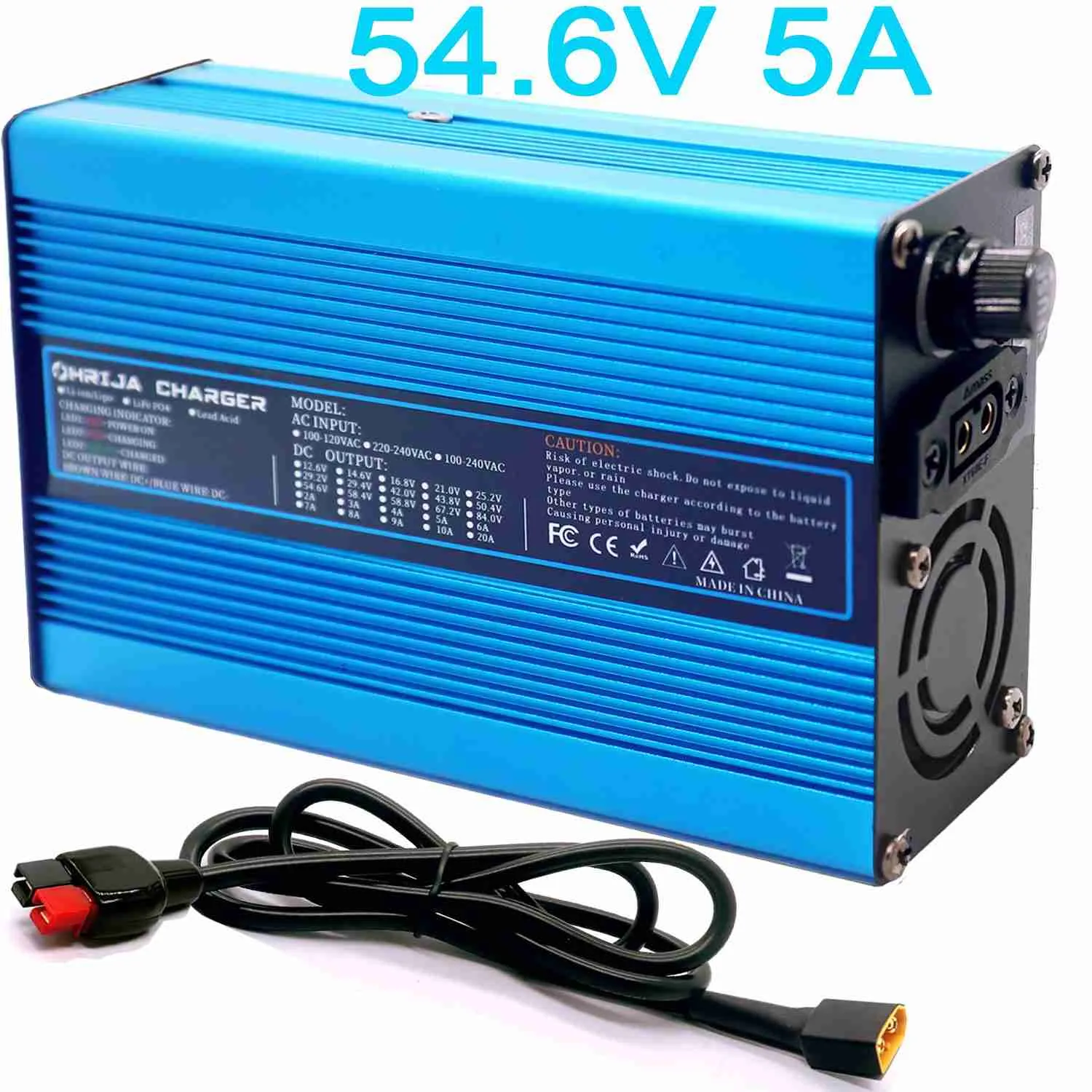
For daily commuting, a 5A charge rate represents the perfect equilibrium between rapid turnaround times and preserving the internal chemistry of the lithium cells. The OHRIJA HRH300 outputs a maximum of 54.6V (±0.2v) and 5Amp (±0.2a), consuming a maximum working power of 295W.
We recommend this specific 48V Lithium Battery Charger for Electric Bike for standard 13S 48.1V packs ranging from 10Ah to 20Ah. Like our flagship model, it features an aluminum alloy shell for superior thermal dissipation, measuring 135*90*50MM at 0.85kg. A standout feature of the HRH300 is its detachable connector system, allowing users to swap between XLR, DC5.5*2.5, Crocodile Clips, and Wire Noses based on their specific battery port, making it highly versatile for mixed-fleet households.
3. OHRIJA 50.4V 2A Aluminum Alloy Charger (Model: HRH120)

As discussed previously, the 12 Series (12S) 44.4V lithium battery is a staple in electric scooters and balancing vehicles. The OHRIJA HRH120 is precision-engineered specifically for these 12S architectures. It delivers a strictly regulated maximum output of 50.4V (±0.2v) at 2Amp (±0.2a).
While 2A is considered a “trickle charge” in modern terms, it is exceptionally beneficial for allowing the battery’s internal BMS to properly balance the individual cell groups at the top of the charge cycle. Operating at a maximum of 110W, this compact charger (136*66*40MM, 0.4kg) is the ideal travel companion. It represents the finest 48V Lithium Battery Charger for Electric Bike in the 12S sub-category.
4. Grin Technologies Satiator Programmable Charger
For DIY builders and electronics enthusiasts, the Grin Satiator is a highly respected unit. It is fully programmable, allowing users to alter the voltage profiles to charge 36V, 48V, or 52V packs. While it lacks the dedicated simplicity of a fixed-voltage unit, its flexibility makes it a strong contender when searching for a universal 48V Lithium Battery Charger for Electric Bike. However, its high price point places it outside the realm of necessity for the average consumer.
5. Bosch Standard Charger 4A
If you own an e-bike with a proprietary Bosch mid-drive system, you are generally locked into their ecosystem. The Bosch Standard 4A charger is a highly reliable OEM unit that communicates directly with the Bosch BMS via proprietary data pins. While it restricts the use of aftermarket packs, it is undeniably the best closed-system 48V Lithium Battery Charger for Electric Bike on the market, ensuring strict warranty compliance.
6. Luna Cycle Advanced Mini 3A Charger
Portability is key for long-distance touring. The Luna Cycle Advanced Mini operates at 3A, offering a middle ground between slow 2A trickle chargers and bulkier 5A units. It features an 80% / 90% / 100% charge toggle switch, allowing riders to undercharge their packs to deliberately extend the overall lifecycle of the lithium cells. This smart functionality makes it a highly recommended 48V Lithium Battery Charger for Electric Bike for longevity-focused users.
7. Shimano Steps EC-E8004 Charger
Similar to Bosch, Shimano operates a closed ecosystem. The EC-E8004 is a lightweight, 4A charger designed specifically for Shimano STEPS battery packs. It features an IPX5 water resistance rating, making it more durable for muddy mountain biking environments. If your e-bike runs a Shimano powertrain, this is the designated 48V Lithium Battery Charger for Electric Bike you must utilize to maintain system integrity.
Expert Buying Guide: Selecting the Right 48V Lithium Battery Charger for Electric Bike
Procuring a 48V Lithium Battery Charger for Electric Bike requires an understanding of basic electrical engineering principles. From our extensive manufacturing experience, we advise consumers to evaluate chargers based on the following critical parameters:
- Exact Voltage Matching: A “48V” battery is almost always a 13S configuration requiring a 54.6V charger. If you have a 12S configuration (44.4V nominal), you must use a 50.4V charger. Applying 54.6V to a 12S pack is dangerous. Always read the label on your battery pack before purchasing a 48V Lithium Battery Charger for Electric Bike.
- Appropriate Amperage (Charge Rate): Lithium-ion cells prefer to be charged at a rate of 0.2C to 0.5C (where C is the capacity of the battery). If you have a 20Ah battery, a 10A charger (OHRIJA HRH600) charges at 0.5C, which is safe and extremely fast. If you have a small 10Ah battery, pushing 10A (1.0C) generates excessive heat and degrades the cells faster; in this case, the 5A (OHRIJA HRH300) is the superior choice.
- Thermal Infrastructure: The process of AC to DC power conversion generates significant heat. Avoid cheap plastic chargers without adequate venting. We manufacture our chargers with an aluminum alloy shell because aluminum conducts heat away from the internal MOSFETs and capacitors, drastically extending the operational lifespan of the 48V Lithium Battery Charger for Electric Bike.
- Connector Compatibility: The output connector must perfectly match your battery’s charge port. Forcing incompatible connectors causes arcing and shorts. At OHRIJA, we support custom OEM configurations, ensuring you receive the exact DC5.5*2.5, GX16 1+3-, XLR, XT60, or Anderson plug required for seamless integration.
Frequently Asked Questions (FAQs)
Can I leave my 48V Lithium Battery Charger for Electric Bike plugged in overnight?
While high-quality chargers like the OHRIJA HRH300 feature an automatic cut-off once the CC/CV cycle completes and the current drops below a specific threshold, we recommend disconnecting the charger once the indicator light turns green. Continuous micro-cycling at peak voltage can cause unnecessary stress on the cell chemistry over time.
Why does the fan on my 48V Lithium Battery Charger for Electric Bike turn on immediately?
During the Constant Current (CC) phase of charging, the unit is pushing maximum wattage (e.g., 590W on the HRH600) into the battery. This generates thermal load. The internal cooling fans are designed to activate immediately under load to protect the circuitry. The fan will typically slow down or turn off during the final Constant Voltage (CV) absorption phase.
Is a higher amperage 48V Lithium Battery Charger for Electric Bike always better?
Not necessarily. While a 10A charger is exceptionally fast, it should only be used on large capacity packs (usually 15Ah or greater) equipped with a BMS capable of handling a 10A input. Pushing high amperage into a low-capacity battery causes thermal stress and shortens the overall lifespan of the pack. For packs under 15Ah, a 2A or 5A 48V Lithium Battery Charger for Electric Bike is highly recommended.
 English
  Français
  Deutsch
  Italiano
  Nederlands
  Español
  Português do Brasil
  Türkçe
  Русский