
No products in the cart.

Slow charging, incomplete recharging and excessive battery heat are rarely solved by simply buying a charger with a higher amp rating. Lead-acid charging performance depends on the relationship between battery condition, charging voltage, current, temperature and the time allowed for each charging stage. Get those factors right and you can improve recharge consistency, reduce avoidable wear and make better use of the battery capacity you already own.
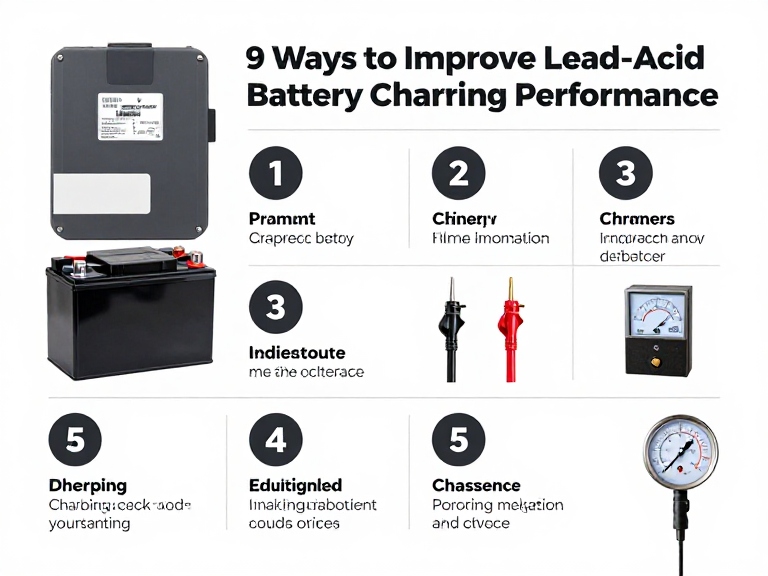
9 Ways to Improve Lead-Acid Battery Charging Performance
Whether you operate a golf cart, backup power system, floor-cleaning machine, mobility device or industrial battery bank, the objective is the same: deliver the correct charge without overheating or chronically undercharging the battery. From our experience in battery charger technology, the most effective improvements usually come from correct charger matching, better charging habits and routine inspection—not from increasing charging current without checking the battery specifications first.
Quick Answer: How Do You Improve Lead-Acid Battery Charging Performance?
To improve lead-acid battery charging performance, use a charger designed for the exact battery voltage and chemistry, select the manufacturer’s recommended current and voltage settings, allow the absorption stage to finish, compensate for battery temperature, maintain flooded battery electrolyte levels, clean and tighten connections, avoid deep discharges, and investigate batteries that repeatedly charge slowly.
Our recommendation: Start by checking the battery label and charger profile. If these do not match, correct that before changing charge current or buying replacement equipment. A properly configured multi-stage charger is generally a better investment than a higher-current charger with an unsuitable charging profile.
Table of Contents
- What affects lead-acid battery charging performance?
- Quick summary of the 9 improvements
- 9 practical ways to improve charging performance
- How to choose the right lead-acid battery charger
- Charger and charging method comparison
- Pros and cons of upgrading your charging setup
- Common lead-acid charging mistakes
- Expert recommendation
- Frequently asked questions
- References
What Affects Lead-Acid Battery Charging Performance?
Lead-acid battery charging is a controlled electrochemical process. Electrical energy is supplied to the battery to reverse the chemical changes that occur during discharge. The charger must provide enough current to restore capacity while controlling voltage and temperature as the battery approaches full charge.
There is no single charging setting that suits every lead-acid battery. Flooded, AGM and gel batteries have different charging requirements. Even batteries with the same nominal voltage may have different recommended charge currents, absorption voltages and charging durations.
How a typical multi-stage charging cycle works
Most modern lead-acid battery chargers use a bulk, absorption and float charging sequence. Some chargers add further stages or monitoring functions, but these three stages explain the main process.
- Bulk: The charger supplies controlled current while battery voltage rises. This stage restores a large part of the discharged capacity.
- Absorption: The charger holds a target voltage while charging current gradually decreases. This stage is essential for completing the charge.
- Float: The charger reduces voltage to maintain the battery at or near full charge without continuously applying the higher absorption voltage.
A common mistake is judging charger performance only by how quickly the battery reaches its absorption voltage. Reaching that voltage does not mean the battery is fully charged. The absorption stage may still need substantial time, particularly after a deep discharge. Victron Energy explains this distinction in its charging guidance and illustrates why charge time depends on battery capacity, depth of discharge and available current.
Quick Summary: 9 Ways to Improve Lead-Acid Battery Charging Performance
| Improvement | What to do | Expected benefit | Priority |
|---|---|---|---|
| 1. Match charger to battery | Check voltage, chemistry and manufacturer settings. | Reduces undercharging and overcharging risk. | Essential |
| 2. Use the correct charge current | Size current according to battery capacity and specifications. | Balances recharge time and battery stress. | Essential |
| 3. Complete absorption | Allow the charger to finish its full charging cycle. | Improves the chance of reaching full state of charge. | Essential |
| 4. Control temperature | Charge in a suitable environment and use temperature compensation where supported. | Helps prevent temperature-related charging errors. | High |
| 5. Maintain electrolyte | Check water levels in serviceable flooded batteries. | Protects exposed plates and supports normal operation. | High |
| 6. Clean connections | Inspect terminals, cables, connectors and charger plugs. | Reduces voltage drop and unwanted resistance. | High |
| 7. Avoid excessive discharge | Recharge before the battery is repeatedly deeply discharged. | Reduces avoidable cycle stress. | High |
| 8. Equalize only when appropriate | Follow the battery manufacturer’s instructions for flooded batteries. | Can correct certain cell imbalances and acid stratification. | Conditional |
| 9. Test battery health | Check voltage, capacity and specific gravity where applicable. | Identifies faults that charger changes cannot fix. | Essential for diagnosis |
9 Practical Ways to Improve Lead-Acid Battery Charging Performance
1. Match the charger to the battery’s voltage and chemistry
This is the first check we recommend because an incompatible charger profile can undermine every other improvement. Confirm the battery’s nominal voltage—such as 6V, 12V, 24V, 36V or 48V—and identify whether it is flooded, AGM or gel.
These battery types are not interchangeable from a charging perspective. Flooded batteries may require different absorption settings and maintenance procedures from sealed AGM or gel batteries. A charger configured for one type can overcharge or undercharge another, even if the nominal voltage is correct.
Check the battery manufacturer’s charging table rather than relying on a generic voltage chart. Then verify that the charger supports the required profile. If the charger has selectable modes, confirm that the selected mode matches the installed battery.
Professional recommendation: Do not select a charger based on the connector or voltage label alone. Confirm battery chemistry, recommended charging voltage, maximum charge current and whether temperature compensation is required.
2. Select an appropriate charging current
Charging current affects recharge time, but more amps do not automatically mean better performance. A current that exceeds the battery manufacturer’s limit can create excessive heat and gas generation. An undersized charger may take too long to restore capacity, particularly in commercial equipment that needs to return to service quickly.
Use the battery’s rated capacity and its recommended charge-current range to size the charger. For example, a 100Ah battery and a 10A charger have a theoretical bulk-stage calculation of approximately ten hours to deliver 100Ah. Actual recharge time is longer or shorter depending on the depth of discharge, charging losses, battery condition and absorption requirements.
For commercial users, the correct choice is the charger that restores the required capacity within the available charging window while remaining inside the battery’s specified limits. Avoid increasing current simply because the existing charging cycle feels slow.
3. Allow the absorption stage to finish
One of the most overlooked causes of poor lead-acid battery performance is repeatedly interrupting charging before absorption is complete. During bulk charging, the battery voltage rises relatively quickly. During absorption, the charger holds voltage while the current gradually tapers. This final stage is necessary to restore the remaining capacity.
If a golf cart or industrial machine is unplugged as soon as the charger indicates that it has reached its absorption voltage, the battery may remain chronically undercharged. Repeated partial charging can contribute to sulfation and reduced available capacity.
Use a charger with an appropriate automatic charging profile and allow it to complete the cycle. If the charger consistently terminates too early, check its settings, battery temperature sensor and charging algorithm before assuming the battery is defective.
4. Control battery temperature during charging
Temperature changes the way lead-acid batteries accept charge. Charging voltage requirements generally need to be adjusted for battery temperature. A fixed voltage that is suitable at a reference temperature may be too high in hot conditions or too low in cold conditions.
Where the charger and battery system support it, use a correctly installed battery temperature sensor and the manufacturer’s temperature-compensation settings. Do not guess at compensation values or apply a setting intended for another battery model.
Keep the charging area ventilated and away from direct heat sources. Avoid charging a frozen battery, and stop charging if the battery becomes abnormally hot, swells, leaks or produces unusual fumes. These are warning signs that require investigation rather than a higher-current setting.
5. Maintain electrolyte levels in flooded batteries
Flooded lead-acid batteries require periodic electrolyte inspection. During normal operation and charging, water is lost through gassing and evaporation. If the electrolyte level falls too far, battery plates may become exposed, leading to permanent damage.
Use distilled water only when topping up a serviceable flooded battery, and follow the battery manufacturer’s instructions for when and how much to add. Do not add acid as part of routine maintenance. Avoid overfilling because electrolyte levels rise during charging.
AGM and gel batteries are sealed designs and should not be opened or topped up. If you use sealed batteries, concentrate on correct charging settings, clean connections and temperature management instead.
6. Clean battery terminals and inspect the charging cables
A charger can be operating correctly while the battery receives less effective charging because of resistance in damaged cables, loose terminals or corroded connectors. These problems can create voltage drop, heat and inconsistent charging behaviour.
Inspect the full charging path, including the AC supply cable, charger output cable, plug, battery connector and terminal connections. Look for cracked insulation, corrosion, loose fittings, discoloration and signs of overheating.
Disconnect power and follow the equipment manufacturer’s isolation procedure before cleaning or tightening connections. Use suitable protective equipment and the correct tools. Replace damaged cables or connectors rather than relying on temporary repairs.
For equipment that uses detachable charging plugs, connector condition matters just as much as charger output. OHRIJA provides charger-related products and connector categories for different applications, including golf cart charger output connectors and battery charger output connectors. Always verify the electrical rating, polarity and physical compatibility before selecting a replacement.
7. Avoid repeatedly deep-discharging the battery
Lead-acid batteries do not need to be completely discharged before recharging. In fact, deliberately running a battery down to its lowest practical voltage before every recharge is a poor operating strategy for most applications.
For deep-cycle applications, reducing unnecessary depth of discharge can help preserve cycle life. Recharge after use where practical, and avoid leaving a discharged battery unused for extended periods. A battery that is repeatedly left partially charged is more vulnerable to sulfation and capacity loss.
For commercial fleets, set a charging routine around actual daily energy use. A golf cart used for several short trips may need a different schedule from a floor-cleaning machine running multiple shifts. The correct approach is to maintain adequate charge without keeping the battery at an unsuitable high voltage or repeatedly overcharging it.
8. Use equalization only when the battery manufacturer recommends it
Equalization is a controlled overcharge procedure used on certain flooded lead-acid batteries. It can help address acid stratification and cell imbalance when performed under the correct conditions. It is not a universal maintenance step and should not be applied indiscriminately.
Trojan Battery’s maintenance guidance specifies equalization for flooded batteries and recommends using battery condition indicators, such as specific-gravity readings, to determine when it is needed. That is a better approach than scheduling aggressive equalization simply because a calendar reminder says it is time.
Important: Do not equalize AGM or gel batteries unless the battery manufacturer explicitly provides a compatible procedure. Excessive voltage can damage sealed batteries. Remove connected loads where required, provide ventilation and follow the exact battery-specific instructions.
9. Test battery condition instead of blaming the charger
A battery that charges slowly, loses capacity quickly or fails to hold voltage may be worn out or damaged. Replacing the charger will not restore active material lost through ageing, reverse a failed cell or repair internal damage.
Start with a visual inspection and a fully charged resting-voltage check using the battery manufacturer’s procedure. For serviceable flooded batteries, a trained technician can use a hydrometer to compare specific gravity across cells. A suitable load test or capacity test provides more meaningful information about the battery’s ability to deliver power under operating conditions.
For multi-battery systems, test individual batteries as well as the complete bank. One weak battery can affect the performance of the entire series-connected system. Record readings over time so that gradual deterioration can be distinguished from a sudden charging fault.
How to Choose the Right Lead-Acid Battery Charger
A good charger should match the battery’s electrical requirements and the operating environment. For most users, the most important features are a correct battery-type profile, controlled multi-stage charging, suitable output current, temperature management and dependable protection features.
What to check before buying
- Output voltage: It must match the complete battery system, not just an individual battery in the bank.
- Battery chemistry setting: Confirm support for flooded, AGM or gel as required.
- Charge-current rating: Compare the charger’s output with the battery manufacturer’s recommended current.
- Charging algorithm: Look for appropriate bulk, absorption and float stages.
- Temperature compensation: Useful where battery temperature varies significantly and the system supports a sensor.
- Protection: Check for over-voltage, over-current, short-circuit and reverse-polarity protection where appropriate.
- Connector and polarity: Verify the exact connector type, pin arrangement and cable rating.
- Operating environment: Consider dust, moisture, vibration, ventilation and expected daily duty cycle.
OHRIJA develops battery charging products for different battery chemistries and applications.
OHRIJA is a battery charger brand belonging to Dongguan Hengruihong Technology Co., Ltd., established in 2020 in Dongguan, Guangdong, China. The company integrates research and development, production and sales, with products including lithium battery chargers, LiFePO4 chargers, lead-acid battery chargers, golf cart chargers, power adapters and switching power supplies.
When reviewing a charger supplier, we recommend checking technical documentation, output specifications, supported battery types and connector options before comparing price. You can learn more about the company on the OHRIJA charger About Us page or explore its battery charger product range.
Lead-Acid Charger and Charging Method Comparison
Different charger designs serve different needs. The best option depends on battery type, operating hours, charging access and how much control the user needs over the charging process.
| Charger or method | Best use case | Advantages | Limitations | Our assessment |
|---|---|---|---|---|
| Basic single-stage charger | Simple, supervised charging where the battery and charger specifications are closely matched. | Simple design and potentially low purchase cost. | Limited control over the complete charging process; may not suit long-term maintenance. | Not our first choice for daily deep-cycle use. |
| Automatic multi-stage charger | Golf carts, mobility equipment, backup systems and regular battery cycling. | Manages bulk, absorption and float stages automatically. | Must still be configured for the correct battery type and voltage. | Best general option for most regular users. |
| Temperature-compensated charger | Installations exposed to changing ambient or battery temperatures. | Can adjust charging voltage in response to battery temperature. | Requires compatible equipment and correct sensor installation. | Worth considering for demanding or variable environments. |
| Programmable industrial charger | Commercial battery banks and specialist equipment. | Allows more precise configuration and system integration. | Higher setup complexity; incorrect settings can cause damage. | Best when a technician can configure and monitor the system. |
| Solar charge controller | Off-grid systems with solar panels and lead-acid storage. | Manages variable solar input and battery charging stages. | Performance depends on panel output, controller sizing and available sunlight. | Choose a controller with a suitable lead-acid profile. |
Pros and Cons of Upgrading Your Lead-Acid Charging Setup
| Pros | Cons and considerations |
|---|---|
| A suitable multi-stage charger can improve charging consistency and reduce the risk of chronic undercharging. | A new charger cannot repair a battery with failed cells or severely reduced capacity. |
| Correct current and voltage settings help balance recharge time with battery requirements. | Higher output current is not automatically better and may exceed battery limits. |
| Temperature compensation can improve charging control where operating temperatures vary. | Temperature sensors must be compatible and correctly installed. |
| Better connectors and cables can reduce voltage drop and unwanted heating. | Connector replacement must preserve polarity, ratings and compatibility. |
| Automatic charging can reduce manual intervention in routine applications. | Automatic operation still depends on correct settings and regular inspection. |
From a cost-benefit perspective, upgrading makes the most sense when the existing charger has an unsuitable profile, lacks required protection or cannot complete the battery manufacturer’s recommended charging cycle. If the charger already meets the specifications, spend money first on testing the battery and checking cables, terminals and operating practices.
Common Mistakes That Reduce Lead-Acid Charging Performance
- Choosing a charger by voltage alone: Voltage compatibility does not confirm chemistry or charging-profile compatibility.
- Buying the highest-amp charger available: Excessive current can create heat and shorten battery life.
- Unplugging before absorption finishes: Repeated partial charging can leave the battery undercharged.
- Using equalization on sealed batteries: AGM and gel batteries should not receive flooded-battery equalization settings unless explicitly permitted by their manufacturer.
- Ignoring temperature: Charging voltage requirements change with battery temperature.
- Leaving a discharged battery unused: Extended periods at low state of charge encourage deterioration.
- Assuming every slow charge is a charger fault: Ageing batteries, damaged cables and weak cells can produce similar symptoms.
- Mixing old and new batteries without assessment: In a battery bank, mismatched condition and capacity can lead to uneven performance.
When Is It Worth Upgrading to a Different Battery Technology?
Improving lead-acid charging performance is often the most economical choice when the existing batteries are healthy and the equipment is designed around them. However, some users may benefit from evaluating lithium alternatives when faster charging, lower weight or higher usable capacity is a priority.
That decision should be based on the complete system cost, not just the advertised battery price. Consider battery replacement cost, charger compatibility, expected cycle life, usable capacity, operating temperature, maintenance requirements and any changes needed to the battery management or control system.
Do not charge a lithium battery with a lead-acid profile simply because the nominal voltage appears similar. Lithium chemistries require their own charging limits and control requirements. If you are comparing technologies, OHRIJA also offers resources such as 12V LiFePO4 battery charger options and a 58.8V 5A charger for compatible 48V lithium-ion batteries. These are lithium charging products, not substitutes for a lead-acid charger.
For electric mobility applications, review the specific charger requirements before making a change. The OHRIJA electric bicycle charger range and its electric wheelchair charger category illustrate why charger selection should follow the battery and equipment specification rather than a generic voltage assumption.
Expert Recommendation: The Most Effective Improvement Order
For most owners and operators, we recommend working through charging problems in a fixed order. This avoids unnecessary purchases and makes it easier to identify the real cause of poor performance.
- Confirm the battery type and system voltage. Read the battery label and technical documentation.
- Check the charger’s profile and output. Compare its voltage, current and charging stages with the battery manufacturer’s requirements.
- Inspect the charging path. Check terminals, plugs, cables and signs of heat or corrosion.
- Review the charging routine. Make sure the battery regularly reaches a full charge and is not left discharged.
- Check temperature and ventilation. Confirm the installation is suitable for charging.
- Test the battery bank. Investigate weak cells, capacity loss or imbalance before replacing equipment.
- Upgrade only where the evidence supports it. Choose a charger that meets the actual battery and application requirements.
For beginners, correct charger matching and completing the charging cycle will usually be the most useful first steps. For commercial users, we recommend documenting charge times, battery temperature, inspection results and battery test readings. This creates a useful maintenance history and helps identify a developing problem before it disrupts operations.
Final Verdict
To improve lead-acid battery charging performance, focus on compatibility, charging stages, current limits, temperature, maintenance and battery condition. A correctly configured automatic charger is generally the best starting point for regular use, but even the best charger cannot compensate for damaged batteries or poor connections.
Our position is straightforward: diagnose before upgrading. Match the charger to the battery, allow absorption to finish, maintain the battery correctly and test performance when results do not improve. This approach is more reliable and usually more cost-effective than simply buying a charger with a higher amp rating.
Frequently Asked Questions
1. What is the best way to improve lead-acid battery charging performance?
Use a charger designed for the battery’s voltage and chemistry, select the manufacturer’s recommended charge current and voltage, and allow the complete multi-stage charging cycle to finish. Then inspect connections, temperature and battery condition.
2. Does a higher-amp charger charge a lead-acid battery better?
Not necessarily. A higher-current charger may reduce bulk charging time, but the battery has a maximum recommended charge current. Exceeding that limit can increase heat and gas generation. Choose current according to the battery manufacturer’s specifications.
3. Should I fully discharge a lead-acid battery before recharging it?
No. Lead-acid batteries do not need to be fully discharged before recharging. Repeated deep discharges can increase wear, so recharge according to the battery manufacturer’s operating guidance.
4. Why does my lead-acid battery take so long to reach a full charge?
Possible causes include a low-current charger, deep discharge, an incomplete absorption stage, low temperature, poor cable connections, incorrect charger settings or an ageing battery. Check the charging profile and test the battery before replacing the charger.
5. Can I leave a lead-acid battery connected to a charger overnight?
It depends on the charger. A suitable automatic charger with a manufacturer-approved float or maintenance mode can generally remain connected as specified in its instructions. A basic charger without appropriate regulation should not be left connected unattended for extended periods.
6. How often should I equalize a lead-acid battery?
There is no universal schedule. Equalization is generally intended for certain flooded lead-acid batteries and should be performed only when the battery manufacturer’s procedure or test results indicate it is necessary. Do not apply flooded-battery equalization to AGM or gel batteries unless explicitly approved.
7. Does temperature affect lead-acid battery charging?
Yes. Battery temperature affects the appropriate charging voltage and the way the battery accepts current. Use manufacturer-approved temperature compensation where supported, and avoid charging a frozen or abnormally hot battery.
8. Can I use the same charger for flooded, AGM and gel batteries?
Only if the charger has compatible selectable profiles and its specifications explicitly support each battery type. The correct voltage and charging algorithm can differ between flooded, AGM and gel batteries. Always check the battery and charger manuals.
9. How can I tell whether the battery or charger is causing poor performance?
Check charger output and settings, inspect cables and connectors, and test the battery after charging. For flooded batteries, specific-gravity measurements can help identify cell imbalance. A suitable load or capacity test is useful when a battery cannot deliver its expected runtime.
References
The following manufacturer resources provide technical guidance on lead-acid charging, maintenance and charging stages. Always use the specifications for your exact battery model as the final authority.
- Trojan Battery – Battery Maintenance. Charging voltage, temperature compensation, watering, ventilation and equalization guidance.
- Victron Energy – Blue Smart Charger Operation. Explanation of lead-acid bulk and absorption charging stages and charge-time considerations.
- Rolls Battery – Battery User Manual. Manufacturer guidance for flooded, AGM and gel battery installation, inspection and charging.