
No products in the cart.

Table of Contents
- What Is a Lead Acid Battery Charger?
- 3 Recommended Types of Lead Acid Battery Chargers
- How Lead Acid Battery Charging Works
- Charger Comparison Table
- Pros and Cons
- How to Choose the Correct Voltage and Current
- Buying Considerations
- Common Charging Mistakes
- An OHRIJA Charger for Commercial Applications
- Who Should Use Each Charger?
- Expert Recommendation
- Frequently Asked Questions
- References
What Is a Lead Acid Battery Charger?
A lead acid battery charger is an electrical device designed to restore energy to a rechargeable battery by controlling the charging voltage and current. It converts incoming AC electricity into regulated DC output suitable for charging the battery.
Lead acid batteries are widely used in automotive systems, golf carts, electric wheelchairs, industrial equipment, emergency backup systems, and renewable energy storage. Their charging requirements differ from those of lithium-ion and LiFePO4 batteries. Even when two battery packs have the same nominal voltage, their charging profiles may be different.
Common lead acid battery constructions include flooded lead acid, AGM (Absorbent Glass Mat), and GEL batteries. They share the same basic electrochemical principle, but their permitted charging voltages, current limits, and maintenance requirements can vary.
We strongly recommend checking the battery manufacturer’s charging specifications before selecting a charger. A charger labeled simply as 12V or 24V does not automatically guarantee compatibility.
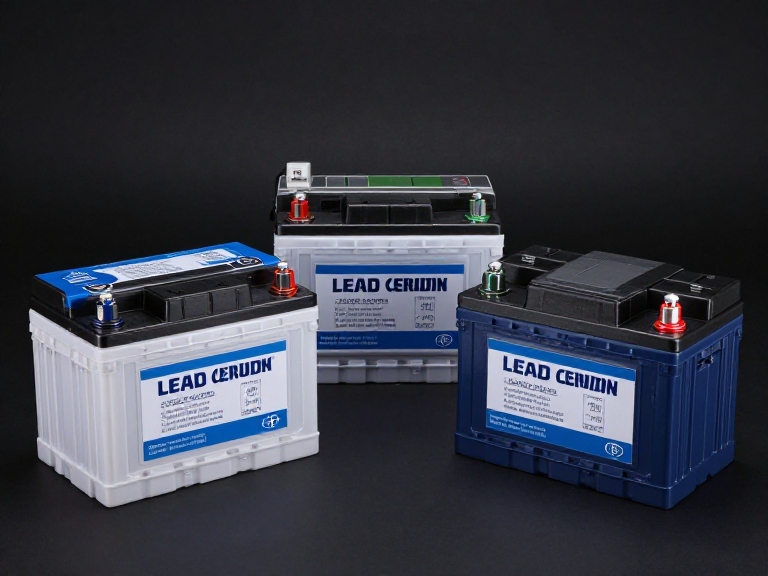
3 Recommended Types of Chargers for a Lead Acid Battery
1. Multi-Stage Smart Battery Charger: Best Overall Choice
A multi-stage smart charger is our first recommendation for most lead acid battery users. It automatically adjusts its charging behavior according to the battery’s charging progress rather than delivering the same output continuously.
Most conventional three-stage charging systems use three main stages:
- Bulk charging: The charger supplies controlled charging current to restore most of the battery’s depleted capacity.
- Absorption charging: The charger maintains a specified voltage while the charging current gradually decreases, allowing the battery to approach full charge.
- Float charging: After the main charging process is complete, the charger reduces its voltage to a suitable maintenance level.
This approach is especially useful because lead acid batteries do not accept current at the same rate throughout the entire charging process. Current acceptance decreases as the battery approaches full charge. A properly configured multi-stage charger accounts for this behavior.
Best applications:
- Daily charging of electric vehicles and mobility equipment.
- AGM and GEL battery systems with compatible charging profiles.
- Deep-cycle batteries used in industrial equipment.
- Commercial battery systems requiring repeatable charging performance.
- Users who want automatic charging without manually monitoring every stage.
Our recommendation: For a battery that is regularly discharged and recharged, choose a smart charger with a charging algorithm specifically matched to the battery construction. Look for selectable flooded, AGM, or GEL programs where appropriate. Do not assume that a charger offering more charging stages is automatically better; the actual voltage settings and control algorithm matter more than the advertised number of stages.
2. Float Charger or Battery Maintainer: Best for Standby Batteries
A float charger is designed to maintain a battery near full charge after its main charging process has been completed. It supplies a controlled, relatively low voltage to compensate for the battery’s natural self-discharge.
This charger is particularly valuable when a lead acid battery remains unused for extended periods. Examples include emergency lighting systems, standby power equipment, backup batteries, seasonal vehicles, and infrequently operated machinery.
However, a float charger should not be confused with an ordinary low-current charger. A proper float charger maintains a battery using a voltage appropriate for its chemistry and temperature. A basic trickle charger may continuously deliver current without adequate monitoring, potentially causing overcharging if left connected for too long.
Best applications:
- Emergency backup batteries that must remain ready for use.
- Standby power systems with long periods between discharge cycles.
- Seasonal vehicles and equipment stored for several weeks or months.
- Battery installations requiring regular charge maintenance.
Our recommendation: If your battery spends most of its time in storage or standby operation, a dedicated automatic battery maintainer is often a more economical choice than purchasing a high-current charger. Confirm that continuous float operation is permitted by the battery manufacturer. Temperature compensation is particularly valuable where ambient temperatures fluctuate significantly.
One important distinction: some flooded batteries have different storage and maintenance recommendations from sealed AGM and GEL batteries. Do not apply one universal float voltage to every lead acid battery.
3. High-Current Industrial Battery Charger: Best for Commercial and Heavy-Duty Applications
A high-current industrial charger is designed for battery systems that require a higher charging output. It is commonly used in electric vehicles, golf carts, industrial machinery, material-handling equipment, and large-capacity battery installations.
Its main advantage is the ability to deliver more charging current when the battery and charging specifications permit it. This can reduce the bulk-charging portion of the charging process and help commercial operators return equipment to service sooner.
However, high current is not automatically better. The battery must be able to accept the selected charging current without excessive heating, gassing, or accelerated degradation. The charger must also control its voltage and transition appropriately into absorption and, where required, float charging.
For example, a 24V battery pack with a capacity of 100Ah should not automatically be connected to a 30A charger simply because the charger supports 24V. The permitted charging current must first be checked against the battery manufacturer’s specifications.
Best applications:
- Commercial electric vehicles and golf cart battery systems.
- Industrial equipment operating on daily charging schedules.
- Large-capacity lead acid battery banks.
- Facilities where equipment downtime has a measurable operating cost.
- Applications requiring higher output current and robust electrical protection.
Our recommendation: Commercial users should evaluate charging time, battery capacity, thermal management, operating hours, and total ownership cost together. A correctly matched high-current charger can improve equipment availability, but an oversized charger can shorten battery life if the battery is not designed to accept its output.
How Does a Lead Acid Battery Charger Work?
Charging a lead acid battery reverses the chemical reactions that occur during discharge. The charger supplies controlled DC energy, allowing the battery’s active materials to return toward their charged state.
Professional charging systems generally control two important electrical parameters: voltage and current. During bulk charging, the charger supplies current within its configured limit. As the battery voltage reaches the absorption threshold, the charging system changes to voltage regulation. The current then gradually decreases as the battery approaches full charge.
In a three-stage charging system, the final float stage maintains the battery at a lower voltage appropriate for long-term maintenance. Not every application requires continuous float operation, and some charging profiles include additional stages such as soft start, battery analysis, or manufacturer-approved equalization.
Professional insight: A battery that reaches its absorption voltage is not necessarily fully charged. The absorption stage is important because it allows the remaining charging process to finish as current acceptance declines. Choosing a charger based only on its maximum voltage can therefore lead to incomplete charging or overcharging.
For a technical explanation of lead acid charging stages, see Delta-Q’s explanation of charging algorithms and charge profiles.
Comparison: Which Lead Acid Battery Charger Should You Choose?
| Comparison factor | Multi-stage smart charger | Float charger | High-current industrial charger |
|---|---|---|---|
| Main objective | Recharge batteries through controlled charging stages | Maintain an already charged battery | Deliver higher charging output for demanding operations |
| Charging speed | Depends on output current and battery capacity | Generally slow | Potentially faster during bulk charging |
| Automatic operation | Usually available | Usually available on automatic models | Depends on charger design |
| Long-term connection | Only if the manufacturer supports maintenance or float operation | Suitable when correctly configured for the battery | Depends on its charging and maintenance profile |
| Ideal user | Households, workshops, vehicle owners | Backup and standby system operators | Industrial and commercial users |
| Purchase priority | Correct chemistry program and voltage accuracy | Stable float control and temperature compensation | Current rating, thermal design, and protection |
For most ordinary charging applications, the multi-stage smart charger offers the strongest overall balance. For standby installations, a float maintainer is usually more appropriate. For commercial equipment, a properly engineered industrial charger may justify its higher purchase price through improved equipment availability.
Pros and Cons of the Three Charger Types
| Charger type | Pros | Cons |
|---|---|---|
| Multi-stage smart charger | Controlled charging, automatic operation, reduced overcharging risk when correctly configured, versatile applications | More expensive than basic chargers; incorrect battery settings can still cause damage |
| Float charger | Convenient maintenance, low charging output, suitable for standby batteries | Not intended to rapidly recharge deeply discharged batteries; unsuitable float settings can damage batteries |
| High-current industrial charger | Higher charging output, supports demanding operations, can reduce charging downtime | Higher purchase and installation costs; requires careful current and thermal management |
How to Choose the Correct Charger Voltage and Current
Voltage compatibility is the first requirement, but it is not the only one. Before purchasing a charger, verify the following specifications.
1. Match the Nominal Battery Voltage
The charger must be designed for the battery pack’s nominal voltage. Common lead acid battery configurations include 12V, 24V, 36V, 48V, and 60V systems.
For example, a 24V nominal lead acid battery system commonly uses a charging voltage higher than 24V. The exact value depends on the battery type and charging stage.
Do not select a charger solely because its product title contains the same voltage number as your battery. Always compare its actual output voltage and charging profile with the battery manufacturer’s requirements.
2. Check the Charging Voltage
A typical six-cell, 12V flooded lead acid battery may use an absorption voltage around 14.4V at approximately 25°C, with a lower float voltage. However, this is an illustrative reference rather than a universal setting.
AGM and GEL batteries can have different charging voltage requirements. Temperature compensation may also be necessary because charging voltage requirements change with battery temperature.
We recommend checking the battery datasheet rather than copying voltage values from another battery installation.
3. Select an Appropriate Charging Current
Charging current is measured in amperes (A), while battery capacity is normally measured in ampere-hours (Ah). A higher-current charger can reduce charging time during the bulk stage, but the permitted current depends on battery design and operating conditions.
For example, consider a 100Ah battery and two compatible chargers:
- A 10A charger has a theoretical bulk-stage calculation of 10 hours to supply 100Ah.
- A 20A charger has a theoretical bulk-stage calculation of 5 hours to supply 100Ah.
These are simplified calculations, not guaranteed full-charge times. Actual charging takes longer because of charging losses, battery condition, depth of discharge, and the absorption stage.
For more detailed technical guidance, consult Victron Energy’s lead acid battery charging guidance.
4. Confirm Battery Chemistry Compatibility
Flooded, AGM, and GEL batteries should not automatically share the same charging program. A charger with selectable chemistry settings can be useful when the correct profiles are available.
Never use a lithium-ion or LiFePO4 charging profile for a lead acid battery simply because the nominal voltage appears similar. If you need a charger for another battery chemistry, review the dedicated lithium-ion battery charger or LiFePO4 battery charger product categories instead.
Buying Considerations: What Matters Before You Purchase?
In our experience, the most expensive charger is not necessarily the best purchase. A suitable charger should meet the electrical requirements of the battery and the practical demands of the application.
Electrical Specifications
- Input voltage compatible with the local AC power supply.
- Correct nominal DC output voltage.
- Charging current within the battery manufacturer’s permitted range.
- Appropriate bulk, absorption, and float settings where required.
- Compatibility with flooded, AGM, or GEL battery construction.
Protection Functions
For professional and commercial applications, we recommend checking for overvoltage protection (OVP), overcurrent protection (OCP), overtemperature protection (OTP), short-circuit protection (SCP), and reverse-polarity or reverse-connection protection.
These functions help reduce electrical risks, but they do not replace correct installation, appropriate fusing, ventilation, and battery maintenance.
Cooling and Operating Environment
High-current chargers generate heat during operation. A charger used in a workshop or industrial environment should have a thermal design appropriate for its output rating and duty cycle.
Fan cooling with temperature-controlled speed can help manage heat under varying loads. However, users should also consider dust exposure, ambient temperature, enclosure protection, and installation clearance.
Manufacturer and Customization Capability
For commercial buyers, choosing a charger manufacturer involves more than comparing catalog prices. We recommend evaluating:
- Experience with the required battery chemistry and voltage range.
- Availability of electrical datasheets and technical documentation.
- Protection and thermal management design.
- Output connector and cable customization.
- Sample testing and engineering communication.
- Production capacity, quality control, and after-sales support.
If your application uses a specific charging connector, explore battery charger output connectors and confirm connector polarity, pin configuration, and current rating before ordering.
Common Mistakes When Charging Lead Acid Batteries
Mistake 1: Using a Charger with the Wrong Voltage
A charger with an unsuitable voltage can leave a battery undercharged or expose it to excessive charging voltage. Always verify the battery pack’s nominal voltage and the charger’s actual charging output.
Mistake 2: Choosing Excessive Charging Current
A higher amp rating does not automatically mean better performance. Excessive current can increase battery temperature and accelerate degradation. Follow the battery manufacturer’s maximum charging-current specification.
Mistake 3: Leaving a Basic Charger Connected Indefinitely
Not all basic chargers provide controlled float charging or automatic termination. Continuous charging with an unsuitable charger can cause excessive gassing, water loss, and premature battery failure.
Mistake 4: Ignoring Battery Chemistry
AGM, GEL, and flooded batteries can have different charging requirements. Select the appropriate program rather than assuming all lead acid batteries are interchangeable.
Mistake 5: Ignoring Ventilation and Temperature
Charging flooded lead acid batteries can release hydrogen gas. Charge in a properly ventilated area and keep ignition sources away. Do not charge a frozen or visibly damaged battery. Follow the battery manufacturer’s temperature limits and safety instructions.
For further technical information about charging behavior and safety, see Battery University’s guide to charging lead acid batteries.
An OHRIJA 24V 30A Lead Acid Battery Charger for Commercial Applications
For applications that require a 24V charging system with higher output current, OHRIJA offers a 24V 30A lead acid battery charger designed for compatible 2S 27.6V lead acid battery packs.
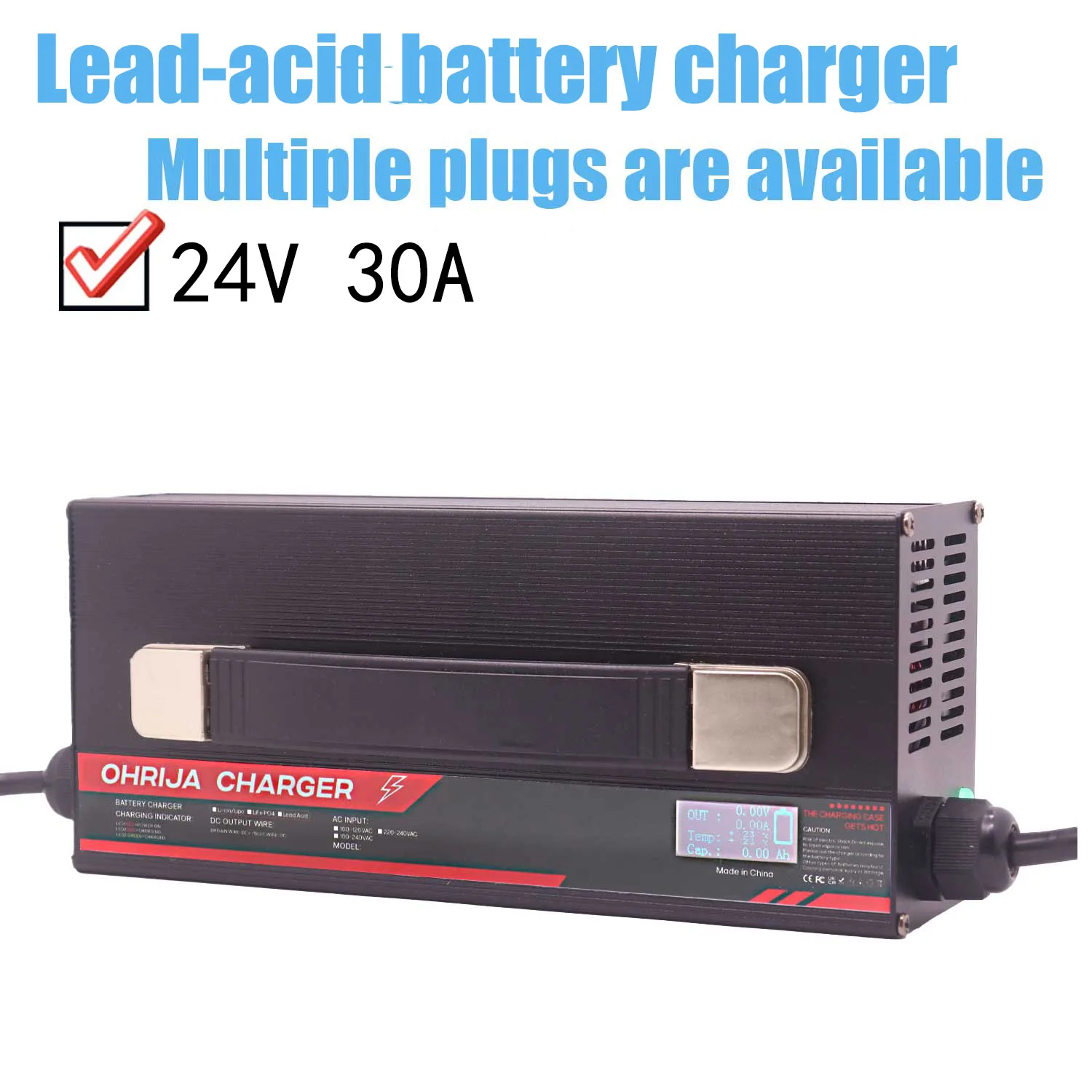
OHRIJA 24V Lead Acid Battery Charger, 30A
Input voltage: 110/220V AC
Output: 24V DC, 30A configuration
Compatibility: Specified 2S 27.6V lead acid battery packs
Cooling: Intelligent fan cooling with temperature-sensing speed control
Protection: OVP, OCP, OTP, SCP, and reverse-connection protection
View OHRIJA 24V 30A Lead Acid Battery Charger
This model is intended for applications such as industrial batteries, compatible electric vehicle systems, energy storage equipment, and mechanical power applications.
Its 30A output makes it worth evaluating for applications where a compatible battery can accept this charging current. The intelligent cooling system is also a practical consideration for equipment that operates under demanding charging conditions.
However, buyers should verify the exact battery charging profile, rated charging voltage, and permitted current before connecting the charger. The product’s 24V output designation should not be interpreted as proof of compatibility with every 24V lead acid battery pack.
For other system configurations, OHRIJA provides dedicated lead acid battery charger solutions, including:
- 2S 12V 13.8V battery charger.
- 4S 24V 27.6V battery charger.
- 6S 36V 41.4V battery charger.
- 8S 48V 55.2V battery charger.
- 10S 60V 69V battery charger.
For specialized vehicle applications, you can also review golf car battery chargers, electric bicycle chargers, and electric wheelchair chargers.
Who Should Use Each Type of Lead Acid Battery Charger?
| User or application | Recommended charger | Reason |
|---|---|---|
| Personal vehicle owner | Multi-stage smart charger | Automatic charging and battery-specific programs |
| Backup power operator | Float charger | Maintains battery readiness during standby |
| Golf cart fleet operator | Suitable high-current or smart charger | Supports regular charging schedules and fleet availability |
| Industrial equipment manufacturer | Industrial charger | Supports specified battery capacity and operating requirements |
| Seasonal equipment owner | Automatic battery maintainer | Helps compensate for self-discharge during storage |
| Battery system integrator | Customized multi-stage charger | Allows closer matching of voltage, current, connectors, and charging profile |
Who does not need an industrial charger? A user maintaining a small backup battery or occasionally charging a personal vehicle generally does not need a high-output commercial model. Paying for unnecessary charging capacity offers little practical benefit.
Expert Recommendation: Which Charger Is Actually Worth Buying?
Our recommendation is straightforward: choose a multi-stage smart lead acid battery charger for general-purpose charging, a float charger for long-term standby maintenance, and a high-current industrial charger when commercial charging demands justify the additional output.
For beginners, the most important factors are correct voltage, chemistry compatibility, automatic charging control, and adequate protection. Avoid purchasing a charger simply because it has the highest amp rating or the lowest advertised price.
For commercial users, the decision should be based on total operating cost. A correctly matched industrial charger may have a higher initial price, but shorter charging downtime, reliable thermal management, and suitable protection can make it a better long-term investment.
For manufacturers and equipment suppliers, we recommend discussing battery specifications, charging algorithms, connector requirements, input voltage, and operating conditions with the charger supplier before placing a bulk order.
The final verdict: A properly configured multi-stage smart charger is the best starting point for most lead acid battery applications. Float charging is the better solution for standby maintenance, while a high-current industrial charger is worth upgrading to when battery capacity and operating schedules genuinely require it. Correct matching is more important than maximum charging power.
Frequently Asked Questions About Lead Acid Battery Chargers
1. What type of charger is recommended for a lead acid battery?
A multi-stage automatic smart charger is generally recommended for most lead acid batteries. It uses bulk, absorption, and float charging stages to control the charging process. The charger must have voltage and current settings compatible with the battery’s construction and manufacturer specifications.
2. Can I use a regular charger for a lead acid battery?
Yes, provided the charger is specifically designed for the battery’s voltage and charging requirements. A basic charger without appropriate voltage regulation or automatic termination may increase the risk of overcharging. A compatible automatic charger is usually the safer and more convenient option.
3. Is a trickle charger the same as a float charger?
No. Both can be used for battery maintenance, but their control methods may differ. A proper float charger maintains a regulated voltage to compensate for self-discharge. A basic trickle charger may supply continuous current without sufficiently monitoring battery condition. For extended connections, choose a manufacturer-approved automatic maintainer.
4. Can I use a 24V charger for a 24V lead acid battery?
Not necessarily. The charger’s actual charging voltage must be higher than the nominal battery voltage according to the specified charging profile. Confirm the absorption and float settings, battery chemistry, and manufacturer’s requirements before use.
5. How many amps should a lead acid battery charger have?
The correct current depends on battery capacity, chemistry, condition, and manufacturer specifications. A 100Ah battery does not automatically require a 10A or 20A charger. Check the permitted charging-current range and choose an output that meets your required charging time without exceeding the battery’s limits.
6. Is a higher-amp charger better for lead acid batteries?
Not always. Higher current can reduce bulk charging time, but excessive current can cause overheating, gassing, and premature battery degradation. A higher-amp charger is worthwhile only when the battery is rated to accept that current and the charger provides appropriate regulation.
7. Can one charger charge flooded, AGM, and GEL batteries?
Some chargers support all three types through selectable charging programs, but not every model does. Their charging voltage requirements can differ. Confirm that the charger provides the correct battery-specific program rather than assuming that one default setting is suitable for all lead acid batteries.
8. How long does it take to charge a lead acid battery?
Charging time depends on battery capacity, remaining charge, charging current, battery condition, and absorption-stage duration. As a simplified example, a fully discharged 100Ah battery with a 10A charger may require approximately eight hours for the bulk portion to reach around 80% state of charge, followed by additional absorption time. Actual total time can be considerably longer.
9. Can I leave a lead acid battery connected to a charger overnight?
Only if the charger is designed for automatic operation and its maintenance settings are approved for the battery. A compatible smart charger with an appropriate float or maintenance function is generally preferable to an uncontrolled basic charger. Follow the battery and charger manufacturers’ instructions.
10. Does OHRIJA offer high-current lead acid battery chargers?
Yes. OHRIJA offers lead acid battery charger configurations for different voltage and current requirements, including a 24V 30A model for specified 2S 27.6V lead acid battery packs. Buyers should confirm battery compatibility, charging specifications, and connector requirements before ordering.
References
- Battery University – BU-403: Charging Lead Acid. Technical information about charging voltage, charging stages, battery types, and safe charging practices.
- Victron Energy – Lead-Acid Battery Charging. Technical guidance on bulk, absorption, and float charging behavior.
- Delta-Q Technologies – What Is an Algorithm / Charge Profile?. Explanation of charging algorithms and manufacturer-specific lead acid charging profiles.
Technical note: Charging voltages, current limits, temperature compensation, and maintenance requirements vary by battery manufacturer and model. Always consult the applicable battery datasheet and charger documentation before installation or operation.