
No products in the cart.

Lithium Iron Phosphate (LiFePO4) chemistry has completely taken over marine, RV, off-grid solar, and mobility power setups. However, using a generic lead-acid power brick or an uncalibrated power supply on an 8S 24V LiFePO4 bank is one of the fastest ways to destroy a several-hundred-dollar battery investment. A nominal 24V LiFePO4 battery pack consists of 8 series-connected cells (8S) requiring an absolute peak charge voltage of 29.2V. Standard lead-acid chargers float at incorrect voltages, lack zero-volt BMS wake-up features, and cause chronic undercharging or cell imbalance.
From our experience as power electronics manufacturers and field technicians, choosing the right charging unit requires looking far beyond simple wattage numbers. You must evaluate thermal management, housing durability, connector reliability, and precise CC/CV (Constant Current / Constant Voltage) charge profiles. In this comprehensive 2026 guide, we break down the 9 best 24v lifepo4 chargers currently available, compare their mechanical performance, and help you select the exact unit for your commercial or heavy-duty power requirements.
Quick Answer: What Are the Best 24V LiFePO4 Chargers?
In most professional situations, the best charger depends on your required amperage and operational environment. For heavy-duty fast charging and real-time diagnostic monitoring, we recommend the OHRIJA 29.2V 20A OLED Smart Charger. It features a heavy-duty aluminum alloy chassis, real-time OLED telemetry, and an exact 29.2V cut-off tailored specifically for 8S 25.6V nominal LiFePO4 banks. For lightweight portability and lower capacity banks, the compact OHRIJA 29.2V 5A Charger delivers whisper-quiet, efficient power. If you require waterproof marine installations, units like the Victron Blue Smart IP65 or NOCO GeniusGENPRO series offer specialized weather-sealed alternatives.
Table of Contents
- What is a Dedicated 24V LiFePO4 Charger?
- How 24V LiFePO4 Charging Works: The CC/CV Algorithm
- The 9 Best 24V LiFePO4 Chargers in 2026
- Quick Summary Table
- Benefits of Using a Dedicated Lithium Iron Phosphate Charger
- Limitations and Practical Drawbacks
- Comparison Table: LiFePO4 vs. Lead-Acid Charging
- Who Should Use It vs. Who Does Not Need It
- Pros and Cons Table
- Common Mistakes When Charging 24V LiFePO4 Batteries
- Crucial Buying Considerations & Buying Guide Table
- Expert Recommendation
- Frequently Asked Questions (FAQ)
- Authoritative References
What is a Dedicated 24V LiFePO4 Charger?
A dedicated 24V LiFePO4 charger is a specialized power conversion unit calibrated specifically for 8-cell (8S) Lithium Iron Phosphate battery packs. While the nominal voltage of the pack is labeled as 24V (or more accurately 25.6V, since each cell rests nominally at 3.2V), the fully charged terminal voltage reaches exactly 29.2V (3.65V per cell).
Unlike standard lithium-ion chargers found in the Li-ion battery charger category, which hit different cut-off points, dedicated units in the LiFePO4 battery charger category strictly adhere to the flat discharge curve and tight voltage limits of iron-phosphate chemistry. They also integrate targeted algorithms to interact safely with internal Battery Management Systems (BMS).
How 24V LiFePO4 Charging Works: The CC/CV Algorithm
In our testing, high-performance 24v lifepo4 chargers utilize a 2-stage Constant Current / Constant Voltage (CC/CV) charge profile designed to maximize cell longevity and balance the internal 8S stack:
- Constant Current (CC) Phase (Bulk Stage): The charger delivers its maximum rated current (for example, 20 Amps) while the battery voltage gradually rises. This stage restores roughly 80% to 90% of the battery’s capacity very rapidly.
- Constant Voltage (CV) Phase (Absorption Stage): Once the pack reaches 29.2V, the charger locks the voltage precisely at 29.2V ± 0.2V. The current naturally tapers down as the individual cells top off and the BMS balances the voltage across all 8 series cells.
- Cut-Off / BMS Reset Stage: When current drops to a tiny fraction (typically below 5% of max current), the charger completely cuts power. Crucially, if a battery’s BMS has tripped due to low-voltage disconnect, a quality charger will send a small voltage pulse to “wake up” the sleeping BMS.
The 9 Best 24V LiFePO4 Chargers in 2026
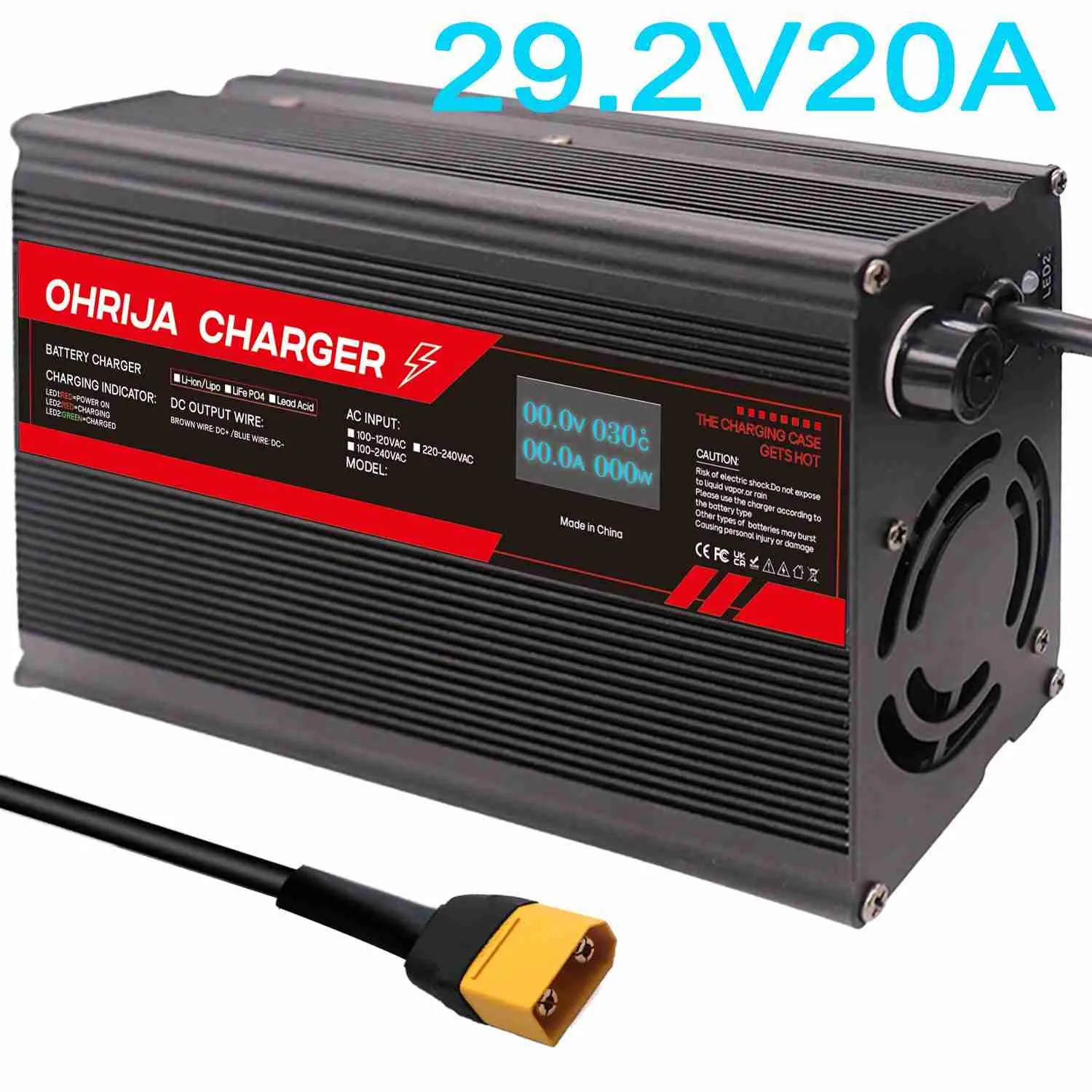
1. OHRIJA 29.2V 20A OLED Smart Charger (Best Overall Heavy-Duty)
Engineered for high-capacity 24V 100Ah+ LiFePO4 banks, this flagship unit delivers up to 590W of continuous power. Built inside a durable aluminum alloy shell, it features an integrated OLED real-time display that monitors exact voltage, current, and charging status. It comes equipped with industrial output options including Anderson 50A, XT60, XT90, and heavy alligator clips.
- Max Output: 29.2V ± 0.2V / 20A ± 0.2A
- Construction: Premium Aluminum Alloy (Black, Silver, Red)
- Weight/Size: 2.4kg | 210 x 120 x 70mm
- Best For: Off-grid RVs, trolling motors, commercial energy storage, rapid shop charging.
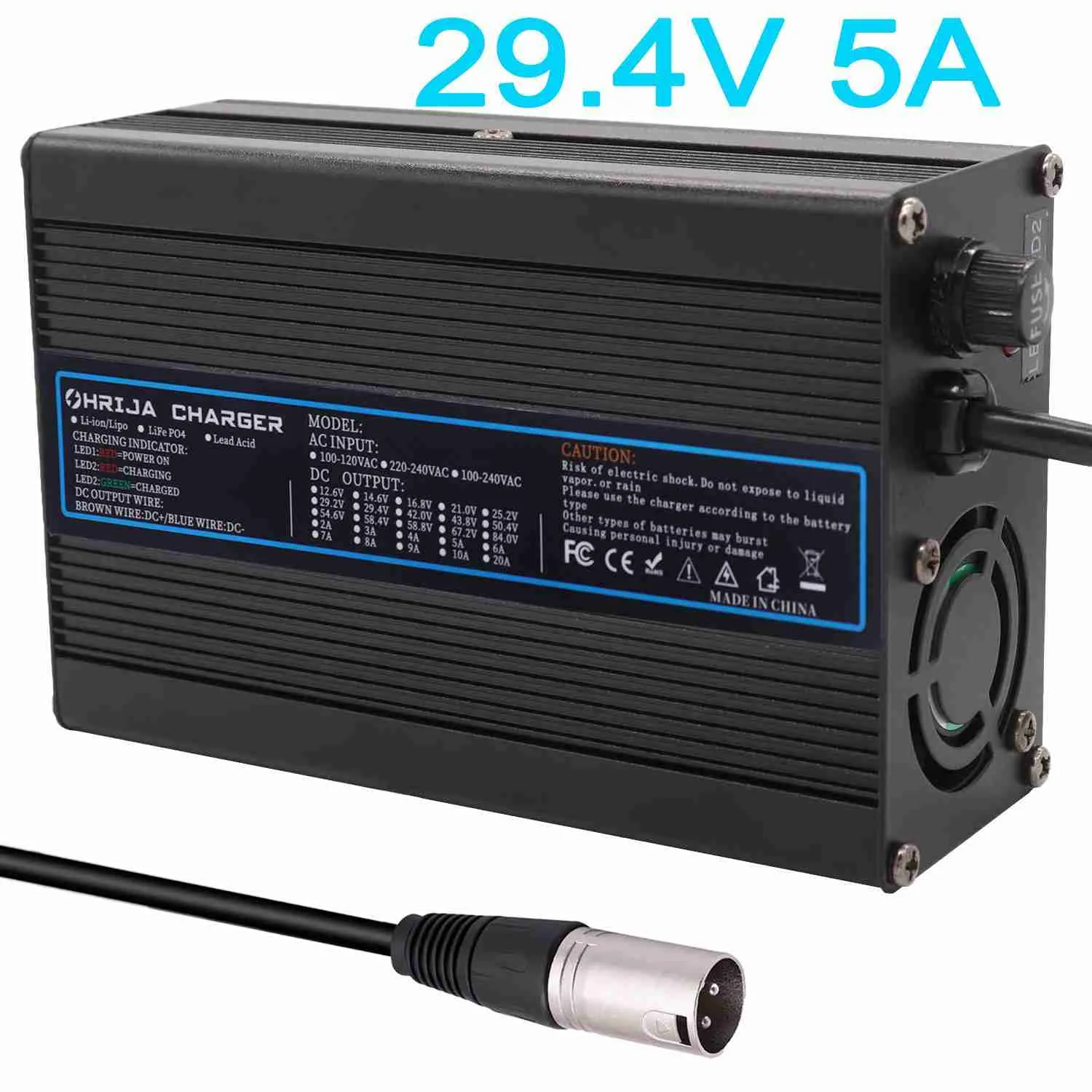
2. OHRIJA 29.2V 5A Aluminum Charger (Best Portable / Budget Choice)
For smaller 24V setups, electric wheelchairs, mobility carts, or 20Ah to 50Ah battery packs, this 175W ultra-compact charger offers incredible efficiency in a lightweight 0.9kg package. Utilizing an extruded aluminum body for effective passive and active thermal management, it includes multiple output connector options such as XLR, GX16, IEC C13, and Anderson plugs.
- Max Output: 29.2V ± 0.2V / 5A ± 0.2A
- Construction: Compact Aluminum Shell (Black, Silver, Red, Blue, Green)
- Weight/Size: 0.9kg | 135 x 90 x 50mm
- Best For: Mobility scooters, e-bike conversions, portable power boxes, maintenance charging.
3. Victron Energy Blue Smart IP65 24V 13A
Victron is a respected name in marine power systems. The IP65 24/13 model features Bluetooth integration, allowing you to monitor voltage and current from a smartphone app. It is IP65 water-resistant, making it ideal for open boat cockpits. However, it commands a high price premium for its 13A output compared to 20A dedicated shop chargers.
4. NOCO Genius GENPRO10X2 / 24V Waterproof Series
Designed primarily as an onboard marine charger, NOCO builds fully potted, IP68 waterproof units. While robust against total submersion, the trade-off is fixed wiring, heavier weight, and slower charge recovery times compared to portable aluminum bench chargers.
5. OHRIJA 29.4V 10A High-Performance Charger
Bridging the gap between 5A and 20A units, the 24V lithium battery charger 10A provides a versatile 300W sweet spot. It is an ideal middle-ground solution for 50Ah to 100Ah battery banks, maintaining high thermal efficiency without requiring a massive footprint.
6. Renogy 24V 20A DC-to-DC On-Board Charger
Unlike AC-to-DC wall chargers, this unit is designed for vehicle overland setups, taking power directly from a 12V or 24V alternator to charge an auxiliary 24V LiFePO4 bank while driving. It requires permanent vehicle wiring and professional installation.
7. PowerXtreme 24V 10A Bench Charger
A basic plastic-cased desktop charger aimed at light-duty indoor applications. While affordable, its plastic enclosure traps heat faster under continuous high loads compared to aluminum alloy alternatives.
8. OHRIJA 24V 15A AC to DC Power Supply / Charger Module
For custom industrial builds, workshop test benches, or integrated power racks, utilizing an AC to DC power supply 24V 15A unit provides raw, uncompromised power delivery designed for direct integration into larger electrical cabinets.
9. Schumacher SC1445 24V Commercial Wheel Charger
A massive, traditional shop charger intended for commercial automotive garages. While heavy and bulky, it offers emergency jump-starting modes, though its lithium profile lacks the refined cell-balancing precision of dedicated smart LiFePO4 units.
Quick Summary Table: 9 Best 24V LiFePO4 Chargers
| Charger Model | Max Output | Housing Material | Weight | Primary Use Case |
|---|---|---|---|---|
| OHRIJA 20A OLED | 29.2V / 20A (590W) | Aluminum Alloy | 2.4 kg | Heavy-Duty Fast Charging / Off-Grid |
| OHRIJA 5A Compact | 29.2V / 5A (175W) | Aluminum Alloy | 0.9 kg | Lightweight / Mobility / Small Packs |
| Victron IP65 13A | 29.2V / 13A | Rubber / Composite | 1.9 kg | Marine / Bluetooth Monitoring |
| NOCO GENPRO 10A | 29.2V / 10A | Sealed Potted Plastic | 2.8 kg | Onboard Marine / Waterproof |
| OHRIJA 10A Mid-Range | 29.2V / 10A (300W) | Aluminum Alloy | 1.4 kg | General Purpose / 50Ah-100Ah Banks |
| Renogy 20A DC-DC | 29.2V / 20A | Aluminum Chassis | 1.8 kg | RV Alternator-to-Battery Charging |
| PowerXtreme 10A | 29.2V / 10A | ABS Plastic | 1.1 kg | Basic Indoor Bench Charging |
| OHRIJA 15A Module | 29.2V / 15A | Industrial Steel/Alloy | 1.6 kg | Integrated Cabinet / Workshop Bench |
| Schumacher SC1445 | 24V / 25A Variable | Heavy Sheet Metal | 12.5 kg | Commercial Fleet / Auto Shop |
Benefits of Using a Dedicated Lithium Iron Phosphate Charger
Using improper charging equipment is the primary cause of early lithium cell degradation. Dedicated 24v lifepo4 chargers deliver three non-negotiable advantages:
- Precision 29.2V Voltage Cut-off: Ensures every 3.2V cell reaches its optimal 3.65V top charge without triggering over-voltage stress.
- BMS Zero-Volt Activation: If your battery shuts down its output due to over-discharge, a dedicated charger supplies a wake-up voltage signal to reset the BMS solid-state switches.
- Maximum Capacity Realization: Lead-acid chargers drop into float mode too early (typically around 27.6V), leaving your LiFePO4 battery sitting at only 70% to 80% state of charge.
Limitations and Practical Drawbacks
Despite their superior performance, high-output 24v lifepo4 chargers have specific operational constraints:
- Non-Universal Chemistry Use: You cannot safely use a 29.2V LiFePO4 charger on standard 24V lead-acid or 7S Li-ion batteries without risking thermal runaway or overcharging.
- Active Cooling Fan Noise: High-amperage units (15A to 20A+) generate heat that requires active fan cooling. While aluminum shells mitigate heat, cooling fans do produce moderate operational noise.
Comparison Table: LiFePO4 vs. Lead-Acid Charging Parameters
| Parameter | Dedicated 24V LiFePO4 Charger | Standard 24V Lead-Acid Charger |
|---|---|---|
| Peak Absorption Voltage | Strict 29.2V (3.65V per cell) | 28.8V – 29.6V (Uncontrolled float) |
| Float Stage Requirement | Not Needed (CC/CV Cut-off) | Mandatory Float at 27.2V – 27.6V |
| Desulfation / Equalization Stage | STRICTLY FORBIDDEN (Destroys Lithium) | Regular high-voltage spikes (30V+) |
| BMS Wake-Up Function | Yes (0V auto-reset) | No (Reads 0V as dead connection) |
Who Should Use It vs. Who Does Not Need It
Who Needs a Dedicated 24V LiFePO4 Charger:
- RV, camper, and vanlife owners running 24V house battery systems.
- Marine boaters operating 24V trolling motors or thrusters.
- Commercial shops, floor scrubbers, and electric mobility fleets.
- Off-grid solar enthusiasts maintaining 25.6V nominal LiFePO4 storage banks.
Who Does Not Need It:
- Users running 12V nominal parallel systems (you need a 12V LiFePO4 battery charger 30A unit instead).
- Lightweight e-mobility users running 48V or 60V systems (who require specialized units like an 48V 10A eBike charger or a 67.2V scooter battery charger).
Pros and Cons Table
| Pros of Dedicated 24V LiFePO4 Chargers | Cons of Dedicated 24V LiFePO4 Chargers |
|---|---|
| Extends battery pack cycle life up to 3,000 – 5,000 cycles. | Higher initial purchase cost than basic trickle chargers. |
| Restores full 100% usable capacity safely. | Cannot be shared with traditional SLA or GEL batteries. |
| Includes BMS recovery/wake-up protocols. | High-power models require aluminum enclosures & fans. |
| Prevents destructive cell imbalance and thermal degradation. | Must be correctly matched to battery capacity (Ah rating). |
Common Mistakes When Charging 24V LiFePO4 Batteries
In our technical service department, we frequently analyze field failures caused by improper user practices. Here are the most critical errors to avoid:
- Using Lead-Acid “Desulfation” or “Equalization” Modes: Traditional smart chargers periodically blast 30V+ high-voltage pulses to break up lead-sulfate crystals. On a LiFePO4 battery, this triggers the BMS over-voltage protection instantly or destroys the cells if the BMS fails.
- Charging Below Freezing Point (0°C / 32°F): Charging a standard LiFePO4 cell below freezing causes permanent lithium plating on the anode, creating internal shorts. Unless your battery pack has built-in heating pads, always charge in temperature-controlled spaces.
- Selecting Incorrect Output Connectors: High current (like 20A) produces significant heat across loose connections. Avoid cheap barrel plugs for current above 5A; always insist on heavy-duty Anderson, XT60, XT90, or solid copper alligator clips. If you experience unexpected charger heating, read our guide on how to troubleshoot a battery charger.
- Ignoring e-Bike / Scooter Specific Voltage Profiles: If you are charging specialized personal electric vehicles, ensure you review how to charge eBike battery safely or consult a certified electric bicycle charger supplier. High-voltage platforms like an 84V electric scooter charger require totally different safety protocols.
Crucial Buying Considerations & Buying Guide Table
When selecting among various 24v lifepo4 chargers, match these technical metrics against your operational setup:
| Factor | Recommended Specification | Why It Matters |
|---|---|---|
| Charge Current (Amperage) | 10% to 30% of Battery Ah rating (e.g., 20A for 100Ah) | Too low = extremely slow charging. Too high = excess cell heat and reduced cycle life. |
| Housing Material | Extruded Aluminum Alloy Shell | Provides superior structural protection and acts as a heat sink for long component life. |
| Peak Cut-Off Voltage | Exact 29.2V ± 0.2V | Guarantees complete charge saturation without triggering BMS high-voltage disconnects. |
| Safety Certifications | UL, CE, RoHS, FCC Listed | Ensures protection against short circuits, reverse polarity, and thermal runaway. |
Expert Recommendation
From our engineering experience at OHRIJA, we strongly advise against cutting corners on power electronics. A poorly regulated charger will cost you significantly more in damaged batteries over time than the price difference of a quality unit.
For 100Ah to 200Ah 24V battery systems (popular in RVs, solar banks, and trolling motors), we recommend the OHRIJA 29.2V 20A OLED Charger. Its heavy-duty aluminum shell, live diagnostic telemetry, and robust thermal design deliver continuous commercial performance. If you operate smaller mobility packs or 20Ah to 50Ah batteries, opt for the ultra-portable OHRIJA 29.2V 5A Charger. Match your output connector (Anderson, XT90, or Clips) correctly to your battery terminal to ensure zero resistance during peak current delivery.
Frequently Asked Questions (FAQ)
Can I charge a 24V LiFePO4 battery with a regular lead-acid charger?
While a lead-acid charger may push some energy into the battery, we strongly advise against it. Lead-acid chargers enter float mode too early (leaving the battery at 70-80% capacity) and often incorporate automatic “equalization/desulfation” stages that send destructive high-voltage spikes above 30V. Always use a dedicated 29.2V LiFePO4 charger.
What voltage should a 24V LiFePO4 charger output?
A dedicated 24V LiFePO4 charger must output a peak absorption voltage of exactly 29.2V (± 0.2V). Since an 8S LiFePO4 battery consists of 8 cells in series, 29.2V translates to 3.65V per cell, which is the maximum safe threshold for full charge saturation.
How fast will a 20A charger charge a 24V 100Ah LiFePO4 battery?
A 20A charger (like the OHRIJA 29.2V 20A OLED unit) will charge a completely depleted 100Ah LiFePO4 battery in roughly 5 hours (100Ah / 20A = 5 hours). Because LiFePO4 accepts constant current efficiently up to 90%+ state of charge, charging speed remains fast and linear throughout most of the cycle.
Authoritative References & Electrical Standards
To verify charging protocols, battery safety specifications, and technical standards, consult these authoritative resources:
- Battery University – Comprehensive educational guide on lithium-based charging algorithms, cell balancing, and CC/CV profiles.
- Underwriters Laboratories (UL Standards) – UL 2580 and UL 1564 safety standards for electric vehicle and industrial battery charging systems.
- IEEE Standards Association – IEEE 1675 guidelines for stationary lithium-ion battery installation, maintenance, and charging control.