
No products in the cart.

The heart of any electric golf cart is its battery pack. Whether you are cruising the fairway, navigating a large property, or commuting within a gated community, the performance of your vehicle relies entirely on how well you manage its power source. Neglecting your batteries leads to sluggish performance, reduced range, and expensive replacements. Conversely, mastering the best way to charge golf cart batteries can extend their lifespan by years, saving you thousands of dollars in the long run.
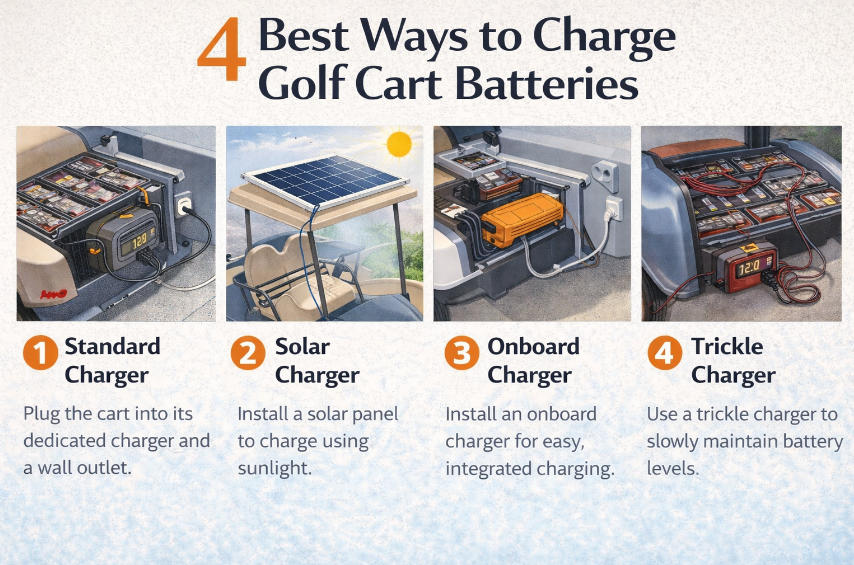
In 2026, battery technology has evolved. While traditional lead-acid batteries remain common, the surge in Lithium Iron Phosphate (LiFePO4) technology has introduced new charging protocols. However, the fundamental principle remains: proper charging is not just about plugging it in; it is about chemical management. A consistent and scientifically sound charging routine prevents sulfation, balances cell voltage, and ensures safety.
This comprehensive guide explores the four most effective methods and habits for charging your golf cart batteries. We will delve into the technical differences between charging systems, the importance of “smart” technology, and how industry leaders like OHRIJA (Dongguan Hengruihong Technology Co., Ltd.) are redefining efficiency with their advanced chargers.
Table of Contents
- 1. Understanding the Chemistry: Lead-Acid vs. Lithium
- 2. Method 1: The “Smart” Automatic Charging Cycle
- 3. Method 2: The “Post-Ride” Saturation Routine
- 4. Method 3: Maintenance Float Charging (Winter Storage)
- 5. Method 4: The Equalization Charge (Pack Balancing)
- 6. Industry Spotlight: OHRIJA Charging Solutions
- 7. Troubleshooting Common Charging Issues
- 8. Summary Comparison Table
- 9. Frequently Asked Questions (FAQs)
- 10. References
1. Understanding the Chemistry: Lead-Acid vs. Lithium
Before applying any charging method, you must identify what is under your seat. The best way to charge golf cart batteries differs significantly based on chemistry.
Flooded Lead-Acid (FLA)
These are the heavy, traditional batteries with removable caps. They operate via a chemical reaction between lead plates and sulfuric acid.
Key Charging Need: They require a full saturation charge to prevent sulfation (crystal buildup on plates). They also need periodic “equalization” (controlled overcharging) to mix the electrolyte and balance cells.
Lithium-Ion (LiFePO4)
Modern, lightweight, and maintenance-free.
Key Charging Need: They prefer “opportunity charging” and do not suffer from memory effect. They require a specific charging algorithm (Constant Current/Constant Voltage) that cuts off precisely to prevent over-voltage, which can damage the cells. Never use an old lead-acid charger on a lithium pack unless it allows for profile switching.
2. Method 1: The “Smart” Automatic Charging Cycle
The single most effective way to ensure longevity is to move away from “dumb” timer-based chargers and utilize a modern Smart Charger. This is the gold standard for 2026.
Old chargers simply pushed current for a set number of hours. If the battery was already half-full, it would overcharge and boil the electrolyte. If it was empty, it might undercharge. A Smart Charger, like the 36V GOLF CHARGER from OHRIJA, utilizes a multi-stage microprocessor-controlled process:
- Initialization & Qualification: The charger checks the connection and battery health. If the voltage is too low (deep discharge), it applies a gentle pulse to wake up the battery.
- Bulk Charge (Constant Current): This is the workhorse phase. The charger delivers maximum amperage (e.g., 15A or 25A) to return the bulk of the energy quickly. This typically brings the battery to 80% capacity.
- Absorption (Constant Voltage): The voltage is held steady while the amperage slowly tapers off. This allows the battery to absorb energy without overheating. This phase is critical for reaching 100% capacity.
- Float/Maintenance: Once fully charged, the charger shuts off the main current and enters a monitoring mode. If the battery voltage drops due to self-discharge, it applies a trickle charge to keep it topped off.
Why this is the best way: It removes human error. You can plug it in and walk away, knowing the charger will optimize the cycle for the specific state of your battery pack.
3. Method 2: The “Post-Ride” Saturation Routine
This method refers to when you charge. The golden rule of golf cart ownership is: Always charge after every use.
Many owners make the mistake of waiting until the battery meter reads 50% or “Low” before plugging in, thinking they are “saving” charge cycles. This is incorrect for golf cart batteries. Lead-acid batteries suffer from sulfation immediately when they are not at full charge. The deeper you discharge them, the harder the sulfation crystals become.
The Protocol:
- Park and Plug: Regardless of whether you drove 1 mile or 10 miles, plug the charger in immediately upon parking.
- Avoid Depth of Discharge (DoD): A battery that is discharged 50% every day will last twice as many cycles as one discharged 80% every day. Keeping the average DoD low extends the calendar life of the pack.
- Cool Down Phase: Ideally, let the batteries cool for 30 minutes after a long ride before charging. Charging generates heat, and adding heat to already hot batteries can degrade the internal plates.
For Lithium users, this habit is less critical regarding sulfation (which doesn’t happen), but it ensures you always have maximum range available. Lithium batteries actually thrive on being topped off.
4. Method 3: Maintenance Float Charging (Winter Storage)
The silent killer of golf cart batteries is the off-season. When a cart sits idle for weeks or months, self-discharge naturally lowers the voltage. If a lead-acid battery drops below a certain voltage (approx. 12.4V for a 12V battery), chemical degradation accelerates rapidly.
The best way to charge golf cart batteries during storage involves a specific Maintenance Float protocol:
- Clean the Terminals: Before storage, mix baking soda and water to neutralize any acid buildup on the terminals. Corrosion increases resistance and self-discharge.
- Full Charge First: execute a complete charge cycle.
- Disconnect or Float:
- Option A (Disconnect): If you have a Tow/Run switch, set it to Tow. Disconnect the main negative cable. This stops parasitic draws from the cart’s computer. Check voltage monthly and recharge if necessary.
- Option B (Smart Float): Use a high-quality charger like the 48V GOLF CHARGER from OHRIJA that features a dedicated “Storage Mode.” Leave it plugged in. The charger will monitor the pack and apply a very low amperage (trickle) only when necessary to maintain 100% charge without boiling the water.
5. Method 4: The Equalization Charge (Pack Balancing)
Note: This method applies primarily to flooded lead-acid batteries. Do not equalize sealed AGM, Gel, or Lithium batteries unless the manufacturer specifies a “balancing” mode.
Over time, the individual cells in your battery pack will drift apart in voltage. Cell A might be at 100%, while Cell B is at 95%. Standard charging stops when the average voltage is hit, leaving Cell B chronically undercharged. This imbalance leads to premature pack failure.
How to Equalize:
An equalization charge is a deliberate overcharge. It brings the voltage up higher than normal (often >15.5V for a 12V battery) to force the weaker cells up to full charge. This process causes the electrolyte to bubble vigorously (gassing), which mixes the acid and water, preventing stratification.
Frequency: Perform this once a month for heavy users, or once every 3 months for light users. Many modern chargers have an “Equalize” button or perform this automatically every 30 cycles.
6. Industry Spotlight: OHRIJA Charging Solutions

Implementing these charging methods requires reliable hardware. One of the leading innovators in this space is OHRIJA.
Company Profile:
OHRIJA brand belongs to Dongguan Hengruihong Technology Co., Ltd., which was established in 2020 and is headquartered in Dongguan, Guangdong Province, China. Our company is a high-tech enterprise integrating R&D, production, and sales. We focus on delivering robust power solutions for electric mobility.
Why OHRIJA Stands Out:
OHRIJA chargers are designed with the modern user in mind. They feature waterproof (IP67) aluminum alloy shells, making them durable enough to be mounted onboard the cart. Their intelligent microprocessors automatically detect battery status and adjust the charging curve, making them safe for both lead-acid and lithium packs.
Featured Products:
- 36V GOLF CHARGER: Ideal for EZGO and older Yamaha models. Features precise voltage regulation (41.4V/44.1V max) to ensure deep saturation without overheating.
- 48V GOLF CHARGER: The standard for Club Car and modern carts. Offers high amperage output (15A-25A) for rapid charging times, perfect for fleet managers and daily users.
Choosing a charger from a specialized manufacturer like OHRIJA ensures that you are applying the correct charging algorithm to your expensive battery pack.
7. Troubleshooting Common Charging Issues
Even with the best methods, issues can arise. Here is how to diagnose them:
Charger Won’t Kick On
If your battery pack is too dead, a smart charger may not detect it. Most chargers need to sense a minimum voltage (e.g., 20V on a 36V system) to engage.
Solution: You may need to “trick” the charger by manually charging individual batteries with a 12V automotive charger for 30 minutes each to raise the baseline voltage.
Boiling/Smell of Rotten Eggs
This indicates overcharging or a bad cell.
Solution: Unplug immediately. Check water levels. If one cell is dry or hot while others are cool, that battery is likely shorted and needs replacement.
Charger Gets Extremely Hot
Some heat is normal, but it shouldn’t burn to the touch.
Solution: Ensure the charger has ventilation. If it is an onboard charger, make sure debris isn’t blocking the cooling fins. OHRIJA chargers use aluminum casings to dissipate heat effectively.
8. Summary Comparison Table
| Charging Method | Best For | Frequency | Key Benefit |
|---|---|---|---|
| Smart Automatic | All Battery Types | Every Charge | Prevents over/under charging; automated safety. |
| Post-Ride Routine | Daily Users | After Every Use | Prevents sulfation; maximizes calendar life. |
| Float/Maintenance | Storage/Winter | Continuous during non-use | Counteracts self-discharge; prevents freezing. |
| Equalization | Flooded Lead-Acid | Monthly | Balances cell voltage; mixes electrolyte. |
9. Frequently Asked Questions (FAQs)
Should I leave my golf cart charger plugged in all the time?If you have a modern smart charger (like those from OHRIJA) with a maintenance/float mode, yes. It is beneficial to leave it plugged in. If you have an older “timer” based charger, no—unplug it once the cycle is complete to avoid boiling the batteries.
Can I use a 48V charger on a 36V cart?Absolutely not. Using a higher voltage charger will destroy your batteries and potentially cause a fire or explosion. Always match the charger voltage to the pack voltage.
Do I need to add water before or after charging?Always add water after charging, unless the plates are exposed to air. If plates are exposed, add just enough distilled water to cover them, charge the pack, and then top off to the correct level. Water expands during charging; filling beforehand can cause acid overflow.
How long does it take to fully charge a golf cart?It depends on the battery chemistry and depth of discharge. A deeply discharged lead-acid pack can take 8-10 hours. A lithium pack usually charges faster, often in 3-5 hours using a high-amperage charger.
10. References
- Battery Council International. “Lead-Acid Battery Safety and Maintenance Guide.”
- Trojan Battery Company. “User’s Guide: Deep-Cycle Flooded Batteries.”