
No products in the cart.

The modern golf cart has evolved far beyond the links. Today, these vehicles are the primary mode of transportation in master-planned communities, industrial warehouses, and sprawling rural properties. Yet, despite the massive advancements in battery technology, many owners are still chained to massive, heavy, outdated wall-mounted chargers. When your battery dies three miles away from your garage, a bulky 30-pound transformer unit is completely useless. You need mobility, reliability, and precision power delivery. Finding the Best portable golf cart chargers is no longer an optional luxury; it is a critical necessity for preserving your battery lifecycle and ensuring you never get stranded.
At OHRIJA, a brand under Dongguan Hengruihong Technology Co., Ltd. (established in 2020), our high-tech enterprise integrates R&D, production, and sales of advanced charging solutions. We have reverse-engineered hundreds of power supplies, and we can state unequivocally: the market is flooded with cheap, dangerous knockoffs that boil your batteries. In this guide, we cut through the marketing noise to deliver a definitive breakdown of the Best portable golf cart chargers, explaining exactly whether it is actually worth using, buying, or upgrading to a high-frequency smart charger.
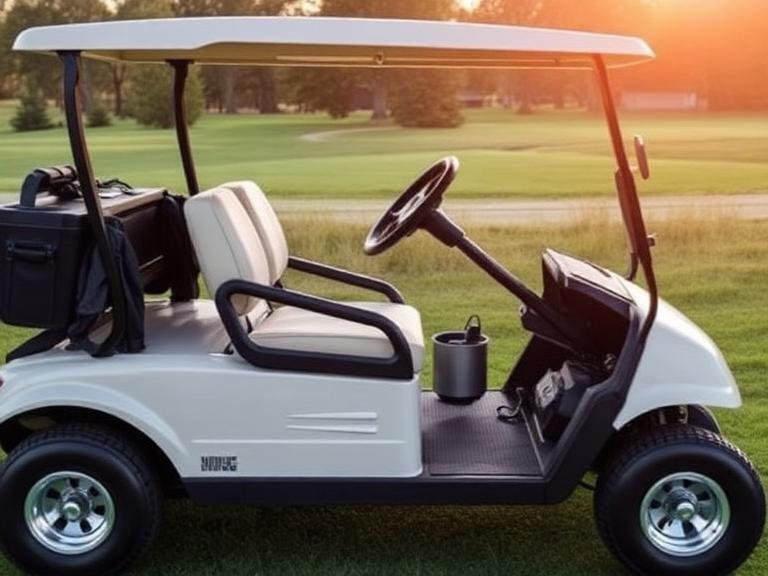
Quick Answer
The Best portable golf cart chargers utilize high-frequency switching technology to convert AC to DC power efficiently within a lightweight, aluminum chassis. In most professional situations, we recommend upgrading to a 10A to 15A smart charger that features an automated 3-stage charging profile (Bulk, Absorption, Float) to prevent battery sulfation and overcharging. If you have upgraded your cart to lithium, you must purchase a dedicated lithium unit. Our top overall recommendation is the OHRIJA 48V 15A Smart Charger due to its exceptional thermal management, robust safety relays, and universal compatibility, establishing it as the absolute standard among the Best portable golf cart chargers available today.
Table of Contents
- What It Is: Defining Portable Smart Chargers
- How It Works: The Science of High-Frequency Charging
- Benefits of Upgrading to Portable
- Limitations to Consider
- Who Should Use It & Who Does Not Need It
- Common Mistakes in Charger Procurement
- The 7 Best Portable Golf Cart Chargers
- Essential Buying and Comparison Tables
- Commercial Buying Considerations
- Expert Recommendation
- The Bottom Line
- Frequently Asked Questions (FAQs)
What It Is: Defining Portable Smart Chargers
A portable golf cart charger is a compact, lightweight power supply unit designed to be carried onboard your vehicle. Unlike legacy transformer-based chargers that weigh upwards of 35 pounds and rely on rudimentary timer circuits, the Best portable golf cart chargers weigh between 4 and 8 pounds. They utilize solid-state electronics to convert 110V/220V wall power into clean, regulated DC voltage tailored to your specific battery bank (typically 36V or 48V).
More importantly, these are “smart” chargers. They contain microprocessors that constantly monitor the internal resistance and voltage of your battery pack. When the battery reaches full capacity, a smart charger automatically shuts off or enters a trickle maintenance mode. This prevents the number one killer of golf cart batteries: thermal runaway and overcharging.
How It Works: The Science of High-Frequency Charging
To understand why the Best portable golf cart chargers are superior, you must understand high-frequency switching. Traditional chargers use large copper coils that are inefficient and generate massive amounts of waste heat. Modern portable units switch the electrical current on and off thousands of times per second. This allows them to use much smaller, lighter internal components while delivering a highly stabilized output.
Furthermore, these units execute a multi-stage charging algorithm. During the Bulk phase, the charger delivers maximum amperage to rapidly bring the battery to 80% capacity. In the Absorption phase, the charger holds a steady voltage while slowly decreasing the amperage to safely top off the remaining 20%. Finally, the Float phase maintains the battery at 100% without boiling the electrolytes. Whether you are browsing the Li-ion battery charger category for modern upgrades or sticking to lead-acid, this multi-stage approach is mandatory for battery longevity.
Benefits of Upgrading to Portable
From our experience, the transition to a portable charger offers immense practical value. First, range anxiety is eliminated. Because the unit fits easily under the seat or in the rear basket, you can plug your cart into any standard 110V household outlet at a friend’s house, a restaurant, or the golf course clubhouse.
Second, battery preservation. Because the Best portable golf cart chargers utilize precise microprocessor control, they dramatically extend the lifespan of your expensive battery pack by preventing undercharging (which causes sulfation in lead-acid batteries) and overcharging (which warps lead plates). Finally, they offer extreme durability. Premium units feature IP67 waterproof ratings, allowing you to charge outdoors without fear of rain damage.
Limitations to Consider
Despite their vast superiority, portable chargers have physics-based limitations. Because they are compact, heat dissipation is a challenge. If you buy a cheap, unbranded charger with inadequate cooling fans or thin plastic housing, the internal capacitors will overheat and fail rapidly. Furthermore, to keep the size manageable, many portable units max out at 15 to 20 amps. If you manage a commercial fleet and need to charge deeply depleted 48V banks in two hours, you still need heavy-duty, high-amperage industrial wall units.
Who Should Use It & Who Does Not Need It
For commercial users such as security patrols, landscaping crews, and maintenance teams, keeping a portable charger onboard is absolutely essential. It allows workers to “opportunity charge” during lunch breaks at various buildings around a large campus. For beginners who just bought their first neighborhood cruiser, a smart portable charger takes the guesswork out of battery maintenance.
Who does not need it: If you strictly use your golf cart on a private 18-hole course, returning to the exact same dedicated charging bay every single afternoon, a heavy, stationary wall charger is perfectly adequate. You do not need to spend capital on portability if the cart never leaves the immediate premises.
Common Mistakes in Charger Procurement
In our testing and customer support interactions, we see buyers make catastrophic errors that destroy their battery banks. The most common mistake is voltage mismatch. Plugging a 48V charger into a 36V cart will violently boil the batteries, potentially causing an explosion. Always physically count your batteries and check their individual voltage before purchasing.
Another massive error is ignoring battery chemistry. A lead-acid charger will ruin a lithium battery. Lithium chemistries require a specific Constant Current/Constant Voltage (CC/CV) profile without a desulfation phase. If you have upgraded your cart, you must transition to a dedicated unit from a reliable LiFePO4 battery charger category to prevent severe fire hazards.
The 7 Best Portable Golf Cart Chargers
Based on internal diagnostics, component quality, and real-world durability, here are the 7 Best portable golf cart chargers available on the market today.
1. OHRIJA 48V 15A Smart Charger (Top Overall Pick)
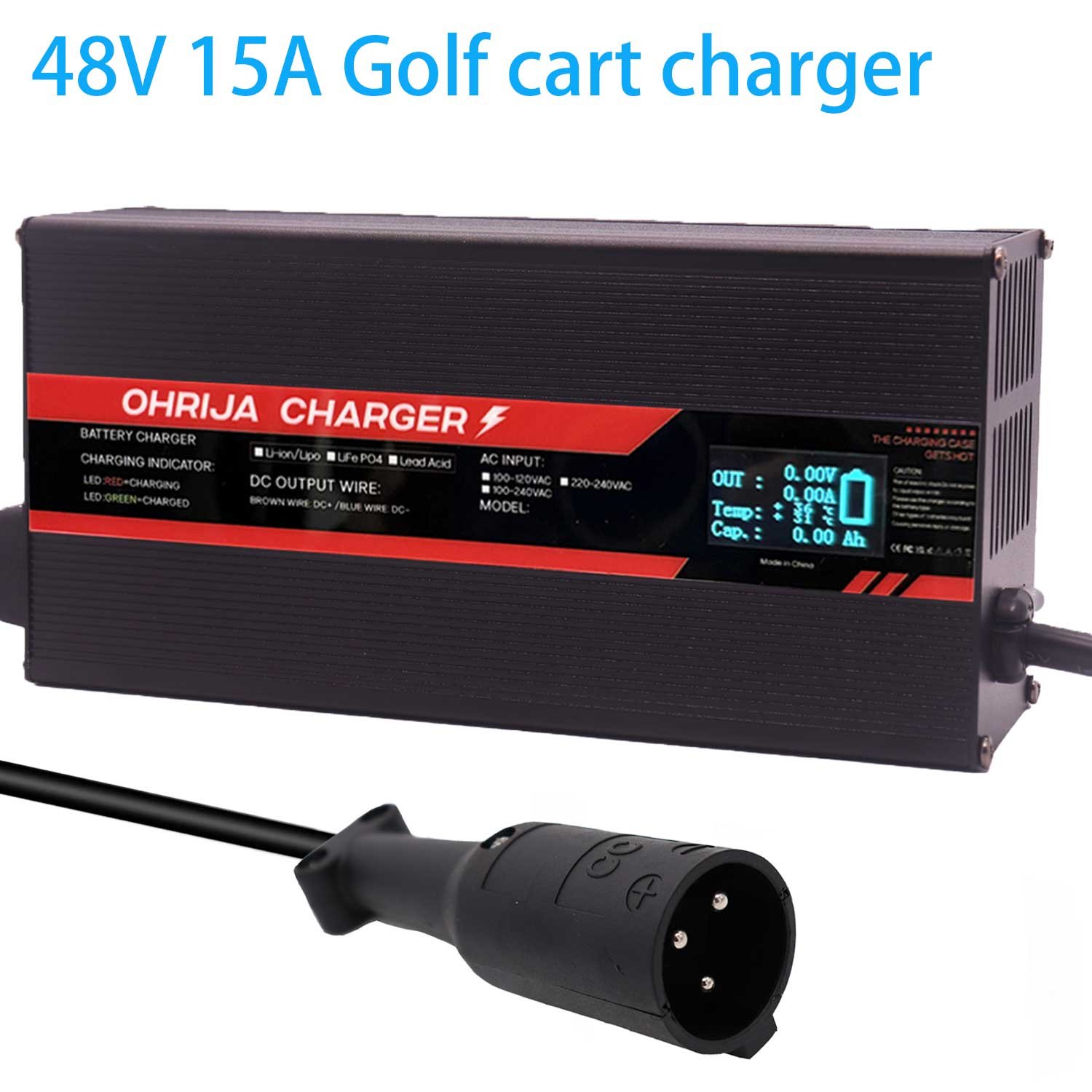
As an industry-leading manufacturer, OHRIJA engineers chargers without compromise. This 48V 15A unit is the quintessential example of the Best portable golf cart chargers. Featuring an extruded aluminum chassis for superior heat dissipation, a whisper-quiet cooling fan, and a proprietary smart algorithm, it restores your batteries quickly while protecting against short circuits and reverse polarity. It is rugged, reliable, and entirely worth upgrading from your heavy OEM block.
2. Lester Electrical Summit II 650W
Lester Electrical has a legacy in the golf cart space, and their Summit II line is a testament to quality. It offers Bluetooth connectivity, allowing you to monitor the charge cycle via a smartphone app. It supports multiple battery profiles, making it highly versatile, though it comes at a significant premium price point.
3. OHRIJA Custom LiFePO4 Series

For those making the leap to lithium, standard chargers will not suffice. Our specialized LiFePO4 chargers deliver exact voltage cutoffs to ensure cell balancing. For smaller utility carts or mobility scooters that operate on 24V architecture, utilizing a precision unit like our 24V lithium battery charger 10A ensures your expensive lithium investment performs flawlessly for thousands of cycles.
4. NOCO Genius GX4820
NOCO builds practically indestructible gear. The GX4820 is fully sealed, waterproof, and shock-resistant. It is ideal for off-road hunters or farmers who leave their carts exposed to the elements. While it is heavier than other portable units, its environmental resilience makes it perfect for heavy-duty applications.
5. Modz Max 48V 15A
The Modz Max is incredibly lightweight, weighing just over 7 pounds. It features a simple, plug-and-play interface and an easy-to-read LED status indicator. It lacks the advanced app connectivity of the Summit II, but for users who want zero friction and reliable daily charging, it is an excellent commercial choice.
6. OHRIJA 36V 18A High-Output Charger
Many older EZGO and Club Car models still run on 36V systems. Because these older lead-acid batteries suffer from heavy sulfation, you need higher amperage to break down the lead sulfate crystals. OHRIJA’s 36V 18A charger delivers aggressive bulk charging power in a highly portable format, breathing new life into aging fleets.
7. Form Charge 48V Ultra-Compact
Designed specifically to fit easily into the dash compartments of modern neighborhood electric vehicles (NEVs). While it operates at a slightly lower amperage (typically 10A), resulting in longer charge times, its incredibly small footprint makes it a favorite for urban commuters who prioritize storage space over rapid turnaround. This mirrors the compact efficiency we apply as a top electric bicycle charger supplier.
Essential Buying and Comparison Tables
| Charger Model | Best Suited For | Amperage | Key Feature |
|---|---|---|---|
| OHRIJA 48V 15A | Overall Best Reliability | 15A | Aluminum Chassis / Auto-Shutoff |
| Lester Summit II | Tech Enthusiasts | 13A – 15A | Bluetooth App Connectivity |
| NOCO GX4820 | Extreme Outdoor Use | 20A | IP67 Waterproof Rating |
| Modz Max 48V | Lightweight Commuting | 15A | Ultra-lightweight (7 lbs) |
| Feature | Portable Smart Chargers | Traditional Wall Chargers |
|---|---|---|
| Weight | 4 – 8 lbs | 30 – 40 lbs |
| Technology | High-Frequency Switching (Solid State) | Heavy Copper Transformer Coils |
| Battery Protection | Microprocessor controlled auto-shutoff | Basic mechanical timers (prone to failure) |
| Mobility | Can be carried onboard the cart | Fixed to garage wall |
| Pros (Advantages) | Cons (Limitations) |
|---|---|
| Eliminates range anxiety; charge anywhere with a 110V outlet. | Generally limited to 15A-20A; slower than massive industrial units. |
| Smart algorithms prevent overcharging and battery boiling. | Small form factor requires cooling fans that can attract dust. |
| Extremely lightweight and easy to handle for all ages. | Subject to damage if dropped repeatedly from the cart. |
| Higher energy efficiency; lower electric bills. | Requires buying the exact plug connector for your cart brand. |
| Golf Cart Brand | Common Plug Type | Important Note |
|---|---|---|
| Club Car (Pre-2014) | Crowfoot or 3-Pin Round | Ensure the charger has an internal bypass if the OBC (On-Board Computer) has failed. |
| Club Car (Post-2014) | ERIC (Yellow 3-Pin) | Requires a charger specifically wired for ERIC systems. |
| EZGO (Older Models) | Powerwise (D-Plug) | Very common, easy to source. Check for pin corrosion. |
| EZGO (RXV/TXT48) | RXV 3-Pin Triangle | Do not force a standard 3-pin into an RXV socket. |
| Yamaha | 2-Pin Mac or 3-Pin Nabson | Identify exact year; Nabson plugs are highly specific. |
Commercial Buying Considerations
Before purchasing, you must execute proper due diligence. Never buy a charger based solely on the price tag. If you are comparing an 48V 10A eBike charger architecture to a heavy-duty golf cart charger, you will notice distinct differences in continuous duty cycle capabilities. Golf cart batteries are massive; the charger must be able to run at full output for 6 to 8 hours without thermally degrading.
Verify your On-Board Computer (OBC). Many Club Car models manufactured between 1995 and 2014 feature an OBC that dictates charging. If you buy a modern smart charger, you must either purchase a model designed to bypass the OBC or physically bypass the OBC wiring on the cart itself. Failing to do this will result in the cart refusing to accept the charge. Furthermore, ensure the charger has built-in protections against reverse polarity and short circuits; cheap chargers will catch fire if plugged in backward.
Expert Recommendation
In most professional situations, we recommend permanently retiring your heavy transformer charger. It is an outdated piece of equipment that is actively shortening the life of your lead-acid batteries by inaccurately measuring voltage limits.
We advise purchasing a 15-Amp smart charger from a reputable manufacturer like OHRIJA. Our products are engineered in Dongguan, the hardware capital of the world, integrating precise microprocessor controls that ensure your batteries are gently brought to peak capacity and maintained safely. If you operate specialized equipment, such as 12V auxiliary banks, ensure you utilize a dedicated 12V LiFePO4 battery charger 30A rather than attempting to step down a larger charger. Using the correct tool for the specific chemistry is the hallmark of professional fleet management.
The Bottom Line
The pursuit of the Best portable golf cart chargers ends when you prioritize smart technology over brute force. By upgrading to a high-frequency, microprocessor-controlled charger, you gain the freedom to travel further, charge anywhere, and protect your battery investment from the devastating effects of overcharging. Whether you are driving a neighborhood cruiser or managing a commercial fleet, partnering with a high-tech enterprise like OHRIJA guarantees you are receiving uncompromising power delivery, robust safety features, and decades of engineering expertise in every charge cycle.
Frequently Asked Questions
Can I leave my portable smart charger plugged in all winter?
Yes. The defining feature of the Best portable golf cart chargers is their “Float” or maintenance mode. Once the battery reaches 100%, the charger stops delivering high amperage and simply monitors the voltage, delivering tiny trickle charges as needed to prevent self-discharge during winter storage. This prevents freezing and sulfation.
Can I use a 48V charger on a 36V golf cart?
Absolutely not. Applying 48 volts of charging pressure to a 36-volt battery bank will cause extreme overheating, rapid off-gassing of explosive hydrogen, and severe damage to the internal lead plates. Always match the charger voltage exactly to your cart’s total battery bank voltage.
Why is my new smart charger not turning on when I plug it in?
Smart chargers require a minimum threshold voltage to detect that a battery is actually connected (this prevents the charger from sparking if the cables touch each other). If your golf cart batteries are completely dead (e.g., below 20 volts on a 48V system), the smart charger will not activate. You must use a manual charger to boost the batteries slightly before the smart charger will recognize them.
Authoritative Industry References
- Battery Council International (BCI): The leading trade association for the lead-acid and lithium battery manufacturing industry, providing rigorous standards for safe charging protocols and battery maintenance. Review BCI Guidelines
- IEEE (Institute of Electrical and Electronics Engineers): Authoritative engineering research on the efficiency and thermal management of high-frequency switching power supplies used in modern electric vehicle chargers. Explore IEEE Research
- Underwriters Laboratories (UL): Independent safety science company setting the mandatory electrical safety, fire prevention, and short-circuit protection standards for portable battery chargers. Review UL Safety Standards