
No products in the cart.

The global transition from heavy, maintenance-intensive flooded lead-acid batteries to lithium iron phosphate (LiFePO4) is the most significant revolution the golf cart industry has seen in decades. Dropping 300 pounds of dead weight from your chassis instantly improves acceleration, braking, and turf preservation. However, upgrading your power source without upgrading your charging infrastructure is a guaranteed path to catastrophic equipment failure. Finding the proper 48v lifepo4 chargers for GOLF CAR BATTERY systems is not a cosmetic choice; it is a strict mechanical requirement.
From our experience engineering and testing advanced power supplies at OHRIJA, we continually see consumers destroy $2,000 lithium battery packs by mistakenly relying on legacy lead-acid chargers. Lead-acid chargers execute “equalization” and “desulfation” phases that push voltages up to 60V or higher. Applying that voltage curve to a 48V LiFePO4 pack will instantly trip its Battery Management System (BMS) into a protective shutdown, or worse, permanently damage the internal cells. In this comprehensive industry guide, we take a clear, uncompromising position on the hardware you actually need. We will break down the precise electrical mechanics, highlight common installation failures (like the notorious Club Car On-Board Computer issue), and rank the top 13 chargers on the market to help you make an informed buying decision.
Quick Answer
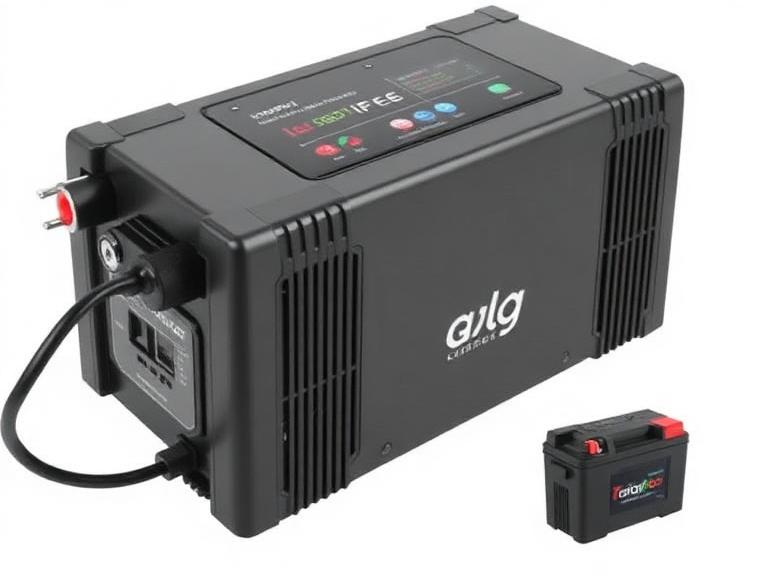
You cannot use a standard lead-acid charger on a lithium golf cart conversion. The best 48v lifepo4 chargers for GOLF CAR BATTERY systems must utilize a strict Constant Current / Constant Voltage (CC/CV) algorithm, terminating exactly at 58.4V for a 16-cell (16S) 48V pack. In most professional situations, we recommend upgrading directly to the OHRIJA 58.4V 15A Golf Cart Charger. It provides optimal amperage for overnight charging without generating excessive heat, completely bypasses legacy lead-acid equalization phases, and ensures your expensive lithium investment delivers its promised 10-year lifespan safely and reliably.
Table of Contents
- What It Is: The 48V LiFePO4 Charger Explained
- How It Works: The CC/CV Algorithm
- Benefits of a Dedicated Lithium Charger
- Limitations and Installation Hurdles
- Who Should Use It & Who Does Not Need It
- Common Mistakes During Upgrades
- Crucial Buying Considerations
- The 13 Best 48v LiFePO4 Chargers for Golf Car Battery
- Expert Recommendation
- Essential Comparison Tables
- The Bottom Line
- Frequently Asked Questions (FAQs)
What It Is: The 48V LiFePO4 Charger Explained
A dedicated 48v lifepo4 charger for a golf car battery is a specialized high-frequency switching power supply designed exclusively for lithium iron phosphate chemistry. A standard “48V” LiFePO4 golf cart battery is actually composed of 16 individual 3.2V cells wired in series (referred to in the industry as a 16S configuration). The nominal voltage is 51.2V, and the absolute maximum charging voltage is 3.65V per cell. Therefore, a true 48V LiFePO4 charger must deliver exactly 58.4V at its peak output. Anything less leaves the battery undercharged; anything more triggers a protective shutdown.
How It Works: The CC/CV Algorithm
Unlike old transformer-style chargers that simply dump unregulated current into lead plates until they boil, modern smart chargers like the best lithium iron phosphate battery chargers operate on a strict two-stage profile known as Constant Current / Constant Voltage (CC/CV).
- Constant Current (Bulk Phase): The charger pushes its maximum rated amperage (e.g., 15A) into the battery while allowing the voltage to slowly rise. This phase rapidly restores the battery from 0% to roughly 90% capacity.
- Constant Voltage (Absorption Phase): Once the battery reaches exactly 58.4V, the charger locks the voltage in place and slowly tapers the amperage down to near zero. Once the current drops to a predetermined threshold, the charger shuts off completely. There is no “float” or “trickle” charge, as holding continuous voltage degrades lithium cells over time.
Benefits of a Dedicated Lithium Charger
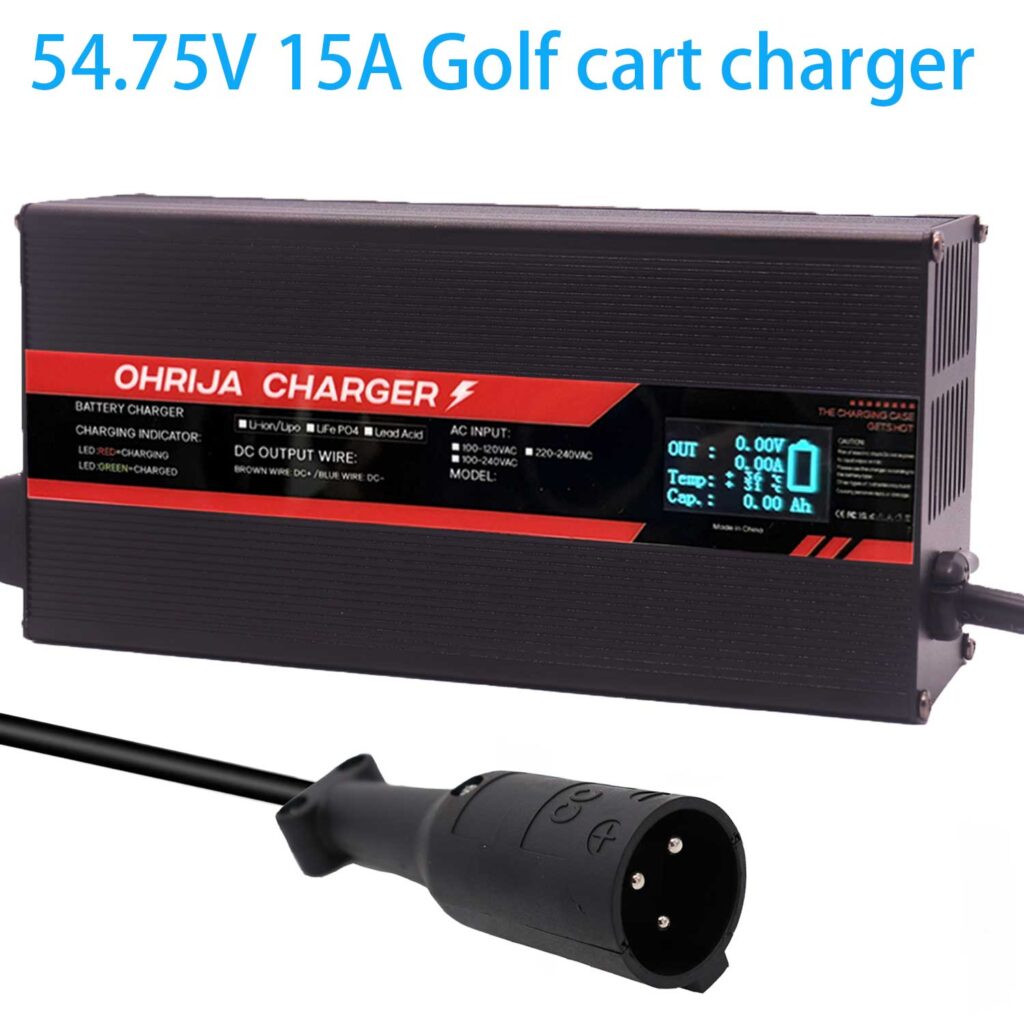
OHRIJA 54.75V 15A Golf Cart Chargers 48V Lithium Golf Cart Battery Chargers Lifepo4 Golf Cart Chargers
39.90$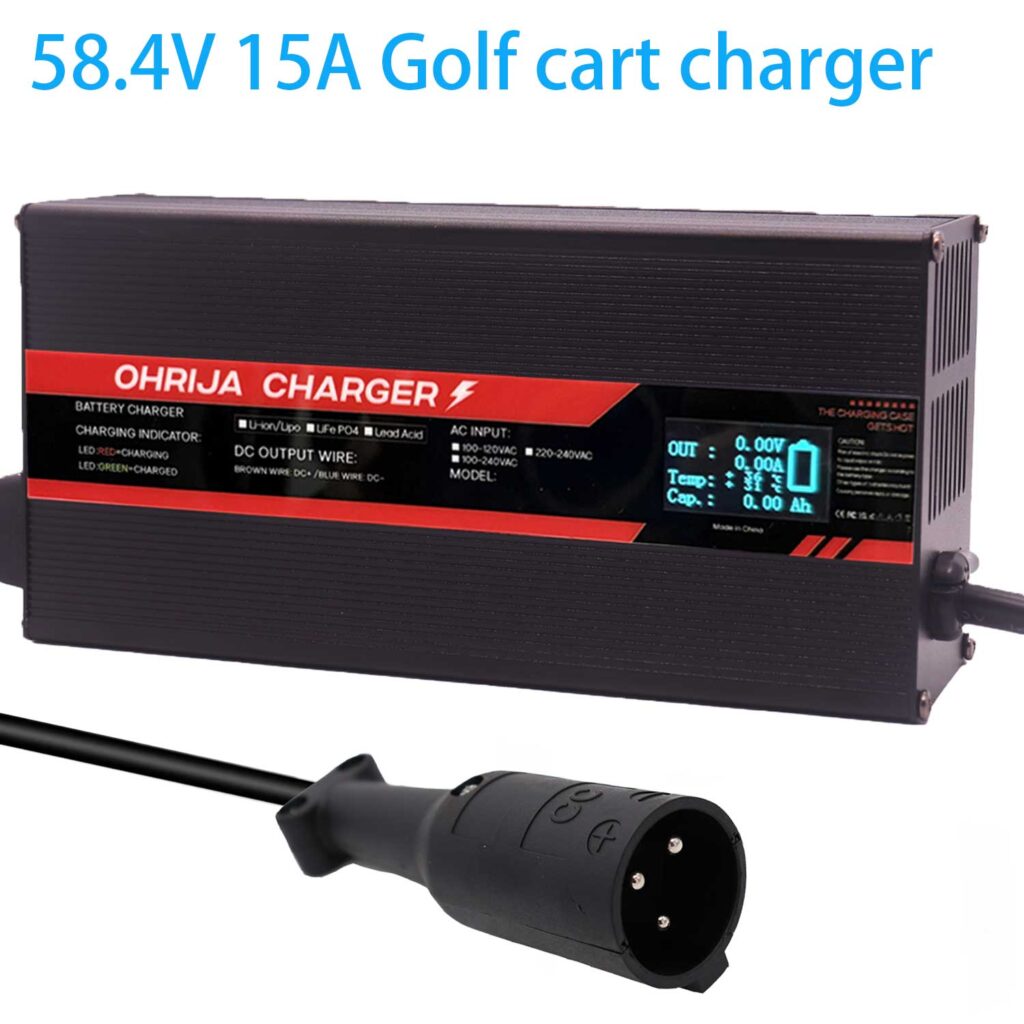
OHRIJA 58.4V 15A Golf Cart Chargers 48V Lithium Golf Cart Battery Chargers Lifepo4 Golf Cart Chargers
39.90$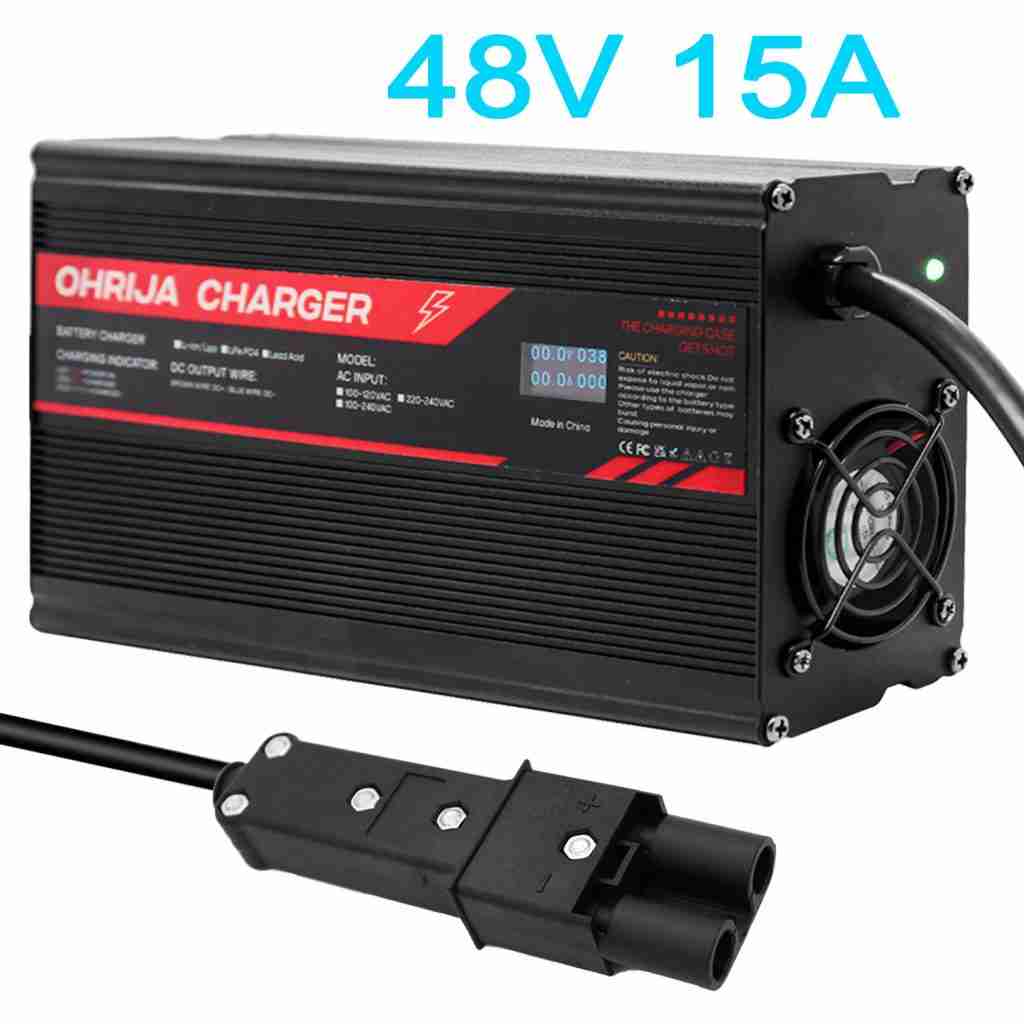
OHRIJA club car golf cart Battery Charger 48V 15A makes it suitable for 55.2V Lead Acid batteries OLED display
65.50$
The primary benefit of purchasing a specialized charger is operational safety. A smart lithium charger communicates with (or operates strictly within the parameters of) the battery’s internal BMS. Furthermore, modern high-frequency chargers are incredibly lightweight—often weighing less than 8 pounds compared to the 40-pound lead-acid relics of the past. They operate efficiently, converting over 90% of wall AC power into usable DC power, lowering your electric bill and reducing waste heat.
Limitations and Installation Hurdles
The main limitation of upgrading your charger is the initial capital expenditure. Additionally, for owners of Club Car DS or Precedent models (years 1995 to 2014), the vehicle is equipped with an On-Board Computer (OBC). The OBC physically controls the negative charging wire. If you attempt to plug a new smart lithium charger into a Club Car without physically cutting and bypassing the OBC wiring harness, the charger will not turn on. This installation hurdle frustrates many consumers who expect a simple plug-and-play experience.
Who Should Use It & Who Does Not Need It
For commercial users and heavy-duty applications: Fleet managers operating golf courses, large warehouses, or neighborhood electric vehicle (NEV) rentals who have transitioned to lithium drop-in kits must secure dedicated 48V chargers to ensure fleet uptime and prevent fire hazards.
Who does not need it: If you are still running a bank of six 8-volt flooded lead-acid batteries, do not buy a lithium charger. It will fail to execute the equalization charge your lead plates desperately need to prevent sulfation. For those specific applications, you must retain an algorithmic lead-acid charger.
Common Mistakes During Upgrades
In our testing and daily technical support operations, the most catastrophic mistake consumers make is assuming “48V is 48V.” They connect their old EZ-GO Powerwise or Club Car PowerDrive charger to their brand new $2,500 lithium pack. The legacy charger will push 60+ volts to “boil” the battery, causing the lithium BMS to instantly sever the connection to protect the cells. The user is then left stranded with a cart that will not move and a charger that will not turn on.
Another common mistake is buying severely underpowered chargers. Using a 5-amp charger on a 105Ah golf cart battery will take over 20 hours to recharge. We recommend a minimum of 15 Amps for a 48V system.
Crucial Buying Considerations
Before purchasing, identify your golf cart’s receptacle type. Are you using a Yamaha 2-pin, an EZ-GO RXV triangle, an EZ-GO TXT D-plug, or a Club Car 3-pin round connector? Ensure the charger comes pre-wired with your specific plug. Secondly, evaluate the environmental rating. If you store your cart outside, you need an IP67 waterproof charger. Finally, look for chargers that offer a “BMS Wake-Up” feature. If your lithium battery depletes entirely and goes into “sleep mode,” standard chargers will not detect it. A charger with a wake-up pulse will send a micro-current to reactivate the BMS and begin the charging cycle.
The 13 Best 48v LiFePO4 Chargers for Golf Car Battery in 2026
Here is our definitive ranking of the top chargers available on the market, prioritized by charging accuracy, build quality, and commercial reliability.
1. OHRIJA 58.4V 15A Lithium Golf Cart Battery Charger
Taking the top spot is our proprietary OHRIJA 58.4V 15A unit. We engineered this specifically to address the exact voltage requirements of 16S LiFePO4 packs. It completely eliminates the guesswork of programming profiles. You plug it in, it delivers a flawless CC/CV curve peaking at exactly 58.4V, and it shuts off. Its aluminum extrusion housing acts as a massive heat sink, eliminating the need for loud, failure-prone internal cooling fans.
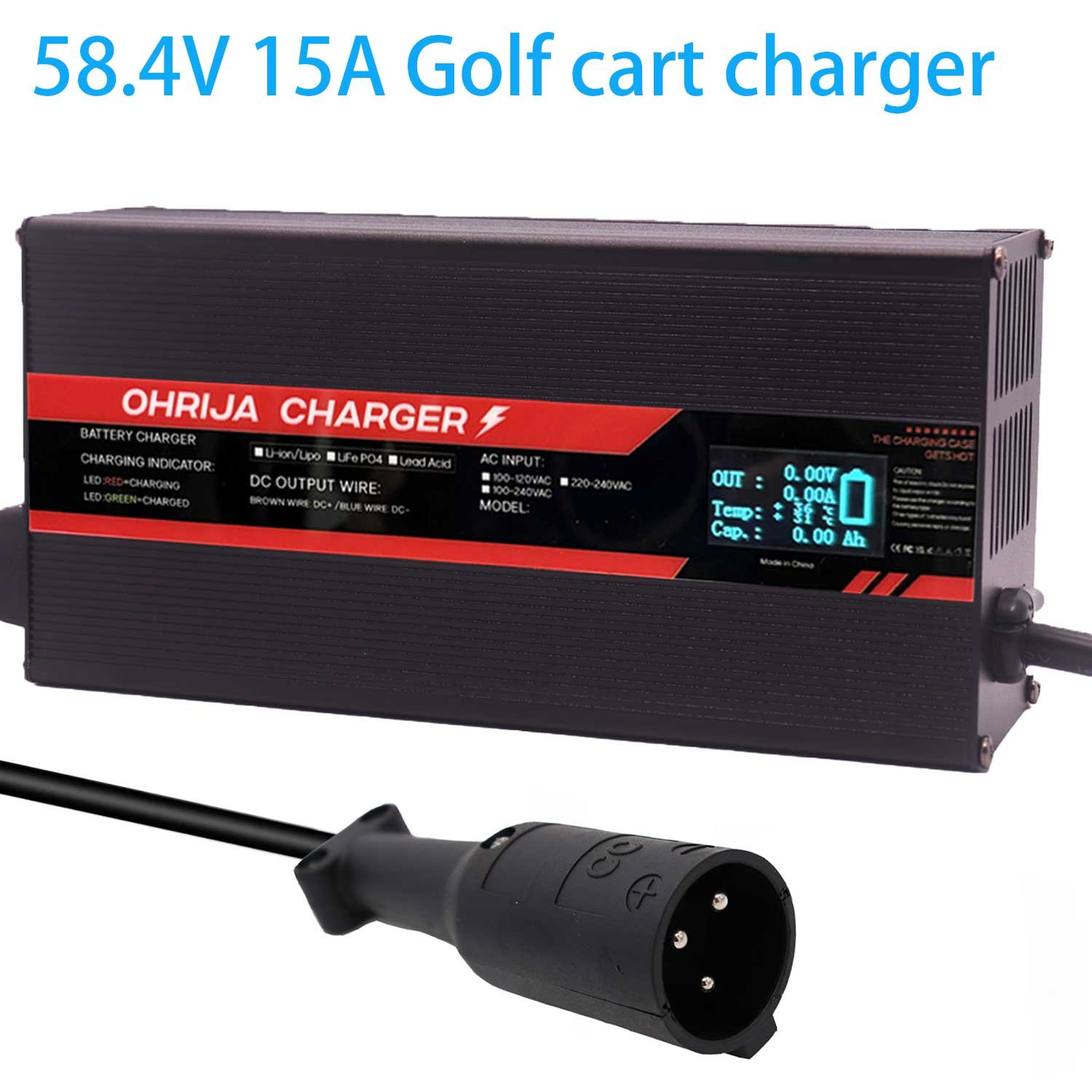
OHRIJA 58.4V 15A Golf Cart Chargers 48V Lithium Golf Cart Battery Chargers Lifepo4
2. Lester Electrical Summit II 650W 48V
Lester Electrical is a legendary name in motive power. The Summit II is the most technologically advanced charger on this list. It features Bluetooth connectivity, allowing you to use a smartphone app to download and install specific lithium profiles (such as the Dakota Lithium 22025 profile). It is exceptionally robust, but the requirement to manually program the unit via an app can be daunting for casual users.
3. Pro Charging Systems Eagle Performance i4818CH (18A)
For heavy-duty applications where rapid turnaround is required, the 18-amp output of the Eagle Performance series is unmatched. Built in the USA, it utilizes PROVolt technology. While traditionally known for lead-acid, their newer models offer specific lithium autodetect algorithms. It is expensive, but the reliability for commercial fleets is unquestionable.
4. OHRIJA 48V 15A Club Car Battery Charger (OLED Display)
If you require advanced diagnostics during your charge cycle, this OHRIJA unit features a brilliant OLED display providing real-time voltage and amperage readouts. While its primary voltage curve (up to 55.2V) makes it exceptionally well-suited for advanced lead-acid and certain specialized chemistry setups, its smart-switching technology makes it an incredibly versatile bench charger for golf cart technicians.
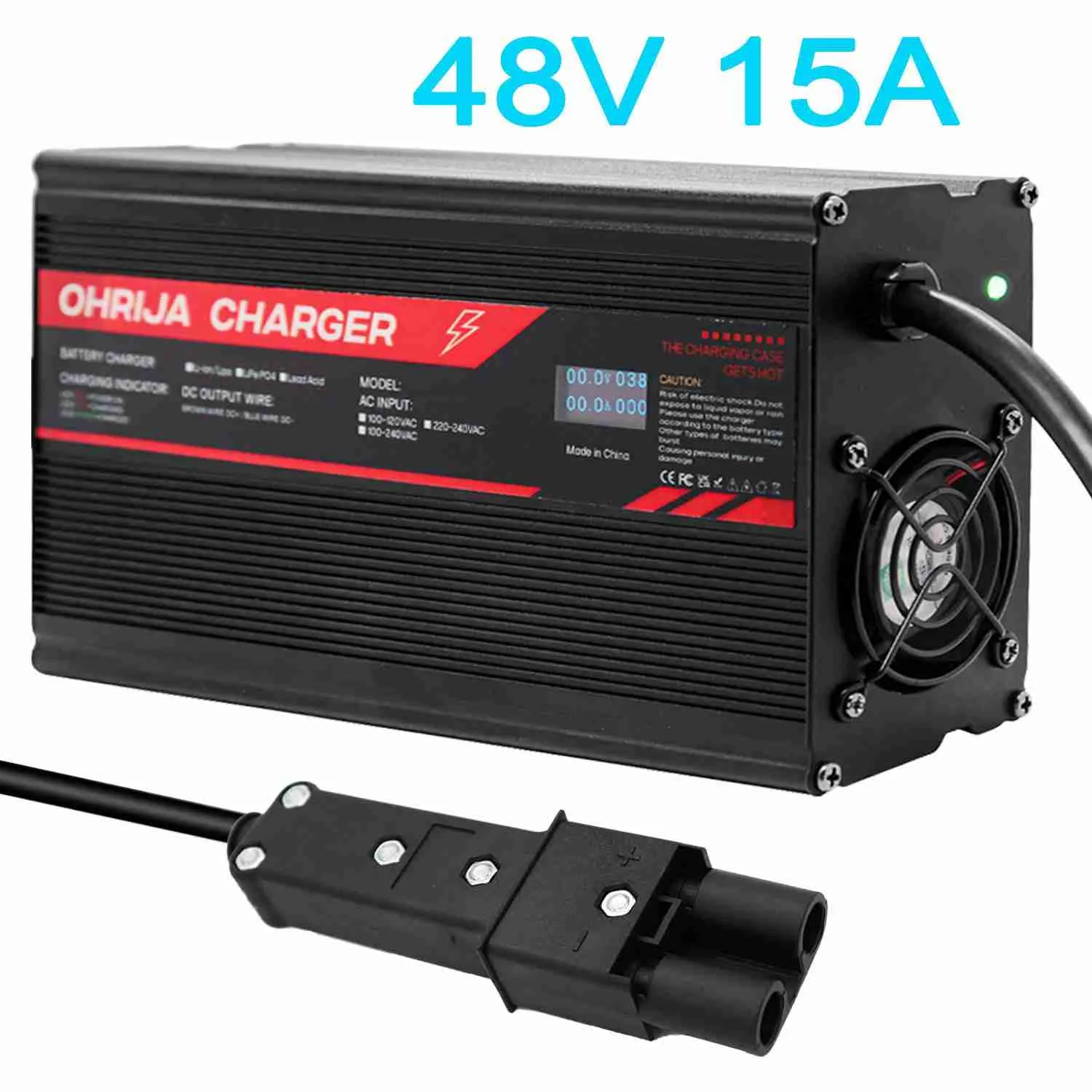
OHRIJA Club Car Golf Cart Battery Charger 48V 15A (OLED Display)
5. NOCO Genius GX4820 (20A)
NOCO produces some of the most durable, compact chargers globally. The GX4820 outputs a massive 20 Amps, making it one of the fastest chargers available for a 48V system. It is fully IP67 waterproof and features a specific lithium mode. However, the price point places it firmly in the premium commercial category.
6. Modz Max 48V 15A Lithium Charger
A highly popular aftermarket option that offers a lightweight, plug-and-play experience. It lacks the app connectivity of the Lester Summit II but provides a reliable 15A charge that will safely replenish a 105Ah pack overnight. It is an excellent middle-ground option for residential users.
7. Form Charge 48V 15A Smart Charger
Known for its ultra-compact form factor, this charger is ideal for mounting directly on-board the golf cart. If you want to plug an extension cord directly into your cart at the clubhouse, the Form Charge provides excellent vibration resistance for permanent mounting.
8. Eco Battery 48V 15A Charger
Designed to pair specifically with Eco Battery’s popular lithium drop-in kits, this charger features CAN-bus communication capabilities. If you are running an integrated system, this charger speaks directly to the battery BMS to optimize the charge curve dynamically.
9. RoyPow 48V LiFePO4 Charger
RoyPow dominates the pre-packaged lithium upgrade market. Their proprietary chargers are tightly calibrated to their specific battery cell architecture. If you bought a RoyPow battery, sticking with their OEM charger is the safest play for warranty compliance.
10. Allied Lithium 48V 15A Commercial Charger
Allied Lithium provides robust chargers with excellent heat dissipation. Their units are highly regarded in coastal environments where humidity and salt air rapidly degrade cheaper internal electronics.
11. Dakota Lithium 48V 15A Charger
Dakota offers a premium charger backed by their exceptional brand warranty. It executes a perfect 58.4V CC/CV profile and includes the crucial “BMS Wake-Up” feature to revive dormant batteries.
12. Schauer JAC1548 Lithium
A rugged, no-nonsense industrial charger. It doesn’t have Bluetooth or OLED screens, but it features heavy-duty internal transformers and a reputation for surviving years of abuse in maintenance sheds.
13. OHRIJA 48V 15A Power Drive (Legacy Reference)
For commercial users who have a mixed fleet—some carts converted to lithium, and some still operating on heavy flooded lead-acid—it is vital to have hardware tailored to the chemistry. We include our classic Power Drive unit on this list as a reminder that if you are still running lead-acid, you must use a charger designed for it. Do not mix and match chemistries and chargers.
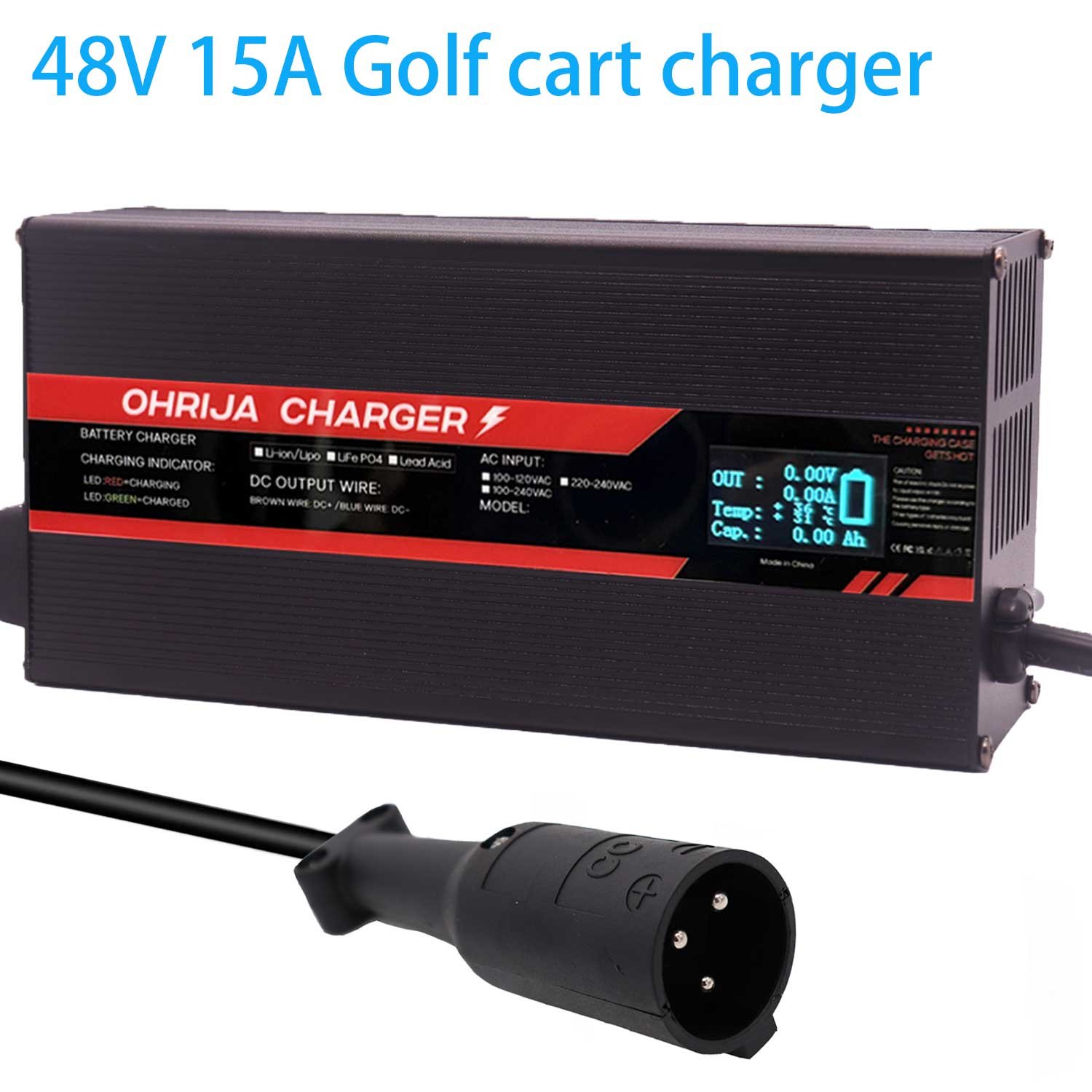
OHRIJA 48V 15A Golf Cart Chargers (Lead Acid Power Drive)
Expert Recommendation
If you are upgrading your golf cart to lithium, you must upgrade your charger simultaneously. Attempting to save money by reusing your old lead-acid charger will inevitably trigger a BMS fault or destroy your new battery. In most professional situations, we recommend the OHRIJA 58.4V 15A LiFePO4 Charger for users who want a flawless, plug-and-play experience without the hassle of downloading apps or programming profiles. For users who demand deep technical data and don’t mind a steep price tag, the Lester Summit II is an excellent premium alternative. If you are exploring broader power solutions for different vehicles, ensure you review the best golf cart battery chargers 48V options to match your specific fleet needs.
Essential Comparison Tables
| Charger Model | Amperage | Best Feature | Ideal User |
|---|---|---|---|
| OHRIJA 58.4V | 15A | Exact 58.4V LiFePO4 Profile & Heat Sink Design | Residential / Plug-and-Play users |
| Lester Summit II | 13.5A – 15A | Bluetooth App & Cloud Profiles | Tech enthusiasts & Fleet managers |
| Eagle Performance | 18A | High-speed PROVolt charging | Commercial & Heavy-duty applications |
| NOCO GX4820 | 20A | IP67 Waterproof Rating | Outdoor storage & Extreme environments |
| Feature | 48V LiFePO4 Smart Charger | Traditional Lead-Acid Charger |
|---|---|---|
| Peak Voltage | Strictly capped at 58.4V. | Can exceed 60V+ for equalization. |
| Algorithm | 2-Stage: Constant Current / Constant Voltage. | Multi-stage with trickle/float charging. |
| BMS Compatibility | Works with the BMS; will not trigger over-voltage faults. | Triggers BMS shutdown, leaving the battery uncharged. |
| Weight | Lightweight (5 – 10 lbs). | Very heavy (30 – 40 lbs) due to large copper transformers. |
| Pros (Advantages) | Cons (Limitations) |
|---|---|
| Guarantees 100% capacity charging without damaging lithium cells. | Requires an additional upfront purchase during a lithium battery conversion. |
| Highly energy efficient (90%+ AC to DC conversion rate). | Cannot be used interchangeably to charge older lead-acid carts safely. |
| Lightweight and easy to mount on-board the golf cart. | Requires physical bypassing of the On-Board Computer (OBC) on older Club Car models. |
| Battery Capacity (Ah) | Recommended Charger Amperage | Estimated Charge Time (0% to 100%) |
|---|---|---|
| 50Ah – 60Ah | 10 Amps | 5 to 6 Hours |
| 100Ah – 105Ah | 15 Amps (Industry Standard) | 6 to 7 Hours |
| 150Ah+ | 18 Amps to 20 Amps | 7 to 9 Hours |
The Bottom Line
The search for the best 48v lifepo4 chargers for GOLF CAR BATTERY systems ends when you recognize the strict chemical requirements of lithium technology. You cannot compromise on voltage regulation. Whether you are outfitting a single neighborhood cruiser or a commercial fleet, you must utilize a charger that executes a precise 58.4V CC/CV algorithm. By investing in highly engineered hardware like the OHRIJA 58.4V 15A Charger or the Lester Summit II, you protect your battery’s internal management system, eliminate the risk of thermal runaway, and ensure your golf cart delivers maximum range and performance for the next decade.
Frequently Asked Questions
Can I use my old golf cart charger on a new lithium battery?
No. In almost all professional situations, using a legacy lead-acid charger on a LiFePO4 battery will trigger the battery’s protective BMS to shut down due to over-voltage (often caused by the charger’s equalization phase). Even if it manages to charge the battery partially, it will not properly balance the lithium cells, drastically reducing the lifespan and capacity of your expensive battery pack.
Why does my new lithium charger not turn on when plugged into my Club Car?
If you own a Club Car (typically manufactured between 1995 and 2014), your cart features an On-Board Computer (OBC) that controls the negative charging circuit. A modern smart lithium charger operates independently and will not receive the “turn on” signal from the OBC. You must install an OBC bypass wire (which connects the black wire from the back of the charge receptacle directly to the main negative terminal of your battery) for the new charger to function.
What does “BMS Wake-Up” mean on a lithium charger?
If you drain a lithium golf cart battery to 0%, the Battery Management System (BMS) will completely disconnect the internal cells from the exterior terminals to prevent permanent damage. A standard charger will read 0 volts, assume no battery is connected, and refuse to turn on. A charger with a “BMS Wake-Up” feature sends a small, deliberate electrical pulse into the dead lines to “wake up” the computer, forcing the BMS to reconnect the cells so the charging cycle can begin.
Authoritative Industry References
- Battery Council International (BCI): Technical guidelines and industry standards regarding proper charging algorithms and safety protocols for motive power lithium-ion battery integration. Review BCI Guidelines
- IEEE Standards Association: Engineering standards detailing the required constant-current/constant-voltage (CC/CV) charging profiles necessary to maintain cycle life in LiFePO4 chemistries. Explore IEEE Standards
- Underwriters Laboratories (UL): Safety science organization outlining the UL 1564 and UL 2202 certification requirements for industrial and electric vehicle battery chargers to prevent thermal runaway. Read UL Safety Requirements