
No products in the cart.

Every marine vessel operator, commercial golf cart fleet manager, off-grid solar installer, and RV traveler eventually faces the same frustrating scenario: you spend a small fortune on high-capacity AGM, Gel, or Lithium batteries, only to watch their usable runtime degrade by half within eighteen months. When energy storage systems fail prematurely, the battery manufacturer is almost always blamed. Yet in our diagnostic teardowns across thousands of returned battery banks, the cells were rarely defective from the factory. The true culprit is almost always the charging hardware. People treat battery chargers as generic power bricks, assuming that as long as the plug fits and the indicator light glows red, electrical energy is transferring safely. In reality, deep-cycle chemistries operate under radically different electrochemical demands than automotive starting batteries. Connecting a high-capacity deep-discharge bank to an uncalibrated automotive charger or an outdated linear power supply is the fastest way to trigger irreversible plate sulfation, dry out valve-regulated separator mats, or induce destructive thermal runaway. Mastering how chargers for deep-cycle batteries function is the single most critical factor in protecting your capital investment and extracting the full five-to-ten-year lifecycle your energy bank was engineered to deliver. As power electronics engineers and industrial charging manufacturers who develop switch-mode power topologies, calibrate multi-stage algorithms, and evaluate thermal dissipation daily at OHRIJA, we break down the eight fundamental truths you must understand before buying or deploying chargers for deep-cycle batteries.
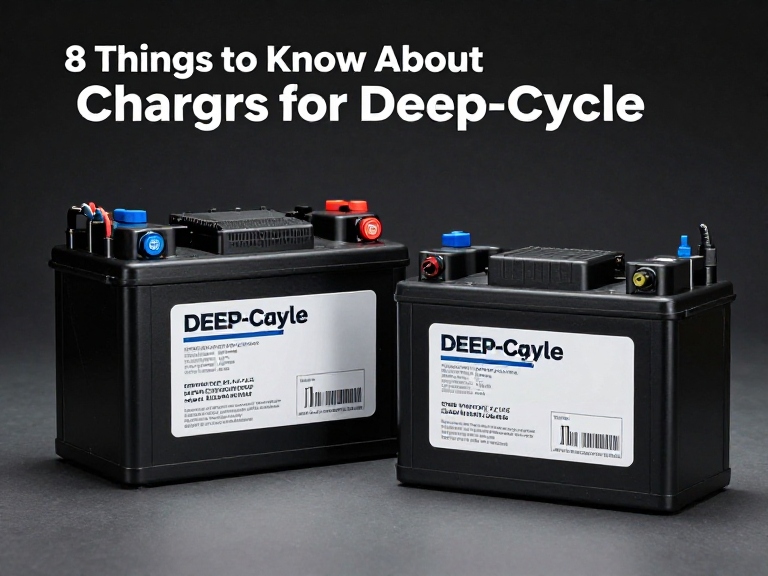
Quick Answer: What You Must Know About Chargers for Deep-Cycle Batteries
To keep deep-cycle battery banks alive and prevent premature capacity loss, eight non-negotiable engineering principles govern chargers for deep-cycle batteries: (1) Automotive Starting Chargers Are Destructive (they read deceptive surface voltage and undercharge dense deep-cycle plates by up to 20%); (2) Chemistry Profiles Are Incompatible (Flooded, AGM, Gel, and LiFePO4 require strict voltage cutoff ceilings ranging from 14.1V to 14.7V); (3) Sizing Demands the 10% to 20% C-Rate Rule (charging current must equal 10% to 20% of total amp-hour capacity); (4) Multi-Stage Algorithms Are Mandatory (smart units must transition seamlessly through Bulk, Absorption, Float, and Storage stages); (5) Temperature Compensation Protects Against Seasons (cold electrolyte requires higher voltage, while summer heat demands lower voltage to avoid dry-out); (6) Lithium Requires BMS Wake-Up & Balancing Tails (LiFePO4 profiles must terminate without trickle voltage while allowing micro-amp cell balancing); (7) Equalization Revives Flooded Plates but Destroys Sealed Batteries (controlled 15.5V overcharge dissolves sulfate on flooded cells but permanently ruins AGM/Gel/Lithium); and (8) Industrial Hardware Architecture Matters (extruded aluminum enclosures, power factor correction, and low-ripple DC output vastly outlast cheap plastic converters). Sourcing a verified, multi-chemistry unit like an OHRIJA battery CHARGER ensures exact voltage thresholds and commercial reliability.
Article Directory
- Deep-Cycle Fundamentals: Why Starting Chargers Destroy Energy Storage Banks
- Quick Summary Table: The 8 Things to Know at a Glance
- The 8 Critical Realities of Chargers for Deep-Cycle Batteries
- Hardware Spotlight: OHRIJA High-Efficiency Industrial Battery Chargers
- Direct Technical Comparison: Automotive vs. Generic vs. Advanced Multi-Stage Chargers
- Pros and Cons Table: Investing in Dedicated Smart Chargers
- Operational Realities: Cycle Life Payback vs. Equipment Constraints
- Who Needs Dedicated Deep-Cycle Chargers vs. Who Can Use Basic Maintainers
- Costly Sourcing & Charging Mistakes That Ruin Battery Banks
- Essential Buying Considerations: Auditing Voltage, Current, and Certifications
- Expert Power Electronics Verdict & Sourcing Roadmap
- Frequently Asked Questions
- Authoritative Electrical Engineering & Standards References
Deep-Cycle Fundamentals: Why Starting Chargers Destroy Energy Storage Banks
To grasp why dedicated chargers for deep-cycle batteries are essential, you have to understand the physical and chemical differences inside the battery casing. An automotive starter battery is designed for a single task: delivering a massive burst of cold cranking amps (typically 400A to 800A) for three seconds to spin an internal combustion engine. To achieve this, starting batteries utilize dozens of paper-thin, sponge-like lead plates that maximize surface area. They are designed to discharge no more than 1% to 3% of their capacity before the vehicle’s alternator immediately replenishes them.
Deep-cycle batteries—whether powering marine trolling motors, golf carts, aerial scissor lifts, or off-grid solar inverters—are built for marathon endurance. They feature solid, thick, heavy lead plates (in lead-acid platforms) or high-density lithium iron phosphate prismatic cells designed to be depleted down to 50% or even 80% depth of discharge (DoD) across hundreds or thousands of cycles. Chemical reactions inside deep-cycle plates penetrate deep into the active material matrix, not just the surface.
When you connect an inexpensive, single-stage automotive charger to a deep-cycle battery, the charger monitors terminal voltage. Because depleted deep-cycle plates create localized chemical resistance, the battery exhibits a deceptive “surface charge.” The automotive charger misinterprets this surface voltage as a fully charged state and prematurely throttles down current or shuts off entirely. The deep inner layers of the lead plates remain unreduced. Over weeks of repeated partial charging, unreduced lead sulfate hardens into permanent crystalline structures—a process known as irreversible sulfation. Within months, your 100Ah battery behaves like a 40Ah battery. High-performance chargers for deep-cycle batteries overcome this by utilizing multi-stage switch-mode topologies that hold elevated absorption voltages long enough to force chemical conversion throughout the entire thickness of the plate.
Quick Summary Table: The 8 Things to Know at a Glance
| Factor Number & Topic | Target Engineering Specification | Chemistry Relevance | Operational Failure Prevented |
|---|---|---|---|
| 1. Purpose-Built Topology | High-frequency Switch-Mode (SMPS) with micro-controlled multi-stage profiling | All Deep-Cycle Chemistries | Prevents premature charge shutoff caused by deceptive surface voltage |
| 2. Chemistry Voltage Ceilings | AGM: 14.4–14.7V | Gel: 14.1–14.4V | Flooded: 14.6–14.8V | LiFePO4: 14.4–14.6V | Specific to each formulation | Prevents electrolyte boiling in Gel and severe undercharging in AGM |
| 3. Sizing Amperage (C-Rate) | 10% to 20% of total Ah capacity (0.1C to 0.2C continuous current) | All Chemistries (Lead & Lithium) | Eliminates thermal runaway from oversizing and sulfation from undersizing |
| 4. Multi-Stage Profiling | Bulk (CC) → Absorption (CV) → Float → Periodic Storage Pulse | Flooded, AGM, Gel | Ensures 100% true state-of-charge saturation without drying mats |
| 5. Dynamic Temperature Compensation | -3mV to -5mV / °C / cell departure from 25°C (77°F) baseline | Lead-Acid (Flooded, AGM, Gel) | Stops winter undercharging and summer thermal dry-out |
| 6. Lithium BMS Handshake | 0V activation pulse, CC/CV profile, no trickle float voltage | LiFePO4 & Li-ion Systems | Wakes sleeping BMS protection circuits; protects cathode structure |
| 7. Controlled Equalization | Controlled 15.5V to 16.2V low-current overcharge on flooded cells only | Flooded Lead-Acid ONLY | Remixes stratified acid; dissolves hardened lead sulfate crystals |
| 8. Hardware & Thermal Build | Extruded aluminum casing, active cooling, low ripple (<2%), PFC >0.95 | All Commercial & Industrial | Prevents internal capacitor desoldering and electrical fires |
The 8 Critical Realities of Chargers for Deep-Cycle Batteries
1. Automotive Cranking Chargers Will Rapidly Destroy Deep-Cycle Banks
The belief that any 12-volt battery charger can service any 12-volt battery is the most expensive myth in energy storage maintenance. Standard automotive shop chargers are linear, unregulated or crude taper chargers. They deliver maximum current when the battery is completely flat, but as internal resistance builds, their output drops sharply. In a starting battery, this is acceptable because the plates are thin. In deep-cycle batteries, a linear taper leaves the battery sitting at roughly 80% state-of-charge (SoC).
Operating a deep-cycle battery in a partial state of charge (PSoC) is fatal. The uncharged active material on the plates forms lead sulfate crystals ($PbSO_4$). If these crystals are not driven back into solution via a dedicated, elevated absorption stage within 24 to 48 hours, they harden into non-conductive lead sulfate crystals that permanently choke the plate pores. Professional chargers for deep-cycle batteries maintain constant current (bulk phase) until the target absorption threshold is achieved, ensuring deep chemical reconstitution before any current tapering occurs.
2. Chemistry Voltage Ceilings Are Inflexible: AGM, Gel, Flooded, and Lithium Do Not Mix
In most professional situations, battery damage occurs not because the charger was broken, but because the user selected the wrong battery chemistry mode. Deep-cycle batteries do not share a universal charging voltage ceiling:
- Flooded Lead-Acid: Requires an absorption voltage between 14.6V and 14.8V (for a 12V system) to encourage light gassing, which naturally stirs the liquid electrolyte and prevents destructive acid stratification.
- Absorbent Glass Mat (AGM): Features microscopic borosilicate glass fiber mats saturated with electrolyte. High-performance AGMs require an absorption ceiling of 14.4V to 14.7V. If undercharged at 14.1V, they lose capacity; if pushed past 14.8V, they vent hydrogen through pressure relief valves that can never be replenished, drying out the mats permanently.
- Gel Cell Batteries: The most delicate lead-acid chemistry. The sulfuric acid is mixed with fumed silica to form an immobile gel. Gel batteries must never exceed 14.1V to 14.4V. Pushing higher voltages into a Gel battery creates gas bubbles inside the gel matrix that separate the electrolyte from the plates, permanently creating dead zones inside the battery.
- Lithium Iron Phosphate (LiFePO4): Operates on a steep electrochemical curve terminating between 14.4V and 14.6V ($3.60\text{V} \text{ to } 3.65\text{V}$ per cell). Unlike lead-acid, lithium requires zero float trickle charging. Leaving a lead-acid float charge on a lithium battery causes continuous electrolyte oxidation.
Quality multi-chemistry charging systems, such as an engineered LEAD ACID BATTERY CHARGER or a dedicated LIFEPO4 BATTERY CHARGER, feature independent firmware maps calibrated to these precise millivolt boundaries.
3. Sizing Your Charger: The 10% to 20% C-Rate Formula
When selecting chargers for deep-cycle batteries, bigger is not always better, but smaller is frequently catastrophic. Sizing a charger requires calculating the battery bank’s total capacity in Amp-hours (Ah) and applying the industry-standard 0.1C to 0.2C rule.
The mathematical guideline is straightforward:
- Minimum Charge Current: 10% of total Ah capacity (e.g., a 100Ah battery requires at least a 10-amp charger).
- Optimal Charge Current: 15% to 20% of total Ah capacity (e.g., a 100Ah battery thrives on a 15A to 20A charger; a 200Ah bank requires 20A to 40A).
In our testing, undersizing a charger (such as using a 4-amp trickle charger on a massive 200Ah battery bank) causes severe chemical damage. Because the current output is too low, the charger cannot push the battery through the bulk stage fast enough to overcome internal self-discharge and plate resistance. The charger’s internal safety timer will often trip after 12 hours, shutting off while the battery is still half-empty. Conversely, pumping a 50-amp charge into a small 50Ah AGM battery (a 1.0C rate) generates extreme internal heat, violently warping the lead plates and popping the safety relief seals.
4. Multi-Stage Profiling: Demystifying Bulk, Absorption, Float, and Storage
A true commercial-grade deep-cycle charger is governed by a digital microprocessor executing a four-stage or five-stage charging profile. Each stage performs a specific physical and chemical function:
- Stage 1: Bulk Charge (Constant Current): The charger pumps its maximum rated amperage into the depleted battery while voltage climbs steadily. This stage restores roughly 75% to 80% of total energy capacity in the shortest possible time.
- Stage 2: Absorption (Constant Voltage): Once the battery reaches its predetermined absorption voltage ceiling (e.g., 14.6V for AGM), the charger locks the voltage in place. As the active plate material saturates, internal resistance naturally rises, and the current tapers down toward zero. This stage is critical: it pushes the remaining 20% of capacity into the dense plate core. Prematurely exiting this stage guarantees sulfation.
- Stage 3: Float Charge (Maintenance Voltage): Once current drops below a pre-set threshold (typically 2% to 3% of battery capacity, or when an internal timer elapses), the charger drops its voltage down to a safe resting level (typically 13.2V to 13.6V). This compensates for natural self-discharge without boiling electrolyte or corroding positive plate grids.
- Stage 4: Storage / Recondition Pulse: If the battery remains connected for weeks or months (such as winter RV or boat storage), advanced chargers periodically pulse current or cycle between 13.0V and 13.5V to prevent acid stratification and maintain active chemical readiness.
5. Temperature Compensation: The Overlooked Battery Killer
Battery chemistry is fundamentally an electrochemical reaction governed by temperature. As ambient temperatures drop, chemical reactions slow down and internal resistance increases. As temperatures rise, reactions accelerate and internal resistance plummets. Therefore, a fixed charging voltage that works perfectly at 25°C (77°F) becomes destructive in summer heat and useless in winter cold.
Professional chargers for deep-cycle batteries utilize an external temperature probe bolted directly to the negative battery terminal. The charger’s microprocessor continuously adjusts the target absorption and float voltages based on a negative temperature coefficient: typically -3mV to -5mV per °C per cell departuring from 25°C.
Consider the real-world impact on a 12V lead-acid battery (6 cells):
- In Freezing Winter Conditions (0°C / 32°F): The target absorption voltage must be raised by roughly 0.6V—from 14.6V up to 15.2V. Without temperature compensation, the charger cuts off far too early, leaving the battery chronically undercharged and vulnerable to freezing (a discharged battery’s electrolyte turns to water and freezes, cracking the plastic case).
- In Blistering Summer Heat (40°C / 104°F): The target voltage must be reduced down to 14.15V. Pushing 14.7V into a boiling battery causes thermal runaway, vaporizing the liquid electrolyte and permanently destroying the plates.
6. Lithium Integration: BMS Handshakes, 0V Activation, and Balancing Tails
With the rapid transition toward Lithium Iron Phosphate (LiFePO4) in golf carts, RVs, and marine vessels, traditional multi-stage lead-acid chargers have become operational liabilities. A dedicated lithium charger must manage the battery’s internal Brain: the Battery Management System (BMS).
Charging deep-cycle lithium requires three distinct capabilities:
- 0V Low-Voltage Wake-Up Function: When a lithium battery is over-discharged, its internal BMS trips an electronic low-voltage disconnect to protect the cells, reducing terminal voltage to 0.0V. Standard lead-acid chargers will not turn on when connected to a 0V battery because they require a sensed voltage threshold (usually 4V to 8V) to initiate charging. A smart lithium charger emits a specialized low-current pulse that wakes the sleeping BMS back to life.
- Strict Constant-Current / Constant-Voltage (CC/CV) Curve: Lithium does not need multi-stage absorption soak times. It accepts full rated current up to 95% capacity, followed by a brief constant-voltage saturation phase, and then must shut off completely. Applying a continuous float trickle overcharges the anode structure.
- Passive Cell Balancing Tail: During the final phase at 14.4V to 14.6V, individual lithium cells drift slightly in voltage. The charger must hold voltage steady while current tapers to a tiny fraction of an amp, allowing the BMS passive bleed resistors time to equalize individual cell voltages. Explore dedicated lithium platforms across our LI ION BATTERY CHARGER lineup.
7. Controlled Equalization: When It Saves Batteries and When It Destroys Them
Equalization is the deliberate, controlled overcharging of a fully charged battery bank at elevated voltages (typically 15.5V to 16.2V on a 12V system) at very low current. It is an indispensable maintenance tool, but applying it incorrectly is an immediate death sentence for sealed batteries.
Here is the critical distinction:
- On Flooded Lead-Acid Batteries (Mandatory Periodic Service): In deep flooded cells, heavy sulfuric acid sinks to the bottom of the casing while light water floats to the top—a devastating phenomenon known as acid stratification. Equalization produces vigorous bubbling (gassing) that physically stirs the liquid electrolyte back into a uniform specific gravity while stripping hardened sulfate crystals off the plates. It should be performed every 30 to 60 days.
- On AGM, Gel, and Lithium Batteries (STRICTLY PROHIBITED): Sealed VRLA (Valve-Regulated Lead-Acid) batteries cannot replenish lost water. Subjecting an AGM or Gel battery to a 15.5V equalization cycle blows open the pressure release valves, venting critical water vapor into the air. The internal glass mats dry out, the gel cracks, and the battery is permanently ruined in a single afternoon. On lithium, 15.5V triggers catastrophic overvoltage protection or cell venting. Quality chargers lock out equalization unless explicitly activated by the user for flooded chemistries.
8. Hardware Engineering: Aluminum Enclosures, Ripple Voltage, and Spark-Proof Protections
The final thing to know about chargers for deep-cycle batteries lives inside the hardware chassis. Cheap consumer chargers use thin ABS plastic housings that trap heat, single low-grade capacitors, and unfiltered switching circuits that dump massive alternating current (AC) ripple voltage onto your direct current (DC) battery bank.
In our manufacturing testing, high AC ripple voltage (exceeding 2% to 3% RMS) causes severe internal battery heating, breaking down active plate paste and confusing lithium BMS microcontrollers. Industrial-grade chargers are housed inside heavy extruded aluminum alloy enclosures that act as structural heatsinks, utilizing high-efficiency ball-bearing cooling fans that engage dynamically under thermal load. Furthermore, commercial platforms incorporate Active Power Factor Correction (PFC > 0.95), short-circuit protection, reverse-polarity lockouts that prevent sparks when connecting clamps in dark battery compartments, and specialized connectors. Review heavy-power configurations across our GOLF CAR BATTERY CHARGER and CONNECTOR REMOVAL CHARGER lines.
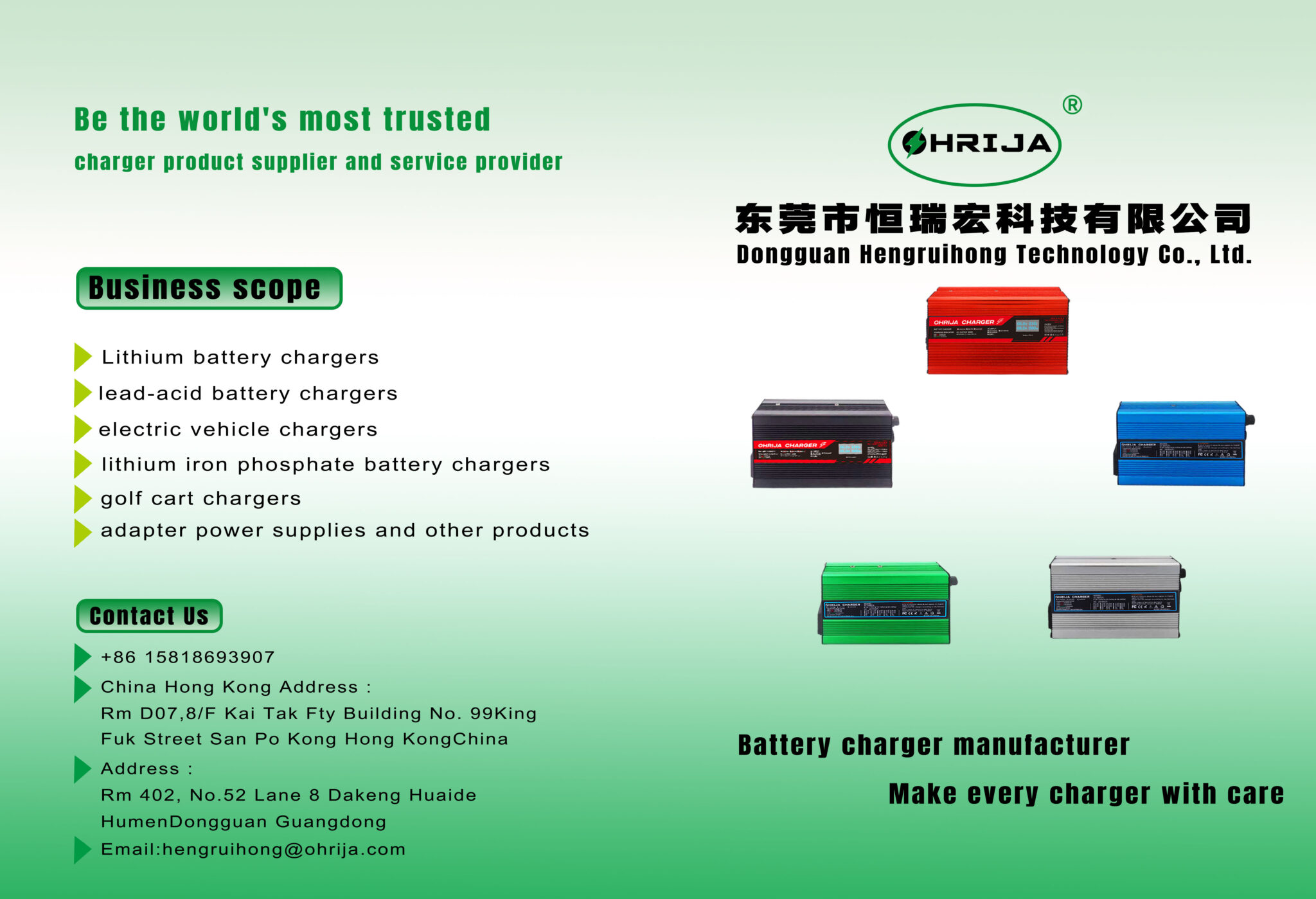
Manufacturer Spotlight: OHRIJA Intelligent Multi-Chemistry Battery Chargers
When deploying mission-critical chargers for deep-cycle batteries across commercial golf cart fleets, marine vessels, and industrial energy storage, OHRIJA (Dongguan Hengruihong Technology Co., Ltd.) delivers field-proven power electronics engineered for extreme durability and precision chemical matching.
| Corporate Engineering Profile | High-tech manufacturing enterprise integrating R&D, precision assembly, and global testing in Dongguan, China |
| Supported Battery Chemistries | Lithium Iron Phosphate (LiFePO4), Lithium-Ion (NMC/NCA), Sealed AGM, Gel Cell, and Flooded Deep-Cycle |
| Voltage Spectrum Available | From 12V/24V up to specialized high-voltage series: 13S 54.6V battery CHARGER, 14S 58.8V battery CHARGER, and 16S 67.2V battery CHARGER platforms |
| Chassis Architecture | Rugged extruded 6063 aluminum alloy housing; active dynamic fan cooling; high-efficiency convective heat dissipation |
| Integrated Circuit Protections | Hardware OVP, OCP, SCP, reverse polarity lockout, thermal throttling, and 0V dead-battery wake-up logic |
| Industrial Compliance | UL 1564, CE, FCC, RoHS certified; low DC ripple (<1%); Active Power Factor Correction (PFC > 0.98) |
Engineering Recommendation: Explore full technical specifications on the OHRIJA battery CHARGER platform, or consult our specialized engineering divisions for high-power electric vehicle charging.
Direct Technical Comparison: Automotive vs. Generic vs. Advanced Multi-Stage Chargers
| Engineering Metric | Automotive Starter Charger (Taper / Linear) | Generic Off-The-Shelf Smart Charger | OHRIJA Industrial Multi-Stage Smart Charger |
|---|---|---|---|
| Charging Profile Architecture | Crude single-stage linear taper | Basic 3-stage (Fixed timing parameters) | Microprocessor 4/5-Stage + Custom CC/CV algorithms |
| Chemistry Specificity | Fixed single lead-acid profile | Pre-set switch (often inaccurate voltages) | Precision calibrated firmware (AGM, Gel, Flooded, LiFePO4) |
| Full Saturation Capability | Poor (≤80% true state of charge) | Moderate (85%–92% depending on drift) | Exceptional (99%–100% full chemical reconstitution) |
| Temperature Compensation | None (Severe summer boil-over risk) | Internal ambient sensor (measures box, not battery) | External battery terminal thermal probe |
| Lithium BMS 0V Wake-Up | No (Fails to recognize tripped battery) | Rare / Unreliable | Yes (Integrated automatic 0V recovery pulse) |
| Chassis & Thermal Build | Stamped sheet steel or thin plastic | Molded ABS plastic (Traps internal heat) | Extruded aluminum alloy heatsink + smart ball-bearing fan |
| DC Voltage Ripple | High (>5% to 10% AC ripple) | Moderate (2% to 4% ripple) | Ultra-Low (<1% clean DC output) |
| Expected Battery Lifespan | 1 to 2 Years (Accelerated sulfation) | 2 to 4 Years | 5 to 8+ Years (Maximum manufacturer cycle rating) |
Pros and Cons Table: Investing in Dedicated Smart Chargers
| Charging Strategy | Commercial & Operational Advantages (Pros) | Inherent Limitations & Realities (Cons) |
|---|---|---|
| Dedicated Smart Chargers for Deep-Cycle Batteries (e.g., OHRIJA Multi-Stage Platforms) | Maximizes battery cycle life, extracting 100% of rated manufacturer cycles. Guarantees exact absorption voltage ceilings matched to battery chemistry. Eliminates boiling of Gel electrolytes and dry-out of AGM separators. Temperature compensation prevents seasonal winter undercharging. Wakes up tripped Lithium LiFePO4 battery management systems safely. Aluminum heatsinks and industrial components withstand daily commercial duty. | Higher upfront acquisition cost than cheap hardware store chargers. Requires user understanding to select matching chemistry modes. Larger physical footprint and heavier weight than plastic trickle units. |
| Generic / Automotive Taper Chargers (Standard Department Store Units) | Extremely low upfront purchase price ($25 to $50). Lightweight, compact, and readily available at retail shops. Adequate for emergency jump-starts on standard car starting batteries. | Chronically undercharges deep-cycle plates, causing permanent sulfation. Lacks thermal compensation, causing severe water loss in warm environments. Cannot wake up tripped lithium BMS circuits. High AC ripple voltage degrades active chemical materials. Destroys expensive battery banks within 12 to 18 months. |
Operational Realities: Cycle Life Payback vs. Equipment Constraints
Every commercial equipment purchase must be justified through Return on Investment (ROI). Investing in dedicated chargers for deep-cycle batteries is not an aesthetic luxury; it is an aggressive asset preservation strategy.
The Proven Economic Benefits:
- Doubling or Tripling Battery Bank Lifespan: A commercial bank of four 6-volt deep-cycle AGM batteries or a 48V lithium golf cart pack costs between $1,200 and $3,500. A standard cheap charger will degrade this bank in two years, forcing a premature replacement. A dedicated smart charger costing $150 to $300 extends the life of that exact same battery bank to six or seven years. The charger pays for itself several times over simply by delaying capital replacement expenses.
- Eliminating Stranded Fleet Downtime: In commercial warehouse utility vehicles, scissor lifts, and rental golf cart fleets, an uncharged vehicle is lost revenue. Smart chargers charge faster during the bulk stage because they do not prematurely taper current, ensuring vehicles reach full operating capacity between work shifts.
- Energy Efficiency and Lower Utility Bills: Modern switch-mode chargers for deep-cycle batteries equipped with Active Power Factor Correction (PFC > 0.95) convert grid power to DC with efficiencies exceeding 90% to 94%. Older linear transformer-based chargers operate at an abysmal 60% to 70% efficiency, burning the remaining electricity as wasted room heat. Over a fleet of ten carts charging daily, high-efficiency chargers save hundreds of dollars in annual electrical utility overhead.
The Inherent Operational Constraints:
- Chemistry Selection Human Error: The primary failure point of advanced multi-chemistry chargers is the operator. If a technician accidentally toggles the charger into “Flooded / Equalize” mode on an expensive bank of sealed Gel batteries, the charger will obediently push 15.5 volts into the sealed casing, destroying thousands of dollars in batteries within hours. In fleet environments, lockout firmware or dedicated single-chemistry chargers are often preferred to eliminate human error.
- DC Cable Voltage Drop: Even the finest charger cannot perform accurately if connected through thin, undersized DC cables. Pumping 25 amps through ten feet of 14 AWG wire creates an immediate 0.5V voltage drop across the copper wire. The charger senses 14.6V at its output terminals, while the battery is only receiving 14.1V. High-current charging demands heavy 8 AWG or 6 AWG copper cables to maintain calibration integrity.
Who Needs Dedicated Deep-Cycle Chargers vs. Who Can Use Basic Maintainers
Every dollar spent on power equipment should match your operational duty cycle. Understanding who genuinely requires industrial-grade chargers for deep-cycle batteries prevents both under-investing in fragile hardware and over-engineering simple applications.
Who Must Invest in High-Performance Chargers for Deep-Cycle Batteries:
- Commercial Golf Cart & Utility Fleet Operators: If your facility manages 36V, 48V, or 72V fleets running continuous daily shifts, commercial-grade chargers with aluminum enclosures and high-amperage bulk stages are mandatory. Standard maintainers cannot replenish heavy traction plates overnight.
- Marine Vessel & Yacht Owners: Boats combine deep-cycle house banks (running refrigeration, navigation, and lighting) with harsh salt-air humidity. Marine setups demand waterproof or moisture-sealed chargers with dual isolated outputs, zero-spark battery connections, and dedicated AGM/Gel/Lithium algorithms.
- RV, Overlanding & Vanlife Nomads: When living off-grid, your battery bank is your lifeline. Pairing high-capacity LiFePO4 batteries with smart chargers capable of low-noise operation, 0V BMS wake-up, and generator-friendly power factor correction ensures you never find yourself stranded in the wilderness with unrecoverable power.
- Off-Grid Solar Energy Storage Systems: Backup generators running into deep-cycle banks require high-current chargers that saturate batteries rapidly during brief generator runtimes, maximizing fuel economy.
Who Can Rely on Basic Low-Amperage Maintainers:
- Seasonal Vehicle Storage on Already-Charged Batteries: If your classic car or motorcycle sits parked in a climate-controlled garage all winter with a fully charged battery, a simple, low-cost 1.5A to 2A smart battery maintainer is sufficient to offset natural internal self-discharge.
- Infrequent Small-Battery Hobbyists: If you operate a small 12Ah deep-cycle battery for a portable fish finder once a month, investing in a commercial $300 high-amperage multi-stage charger is economically unnecessary. A quality 2A multi-stage micro-charger will fulfill your needs.
Costly Sourcing & Charging Mistakes That Ruin Battery Banks
Power Engineering Warning: The Absorption Phase Parasitic Load Trap
The most insidious battery killer in RV and marine installations is charging a deep-cycle bank while simultaneous DC loads (inverters, DC refrigerators, interior lighting) are running in the background. Modern smart chargers determine when to exit the absorption stage based on current taper (e.g., when current drops below 2 amps). If your 12V refrigerator pulls 5 amps continuously, the charger measures this draw and assumes the battery is still absorbing energy. The charger remains locked in high-voltage absorption mode indefinitely, boiling the electrolyte and destroying the battery bank. Always ensure your charger features a master safety timer backup (typically 4 to 8 hours max absorption).
- Charging Lead-Acid or Lithium Batteries Below Freezing (0°C / 32°F): While lead-acid batteries can accept a slow charge when cold (provided voltage is elevated via temperature compensation), lithium (LiFePO4) batteries must NEVER be charged below freezing. Attempting to force current into a freezing lithium cell causes irreversible metallic lithium plating on the anode, resulting in permanent capacity loss and internal short-circuits that can lead to fire. Always ensure your lithium charger or battery BMS includes low-temperature charge cutoff sensors.
- Using Thin Extension Cords on High-Power Chargers: A commercial 48V 25A charger pulls over 1,500 watts from the 110V/120V AC wall outlet. Connecting that charger to a flimsy, 50-foot 16 AWG household extension cord causes severe AC voltage drop. The charger’s switching transformers overheat, efficiency collapses, and internal components suffer electrical brownouts. Always use heavy 12 AWG or 10 AWG grounded extension cords.
- Leaving Flooded Lead-Acid Batteries Un-Watered Before Charging: The liquid level in flooded cells must cover the lead plates before initiating a charge cycle. Charging with exposed plates causes the dry portions of the plates to oxidize and overheat. However, never fill flooded cells to the top before charging; electrolyte expands as it warms and bubbles during charge, causing corrosive acid to overflow the cell caps. Fill just above the plates before charging, and top off to the fill line only after the charge cycle is complete.
- Ignoring Cable Length and Polarity Reversal Protection: Connecting battery clamps in reverse creates an instantaneous direct short circuit. Low-end chargers blow cheap internal fuses that require disassembling the casing to replace. Industrial chargers utilize electronic solid-state reverse polarity lockouts: if polarity is inverted, the output relays remain open, preventing sparks, blown fuses, and damaged equipment.
Essential Buying Considerations: Auditing Voltage, Current, and Certifications
Before issuing a commercial purchase order or buying equipment for private energy storage, audit prospective chargers for deep-cycle batteries against these four non-negotiable engineering benchmarks:
1. Verified Full-Charge Cutoff Voltage Precision (±0.1V Calibration)
Never buy an unbranded charger that does not explicitly publish its exact absorption and float voltage thresholds in its technical documentation. Settle for nothing less than microprocessor-controlled calibration accurate to within ±0.1V DC. A charger that drifts by 0.4V will either leave an AGM bank chronically sulfated at 14.2V or over-boil a Gel bank at 14.8V.
2. Certified Electrical Safety Clearances (UL 1564 & IEC 60335-2-29)
Charging deep-cycle batteries involves high continuous direct current. Insist on verified compliance with recognized international safety directives:
- Underwriters Laboratories (UL 1564): Standard for Industrial Battery Chargers, covering thermal endurance, transformer insulation, and fire safety.
- International Electrotechnical Commission (IEC 60335-2-29): Global safety specifications for commercial and domestic battery charging systems.
- CE, FCC Part 15 Class A/B, and RoHS: Ensuring low electromagnetic radiation that will not disrupt onboard marine VHF radios, GPS navigation, or sensitive solar inverter communications.
3. Enclosure Engineering and Ingress Protection (IP Ratings)
Match the physical chassis to your operational environment:
- Dry Workshop / Indoor Fleet: Heavy extruded 6063 aluminum alloy casings with variable-speed brushless cooling fans.
- Marine, Outdoor RV, or Turf Environments: Fully potted electronics enclosed within an hermetically sealed IP65 or IP67 waterproof enclosure that resists driving rain, salt spray, and abrasive fertilizer dust.
4. Total System Integration & Modular Connectors
A charger should interface cleanly with your vehicle or battery bank. Avoid cheap alligator clips for permanent or high-current (>15A) applications; clips create high contact resistance and can vibrate loose. Demand heavy-duty industrial terminations: Anderson Powerpole connectors, REMA plugs, M8 ring terminals, or dedicated golf cart receptacle plugs (Club Car 3-pin round, EZ-GO D-style, or Yamaha Nabson). Explore custom modular options across our specialized CONNECTOR REMOVAL CHARGER lines.
Expert Power Electronics Verdict & Sourcing Roadmap
In our professional assessment across decades of power electronics engineering and battery failure analysis, continuing to charge high-value deep-cycle batteries with generic automotive chargers or outdated linear converters is financial negligence. A battery bank is only as good as the charger maintaining it. Treating energy storage charging as an integrated system rather than an afterthought is the single most effective way to eliminate battery headaches.
Here is your clear, actionable sourcing roadmap for chargers for deep-cycle batteries:
- Identify Your Exact Chemistry & Capacity: Look at your battery data plate. Confirm whether you have Flooded, AGM, Gel, or LiFePO4 chemistry, and record the total Amp-hour (Ah) rating.
- Apply the Sizing Formula: Select a charger outputting between 10% and 20% of total Ah capacity (e.g., a 15A to 20A charger for a 100Ah battery; a 30A to 40A charger for a 200Ah bank).
- Mandate Multi-Stage Firmware with Thermal Compensation: Ensure the charger features true Bulk, Absorption, and Float stages, external temperature monitoring for lead-acid, and 0V wake-up logic for lithium.
- Choose Industrial Hardware Reliability: Partner with a proven manufacturing specialist like OHRIJA. Sourcing an extruded aluminum, switch-mode smart charger calibrated to your exact system voltage—from standard 12V and 24V deep-cycle systems up to high-voltage platforms like our 14S 58.8V battery CHARGER and 16S 67.2V battery CHARGER lines—ensures pristine DC power, complete chemical saturation, and maximum operational lifespan across every single battery cycle.
Frequently Asked Questions
Can I use a regular car battery charger on a deep-cycle battery?
No. Standard automotive chargers are designed for starter batteries that experience brief, shallow discharges. They deliver high initial current that quickly tapers off linearly based on surface charge, leaving deep-cycle batteries chronically undercharged. This causes rapid lead-sulfate crystallization in lead-acid chemistries or fails to trigger the balancing stage in lithium systems. Dedicated chargers for deep-cycle batteries use multi-stage microprocessors to fully saturate heavy plates.
What size charger do I need for a 100Ah deep-cycle battery?
The industry standard sizing rule dictates a charge current equal to 10% to 20% of the battery’s amp-hour (Ah) capacity (a 0.1C to 0.2C rate). For a 100Ah deep-cycle battery, an optimal charger outputs between 10A and 20A. A charger below 10A will struggle to complete absorption before timing out, while exceeding 25A on AGM or Gel can cause thermal overheating and vent valuable electrolyte.
How does an AGM deep-cycle charger differ from a Gel or LiFePO4 charger?
The difference lies in terminal absorption and float voltage thresholds. AGM batteries typically charge at 14.4V to 14.7V and float at 13.6V. Gel batteries use a silica-thickened electrolyte that boils and creates irreversible voids if charged above 14.1V to 14.4V. LiFePO4 batteries require a constant-current/constant-voltage (CC/CV) profile terminating at 14.4V to 14.6V with zero float voltage trickle, demanding chargers calibrated strictly to their chemical profile.
What causes deep-cycle batteries to fail prematurely even when charged regularly?
The leading causes of premature deep-cycle battery death are chronic undercharging (leading to hardened sulfation), charging at excessive voltage without temperature compensation, failure to equalize flooded cells, and using chargers that do not properly manage parasitic loads during the absorption phase.
Authoritative Electrical Engineering & Standards References
- Battery University: BU-403 Charging Lead Acid & Multi-Stage Saturation Algorithms
- Underwriters Laboratories (UL Standards): UL 1564 Standard for Industrial Battery Chargers
- International Electrotechnical Commission (IEC): IEC 60335-2-29 Particular Requirements for Battery Chargers and Energy Storage Systems