
No products in the cart.

Lithium Iron Phosphate technology has completely revolutionized the energy storage sector, offering unprecedented cycle life, exceptional thermal stability, and deep discharge capabilities. However, transitioning from traditional chemistries to advanced lithium systems requires a fundamental shift in maintenance protocols. At OHRIJA, a brand belonging to Dongguan Hengruihong Technology Co., Ltd. established in 2020 and headquartered in Dongguan, Guangdong Province, China, we specialize in the meticulous engineering of power solutions. From our experience as a high-tech enterprise integrating R&D, production, and sales, we know that the operational lifespan of your energy storage system is directly dictated by your charging habits. Many users fail to realize their full return on investment simply because they do not know how to properly charge a 24V LiFePO4 battery.

Whether you are powering a robust marine vessel, an off-grid solar array, or utilizing our specialized GOLF CAR BATTERY CHARGER for your neighborhood vehicle, applying the correct voltage parameters and utilizing purpose-built hardware is non-negotiable. We recommend completely discarding outdated lead-acid methodologies when transitioning to lithium. In this authoritative engineering guide, we will detail the strict protocols required to successfully charge a 24V LiFePO4 battery, outlining the Constant Current/Constant Voltage (CC/CV) phases, hardware requirements, and the critical role of the Battery Management System (BMS).
Table of Contents
- 1. Understanding the Architecture of a 24V LiFePO4 System
- 2. The Essential Steps to charge a 24V LiFePO4 battery
- 3. Critical Voltage Parameters for 24V Systems
- 4. Catastrophic Mistakes When You charge a 24V LiFePO4 battery
- 5. Integrating OHRIJA Power Solutions
- 6. Summary Table: 24V LiFePO4 Charging Profile
- 7. Frequently Asked Questions (FAQs)
- 8. Industry References
1. Understanding the Architecture of a 24V LiFePO4 System
Before you attempt to charge a 24V LiFePO4 battery, you must understand its internal architecture. A 24V Lithium Iron Phosphate battery is typically constructed by wiring eight 3.2V nominal cells in series (known as an 8S configuration). This results in a nominal voltage of 25.6V. Unlike lead-acid batteries, which suffer from massive voltage sag as they deplete, LiFePO4 cells maintain a highly stable discharge curve, delivering near-constant voltage until they are almost entirely depleted.
This flat voltage curve is a massive advantage for powering appliances, but it means that determining the state of charge (SOC) based purely on resting voltage is challenging. From our experience, the internal Battery Management System (BMS) acts as the brain of the operation. The BMS monitors cell balancing, prevents over-discharge, and halts the incoming current if the voltage thresholds are breached. However, the BMS is a safety net, not a primary charge controller. To properly charge a 24V LiFePO4 battery, you must rely on an external device that delivers the exact voltage and current required by the 8S cell configuration.
2. The Essential Steps to charge a 24V LiFePO4 battery
Executing the charging process requires strict adherence to electrochemical parameters. Failure to follow these steps can result in premature capacity degradation or an activation of the BMS safety lockouts.
2.1 Step 1: Selecting the Appropriate Hardware

The foundation of battery longevity is hardware compatibility. To properly charge a 24V LiFePO4 battery, you must use a dedicated LIFEPO4 BATTERY CHARGER. Using a legacy LEAD ACID BATTERY CHARGER is highly detrimental. Lead-acid chargers employ a multi-stage profile that includes a desulfation or equalization phase. This phase intentionally spikes the voltage to boil the battery acid and remove sulfur crystals. If you apply an equalization spike to a lithium pack, the BMS will instantly disconnect to prevent permanent chemical damage. We recommend utilizing OHRIJA’s precision-engineered LIFEPO4 BATTERY CHARGER units, which are programmed specifically for the lithium charging algorithm without equalization phases.
2.2 Step 2: Environmental and Temperature Verification
Lithium Iron Phosphate cells are highly sensitive to extreme temperatures during the charging phase. You must never attempt to charge a 24V LiFePO4 battery when the internal cell temperature is below 0 degrees Celsius (32 degrees Fahrenheit). Charging lithium below freezing causes lithium plating, where lithium ions accumulate on the surface of the anode rather than intercalating into it. This causes irreversible capacity loss and internal short circuits. Before initiating the cycle, verify that the environment is within the safe operating threshold (typically 0 degrees C to 45 degrees C). Many high-end packs include a cold-temperature cutoff within the BMS, but relying on external temperature awareness is a professional best practice.
2.3 Step 3: Establishing a Secure Connection
Electrical resistance at the terminals causes heat buildup and voltage drops, which confuse the charger’s microprocessor. Ensure that your OUTPUT CONNECTOR is completely free of dirt, oxidation, and corrosion. At OHRIJA, we manufacture high-grade connection hardware, including the highly requested CONNECTOR REMOVAL CHARGER systems, ensuring a tight, high-conductivity bond between the POWER SUPPLY and the battery terminals. Always connect the charger to the battery before plugging the charger into the AC wall outlet to prevent sparking and terminal arcing.
2.4 Step 4: The CC/CV Charging Cycle
The only correct methodology to charge a 24V LiFePO4 battery is the Constant Current / Constant Voltage (CC/CV) algorithm. In the first phase (Constant Current), the charger delivers a steady, maximum rated amperage into the battery while the voltage gradually climbs. This bulk phase restores approximately 90% of the battery’s capacity rapidly. Once the battery reaches the target absorption voltage (typically 28.8V to 29.2V for a 24V system), the charger shifts into the Constant Voltage phase. Here, the voltage is held perfectly steady at 29.2V while the current slowly tapers off as the internal resistance of the battery increases. Once the current drops to a predetermined tail current (usually around 0.02C), the charge cycle is complete, and the charger terminates the output.
3. Critical Voltage Parameters for 24V Systems
When configuring a programmable solar charge controller, an inverter/charger, or an industrial POWER SUPPLY to charge a 24V LiFePO4 battery, inputting the exact voltage parameters is critical.
We recommend setting the Bulk/Absorption voltage to exactly 29.2V (which equates to 3.65V per cell). This ensures the cells reach their 100% state of charge, allowing the internal BMS passive balancers to activate and equalize the cell voltages. If you undercharge the battery at 27.6V, the BMS will never balance the cells, leading to severe capacity drift over time.
Unlike lead-acid batteries, LiFePO4 batteries do not require a float charge. Keeping a constant float voltage applied to lithium cells accelerates their degradation. However, if your equipment requires a float setting (such as an off-grid solar system powering constant DC loads), set the float voltage to 27.2V (3.4V per cell). This allows the battery to rest at a comfortable state of charge while the solar panels carry the active load, ensuring you safely charge a 24V LiFePO4 battery without overstressing the cathode structure.
4. Catastrophic Mistakes When You charge a 24V LiFePO4 battery
From our experience diagnosing failed field equipment, human error during the charging process is the leading cause of premature battery death. The most severe mistake is utilizing alternating current devices or unmodified automotive alternators to charge a 24V LiFePO4 battery. Because LiFePO4 batteries have incredibly low internal resistance, they will accept massive amounts of current. If connected directly to a standard vehicle alternator without a specialized DC-to-DC charger, the battery will overwork the alternator, causing the alternator to overheat and burn out, while simultaneously subjecting the battery to unregulated voltage spikes.
Another frequent error is bypassing the BMS. Some users attempt to jump-start a fully depleted LiFePO4 battery that has gone into low-voltage disconnect protection. To properly revive a “sleeping” battery, you must use a specialized LIFEPO4 BATTERY CHARGER that features a 0V wake-up function. This feature sends a low-current pulse to the BMS, signaling it to open the MOSFETs and accept a standard charge cycle.
5. Integrating OHRIJA Power Solutions
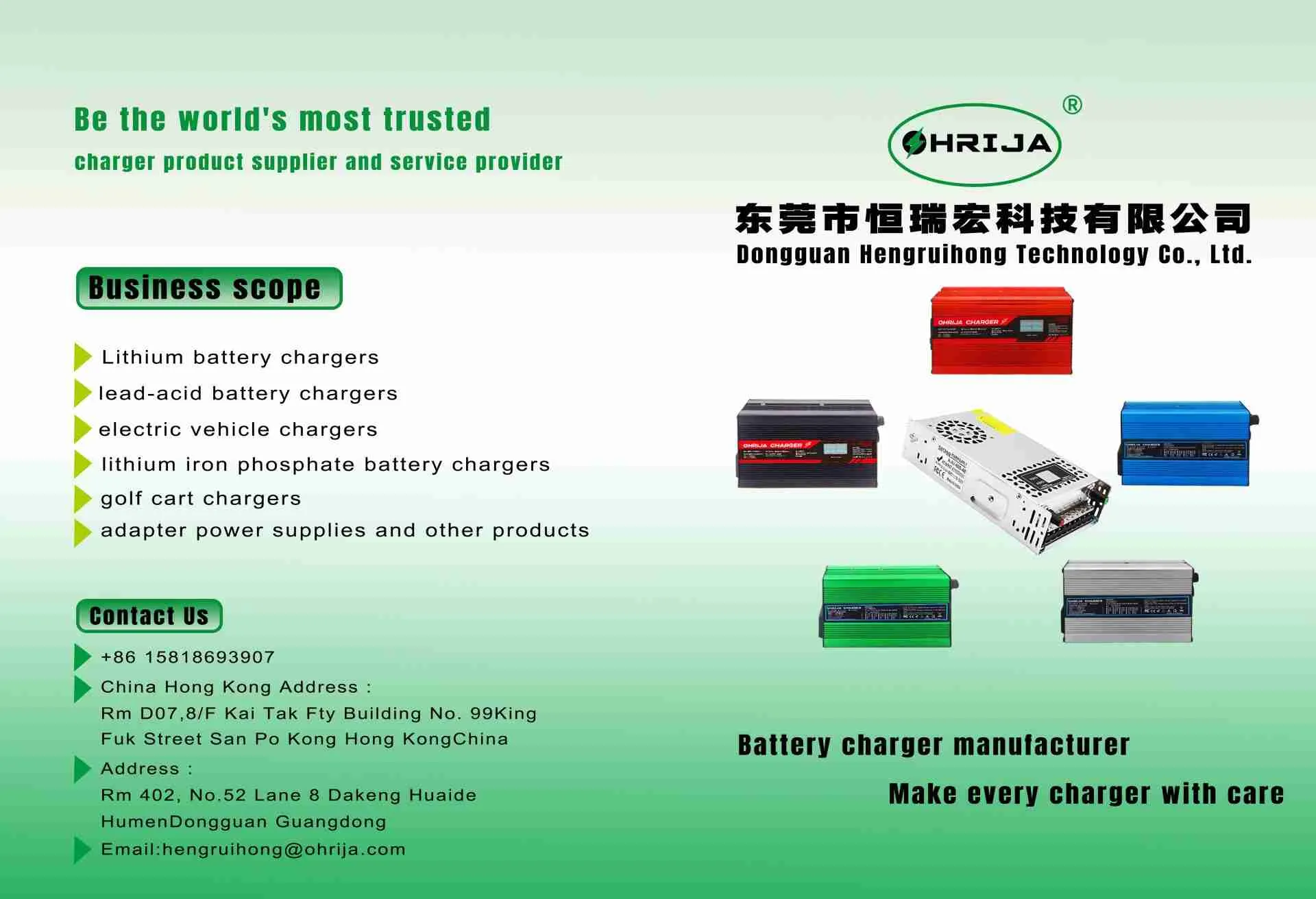
Dongguan Hengruihong Technology Co., Ltd. has engineered an entire ecosystem of charging hardware to eliminate the guesswork involved when facility managers or consumers need to charge a 24V LiFePO4 battery. Our core product lineup reflects our deep integration into global power supply chains. Whether you require a robust LI ION BATTERY CHARGER for robotics or a high-amperage GOLF CAR BATTERY CHARGER for fleet management, our devices feature integrated microprocessors programmed with exact CC/CV algorithms.
We build our chargers with heavy-duty aluminum extrusion casing for optimal thermal dissipation, avoiding internal cooling fans where possible to achieve high IP waterproof ratings. This ensures that whether you need to charge a 24V LiFePO4 battery in a dusty warehouse or a humid marine environment, the OHRIJA hardware operates with uncompromising reliability and precision.
6. Summary Table: 24V LiFePO4 Charging Parameters
To assist your engineering and maintenance teams, we have consolidated the mandatory electrical parameters required to safely charge a 24V LiFePO4 battery into a quick-reference matrix.
| Charging Parameter | Recommended Value / Setting | Engineering Rationale |
|---|---|---|
| System Configuration | 8S (8 Cells in Series) | Nominal voltage of 25.6V. |
| Bulk / Absorption Voltage | 28.8V to 29.2V | Ensures 100% SOC and triggers BMS cell balancing. |
| Float Voltage (If Required) | 27.2V | Prevents overcharging while supporting active DC loads. |
| Equalization Phase | DISABLED / 0 Minutes | High voltage spikes will severely damage lithium cells. |
| Low-Temperature Cutoff | 0 degrees Celsius (32 degrees F) | Prevents permanent lithium plating on the anode. |
| Recommended Hardware | Dedicated LIFEPO4 BATTERY CHARGER | Delivers exact CC/CV algorithm with 0V wake-up functionality. |
7. Frequently Asked Questions (FAQs)
Can I use a standard trickle charger to charge a 24V LiFePO4 battery?
No. We strongly advise against using trickle chargers or traditional LEAD ACID BATTERY CHARGER units. Trickle chargers lack the sophisticated microprocessors required to terminate the charge curve properly, and they will continuously push current into the lithium pack, eventually triggering the BMS over-voltage protection or causing thermal runaway if the BMS fails.
How long does it take to charge a 24V LiFePO4 battery?
The charge time depends entirely on the capacity of your battery (measured in Amp-hours) and the output of your LIFEPO4 BATTERY CHARGER. To calculate the approximate time, divide the battery capacity by the charger output. For example, if you use a 20A charger to charge a 24V LiFePO4 battery with a 100Ah capacity, it will take approximately 5 hours from a fully depleted state.
What should I do if my charger will not recognize the battery?
If the battery voltage drops below the minimum threshold (usually around 20V for a 24V system), the BMS will sever the connection to protect the cells, causing the battery to output zero volts. Most standard chargers cannot detect a 0V battery. You must use a charger equipped with a 0V wake-up feature, a standard implementation in all professional OHRIJA power supplies.
Is it necessary to charge a 24V LiFePO4 battery to 100% every cycle?
Unlike lead-acid batteries, lithium iron phosphate batteries do not suffer from memory effect and do not need to be fully charged after every use. In fact, keeping the battery between 20% and 80% can theoretically extend its lifespan. However, from our experience, we recommend charging to 100% (29.2V) at least once a month to allow the BMS to balance the internal cell voltages.
8. Industry References
To further expand your knowledge regarding electrochemical storage, charging algorithms, and industrial safety standards, we recommend reviewing the following authoritative engineering resources: