

In the electronics and power management industry, terminology is frequently misused, leading to dangerous electrical applications and premature battery failure. At OHRIJA, a brand belonging to Dongguan Hengruihong Technology Co., Ltd., we have dedicated our engineering resources to solving complex power conversion challenges. Established in 2020 and headquartered in Dongguan, Guangdong Province, China, our company is a high-tech enterprise integrating R&D, production, and sales. One of the most persistent and critical inquiries we receive from our global B2B clients and end-users alike is: Is a switching power supply a charger?

From our experience in designing and manufacturing millions of power adapters, we know that confusing these two distinct devices can lead to catastrophic consequences, including thermal runaway, battery swelling, and electrical fires. To provide a definitive answer to the question Is a switching power supply a charger, we must categorically state: No, a standard switching power supply is not a charger. While they share similar internal topologies and components, their operational logic, output characteristics, and safety management protocols are entirely different. In this comprehensive technical guide, we will dissect the engineering differences, explain the specific charging algorithms required for various battery chemistries, and help you select the exact OHRIJA equipment for your power requirements.
Table of Contents
- 1. Decoding the Question: Is a switching power supply a charger?
- 2. What Exactly is a Switching Power Supply?
- 3. The Complex Mechanics of a True Battery Charger
- 4. Core Differences: Why You Cannot Interchange Them
- 5. The Importance of Battery Chemistry
- 6. OHRIJA’s Integrated Power Solutions
- 7. Summary Table: Technical Comparison
- 8. Frequently Asked Questions (FAQs)
- 9. References
1. Decoding the Question: Is a switching power supply a charger?
To thoroughly understand why the answer to Is a switching power supply a charger is negative, we must look at the primary function of each device. A standard power supply is designed to provide a continuous, unwavering voltage to a load, regardless of the current being drawn (up to its maximum rated limit). It assumes the connected device will manage its own power consumption. A battery, however, is not a static load. Its internal resistance and voltage change dynamically as it absorbs energy. Therefore, if you ask an electrical engineer, Is a switching power supply a charger, they will explain that feeding a constant, unregulated voltage directly into a depleted battery will result in a massive, uncontrolled inrush of current, severely damaging the battery cells.
We recommend viewing a charger as an intelligent sub-category of power supplies. Every modern battery charger contains a switching power supply at its core to convert AC mains to DC, but it adds a crucial layer of intelligent microprocessor control. This control circuit monitors the battery’s state of charge, temperature, and voltage, adjusting the output dynamically. This fundamental distinction is why understanding Is a switching power supply a charger is vital for equipment safety and longevity.
2. What Exactly is a Switching Power Supply?
A switching power supply (often abbreviated as SMPS) is an electronic power supply that incorporates a switching regulator to convert electrical power efficiently. Unlike linear power supplies that dissipate excess power as heat, an SMPS rapidly switches a transistor on and off, minimizing wasted energy. This technology allows for compact, lightweight, and highly efficient power conversion.
At OHRIJA, our standard switching power supply units and DC POWER SUPPLY models are engineered to provide a rock-solid, constant voltage output. For example, if you purchase a 12V 10A switching power supply, it will output exactly 12 volts whether the connected device is drawing 1 amp or 9 amps. These units are perfectly suited for powering LED light strips, industrial automation equipment, CCTV cameras, and internal computer components. However, this exact mechanism is why Is a switching power supply a charger remains a critical question. If you connect a depleted 12V battery (which might rest at 10.5V) to a strict 12V constant power supply, the supply will simply dump as much current as possible into the battery to equalize the voltage, lacking the sophisticated multi-stage charging curves required for safe energy transfer.
3. The Complex Mechanics of a True Battery Charger
If you are still wondering Is a switching power supply a charger, you must examine the Constant Current / Constant Voltage (CC/CV) algorithm utilized by genuine charging equipment. A true charger operates in distinct phases to protect the battery chemistry. From our experience, bypassing these phases is the leading cause of premature battery degradation.
Phase 1: Constant Current (Bulk Charge)
When a battery is deeply discharged, a dedicated charger will act as a constant current source. It limits the maximum amperage flowing into the battery to a safe level, allowing the voltage to slowly rise. A standard switching power supply cannot do this; it will try to maintain constant voltage, potentially burning out its own components or overheating the battery.
Phase 2: Constant Voltage (Absorption Charge)
Once the battery reaches a specific upper voltage threshold, the charger switches into constant voltage mode. The voltage is held steady, and the current naturally tapers off as the battery reaches full saturation.
Phase 3: Termination or Float Charge
This is the most critical safety feature that answers the question Is a switching power supply a charger. A true charger detects when the current drops to a near-zero threshold and either completely shuts off the output (crucial for lithium batteries) or drops to a lower maintenance float voltage (crucial for lead-acid batteries). A standard power supply lacks this detection circuitry and will continuously force current into a full battery, causing catastrophic overcharging.
4. Core Differences: Why You Cannot Interchange Them
To further clarify Is a switching power supply a charger, let us break down the core engineering differences that our OHRIJA R&D team meticulously designs into each separate product line.
Feedback and Monitoring: A charger actively communicates with or monitors the battery. It reads the back-EMF (Electromotive Force) and adjusts its output accordingly. A standard switching power supply only monitors its own output terminals to ensure the voltage remains flat. Therefore, to the question Is a switching power supply a charger, the lack of bidirectional monitoring is a definitive disqualifier.
Output Cut-off Mechanisms: Our chargers are designed with automatic shut-off protocols. When the battery is full, the charger stops delivering power. A switching power supply is “dumb” in this regard; it remains perpetually on. If you leave a battery connected to a standard power supply, the continuous trickle of unregulated power will eventually boil the electrolyte in lead-acid batteries or cause lithium plating in modern cells.
Visual Indication: True chargers feature LED indicators (Red for charging, Green for full) driven by internal current sensors. A standard power supply typically only has a single power indicator showing that the unit is receiving AC mains power.
5. The Importance of Battery Chemistry
When clients ask Is a switching power supply a charger, they often overlook that even among actual chargers, the internal logic varies wildly based on battery chemistry. You cannot use a one-size-fits-all approach. At OHRIJA, we manufacture highly specialized equipment for diverse applications.
We recommend our LI ION BATTERY CHARGER for standard 3.7V nominal lithium-ion cells, which require a strict 4.2V cut-off per cell. For the exceptionally robust and safer lithium iron phosphate chemistry, we engineer the precise LIFEPO4 BATTERY CHARGER, which terminates at exactly 3.65V per cell without a float stage. Attempting to charge these advanced chemistries with a basic switching power supply is a guaranteed path to destruction.
For legacy systems, our LEAD ACID BATTERY CHARGER incorporates a vital float stage to combat self-discharge, a feature entirely absent in standard power supplies. Furthermore, for high-capacity traction applications, our GOLF CAR BATTERY CHARGER is built to deliver sustained high amperage while managing the complex equalization charges required to prevent sulfation in deep-cycle banks.
6. OHRIJA’s Integrated Power Solutions
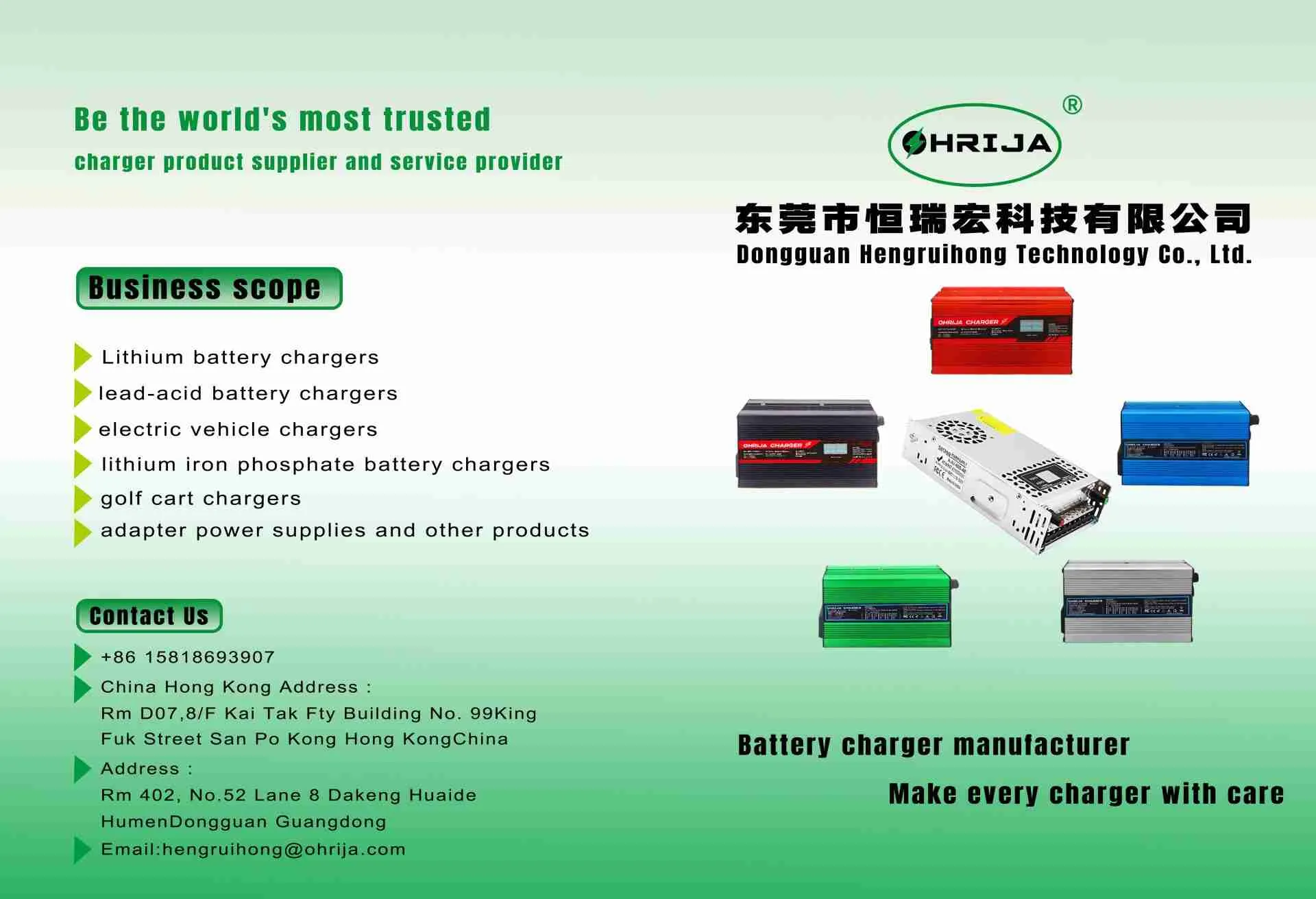
Dongguan Hengruihong Technology Co., Ltd. is proud to offer a complete portfolio of power solutions. We do not just answer theoretical questions like Is a switching power supply a charger; we build the exact hardware you need. Beyond our dedicated battery chargers, we offer specialized equipment for diverse operational environments.
If you require precise laboratory or testing capabilities, our ADJUSTABLE POWER SUPPLY allows technicians to manually dial in specific voltage and current limits. While technically an advanced power supply, it can be used to manually charge a battery if strictly supervised by a professional. For outdoor and marine applications, our WATERPROOF CHARGER features IP-rated sealing to protect the sensitive internal switching circuits from moisture and dust ingress.
We also manufacture robust POWER INVERTERS to convert stored DC battery power back into usable AC mains power for off-grid applications. Additionally, our innovative CONNECTOR REMOVAL CHARGER systems provide unparalleled convenience for maintenance technicians operating in tight industrial spaces.
7. Summary Table: Technical Comparison
To permanently resolve the confusion surrounding Is a switching power supply a charger, we have compiled this expert engineering summary table detailing the critical differences.
| Technical Feature | OHRIJA Switching Power Supply | OHRIJA Battery Charger |
|---|---|---|
| Primary Function | Provides constant, regulated voltage to static loads. | Safely replenishes chemical energy in batteries via algorithms. |
| Output Control | Fixed Constant Voltage (CV). | Dynamic Constant Current (CC) / Constant Voltage (CV). |
| Charge Termination | None. Operates continuously. | Automatic shut-off or switch to float stage when full. |
| Current Limiting | Only for overload/short-circuit protection (often shuts down). | Actively manages current to prevent battery overheating. |
| Status Indication | Simple Power ON indicator. | Multi-state LED (Charging, Full, Fault). |
| Reverse Polarity Protection | Rarely included; will usually blow an internal fuse. | Standard feature; prevents sparks and damage if connected backward. |
8. Frequently Asked Questions (FAQs)
9. References
1. Institute of Electrical and Electronics Engineers (IEEE) Standards for Switch-Mode Power Conversion and Battery Management Systems.
3. Battery University Guidelines on Constant-Current Constant-Voltage (CC/CV) Charging Topologies for Lithium and Lead-Acid Chemistries.