

This professional guide reviews the 7 best battery charger for e scooter options available in 2026, focusing on advanced features like smart charging protocols, customizable connectors, and high-efficiency designs. We will highlight specific models suitable for popular voltage ranges (e.g., 60V, 48V, and 36V) and explain the technical specifications you need to consider before making a purchase.
Table of Contents
- Critical Selection Criteria: Choosing the Best E-Scooter Charger
- Top 7 Best Battery Charger for E Scooter Models (2026)
- Charger 1: OHRIJA 67.2V 4A OLED (Master Performance)
- Charger 2: OHRIJA 29.4V 10A OLED (Ultra-Fast Compact)
- Charger 3: The 48V Smart Li-ion Charger (Safety Focused)
- Charger 4: High-Current 54.6V 5A Charger (Speed Solution)
- Charger 5: Universal 42V 2A Model (Entry-Level Dependability)
- Charger 6: The Multi-Voltage 36V/48V Selectable Charger (Versatility)
- Charger 7: IP67 Waterproof 60V Charger (Outdoor Durability)
- Essential Guide to Voltage and Ampere Matching
- Maximizing Battery Longevity with Smart Charging
- E-Scooter Charger Comparison Summary Table
- Frequently Asked Questions (FAQs)
- References and Further Reading
Critical Selection Criteria: Choosing the **Best E-Scooter Charger**
A charger is not a generic accessory; it is a vital part of your e-scooter’s electrical ecosystem. Choosing the right one—the **best battery charger for e scooter**—means prioritizing three technical specifications: voltage, amperage, and safety protocols.
Voltage (V): The Non-Negotiable Match
The charger’s output voltage **must** perfectly match the maximum charging voltage of your scooter’s battery pack. For instance, a 60V Li-ion battery is typically composed of 16 cells in series (16S), requiring a charger with a maximum output of **67.2V**. Similarly, a 48V (13S) battery requires 54.6V, and a 36V (10S) battery requires 42V. **Never** use a charger with a higher or lower voltage than specified by the battery manufacturer, as this can lead to permanent damage or dangerous overheating.
Amperage (A): Speed and Safety Balance
The output current (amperage, A) determines the charging speed. A higher amperage means faster charging, but charging too fast can generate excessive heat and stress the battery cells, shortening their overall lifespan. Most manufacturers recommend a charging current that is 0.5C to 1C (where C is the battery capacity in Ah). For instance, a 20Ah battery is safely charged at 2A to 4A. Look for a **best battery charger for e scooter** that offers a balanced amperage for both speed and battery health.
Safety and Smart Features (CC/CV Protocol)
The **best battery charger for e scooter** models utilize the **Constant Current, Constant Voltage (CC/CV)** charging protocol, which is essential for Li-ion batteries. CC/CV charging involves two stages:
- **Constant Current (CC):** The charger delivers a fixed, high current until the battery reaches about 80% capacity.
- **Constant Voltage (CV):** The charger switches to a fixed voltage (the maximum), gradually reducing the current until the battery is fully topped off, preventing overcharging.
Additionally, look for over-voltage protection (OVP), over-current protection (OCP), and short-circuit protection (SCP)—standard features in professional-grade chargers like those from **OHRIJA mobility scooter battery charger**.
Top 7 **Best Battery Charger for E Scooter** Models (2026)
This curated list highlights chargers that excel in performance, safety, and compatibility across the most common e-scooter battery configurations.
Charger 1: OHRIJA 67.2V 4A OLED Charger (Master Performance)
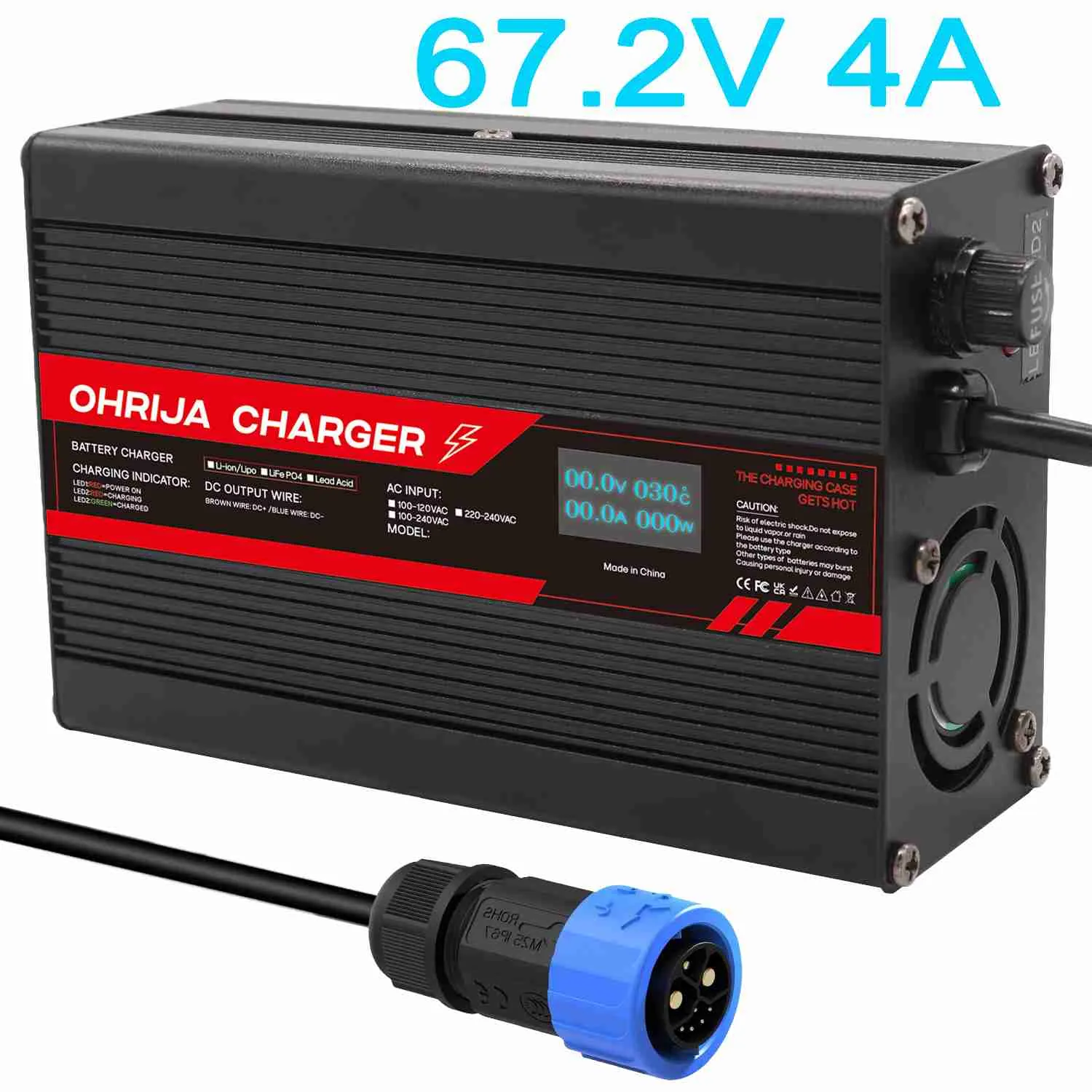
Designed for high-performance and long-range scooters, this charger provides precise control and excellent feedback.
- Applicable Battery: 16S 59.2V/60V Lithium-ion battery packs.
- **Output Specification:** Maximum 67.2V ±0.2v at 4Amp ±0.2a.
- **Key Feature:** Features an **OLED display** that provides real-time monitoring of charging status, voltage, and current—critical for maintaining battery health and ensuring peak performance.
- **Construction:** Durable aluminum alloy shell for superior heat dissipation.
- **Compatibility:** Wide range of output connectors, including **XT60**, **XT90**, DC5.5*2.5, GX16, and XLR, covering virtually all professional-grade scooter models.
- **Working Power:** Maximum 295W, offering a strong balance between fast charging and thermal safety.
Charger 2: OHRIJA 29.4V 10A OLED Charger (Ultra-Fast Compact)
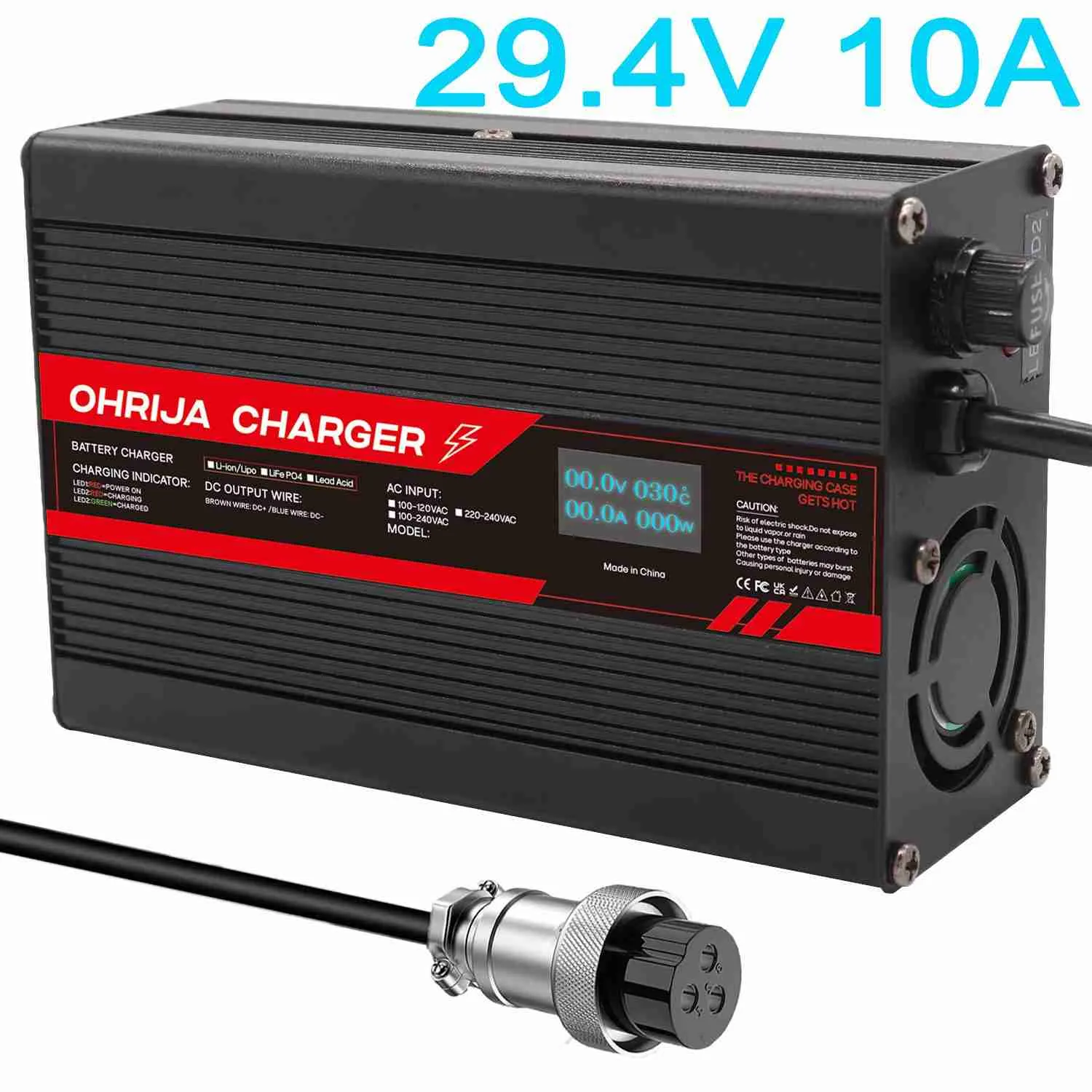
This model is ideal for lighter, older, or compact scooters utilizing 7S battery packs, prioritizing speed where capacity is lower.
- Applicable Battery: 7S 25.9V Lithium-ion battery packs.
- **Output Specification:** Maximum 29.4V ±0.2v at a high 10Amp ±0.2a.
- **Key Feature:** The high 10A current significantly reduces charging time for compatible batteries, perfect for riders who need quick turnaround times between short trips. The **OLED display** retains its real-time monitoring capability.
- **Construction:** Same robust aluminum alloy shell (135*90*50MM, 0.9kg) for reliability and longevity.
- **Compatibility:** Offers essential connectors like **XT60**, **XT90**, DC5.5*2.5, and XLR.
- **Working Power:** Maximum 290W. The high amperage makes this one of the **best battery charger for e scooter** models focusing on charging speed for lower-voltage systems.
Charger 3: The 48V Smart Li-ion Charger (Safety Focused)
Designed for the ubiquitous 48V scooter market, this model emphasizes intelligent, preventative safety features.
- Applicable Battery: 13S 48V Lithium-ion (output 54.6V).
- **Key Feature:** Integrated temperature monitoring sensors that communicate with the battery’s BMS (Battery Management System). If the battery temperature exceeds a preset safety limit during charging, the unit automatically reduces the current or shuts off entirely, preventing thermal runaway.
- **Charging Speed:** Typically 3A, providing a safe, overnight charge for medium-capacity (10Ah-15Ah) batteries.
Charger 4: High-Current 54.6V 5A Charger (Speed Solution)
This charger targets riders of high-capacity 48V scooters (20Ah+) who require faster charging than standard models.
- Applicable Battery: 13S 48V Lithium-ion (output 54.6V).
- **Key Feature:** High 5A output current dramatically cuts down charging time for larger battery packs (e.g., charging a 20Ah battery in 4-5 hours). Important for high-use delivery riders or commuters.
- **Recommendation:** Due to the higher current, ensure your scooter’s battery and charging port are rated to handle 5A safely. This is a contender for the **best battery charger for e scooter** if time is your priority.
Charger 5: Universal 42V 2A Model (Entry-Level Dependability)
The standard, reliable choice for the vast majority of consumer-grade 36V scooters (e.g., many popular shared and budget models).
- Applicable Battery: 10S 36V Lithium-ion (output 42V).
- **Key Feature:** Simple, reliable 2A charging provides a slow, gentle charge that maximizes the long-term lifespan of 36V batteries. Often comes with a standard DC5.5*2.1mm connector.
- **Benefit:** Excellent for overnight charging, minimizing battery stress and thermal buildup.
Charger 6: The Multi-Voltage 36V/48V Selectable Charger (Versatility)
An ideal solution for households or businesses operating multiple scooter types.
- Applicable Battery: User-selectable toggle for 10S (36V/42V) or 13S (48V/54.6V) operation.
- **Key Feature:** A physical switch or digital interface allows the user to safely select the required output voltage, eliminating the risk of accidental voltage mismatch when switching between different scooters.
- **Safety Note:** Requires careful attention during selection; incorrect voltage selection will still damage the battery.
Charger 7: IP67 Waterproof 60V Charger (Outdoor Durability)
Built for resilience, this charger is essential for riders who frequently charge outdoors or in demanding conditions.
- Applicable Battery: 16S 60V Lithium-ion (output 67.2V).
- **Key Feature:** IP67 rating ensures the charger is completely protected against dust ingress and immersion in water up to 1 meter. The rugged, sealed casing makes it exceptionally durable against weather and road abuse.
- **Target Market:** High-end performance scooter riders or fleet operators whose equipment is exposed to the elements.
Essential Guide to Voltage and Ampere Matching
A mismatch between the charger and the battery is the leading cause of charger-related failure. Use this table to quickly confirm the correct pairing for Li-ion batteries.
| Nominal Battery Voltage | Required Charger Voltage (Max Output) | Cell Configuration (Series) | Typical Charger Amperage Range |
|---|---|---|---|
| **24V** | 29.4V | 7S | 2A – 5A |
| **36V** | 42V | 10S | 2A – 4A |
| **48V** | 54.6V | 13S | 3A – 5A |
| **52V** | 58.8V | 14S | 3A – 6A |
| **60V** | 67.2V | 16S | 4A – 8A |
As illustrated by the **OHRIJA mobility scooter battery charger 67.2V 4A** model, the charger voltage (67.2V) is always higher than the nominal battery voltage (60V) to ensure a complete and balanced charge.
Maximizing Battery Longevity with Smart Charging
The **best battery charger for e scooter** units do more than just add power; they protect your battery’s long-term health. Following these practices is essential for extending the life of your expensive lithium-ion pack, which can cost up to half the price of the scooter itself.
The 80/20 Rule and Storage
Lithium-ion batteries suffer stress when constantly charged to 100% or drained below 20%. For daily commuting, aim to keep the battery level between **20% and 80%**. Full charges should be reserved only for days when you anticipate needing the maximum range. If storing the scooter for an extended period, charge the battery to around 50-60%—this is the most stable state for Li-ion cells.
The Thermal Management Imperative
Heat is the number one enemy of Li-ion battery longevity. The **best battery charger for e scooter** models, especially high-amp units, feature robust cooling systems (e.g., aluminum alloy shells and internal fans, as seen on the **OHRIJA** models). Always charge your scooter:
- In a cool, dry, well-ventilated area.
- Away from direct sunlight or extreme heat sources.
- Allow the battery to cool down for 15-30 minutes after a heavy ride before plugging it in.
Smart chargers with **OLED displays** (like the **OHRIJA e scooter charger 29.4V 10A**) help monitor heat by showing real-time current draw, allowing the user to detect abnormal charging patterns early.
E-Scooter Charger Comparison Summary Table
Key specifications of the two featured high-performance chargers compared.
| Model | Applicable Battery (Nominal) | Max Output Voltage | Max Output Current | Key Feature |
|---|---|---|---|---|
| **OHRIJA 67.2V 4A OLED** | 60V (16S) Li-ion | 67.2V | 4A | High-voltage compatibility with real-time OLED monitoring. |
| **OHRIJA 29.4V 10A OLED** | 24V (7S) Li-ion | 29.4V | 10A | Ultra-fast charging for low-voltage systems; compact design. |
| **Typical 48V Smart Charger** | 48V (13S) Li-ion | 54.6V | 3A | Integrated temperature monitoring and safety protocols. |
| **High-Current 54.6V 5A** | 48V (13S) Li-ion | 54.6V | 5A | Faster charging solution for high-capacity 48V batteries. |
Frequently Asked Questions (FAQs)
A: Yes, but with caution. A charger with a higher amperage (e.g., 5A instead of 2A) will charge faster. However, excessive current creates heat, which degrades the battery over time. Only use a higher-amp charger if your battery manufacturer explicitly states it is safe for the battery’s specific C-rate. Models like the **OHRIJA e scooter charger 29.4V 10A** are designed for high current, but always verify compatibility with your scooter’s battery management system (BMS).
A: No. Generic chargers often lack crucial safety features (OVP, SCP) and may not adhere to the precise CC/CV charging profile required by Li-ion batteries. Always purchase a charger from a reputable source, like **OHRIJA** or a similar specialized manufacturer, ensuring the output voltage and connector type are an exact match for your scooter.
A: The output connector (e.g., XT60, XLR, DC5.5*2.5) must match the physical charging port on your e-scooter battery. A mismatch not only prevents charging but can lead to poor contact, overheating, and fire risk. Companies like OHRIJA offer various connector options (XT60 | XT90 | Anderson 50A | GX16 1+3-) to ensure a safe and secure connection.
A: No. Charger output wattage (W) is determined by Voltage x Amperage (P=V\*I), and it must match the battery’s charging requirements, which are independent of the motor’s power (e.g., 350W or 1000W). Focusing solely on matching the voltage and safely managing the current is the correct approach.
References and Further Reading
- Battery University. (2025). *BU-409: Charging Lithium-ion*. (Technical reference on CC/CV protocol and battery longevity).
- National Fire Protection Association (NFPA). (2025). *Safety Standards for Lithium-Ion Battery Charging and Storage*. (Safety guidelines).
 English
  Français
  Deutsch
  Italiano
  Nederlands
  Español
  Português do Brasil
  Türkçe
  Русский