

Your golf cart is only as reliable as the battery that powers it. For owners of Club Car vehicles, maintaining battery health is not just about extending range; it is about protecting a significant investment. As we move through 2026, technology has evolved from the heavy, humming transformers of the past to smart, high-frequency chargers that can diagnose, repair, and maintain your batteries with precision. Finding the battery charger for a club car golf cart that fits your specific model—whether it’s a Precedent, DS, or Onward—is critical for performance.

Many golf cart owners underestimate the impact of a quality charger. A subpar unit can lead to sulfation, reduced capacity, and early battery death. Conversely, a high-quality smart charger can double your battery lifespan. In this comprehensive guide, we have curated the top 7 chargers on the market today. We will explore heavy-duty options, onboard maintainers, and versatile smart chargers, featuring industry leaders like OHRIJA alongside other top contenders.
- 1. OHRIJA 48V 15A Golf Cart Charger (HRH900N)
- 2. OHRIJA 48V 5A Golf Cart Charger (HRH300)
- 3. Lester Electrical Summit II Series
- 4. MODZ Max 48V Battery Charger
- 5. Pro Charging Systems Eagle Performance Series
- 6. NOCO Genius GENPRO10x4 Onboard Charger
- 7. Schumacher XC15 Battery Charger and Maintainer
- Buying Guide: How to Choose the Right Charger
- Understanding Club Car Plugs (OBC vs. Non-OBC)
- Summary Comparison Table
- Frequently Asked Questions
- References
1. OHRIJA 48V 15A Golf Cart Chargers (HRH900N)
The Powerhouse Choice for Rapid Charging
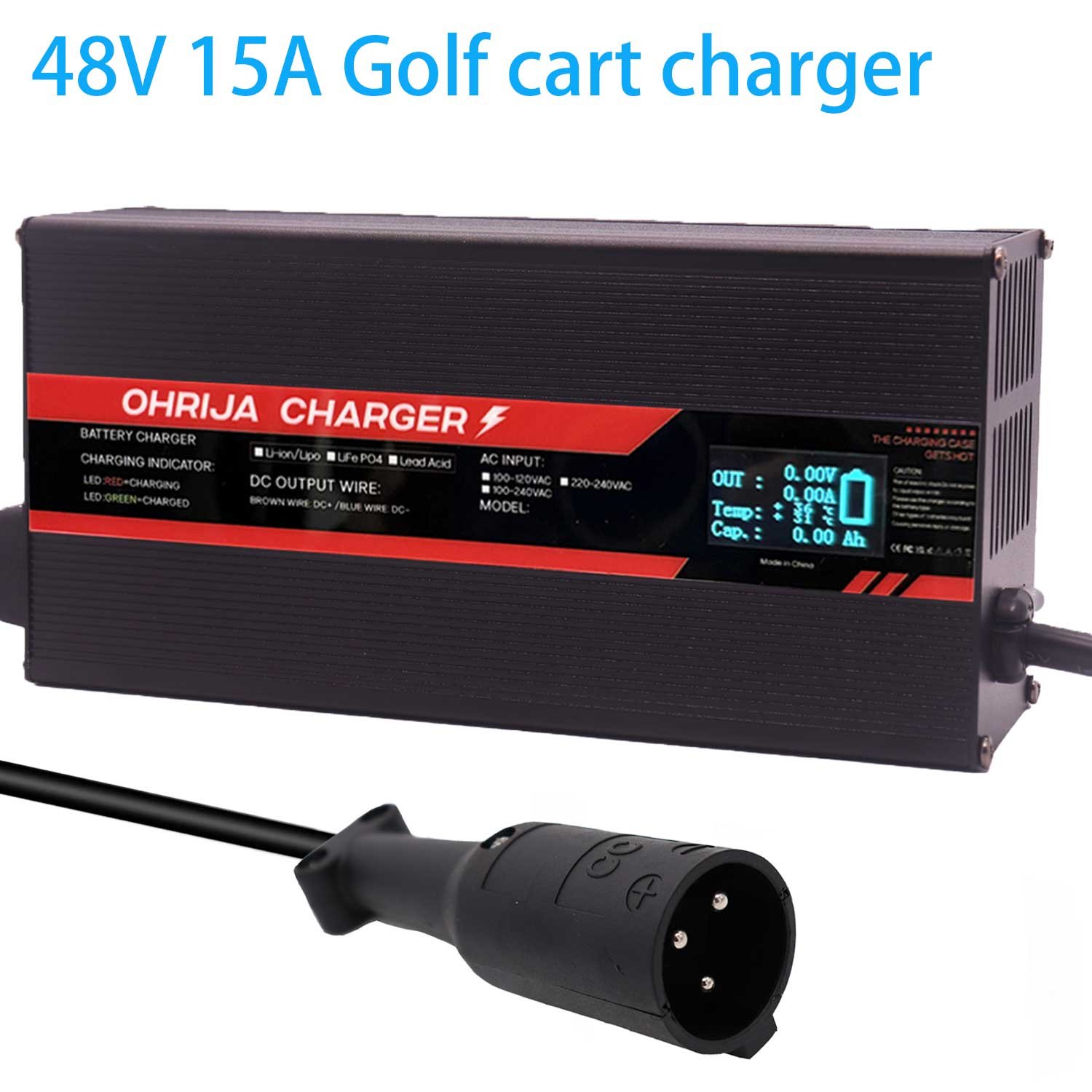
When you need speed and reliability, the OHRIJA 48V 15A Golf Cart Charger stands out as a top-tier contender. Designed specifically for the rigorous demands of daily use, this charger utilizes a robust aluminum alloy shell for superior heat dissipation. It is engineered to handle 48V lead-acid battery banks, delivering a consistent 15 Amps of current to get you back on the course quickly.
What makes this unit a perfect battery charger for a club car golf cart is its versatility in connectivity. It supports the specific round 3-pin plug required for many Club Car models (OBC compliant) as well as other common connectors. Its smart charging profile ensures the battery is topped off at a precise 58.8V, preventing overcharging.
- Model: HRH900N
- Output: 48V / 15A (Max 58.8V)
- Power: 900W Maximum Working Power
- Material: Durable Aluminum Alloy Shell
- Weight: 1.2kg (Lightweight and portable)
- Dimensions: 212 x 93.5 x 60 MM
- Club Car Compatibility: 101828901 Connector included
- Other Connectors: EZGO TXT/RXV, Yamaha G19/G29, Crowfoot
- Safety: Over-voltage protection, intelligent temperature control
This unit is ideal for golfers who play multiple rounds in a day or use their cart for heavy utility work around a property. The 15A output significantly reduces downtime compared to standard 5A or 10A chargers.
2. OHRIJA 48V 5A Golf Cart Charger (HRH300)
Best for Maintenance and Long-Term Storage

Cargador de 48 voltios para carrito de golf
Not every user needs rapid charging. For winter storage, light usage, or maintaining a fleet, the OHRIJA 48V 5A Charger is the economical and efficient choice. While it charges slower than its 15A big brother, the lower amperage is actually gentler on older battery packs, helping to reduce internal heat generation during the charge cycle.
This compact unit fits easily in a storage compartment. It features the same high-quality aluminum construction as the larger model but in a smaller form factor. It is an excellent secondary battery charger for a club car golf cart to keep at a vacation home or in the garage for trickle charging.
- Model: HRH300
- Output: 48V / 5A (Max 58.8V)
- Power: 290W Maximum Working Power
- Dimensions: 135 x 90 x 50 MM (Compact design)
- Weight: 0.9kg
- Color Options: Black, Silver, Red, Blue, Green
- Plug Support: Full support for Club Car, EZGO, and Yamaha connectors
- Application: Ideal for 55.2V Lead Acid maintenance
With its variety of color options and solid build, the HRH300 proves that you don’t need to spend a fortune to get a high-quality maintainer for your Club Car.
3. Lester Electrical Summit II Series
Lester Electrical has been a household name in the golf cart industry for decades. The Summit II series represents their leap into the modern era. This is a smart charger that features Bluetooth connectivity, allowing you to monitor the charge status from your smartphone.
It is designed to be a universal battery charger for a club car golf cart, capable of switching between on-board and off-board configurations. The Summit II is known for its “progressive” charging algorithm which adapts to the age and health of your batteries. While it comes at a premium price point, its rugged, waterproof (IP66 rated) casing makes it virtually indestructible.
4. MODZ Max 48V Battery Charger
The MODZ Max has gained massive popularity for being one of the lightest chargers on the market. Weighing less than 7 pounds, it is a stark contrast to the 30-pound ferro-resonant chargers of the 1990s. It uses high-frequency switching technology to deliver 15 Amps of power efficiently.
This charger is particularly liked by Club Car owners because it is “plug and play.” It doesn’t require complicated setup; you simply plug it in, and the internal cooling fan keeps it running at optimal temperatures. It typically comes with a heavy-duty 16-foot cable, giving you plenty of reach in the garage.
5. Pro Charging Systems Eagle Performance Series
If you are looking for American-made quality, the Eagle Performance Series by Pro Charging Systems is a strong contender. These chargers utilize “DeltaVolt” technology, which they claim provides a more complete charge than standard algorithms, potentially extending the range of your cart.
The Eagle series is unique because each bank is strictly controlled. For a 48V system, it manages the voltage curve meticulously to ensure that the water in your lead-acid batteries does not boil off excessively. It is a heavy-duty unit often used in commercial fleets.
6. NOCO Genius GENPRO10x4 Onboard Charger
While often associated with automotive applications, NOCO has made a significant splash in the deep-cycle world. The GENPRO10x4 is an onboard charger, meaning it is mounted permanently to the golf cart. This is incredibly convenient as you only need to run an extension cord to the cart to charge it.
This is a 4-bank charger, meaning it charges four 12-volt batteries independently (creating a 48V system). This is technically superior to charging the whole pack in series because it balances the batteries perfectly. If one battery is weaker than the others, the NOCO will adjust to ensure the others aren’t overcharged. It is a highly sophisticated battery charger for a club car golf cart setup.
7. Schumacher XC15 Battery Charger and Maintainer
For the budget-conscious owner who has a generic setup, the Schumacher XC15 is a versatile option. While not dedicated solely to golf carts, it has specific deep-cycle settings that work well for 48V systems if configured correctly (often requiring multiple units for series charging or a specific 48V model variant).
It features fully automatic microprocessor control, which adjusts the amperage rate to charge and maintain. It includes a desulfation mode, which can help revive older batteries that have been sitting for too long. Note that this is generally better suited for DIY enthusiasts who understand battery banking.
Buying Guide: How to Choose the Right Charger
Selecting the correct battery charger for a club car golf cart requires understanding three main variables: Voltage, Amperage, and Intelligence.
Voltage Matching
Most modern Club Cars are 48-volt systems. However, older DS models might be 36-volt. You absolutely must match the charger voltage to your cart. Plugging a 48V charger into a 36V cart can destroy the batteries and potentially cause a fire.
Amperage (Charging Speed)
Amperage dictates how fast the charge happens.
5-6 Amps: Best for overnight charging and maintenance (e.g., OHRIJA HRH300).
13-18 Amps: The standard for overnight charging, usually taking 8-10 hours.
20+ Amps: Rapid charging for commercial use. Note that charging too fast repeatedly can generate heat and degrade battery life.
Understanding Club Car Plugs (OBC vs. Non-OBC)
This is the most confusing part for Club Car owners. Club Car utilizes an “On-Board Computer” (OBC) on many models (especially Precedent and DS models from 1995-2014). The OBC tracks energy usage and tells the charger when to turn off.
Round 3-Pin Plug: Commonly found on carts with an OBC. If you buy a “smart” charger (which has its own computer) for an OBC cart, you often need to bypass the OBC wiring on the cart, or the charger won’t work. However, modern chargers like the OHRIJA models often come with instructions or specific modes to work with or bypass these systems.
Triangular Plug (ERIC System): Found on newer Club Cars (2014+). These carts do not have an OBC because the intelligence is inside the factory charger. If you replace an ERIC charger, you need a smart charger.
Summary Comparison Table
| Charger Model | Amperage | Best Feature | Price Tier |
|---|---|---|---|
| OHRIJA HRH900N | 15A | High Speed & Alloy Shell | $$ |
| OHRIJA HRH300 | 5A | Compact Maintainer | $ |
| Lester Summit II | 18A-25A | Bluetooth Smart App | $$$ |
| MODZ Max | 15A | Lightweight Plug-n-Play | $$ |
| Pro Charging Eagle | 15A | DeltaVolt Technology | $$$ |
| NOCO Genius | 10A per bank | Battery Balancing | $$$ |
| Schumacher XC | Variable | Desulfation Mode | $ |
Frequently Asked Questions
References
1. Club Car Owner’s Manuals (Precedent, Onward, DS Series).
2. “Golf Cart Battery Maintenance Guide,” Golf Cart Resource, 2025.
 English
  Français
  Deutsch
  Italiano
  Nederlands
  Español
  Português do Brasil
  Türkçe
  Русский