
No products in the cart.

Authored by the engineering team at OHRIJA. The OHRIJA brand belongs to Dongguan Hengruihong Technology Co., Ltd., which was established in 2020 and is headquartered in Dongguan, Guangdong Province, China. Our company is a high-tech enterprise integrating R&D, production, and sales. We specialize in providing industry-leading lithium battery chargers, lithium iron phosphate battery chargers, lead-acid battery chargers, golf cart chargers, power adapters, and switching power supplies to global markets.

Maintaining the operational readiness of your electric fleet requires a thorough understanding of advanced charging infrastructure. Whether you manage a large-scale commercial golf course fleet or maintain a personal neighborhood electric vehicle, encountering a charging fault is a common operational hurdle. Modern charging units are highly sophisticated devices equipped with microprocessors, thermal sensors, and voltage regulators designed to protect your expensive battery banks from catastrophic damage. When a fault is detected, the unit will enter a protective lockout mode, forcing you to properly reset golf cart charger components before charging can resume.
From our experience engineering advanced power supplies at OHRIJA, many users misdiagnose a locked-out charger as a permanent hardware failure, leading to unnecessary replacement costs. Power grid fluctuations, deeply discharged battery banks, and tripped On-Board Computers (OBCs) can all trigger this defensive state. Understanding the underlying electrical mechanics and executing the correct steps to reset golf cart charger systems will restore functionality safely and efficiently. In this authoritative technical guide, we will analyze the diagnostic prerequisites, outline the exact procedures to reset golf cart charger hardware, and explain how upgrading to our advanced 36V and 48V units can eliminate these headaches entirely.
Table of Contents
- 1. Understanding Why You Must Reset Golf Cart Charger Units
- 2. Expert Diagnostics: Before You Reset Golf Cart Charger Systems
- 3. Step-by-Step: The Professional Way to Reset Golf Cart Charger Hardware
- 4. Advanced Factors: On-Board Computers and Battery Management Systems
- 5. When to Upgrade: The OHRIJA 36V and 48V Solutions
- 6. Summary Table: Troubleshooting and Reset Protocols
- 7. Frequently Asked Questions (FAQs)
- 8. Industry References
1. Understanding Why You Must Reset Golf Cart Charger Units
To accurately address charging failures, one must first understand the protective logic engineered into modern power supplies. When an anomaly occurs in the electrical circuit, a smart charger immediately suspends current delivery. You will typically need to reset golf cart charger systems following an AC power surge, a severe lightning storm, or an unexpected drop in the facility’s voltage. These external grid fluctuations cause the charger’s internal logic board to freeze as a safety precaution, preventing unregulated voltage from reaching your sensitive batteries.
Furthermore, internal vehicle dynamics often necessitate a hard reset. If your lead-acid or lithium iron phosphate (LiFePO4) batteries drop below a critical voltage threshold—often referred to as a deep discharge—the charger may fail to detect the battery pack entirely. In this scenario, the charger assumes no vehicle is connected and remains in standby mode. We recommend attempting to reset golf cart charger hardware as the very first diagnostic step whenever your charging unit displays flashing red fault lights or fails to click on upon connection.
2. Expert Diagnostics: Before You Reset Golf Cart Charger Systems
Before executing the reset protocol, you must verify that the environment and the electrical connections are sound. A failure to reset golf cart charger systems successfully is often the result of an overlooked external variable.
- Verify the AC Receptacle: Utilize a digital multimeter to ensure the wall outlet is providing the correct 110V or 220V AC power. A tripped GFCI outlet or a blown facility circuit breaker will mimic a dead charger. You cannot reset golf cart charger units if they are not receiving primary power.
- Inspect the DC Cord and Receptacle: Examine the plug that connects to your golf cart. Look for melted plastic, bent pins, or heavy corrosion. High electrical resistance at this junction prevents the charger from reading the battery voltage, triggering a fault.
- Check Overall Pack Voltage: A 36V or 48V charger requires a minimum threshold voltage (typically around 25V for a 36V system, and 32V for a 48V system) to engage. If your batteries are completely dead, you may need to manually charge them individually with a 12V automotive charger just enough to wake up the system before you can successfully reset golf cart charger operations.
3. Step-by-Step: The Professional Way to Reset Golf Cart Charger Hardware
Executing a proper hard reset clears the volatile memory of the charger’s microprocessor and drains all residual energy from the internal capacitors. Follow these precise steps to reset golf cart charger hardware safely and effectively.
Step 1: Isolate the AC Power Source

Begin by unplugging the charger’s primary power cord from the AC wall outlet. Do not simply rely on a power strip switch; physically remove the plug to ensure absolute electrical isolation. This halts any incoming current from the grid.
Step 2: Disconnect the DC Output to the Cart
Next, unplug the heavy DC charging cable from the golf cart’s receptacle. The charger must be completely disconnected from both the power grid and the battery bank. Attempting to reset golf cart charger systems while still connected to the cart’s battery bank will fail, as the battery voltage will keep the charger’s logic board energized.
Step 3: Discharge the Internal Capacitors
This is the most critical and frequently rushed step. Inside the charger are large capacitors that store high-voltage electrical energy. Even when unplugged, these capacitors provide power to the logic board for several minutes. To successfully reset golf cart charger microprocessors, you must allow these capacitors to drain entirely. We recommend leaving the unit completely disconnected for a minimum of 15 to 30 minutes. Alternatively, if your charger has a manual reset button or circuit breaker on the front or rear panel, depress or toggle it during this waiting period.
Step 4: Re-establish the Connection Sequence
Once the waiting period has elapsed, the correct reconnection sequence is vital. First, plug the charger back into the AC wall outlet. Wait a few seconds for the charger to run its internal self-diagnostic check (you may see a sequence of flashing lights). Once the charger is in standby mode, firmly plug the DC cord into the golf cart receptacle. You should hear the internal relay click, followed by the transformer humming or the cooling fan activating, indicating that you have successfully managed to reset golf cart charger operations.
4. Advanced Factors: On-Board Computers and Battery Management Systems
If you have executed the steps to reset golf cart charger units and the system still fails to initiate, the issue may lie within the cart’s onboard electronics rather than the charger itself.
For legacy lead-acid fleets (such as older Club Car models), the charging cycle is often dictated by an On-Board Computer (OBC). If the OBC freezes, it will lock out the charger. You may need to bypass or reset the OBC by disconnecting the main negative battery terminal for 10 minutes to force a system reboot.
Conversely, modern lithium iron phosphate (LiFePO4) battery packs utilize a Battery Management System (BMS). From our experience at Dongguan Hengruihong Technology Co., Ltd., if a lithium battery is pushed to its absolute depletion limit, the BMS will enter a deep sleep mode to prevent cell death. In this state, the BMS cuts off the external terminals, meaning the charger reads zero volts and refuses to turn on. Specialized lithium chargers are required to output a “wake-up” pulse to reactivate the BMS. Therefore, when dealing with modern energy storage, utilizing a compatible, smart charger is absolutely critical.
5. When to Upgrade: The OHRIJA 36V and 48V Solutions
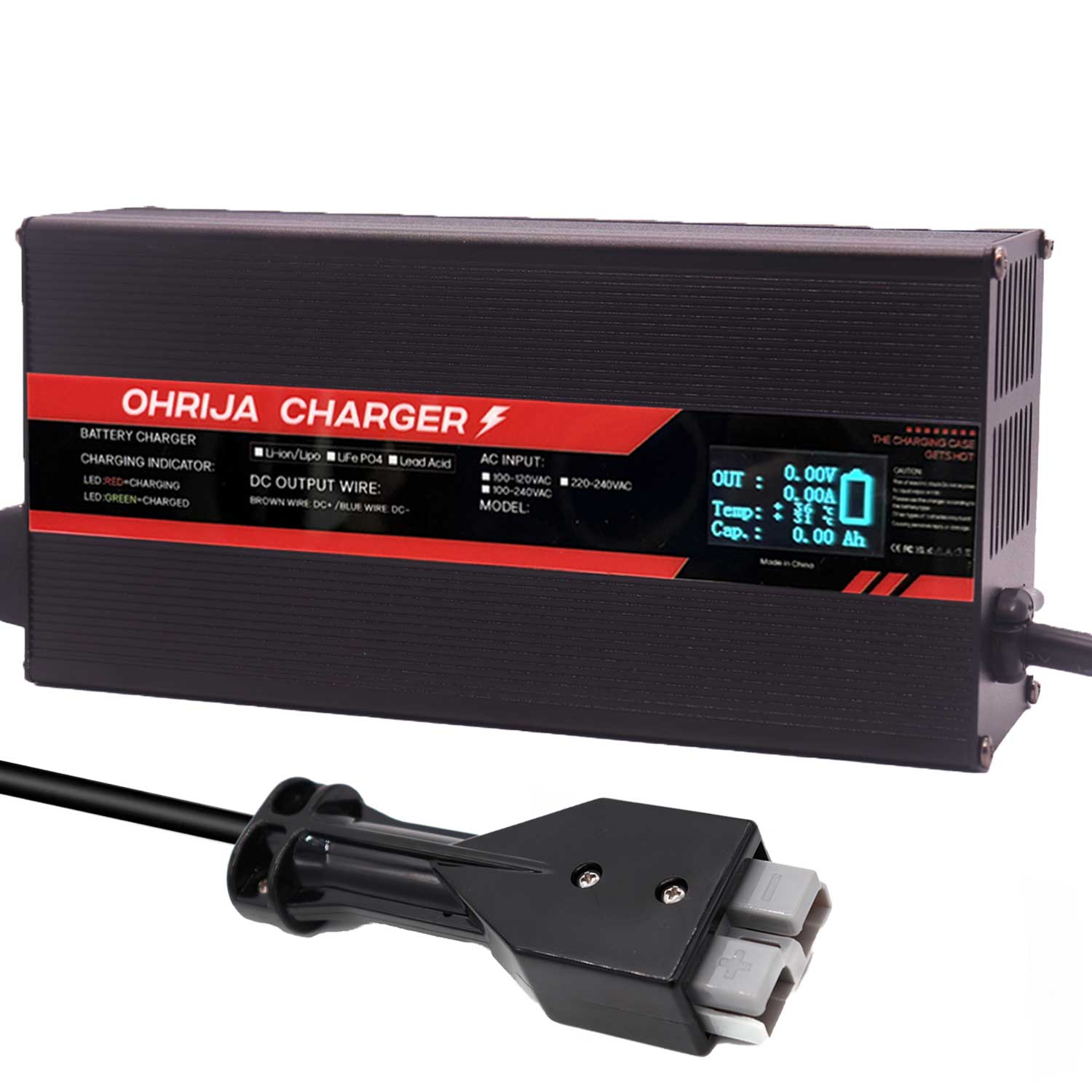
If you find that you must constantly reset golf cart charger units just to keep your fleet operational, your legacy equipment is likely suffering from degrading internal components or outdated charging algorithms. At this juncture, upgrading your hardware is the most cost-effective and reliable solution.
At OHRIJA, we engineer our products to eliminate the frustrations of charging failures. Our flagship 36V GOLF CHARGER and 48V GOLF CHARGER units represent the pinnacle of high-tech power delivery. Integrating advanced microprocessors, these units automatically compensate for AC grid fluctuations, drastically reducing the need for manual resets. Furthermore, our chargers are meticulously programmed with distinct charging curves for both traditional lead-acid and advanced lithium iron phosphate chemistries, ensuring optimal cell balancing, maximum thermal efficiency, and an extended battery lifespan. When you integrate an OHRIJA 36V GOLF CHARGER or 48V GOLF CHARGER into your maintenance routine, you invest in uncompromised reliability and superior engineering.
6. Summary Table: Troubleshooting and Reset Protocols
To assist maintenance personnel and fleet managers, we have consolidated the diagnostic parameters and steps to reset golf cart charger systems into a quick-reference matrix.
| Fault Symptom | Potential Cause | Recommended Action / Reset Protocol |
|---|---|---|
| Charger is completely unresponsive (No lights, no click) | No AC power, tripped wall breaker, or internal charger fuse blown. | Test wall outlet with a multimeter. Check charger’s external AC fuse. Perform full 30-minute hard reset. |
| Flashing red fault light immediately upon connection | Poor DC connection, battery voltage too low, or power surge lockout. | Clean DC receptacle pins. Verify minimum pack voltage. Execute the steps to reset golf cart charger memory. |
| Charger turns on but shuts off after 5 minutes | Thermal overload, failing batteries, or incorrect charging profile. | Ensure charger is in a well-ventilated area. Test battery pack under load. Consider upgrading to an OHRIJA 48V GOLF CHARGER. |
| Lithium battery will not accept charge | BMS (Battery Management System) is in deep sleep mode. | Use a charger with a lithium wake-up function or apply a brief parallel charge to wake the BMS, then reset golf cart charger. |
| Frequent, daily lockouts | Failing internal logic board or unstable local power grid. | Replace the aging unit. We recommend the OHRIJA 36V GOLF CHARGER for superior grid fluctuation tolerance. |
7. Frequently Asked Questions (FAQs)
Why do I have to wait 30 minutes to reset golf cart charger systems?
Industrial chargers contain massive capacitors designed to smooth out electrical current. Even after unplugging the unit from the wall, these capacitors hold a high-voltage charge that keeps the logic board’s memory active. Waiting 15 to 30 minutes allows this energy to bleed off entirely, ensuring a true hard reset of the microprocessor.
Will an OHRIJA charger work with my specific brand of golf cart?
Yes. From our experience supplying global markets, flexibility is key. Both the OHRIJA 36V GOLF CHARGER and the 48V GOLF CHARGER can be configured with various output connectors (such as the Club Car 3-pin, EZ-GO Powerwise, or Yamaha 2-pin/3-pin) to seamlessly integrate with your specific vehicle, provided the voltage matches your battery bank.
Can a power surge permanently damage my golf cart charger?
Yes. While modern chargers have built-in defenses that trigger a lockout (requiring you to reset golf cart charger systems), a massive surge—such as a direct lightning strike—can bypass these defenses and fry the internal transformer or logic board. We highly recommend plugging your charger into a heavy-duty, industrial surge protector.
Can I use a 48V charger on a 36V battery pack?
Absolutely not. Applying 48 volts to a 36-volt battery system will result in catastrophic overcharging, causing the batteries to boil, swell, and potentially rupture. Always match the charger voltage exactly to your battery pack’s nominal voltage rating.