

Navigating the complex landscape of personal electric mobility requires a firm grasp of power management and battery technology. As electric scooters become the primary mode of micromobility worldwide, understanding the core components that keep these vehicles operational is critical. The OHRIJA brand belongs to Dongguan Hengruihong Technology Co., Ltd., which was established in 2020 and is headquartered in Dongguan, Guangdong Province, China. Our company is a high-tech enterprise integrating research and development, production, and sales. With our extensive expertise in manufacturing lithium battery chargers, lithium iron phosphate battery chargers, lead-acid battery chargers, golf cart chargers, power adapters, and switching power supplies, we possess the precise technical authority to address a critical consumer question: exactly what kind of chargers do electric scooters take?

From our experience engineering high-end power adapters, the failure to match a scooter with its correct charging unit is the leading cause of battery degradation, thermal runaway, and electrical failure. Selecting the right power supply is not merely a matter of finding a plug that fits; it involves complex calculations of nominal voltage, maximum charging voltage, amperage outputs, and advanced charging algorithms like Constant Current/Constant Voltage (CC/CV). In this comprehensive industry guide, we will break down the chemistry, the mathematics, and the hardware required to determine what kind of chargers do electric scooters take, ensuring your vehicle operates safely and efficiently for years to come.
Table des matières
- Summary Table: Electric Scooter Charger Matrix
- Understanding Battery Chemistry and Architecture
- Decoding Voltage and Amperage Specifications
- The OHRIJA Professional Charger Lineup
- Analyzing Charger Connector Types
- Expert Maintenance and Safety Protocols
- Foire aux questions
- References and Technical Resources
Summary Table: Electric Scooter Charger Matrix
To provide an immediate technical reference regarding what kind of chargers do electric scooters take, we have developed the following summary matrix. This table correlates nominal battery voltage, internal cell series, and the required absolute charging voltage parameters.
| Chimie des batteries | Tension nominale | Cell Series Configuration | Required Charging Voltage | Optimal OHRIJA Solution |
|---|---|---|---|---|
| Lithium-Ion (Li-ion) | 36V | 10S (10 Series) | 42.0V | OHRIJA 42V 2A Aluminum Alloy Charger |
| Lithium-Ion (Li-ion) | 48V | 13S (13 Series) | 54,6 V | OHRIJA 54.6V 2A Aluminum Alloy Charger |
| Phosphate de fer lithié (LiFePO4) | 36V | 12S (12 Series) | 43.8V | OHRIJA 43.8V 4A Battery Charger |
| Lead-Acid (SLA) | 24 V | 2 x 12V Units | 27.6V – 28.8V | Custom OHRIJA Lead-Acid Series |
Understanding Battery Chemistry and Architecture
To accurately answer the question of what kind of chargers do electric scooters take, one must first dissect the chemical composition of the energy storage unit. Electric scooters predominantly utilize one of three battery architectures: Lithium-Ion (Li-ion), Lithium Iron Phosphate (LiFePO4), or Sealed Lead-Acid (SLA). Each of these chemical compositions demands a strictly tailored charging profile.
Standard Lithium-Ion batteries are the most common in the contemporary micromobility market. A standard Li-ion cell operates at a nominal voltage of 3.6V or 3.7V and reaches absolute full charge at exactly 4.2V. Therefore, a 36V scooter battery actually consists of 10 cells wired in a series (referred to as 10S). Multiplying 10 cells by the 4.2V maximum capacity reveals that this battery requires a 42V charger. Using a charger with a lower output will leave the battery undercharged, while using a charger with a higher output will cause catastrophic overcharging. Therefore, when evaluating what kind of chargers do electric scooters take, identifying the exact chemical variant is the foundational step.
Lithium Iron Phosphate (LiFePO4) batteries, while heavier, offer exceptional thermal stability and a vastly superior cycle life. A single LiFePO4 cell possesses a nominal voltage of 3.2V and a peak charging voltage of 3.65V. A 36V LiFePO4 pack is constructed using 12 cells in series (12S). Multiplying 12 by 3.65V yields a required charging voltage of 43.8V. Applying a standard 42V lithium-ion charger to a 43.8V LiFePO4 battery will result in severe underperformance.
Decoding Voltage and Amperage Specifications
From our experience at Dongguan Hengruihong Technology Co., Ltd., consumers frequently confuse voltage (V) and amperage (A) when attempting to replace lost or damaged charging equipment. Voltage is the electrical pressure pushing the current into the battery, while amperage represents the volume of current flowing per hour. Understanding the relationship between these two metrics is non-negotiable when determining what kind of chargers do electric scooters take.
Voltage must be an exact match. There is no margin for error. If your scooter requires a 54.6V charger, attaching a 58.8V charger will override the Battery Management System (BMS) and destroy the cells. Amperage, however, dictates the speed of the charge. Most standard commuter scooters are paired with a 2A (two-ampere) charger. If you possess a scooter with a 10Ah (amp-hour) battery capacity, a 2A charger will take approximately five hours to replenish the battery from zero to full capacity (10 divided by 2). Upgrading to a 4A fast charger cuts this time in half, but it also increases the thermal stress on the battery cells. We recommend consulting your scooter’s technical manual before increasing the charging amperage to ensure the internal BMS can safely process the higher current flow.
The OHRIJA Professional Charger Lineup
Through rigorous research and development in our Dongguan facilities, OHRIJA has engineered a suite of charging solutions designed to meet the exact specifications of modern micromobility devices. When industry professionals ask what kind of chargers do electric scooters take, we point to our precision-engineered aluminum alloy units, which provide superior heat dissipation compared to standard plastic injection-molded chargers.
OHRIJA Razor Electric Scooter Battery Charger 43.8V 4A

This specific unit demonstrates our commitment to precision engineering. The OHRIJA razor electric scooter Battery charger 43.8V 4A charger makes it suitable for 12S 36V Lifepo4 batteries. By outputting exactly 43.8 volts, it aligns perfectly with the 3.65V maximum per cell requirement of lithium iron phosphate chemistry. The robust 4A output provides rapid charging capabilities for heavy-duty commercial fleets and high-performance recreational scooters, drastically reducing downtime between rides.
OHRIJA 42V 2A Aluminum Alloy Lithium Battery Charger

For the vast majority of urban commuter scooters, the 36V architecture is standard. The OHRIJA 42V 2A Aluminum Alloy Lithium Battery Charger for 36V Electric Scooter/Balancing Vehicle/Electric Vehicle (10 Series 37V Lithium Battery) is our flagship solution for this segment. The aluminum alloy casing acts as a highly efficient passive heatsink, drawing thermal energy away from internal capacitors and transistors. This ensures a stable Constant Current/Constant Voltage (CC/CV) charging phase, protecting the longevity of your 10S lithium battery pack.
OHRIJA 54.6V 2A Aluminum Alloy Lithium Battery Charger
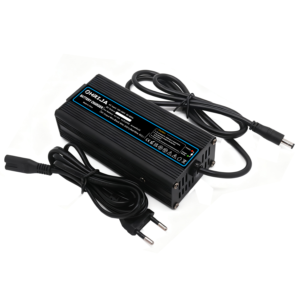
High-performance and dual-motor scooters require larger power reserves, typically utilizing a 48V architecture. The OHRIJA 54.6V 2A Aluminum Alloy Lithium Battery Charger for 48V Electric Scooter/Balancing Vehicle/Electric Vehicle (13 Series 48V Lithium Battery) is specifically calibrated for these demanding applications. Providing exactly 54.6 volts, this charger safely pushes energy into the 13 cells connected in series, ensuring each cell is perfectly balanced at 4.2V by the end of the charging cycle. As with all OHRIJA products, it features built-in over-voltage, over-current, and short-circuit protection.
Analyzing Charger Connector Types
Understanding what kind of chargers do electric scooters take extends beyond internal electronics; it also requires visual identification of the physical port. There is currently no universal standardization for scooter charging ports. The most common connectors include:
- DC Barrel Plug (5.5mm x 2.1mm or 5.5mm x 2.5mm): Commonly found on lightweight commuter models and hoverboards.
- XLR Connector (3-Pin): A highly secure, locking connector frequently utilized on high-power 48V and 60V performance scooters.
- Aviation Plug (GX16 3-Pin): Popularized by brands like Razor, this threaded connector ensures the plug cannot be accidentally disconnected during charging.
- RCA Connector: An older standard typically found on legacy lead-acid scooters.
Before purchasing an OHRIJA charger, we recommend physically measuring the diameter of your charging port and counting the internal pins to ensure seamless compatibility.
Expert Maintenance and Safety Protocols
From our experience as a high-tech manufacturing enterprise, even the highest quality charger cannot compensate for poor battery maintenance habits. When answering the question of what kind of chargers do electric scooters take, we must also address how to use them correctly. We recommend strictly adhering to the following protocols:
Always plug the charger into the wall outlet first, and then connect it to the scooter. This prevents electrical arcing at the charging port, which can degrade the connector pins over time. Furthermore, never charge an electric scooter immediately after a long ride. Lithium batteries generate significant heat during discharge. Connecting a charger to a hot battery triggers thermal resistance, slowing down the charge and degrading cell chemistry. Allow the scooter to cool at ambient room temperature for at least 30 minutes before initiating a charging cycle.
Lastly, never leave a lithium battery charger connected indefinitely. While OHRIJA chargers feature advanced microprocessors that cut off current flow once the battery reaches 100%, leaving the device plugged in exposes the hardware to potential grid power surges and lightning strikes.
Foire aux questions
How do I know exactly what kind of chargers do electric scooters take?
Look at the informational sticker located on the bottom of your scooter deck or on the original charger brick. You must match the “Output Voltage” (e.g., 42V, 54.6V) exactly. The amperage (e.g., 2A, 4A) can vary depending on how fast you want the scooter to charge, but the voltage must be an identical match to prevent severe battery damage.
Can I use a 42V charger on a 48V scooter battery?
No. A 48V battery requires a 54.6V charger to reach full capacity. Connecting a 42V charger to a 48V system will result in the charger failing to push current into the battery, as the electrical pressure required is fundamentally insufficient. Understanding what kind of chargers do electric scooters take means understanding that voltage matching is an absolute requirement.
Why does OHRIJA use aluminum alloy casings for its chargers?
Standard plastic chargers trap heat internally, which degrades the electronic components over time and reduces charging efficiency. From our experience, an aluminum alloy casing acts as a highly efficient thermal dissipator. This ensures the charger operates at a lower temperature, resulting in a safer, faster, and more stable electrical output.
Is it safe to leave my OHRIJA charger plugged in overnight?
Yes, OHRIJA chargers utilize smart CC/CV charging algorithms. Once the battery reaches its absolute maximum voltage (such as 42V or 54.6V), the charger stops outputting current and shifts into a monitoring state. However, we recommend unplugging the device once charging is complete as a general fire safety best practice for all lithium-powered electronics.
References and Technical Resources
To further understand the engineering standards governing lithium battery charging protocols, electrical safety, and what kind of chargers do electric scooters take, please consult the following authoritative organizations:
- United States Department of Energy: Advanced Battery Research
- National Institute of Standards and Technology (NIST): Lithium-Ion Battery Safety
- National Fire Protection Association (NFPA): Micromobility Device Safety Guidelines
- U.S. Consumer Product Safety Commission (CPSC): Micromobility Information Center
 English
  Français
  Deutsch
  Italiano
  Nederlands
  Español
  Português do Brasil
  Türkçe
  Русский